How to Find Vietnam Clothing Suppliers (Hubs, MOQs, Costs and Vetting for U.S. Brands)
Vietnam is the second-largest apparel exporter on the planet, and for good reason: deep skilled labor, strong technical capability, and unit economics that often beat China once you run the full landed-cost math. But "find a Vietnam clothing supplier" is not one decision. It's a stack of them: which regional cluster fits your category, which factory tier matches your order size, how you vet for quality and compliance, and how you keep tariffs and transshipment risk from eating your margin.
This guide walks through the practical process the way a sourcing team actually runs it: where factories cluster, realistic MOQs and FOB costs, sample and production lead times, the vetting checklist that keeps you out of trouble, and the 2026 tariff picture that changes your landed cost. If you want the broader country-level view first, start with our complete guide to sourcing from Vietnam, then come back here for the apparel-specific details.
For brands weighing Vietnam against alternatives, we also cover India vs China manufacturing and the general playbook in how to find a private-label clothing manufacturer.
Why Vietnam for Apparel
Vietnam's apparel and textile exports reached roughly 46 billion US dollars in 2025 according to the Vietnam Textile and Apparel Association, and it sits as one of the top apparel exporters worldwide behind China and Bangladesh. The largest plants are not fringe operators: Vinatex, TAL Apparel, Maxport, Phong Phu, TNG, and Thygesen supply Nike, Lululemon, Uniqlo, H&M, Decathlon, Levi's, Tommy Hilfiger, Calvin Klein and most global brands you'd name.
Where Vietnam genuinely leads is technical and performance apparel. In practice, Vietnam's edge over Bangladesh and Cambodia shows up in technical detailing like flatlock consistency, laser-cut ventilation, and colorfastness on synthetics. For cotton basics alone, Bangladesh usually wins on price. For anything with spandex, bonding, or a technical spec sheet, Vietnam is the default. If you're building an activewear, outerwear, or structured-tailoring brand, that capability gap is the whole reason to be there.
Trade access is the other pull. Vietnam benefits from several Free Trade Agreements including the CPTPP and the EU-Vietnam Free Trade Agreement (EVFTA), which enhance its export capabilities. For EU-bound programs that matters a lot; for U.S.-bound programs the story is more complicated, which we cover below.
Where Vietnam's Garment Factories Cluster
Vietnam's apparel base is geographically concentrated, and picking the right region shortens your logistics and puts you next to the right specialties.
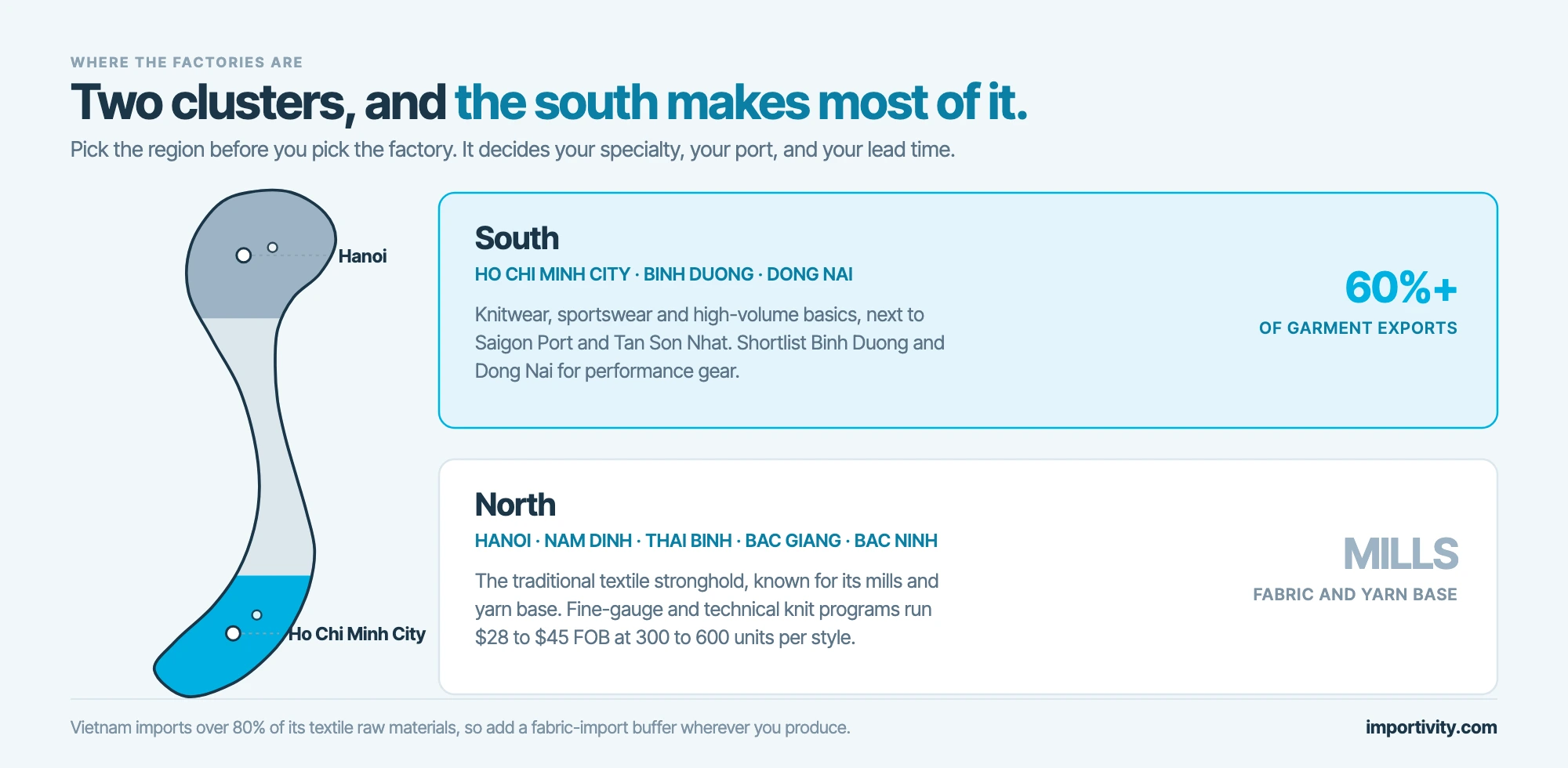
Major textile and garment manufacturing hubs in Vietnam include Ho Chi Minh City, Hanoi, Dong Nai, Binh Duong, and Bac Ninh. The south dominates by volume: Ho Chi Minh City and surrounding provinces account for over 60% of Vietnam's garment exports. HCMC is also the logistics center, with proximity to Saigon Port and Tan Son Nhat International Airport making it a highly efficient base for fast turnaround sourcing.
South (Ho Chi Minh City, Binh Duong, Dong Nai)
The epicenter for high-volume export apparel and logistics. Many foreign-invested factories from Korea, Taiwan, China, and Japan are based in industrial zones around the city, focusing on knitwear, sportswear, and high-volume fashion basics. If you need sportswear or performance gear, focus your shortlist on Binh Duong and Dong Nai.
North (Hanoi, Nam Dinh, Thai Binh, Bac Giang)
The north is the traditional textile stronghold. It is particularly known for its textile mills and garment factories that produce for both domestic consumption and international export. Northern factories are also where the fine-gauge knit and technical-shell capability lives, producing merino and cashmere-blend knits at Portugal-level quality for brands ready to pay a premium.
Central (Da Nang and surrounding areas)
The Central Highlands, including Da Nang, are emerging as a significant hub with a focus on technical garments and an increasing number of factories meeting international workplace conditions and sustainability standards.
Manufacturing Models and Factory Tiers
Before you request quotes, decide which production model you're buying, because it changes who you talk to and what you're responsible for.
Under CMT (Cut, Make, Trim), you provide the design, fabric, and raw materials, and the factory cuts and sews the garment. FOB or full-package means the factory sources fabric and trims to your spec and hands you finished goods. Most first-time importers should buy FOB unless you have a fabric mill relationship and a reason to control materials directly. If the OEM vs ODM distinction is fuzzy for you, read OEM vs ODM manufacturing before you brief factories.
Factory tier drives your MOQ, price, and how hard capacity is to get. The rough breakdown for 2026:
| Tier | Typical MOQ / style | Best for | Reality check |
|---|---|---|---|
| Small-batch / boutique | 50 to 300 units | Independent labels, limited drops, hoodies/tees/joggers | Higher unit cost; limited in-house pattern capacity |
| Mid-tier (Tier-2) | 300 to 1,000 units | Growing DTC and wholesale brands | Sweet spot for most importers |
| Tier-1 export plant | 3,000+ units | Retail programs, technical/performance at scale | Want annual commitments; capacity booked far out |
The small-end numbers are real: some factories are built for independent labels launching limited drops, handling grading, sampling and short runs of hoodies, graphic tees and joggers with MOQs from 50 to 300 pieces per style. But Tier-2 MOQs start at 300 to 1,000 units, and Tier-1 plants want 3,000+ units and annual commitments. One 2026 caution worth planning around: minimum wage rose 6% in July 2024, and capacity at tier-1 plants is booked through Q3 2026.
What Vietnam Apparel Actually Costs
Start with the honest headline: Vietnam is not automatically cheaper than China at the factory gate. Industry estimates put Vietnam roughly 5 to 15 percent below coastal China on FOB unit cost for comparable mid-tier export apparel, with the gap widest on high-labor items like technical outerwear and narrowest on commodity knits where automation matters more than wage rates.
The catch is fabric. Despite its manufacturing prowess, Vietnam imports over 80% of its raw materials for the textile industry, including fabrics and yarns. Those input costs land directly in your FOB price, and importing fabric can add 3 to 6 weeks to a Vietnamese production timeline. This is the number brands most often underestimate.
Beyond the unit price, budget for the extras. Factor in sample development charges (typically 50 to 200 dollars per sample), tooling and pattern grading as a one-time cost, and inspection costs at 200 to 400 dollars per day. On the high-value end, fine-gauge and technical knit programs from the north run $28 to $45 FOB per piece with MOQs of 300 to 600 units per style.
None of these numbers mean anything in isolation. The rule is simple: always compare landed cost, not factory price, when evaluating suppliers or countries. Run the full formula in our step-by-step landed cost guide and confirm your classification with HTS codes explained before you commit.
Sample and Production Lead Times
Getting a garment right is a sequence, not a single order, and compressing it is where quality breaks.
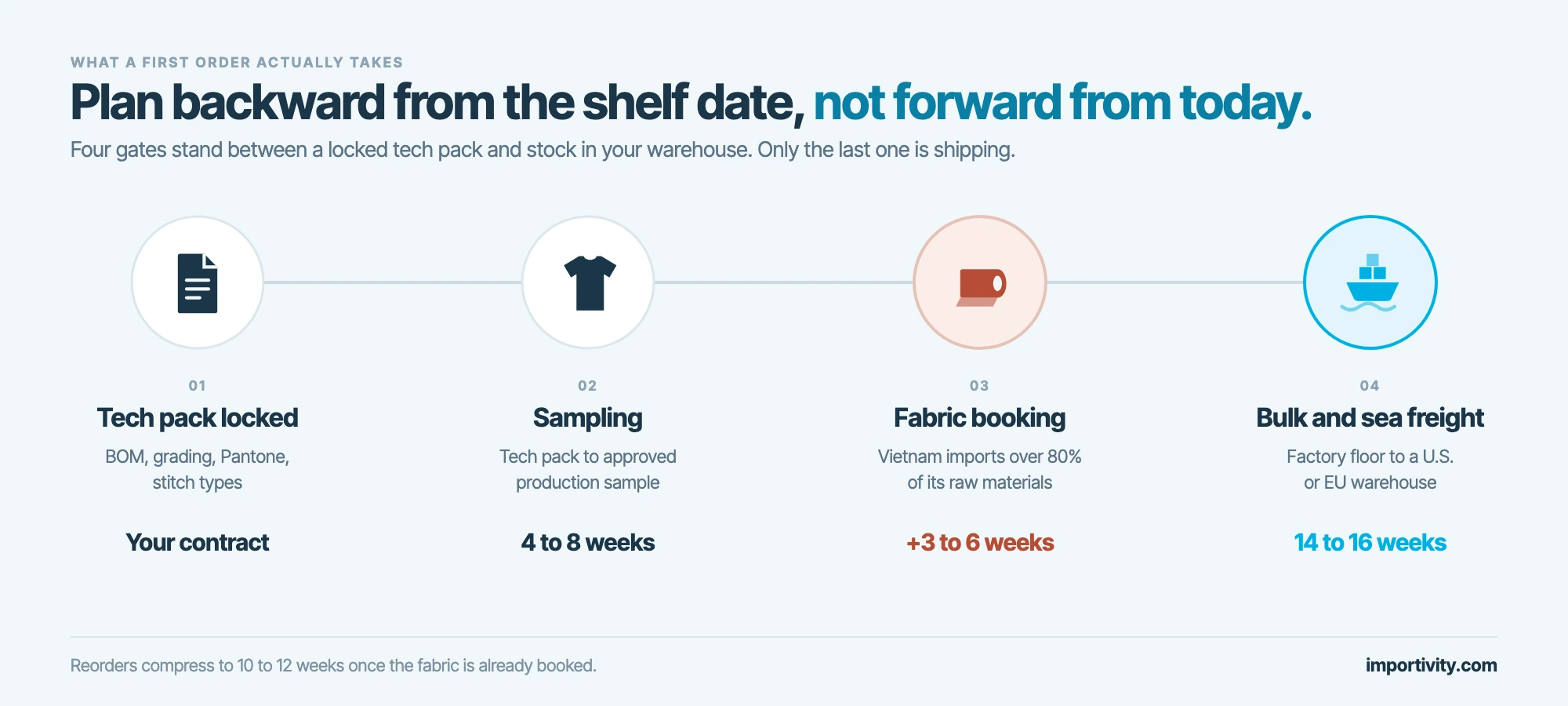
Sampling first. Lead times depend on the production model; generally, sampling takes 15 to 30 days. More precisely for a moderately complex garment, a typical full sample cycle runs four to eight weeks from tech pack finalization to approved production sample. Do not treat this as optional overhead. Always approve a physical sample in your hands, never photos. Our pre-production sample process guide covers how to run the golden-sample step properly.
Then bulk. Full production from Vietnam to U.S. or EU warehouses averages 14 to 16 weeks including sea freight, with reorders compressing to 10 to 12 weeks when fabric is already booked. Build your seasonal calendar backward from your on-shelf date with these numbers, and add the fabric-import buffer if your materials aren't domestic to Vietnam.
The tech pack is your contract
Before a factory will give you a serious quote, you need a comprehensive document detailing your bill of materials, size grading, Pantone colors, stitch types, and label placements; without this, their pricing is just a guess. Get this right using our bill of materials template and structure the ask with our manufacturing RFQ guide.
How to Find and Reach Vietnam Clothing Suppliers
There are three realistic routes: trade shows, verified directories/platforms, and a local sourcing agent. Most brands end up using a combination.
Trade shows are the strongest DIY option. The three biggest apparel and textile shows cluster in Ho Chi Minh City between February and April: VIATT in late February, SaigonTex in April (the largest at 1,000+ exhibitors, strongest for fabric and materials), and Global Sourcing. You can also search the VITAS (Vietnam Textile and Apparel Association) directory to build a shortlist before you travel.
One cultural point that trips up a lot of American buyers: Vietnamese factories don't run on cold email. The industry is still heavily relationship-driven. Factories are more responsive to introductions, in-person visits, and messaging apps like Zalo than they are to cold emails. If you're reaching out by email alone and hearing nothing back, that's normal. It doesn't mean the factory isn't interested. It means you haven't connected through the right channel.
If you don't have time to travel and build relationships, a local agent compresses the process. Our general framework in how to find overseas manufacturers and how to find a manufacturer to make your product applies directly here.
Vetting, Compliance and Tariff Risk
Finding a factory is the easy part. Vetting it, and protecting yourself on origin and tariffs, is where the money is made or lost.
Audit before you order
For U.S. and EU retail, look for the standard compliance stack. Leading Vietnamese manufacturers already hold certifications like ISO, WRAP, BSCI, and OEKO-TEX, so you can be confident products meet modern expectations for responsible sourcing. Certificates are a filter, not a substitute for a facility visit. Run a proper on-site check using our factory audit checklist and formalize the relationship with our supplier onboarding checklist. A quick pre-order vetting list:
- Confirm the factory actually makes your category in-house (not subcontracting silently)
- Verify social-compliance certs (WRAP, BSCI/amfori, SA8000) are current and match the address you'll audit
- Confirm OEKO-TEX or GOTS on fabric if you market chemical safety or organic content
- Pull references from other U.S. buyers in your category
- Get a written, measured golden sample against your graded spec before bulk
Origin and transshipment
Because Vietnam imports most of its fabric, much of it from China, you carry real origin-documentation risk. You need evidence of substantial transformation in Vietnam to support your country-of-origin claim. Read how to prove Vietnam origin and avoid transshipment risk and, if forced-labor exposure is a concern in your fabric chain, forced-labor import compliance.
The 2026 tariff picture
This is fast-moving and it changes your landed cost materially. As of mid-2026, U.S. duties on Vietnamese apparel have been volatile: after the U.S. Supreme Court's February 20, 2026 decision striking down IEEPA-based reciprocal tariffs, U.S. duties on Vietnamese apparel reverted to standard Most-Favored-Nation rates under the Harmonized Tariff Schedule, generally 10 to 32 percent depending on the garment HTS classification, plus a temporary 10 percent Section 122 universal baseline currently scheduled to expire mid-2026. On top of that, the USTR opened new Section 301 investigations into Vietnam and others in March 2026, so further changes are possible. The practical takeaway: this is fast-moving policy, so always confirm the current U.S. rate for your specific HTS classification before finalizing landed-cost calculations. Stay current with Section 301 tariffs explained.
We qualify the plants that build this kind of product and film the visits, which go out through Source With Jordan.
Frequently Asked Questions
What is the minimum order quantity for Vietnam clothing suppliers?
It depends on the factory tier. Small-batch factories run MOQs of roughly 50 to 300 pieces per style, mid-tier full-package factories typically want 300 to 1,000 units, and Tier-1 export plants usually want 3,000+ units per style plus annual commitments. Your MOQ also scales with fabric minimums, so a technical fabric with a high mill minimum can push the floor higher than the factory itself requires.
Are Vietnam clothing suppliers cheaper than China?
On FOB factory price alone, Vietnam is roughly 5 to 15 percent below coastal China for comparable mid-tier apparel, with the widest gap on high-labor items like technical outerwear. But Vietnam imports most of its fabric, so those input costs get baked into the FOB quote and can narrow or erase the gap. Compare landed cost after tariffs, freight and duties, not the sticker FOB number.
How long does production take with a Vietnam clothing factory?
Budget 15 to 30 days for sampling and roughly 14 to 16 weeks for a first full production run to a U.S. warehouse including sea freight. Reorders compress to about 10 to 12 weeks when fabric is already booked. If fabric has to be imported, add another 3 to 6 weeks to the front of the timeline.
What certifications should Vietnam clothing suppliers have?
For U.S. and EU retail programs, look for WRAP, BSCI/amfori, SA8000, ISO 9001 and ISO 14001, plus OEKO-TEX or GOTS for fabric and chemical safety. These matter beyond marketing: they support forced-labor due diligence and give you a documentation trail if CBP questions your supply chain.
Do I need to worry about tariffs and transshipment when sourcing apparel from Vietnam?
Yes. U.S. apparel duties from Vietnam are volatile in 2026 and depend heavily on your exact HTS classification, so confirm your rate before finalizing landed cost. Separately, because Vietnam imports most of its fabric from China, you need clean documentation proving substantial transformation in Vietnam to avoid transshipment and origin-fraud exposure.
About the author
Jordan Lewis
Chief Operating Officer, Importivity
Runs Importivity's sourcing operations across China, Vietnam, Mexico and India, from supplier negotiation through landed delivery.
Press and media inquiries: press@importivity.com