Supplier Onboarding: How to Onboard a New Supplier
Supplier onboarding is the structured process of turning an approved supplier into a production-ready partner: collecting their legal and compliance documents, signing quality and payment agreements, approving samples, and setting up communication and logistics — all before the first purchase order ships. Done well, it takes two to four weeks and prevents the expensive surprises that show up when a factory is onboarded over a handshake and a deposit wire. This checklist walks through the 12 steps we use when onboarding manufacturers for US import programs.
Onboarding is not the same as vetting. Supplier vetting answers "should we work with this factory at all?" — onboarding assumes the answer was yes and builds the operational rails: documents, agreements, systems, and expectations. Skipping it is how importers end up with a great factory and a terrible first order.
What a Complete Supplier Onboarding Covers
Every functioning onboarding program collects the same four things: proof the company is what it claims to be (legal documents), proof it can build your product to spec (quality agreement plus approved samples), agreement on the money (payment terms, currency, penalties), and working logistics (Incoterms, packaging, booking process). The 12 steps below sequence those four buckets in the order that catches problems earliest.
The 12-Step Supplier Onboarding Checklist
Phase 1 — Documentation (days 1–5)
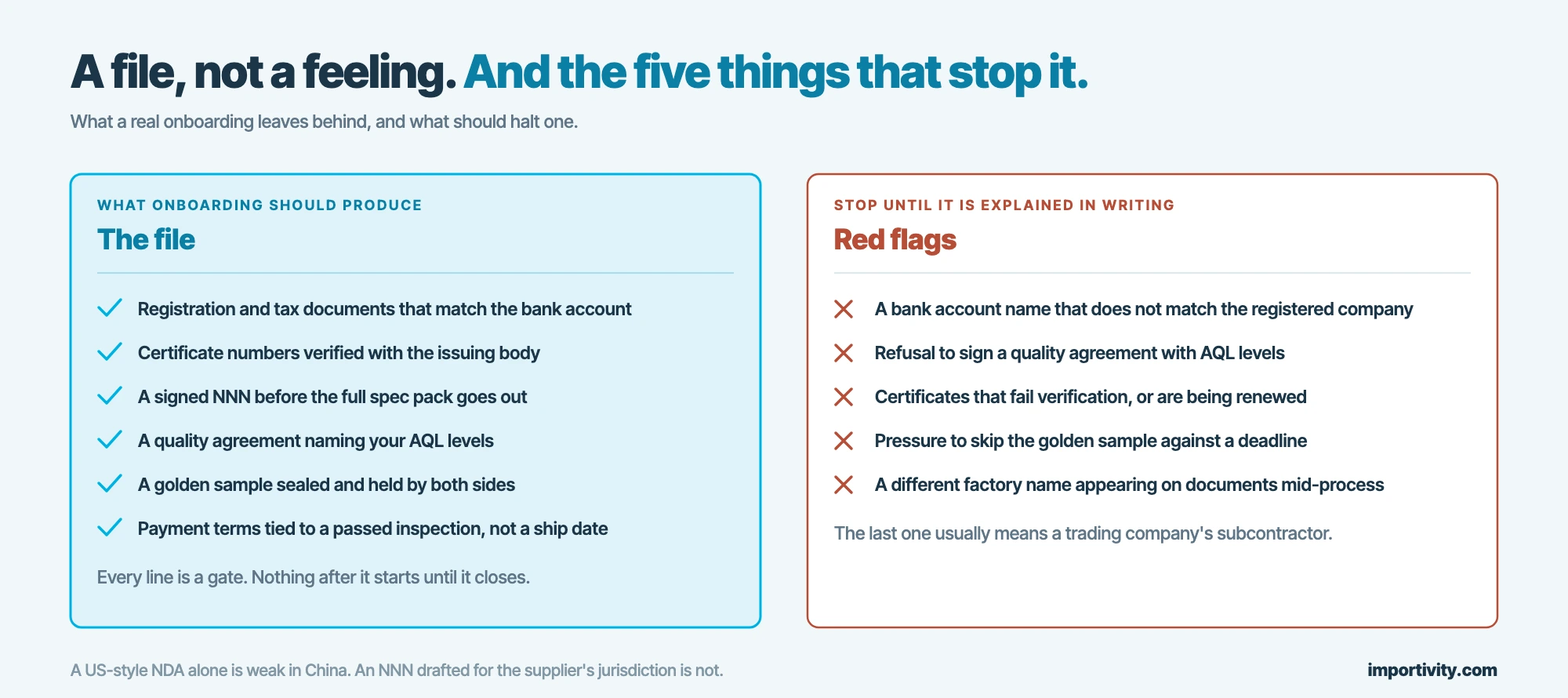
- 1. Collect legal registration documents. Business license, registered legal name and address, and tax registration. Verify the name matches the bank account you will pay — a mismatch is the single biggest fraud flag in overseas payments.
- 2. Collect certifications and test reports. ISO 9001 at minimum; product-specific certificates (UL, CE, FDA, CPSIA) depending on category. Ask for the certificate numbers and verify them with the issuing body, not just the PDF.
- 3. Verify insurance. Product liability and, where relevant, recall coverage. Many factories carry none — decide now whether your policy covers the gap.
- 4. Sign the NNN or NDA agreement. For custom products, a China-enforceable NNN (non-disclosure, non-use, non-circumvention) drafted for the supplier's jurisdiction — a US-style NDA alone is close to unenforceable abroad.
Phase 2 — Quality & product (days 5–15)
- 5. Sign a quality agreement. Define the AQL levels (commonly 2.5 major / 4.0 minor for consumer goods), the inspection stages you reserve the right to run, and who pays for failed inspections and rework.
- 6. Approve a golden sample. A signed, sealed production sample held by both sides — every future pre-production sample and inspection is judged against it, not against a PDF.
- 7. Lock the spec pack. Final drawings, bill of materials, packaging artwork, and labeling requirements, version-numbered so "the factory built the old revision" can't happen.
- 8. Run or commission a factory audit. If vetting didn't include an on-site audit, do it now — our factory audit checklist covers what to inspect in person.
Phase 3 — Commercial & operational (days 10–20)
- 9. Agree payment terms in writing. Deposit percentage, balance trigger (ideally against a passed inspection, not a ship date), currency, and late-delivery penalties. Our guide to negotiating supplier payment terms covers the standard structures.
- 10. Set the communication cadence. One named contact each side, a weekly production update format, and an agreed escalation path. Most "supplier ghosting" stories are really the absence of this step.
- 11. Set up logistics. Incoterm, packaging and carton markings, booking process, and who files what paperwork. Decide FOB vs DDP deliberately — it changes your cost and your control.
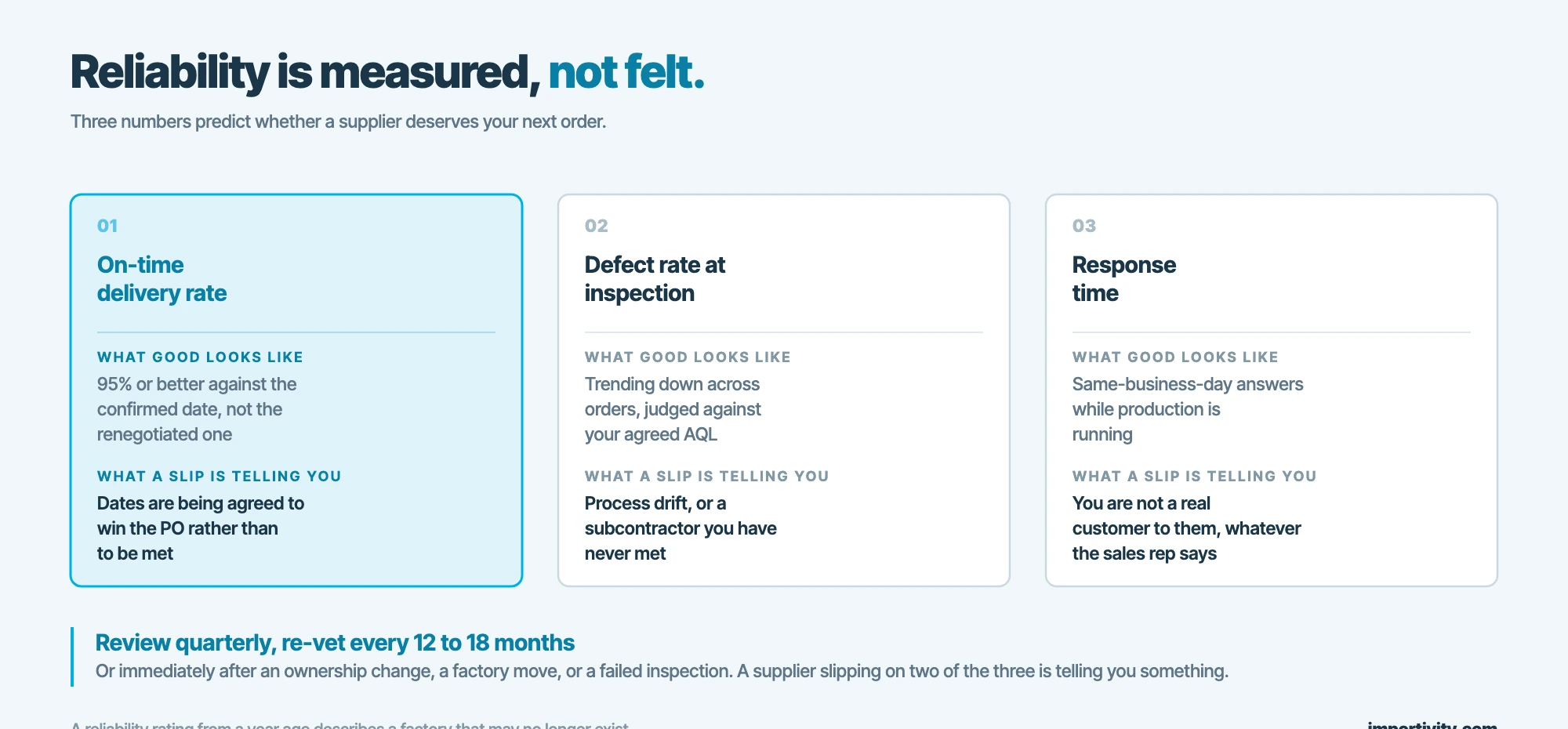
- 12. Baseline the KPIs. On-time delivery, defect rate at inspection, and response time. You cannot evaluate supplier reliability later if you never recorded the starting numbers.
Onboarding Document Checklist by Phase
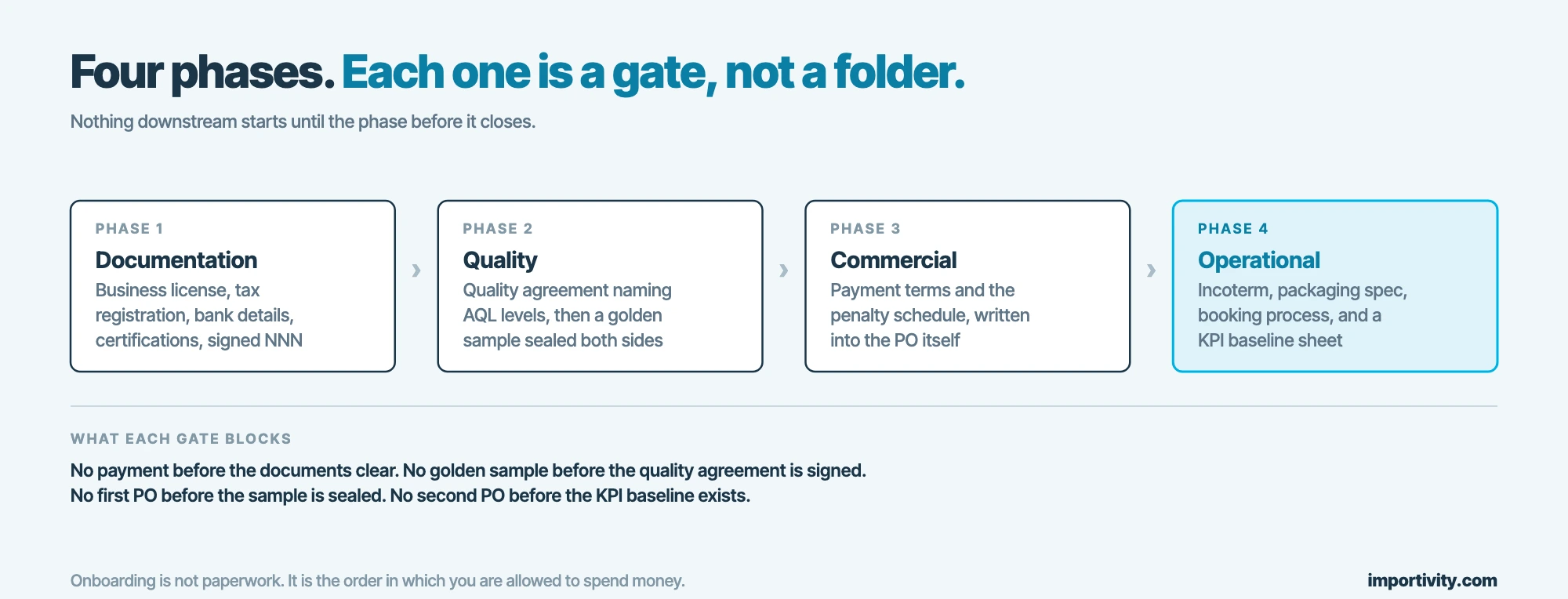
| Phase | Document / deliverable | Who provides it | Gate before |
|---|---|---|---|
| Documentation | Business license, tax registration, bank details on letterhead | Supplier | Any payment |
| Documentation | ISO / product certifications with verifiable numbers | Supplier | Quality agreement |
| Documentation | Signed NNN / NDA | Both | Sharing full spec pack |
| Quality | Quality agreement with AQL levels | Both | Golden sample |
| Quality | Signed golden sample (held by both sides) | Supplier | First PO |
| Commercial | Payment terms + penalty schedule in the PO or contract | Both | First PO |
| Operational | Incoterm, packaging spec, booking process | Both | First shipment |
| Operational | KPI baseline sheet | You | Second PO |
How Buyers Evaluate Supplier Reliability After Onboarding
Reliability is measured, not felt. The three numbers that predict whether a supplier deserves your next order: on-time delivery rate (target ≥95% against the confirmed date, not the renegotiated one), defect rate at third-party inspection (trending down across orders, judged against your agreed AQL), and response time (same-business-day answers during production are the norm for factories that consider you a real customer). Review them quarterly; a supplier slipping on two of the three is telling you something. Re-vet formally every 12–18 months, or immediately after an ownership change, a factory move, or a failed inspection — reliability ratings from a year ago describe a factory that may no longer exist.
Red Flags During Onboarding
- Bank account name that doesn't match the registered company — stop until explained in writing.
- Refusal to sign a quality agreement with AQL levels ("we always ship good quality" is not a standard).
- Certificates that fail verification with the issuing body, or "the certificate is being renewed."
- Pressure to skip the golden sample and go straight to mass production against a deadline.
- A different factory name appearing on documents mid-process — you may be onboarding a trading company's subcontractor. Our guide to risky supplier red flags covers the full list.
If you want to see what this looks like on a live project rather than in a guide, Source With Jordan is where we publish the sourcing itself.
Frequently Asked Questions
What is supplier onboarding?
Supplier onboarding is the structured process between approving a supplier and placing your first purchase order: collecting legal and compliance documents, signing quality and payment agreements, approving a golden sample, and setting up communication and logistics so production starts on defined terms.
How long does supplier onboarding take?
Two to four weeks for a typical overseas manufacturer. Documentation collection runs days 1–5, quality agreements and sample approval days 5–15, and commercial and logistics setup days 10–20. Custom products with tooling or lab testing can extend the quality phase.
What documents should I collect when onboarding a supplier?
Business license and tax registration, bank details on company letterhead, ISO and product certifications with verifiable numbers, proof of insurance, a signed NNN or NDA, a quality agreement with AQL levels, and written payment terms. Verify the bank account name matches the registered legal entity before sending any money.
How do I know if a supplier is reliable?
Track three numbers from the first order: on-time delivery rate (target 95% or better), defect rate at third-party inspection versus your agreed AQL, and response time during production. A supplier slipping on two of the three across consecutive orders is a reliability problem regardless of how good the relationship feels.
What is the difference between supplier vetting and supplier onboarding?
Vetting decides whether to work with a supplier at all — verifying the company, auditing the factory, and checking capability. Onboarding starts after a yes: it builds the operational relationship through documents, agreements, samples, and logistics setup so the first purchase order runs on defined terms.
About the author
Jordan Lewis
Chief Operating Officer, Importivity
Runs Importivity's sourcing operations across China, Vietnam, Mexico and India, from supplier negotiation through landed delivery.
Press and media inquiries: press@importivity.com