The Complete Factory Audit Checklist for Vetting a Supplier Before You Order
A factory audit checklist is the tool that separates a deliberate sourcing decision from an expensive guess. Most import problems trace back to information that was available before the first order was placed. Shipments that fail customs, products that generate returns, suppliers that disappear mid-order: these are not surprises. The audit is how you collect that information on record, before any money changes hands.
The short version: auditing a supplier means verifying that their legal status, production capacity, quality systems, labor practices, and certifications actually match what their sales team told you. Factories routinely overstate capacity, borrow certifications from sister companies, and subcontract production without telling buyers. A proper audit finds all of this. Done before sampling, it saves you months. Done before mass production, it can save your entire landed cost (your full cost to get the goods to your door).
This guide walks through the four types of audits and a section-by-section checklist you can use or adapt. It also covers how to choose between remote, on-site, and third-party audits, and the red flags that should end a conversation entirely. For background on why supplier vetting matters beyond the audit itself, that post covers the broader commercial and legal context.
The Four Types of Factory Audits
Most buyers treat "factory audit" as a single thing. It isn't. There are four distinct audit types, and conflating them creates gaps. For example, you might confirm a factory's quality system is solid while never checking whether their labor practices would survive a Customs forced-labor detention order.
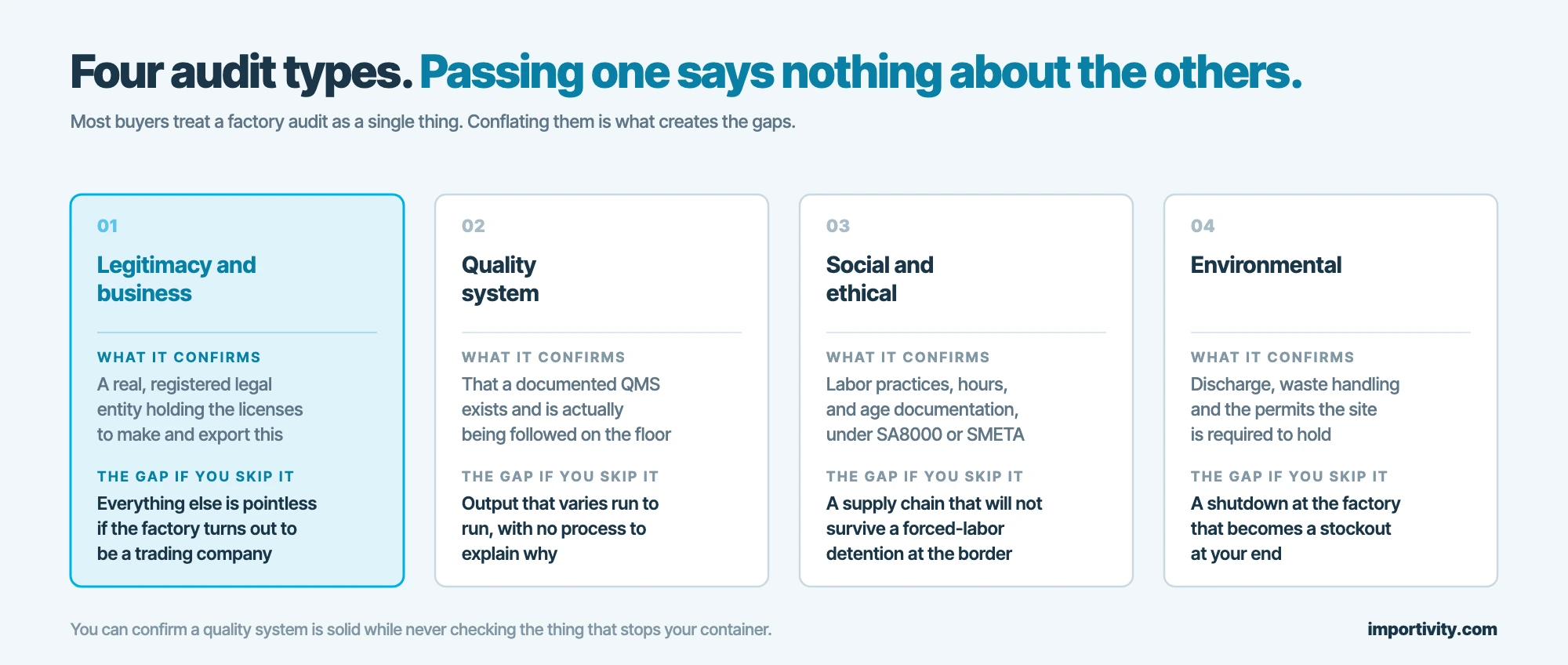
1. Legitimacy and Business Verification Audit
This audit confirms the supplier is a real, registered legal entity with the licenses required to manufacture and export your product category. It is the baseline. Everything else is pointless if the "factory" is a trading company that brokers orders to unknown facilities, or a registration that lapsed two years ago.
2. Quality System Audit (QMS Audit)
This audit evaluates whether the factory has documented procedures, trained staff, and working equipment to produce consistent product. QMS means quality management system. An ISO 9001 certificate is a starting point, not a finish line. It tells you a third party once validated their process, not that the process is still working.
3. Social and Ethical Compliance Audit (SA8000 / SMETA)
This type covers labor conditions, worker age verification, wages, working hours, health and safety, and freedom of association. It matters both ethically and commercially. U.S. Customs can detain shipments under the Uyghur Forced Labor Prevention Act (UFLPA) or other withhold-release orders based on supply chain labor findings. In short, the factory's labor practices directly affect your ability to clear goods.
4. Environmental Compliance Audit
This audit checks adherence to local environmental regulations and, increasingly, international standards required by retail customers (Walmart, Target, Amazon) or export markets (EU). Chemical discharge, waste handling, and energy reporting are the main areas. Smaller buyers often skip this type until a retail customer demands it, at which point you are suddenly racing to qualify a factory you thought was already approved.
The Factory Audit Checklist: Section by Section
The checklist below covers seven sections. Not every section applies to every product category. A garment factory needs more labor-condition checks than a metal fabrication shop, for instance. Still, review all seven before you decide to leave one out.
Section 1: Business Verification
- Business license number, issuing authority, and expiry date: cross-check against the National Enterprise Credit Information Publicity System (gsxt.gov.cn, for China) or the equivalent national registry
- Registered capital versus actual paid-in capital (significant gaps are common and meaningful)
- Proof the company exports in its own name (customs registration or a recent export declaration), plus any export license your product category needs. China dropped its separate foreign trade operator registration on 30 December 2022, so most goods need no export license.
- Any relevant product-specific licenses (e.g., food production permit, toy safety registration)
- Bank account confirmation matching the company name on all documents: this prevents payment fraud
- Confirmation that the audited entity is the actual manufacturer, not an intermediary
Section 2: Production Capacity
- Number of production lines and workers per line
- Stated monthly capacity for your product category (units or metric tons)
- Current order book: a factory running at 95% capacity may not be able to commit to your timeline
- Lead time for tooling, raw material procurement, and first-article samples
- Backup plan for critical material shortages
Section 3: Quality Management System
- ISO 9001 certificate: verify it against the issuing body's online registry, not just the paper copy
- Documented incoming inspection procedure for raw materials
- In-process quality control checkpoints (who performs them, how often, what records are kept)
- Pre-shipment inspection protocol and defect classification system (critical / major / minor)
- Corrective action process: evidence that problems found are tracked and closed out
- Customer complaint records from the past 12 months
Section 4: Equipment and Facilities
- List of primary production equipment with model numbers and ages
- Calibration records for measurement and test equipment
- Preventive maintenance schedule and log
- Storage conditions for raw materials and finished goods (temperature, humidity, pest control where relevant)
- Physical factory size in square meters versus number of workers: a badly overcrowded facility is both a safety issue and a capacity red flag
Section 5: Workforce and Labor Conditions
- Total headcount: permanent workers versus contractors or seasonal workers
- Age verification process: copies of ID collection procedures, not just a verbal assurance
- Payroll records showing wages at or above local legal minimums
- Working hours records for the past three months: excessive overtime is both a compliance issue and a sign the factory is short of staff
- Health and safety committee existence and meeting minutes
- Fire safety: fire extinguisher inspection dates, exit routes unobstructed (walk the floor)
- Worker dormitories if present: conditions, occupancy per room, fire exits
Section 6: Certifications and Test Reports
- List all product certifications claimed (CE, FCC, UL, CPSC, REACH, RoHS, etc.) with certificate numbers
- Verify each certificate directly with the issuing body: fraudulent certificates are common enough that this step cannot be skipped
- Test reports: confirm the tested product specs match what you are buying; some factories reuse test reports from a slightly different specification
- Expiry dates: certifications have renewal cycles and may have lapsed
Section 7: Sub-supplier and Raw Material Control
- List of critical raw material and component suppliers
- Does the factory audit its own sub-suppliers, or only accept the lowest-cost option?
- Traceability: can the factory trace a finished product back to a specific raw material batch?
- Conflict mineral declarations (required for electronics sold into certain markets)
- UFLPA-sensitive regions: any inputs sourced from Xinjiang or other UFLPA-listed regions require documented diligence
Key takeaway: The sub-supplier section is where most buyers stop short. You can run a flawless audit of the factory floor and still receive a UFLPA-detained shipment because the cotton yarn came from a flagged region two tiers back. As a result, traceability to tier-two suppliers is no longer optional for most consumer goods categories.
Remote, On-Site, and Third-Party Audits: Which One to Use
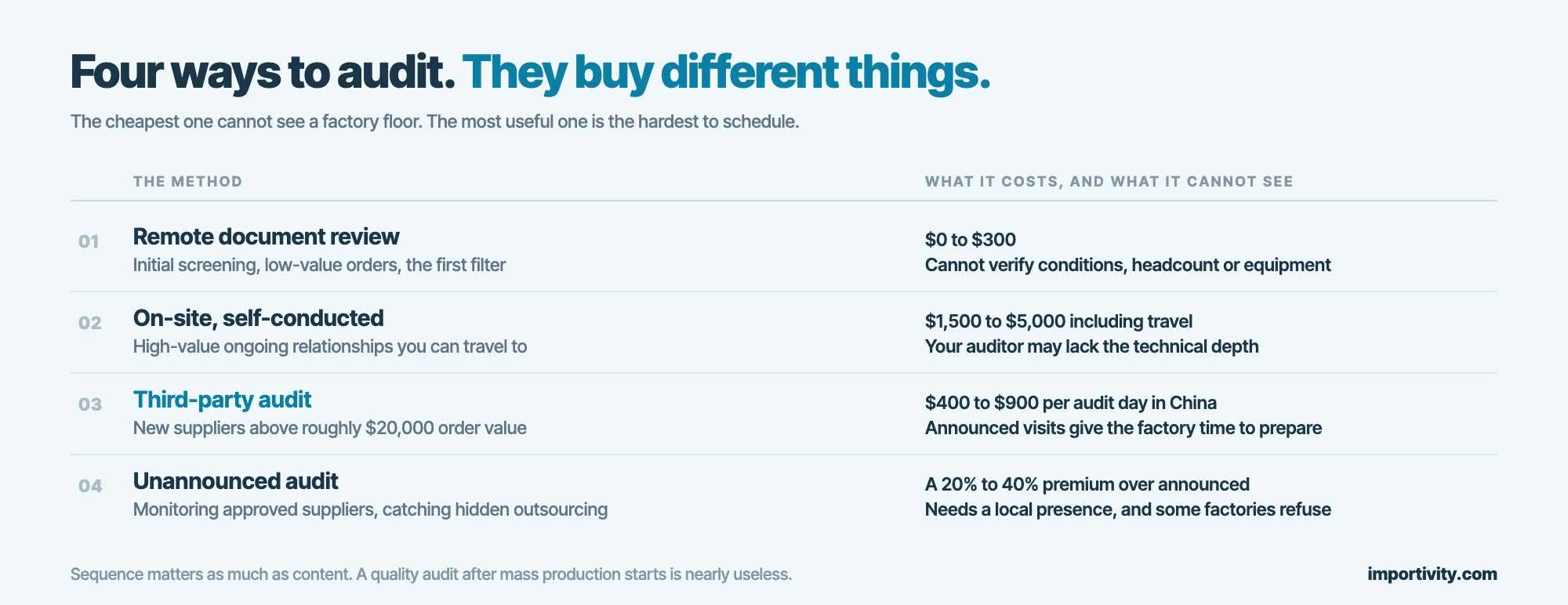
| Audit Method | Best For | Limitations | Typical Cost |
|---|---|---|---|
| Remote / Document Review | Initial supplier screening; low-value orders; first filter before investing in on-site work | Cannot verify physical conditions, actual headcount, or equipment state; documents can be fabricated | $0 to $300 (internal time or agency fee) |
| On-Site Audit (self-conducted) | High-value ongoing relationships; when you or a trusted colleague can travel to the facility | Requires travel cost and time; your auditor may lack technical expertise in the factory's processes; factories sometimes stage visits | $1,500 to $5,000 or more, including travel |
| Third-Party Audit (QIMA, Bureau Veritas, SGS, etc.) | New suppliers above about $20,000 order value; compliance certification needs; retail customer mandates | Cost per audit; results vary by auditor quality; announced audits give factories time to prepare | About $500 per auditor-day (V-Trust lists $498 for a social audit in China, Vietnam or India); most audits take 1 day on site |
| Unannounced Audit | Ongoing monitoring of approved suppliers; detecting outsourcing or shift-work violations | Requires a local presence or agency relationship; harder to schedule; some factories refuse | Ask the audit firm for a quote; some, such as V-Trust, offer unannounced audits without listing a surcharge |
The typical sequence for a new overseas supplier starts with a remote document review to filter obvious disqualifiers. Next comes a third-party audit before placing the first significant order. Finally, a factory visit checklist-driven on-site visit before or during your first mass production run completes the process. Skipping a third-party audit to save about $500 on a $40,000 order puts the full $40,000 at risk.
Do announced audits score higher than unannounced ones?
Yes. Announced audits come out cleaner, because the factory has days or weeks to tidy the floor, clear the fire exits and get its paperwork in order. But in the largest study we could find, the gap from advance notice alone was small. Prepared records are the bigger problem.
- Advance notice: Researchers at Harvard Business School and UC Hastings (Short, Toffel and Hugill) studied 16,795 social audits of 5,819 factories in 66 countries, run between 2005 and 2009. At the same factory, unannounced audits found about 3 percent more violations than announced ones, a gap small enough that it could be chance. When each factory's first audit was left out, unannounced audits found about 8 percent more. (Working paper, later published in the Strategic Management Journal in 2016.)
- Who pays: In the same study, audits paid for by the factory or its agent found 8 percent fewer violations than audits paid for by the brand.
- Repeat visits: Later audits of the same factory found fewer violations, and so did audits where an auditor had been to that factory before.
- Prepared records: Cornell University researchers Jason Judd and Sarosh Kuruvilla looked at 40,458 audits over seven years. They found that on average about 45 percent of the audits were unreliable. In China and India, more than half of 31,652 audits were based on falsified or unreliable information. The unreliable audits showed shorter working weeks and much higher compliance with local wage laws.
What this means for you: a clean announced audit is a good first result, not proof. To get a truer picture, pay the audit firm yourself instead of letting the factory arrange it. Use a different auditor for the follow-up. Ask the auditor to compare time cards with production output and payroll for the same weeks. Once the factory is approved, ask for an unannounced follow-up. If a factory refuses one, that refusal is a finding in itself.
Where Audits Fit in the Sourcing Timeline
The audit sequence matters as much as the audit content. Running a quality system audit after mass production has started is nearly useless. By then you have already committed your money. The correct order is:
- Remote document review, before requesting samples or sharing product specs. This step eliminates factories with obvious legitimacy issues before you invest in tooling or IP disclosure.
- Third-party or on-site audit, after shortlisting two or three candidates, before placing a sample order. At this stage you have leverage; the factory wants your business and will generally cooperate.
- Sample validation and quality control inspection, once samples pass, before issuing a purchase order. This step confirms that what the audit found about their QMS actually translates to the product.
- Pre-production check, at order confirmation, verifying raw materials and production scheduling against what the audit documented.
- In-line and pre-shipment inspection, during and after production. Audits establish a baseline; inspections then confirm each order.
Buyers who collapse steps 1 and 2 into "we reviewed their Alibaba profile" tend to find out what they missed at step 5. By then, a pre-shipment inspection has failed and production is already packaged.
Documents to request before you place an order
Send this list to the factory at step 1. Missing items and long delays are findings too.
- A photo of the business license. In China, the license carries an 18-character Unified Social Credit Code. Look it up on gsxt.gov.cn and check that the company name, address and business scope match, and that the scope covers making your type of product, not only selling it.
- Proof the company exports in its own name, such as its customs registration or a recent export declaration.
- ISO 9001 and product certificates with their certificate numbers, so you can check each one with the body that issued it.
- Test reports for your product or a close match, issued in the factory's name, with the lab's report number.
- The most recent third-party audit report, with its date and the audit firm's name.
- Bank details for the account you will pay, in the same company name as the license.
- A list of the main material suppliers and where they are, so you can check for inputs from Xinjiang, China, or from companies on the UFLPA Entity List. Our guide to forced labor import compliance explains how these rules affect your shipments.
- For the on-site audit: three months of time cards and payroll records, the equipment list, and calibration records.
Red Flags That Should Kill the Deal
Some findings are not negotiating points. These are disqualifiers. If any surface during an audit, move to your next candidate rather than spend months trying to fix a factory with deep structural problems:
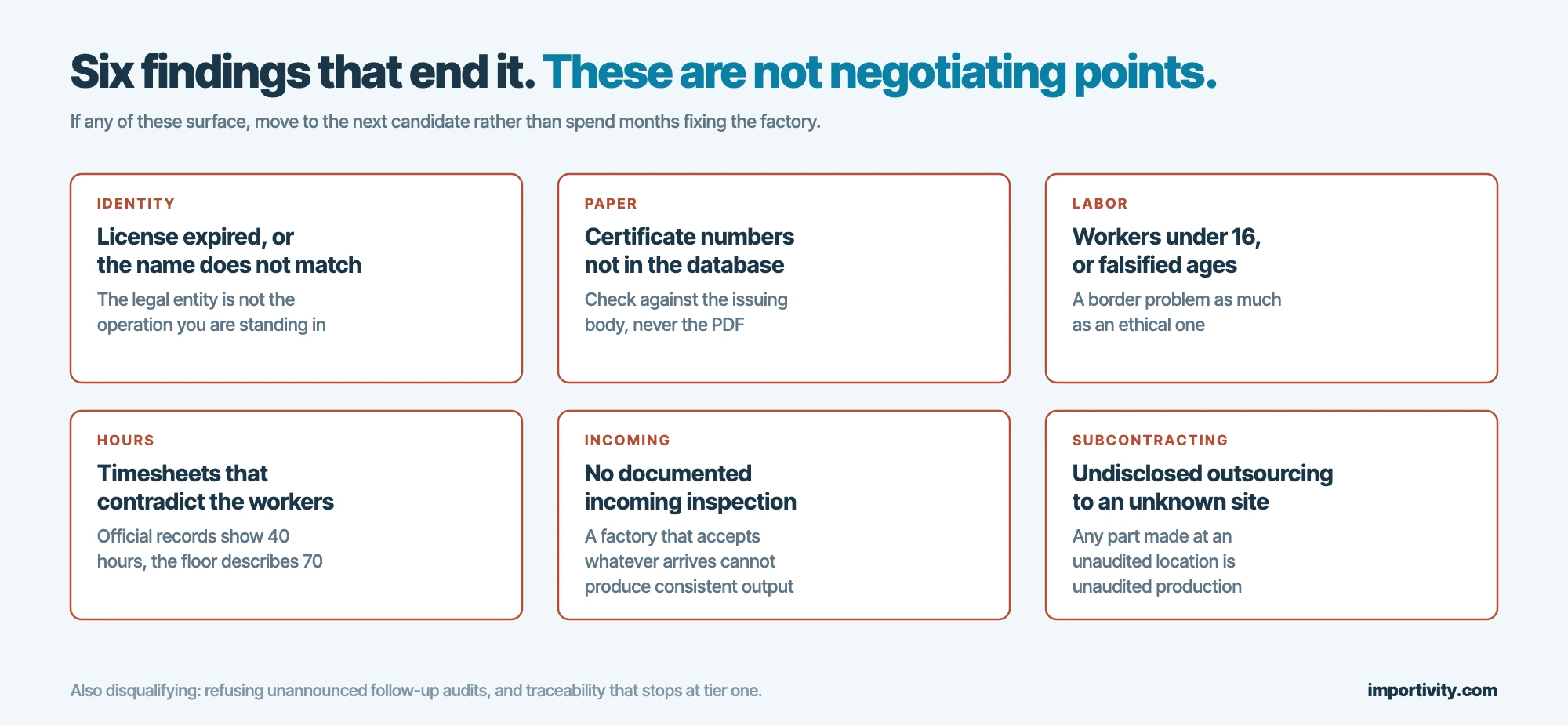
- Business license expired or the legal entity name does not match the factory's operating name
- Certificate numbers that do not appear in the issuing body's database
- Workers under 16 on the floor, or evidence of age document falsification
- No documented incoming inspection: a factory that accepts whatever materials arrive cannot produce consistent output
- Systematic falsification of working hours records (common: official timesheets show 40-hour weeks while workers describe 70-hour weeks)
- Outsourcing to an unknown facility without disclosure: any part of your product made at an unaudited location is unaudited production
- Refusal to allow unannounced follow-up audits as a condition of doing business
- Raw material traceability that stops at tier one with no paperwork for inputs from UFLPA-listed regions
Our supplier vetting process is built to surface these issues step by step. The aim is not to find reasons to disqualify suppliers. It is to make sure the disqualifiers are found before a purchase order is signed rather than after a shipment is detained.
We film the factory floors we qualify rather than taking a supplier's word for them, and those walkthroughs go out through Source With Jordan.
If you want factories for your product found and checked against this list before you pay a deposit, submit a free sourcing request.
Frequently Asked Questions
How much does a factory audit cost, and who pays for it?
Third-party audits are priced per auditor-day. As one published example, V-Trust lists $498 per auditor-day for a social audit in China, Vietnam or India, and QIMA says most of its manufacturing audits take one day on site. The buyer should pay. It is your due diligence, and a study of 16,795 audits found that audits paid for by the factory or its agent found 8 percent fewer violations than audits paid for by the brand. Some large importers write audit fees into their supplier agreements, but for most small and mid-size buyers the cost comes out of sourcing overhead. Budget one to two audit days for a standard factory, depending on size and scope.
Do I need a factory audit if the supplier has ISO 9001 certification?
ISO 9001 tells you that a qualified third party once validated the factory's quality management system against a documented standard. However, it does not tell you that the system is currently functioning, that the certificate is still valid and not borrowed from a parent company, or that it covers the specific product line you are buying. Treat an ISO 9001 certificate as one positive signal in a checklist, not as a substitute for the checklist. Verify the certificate number directly with the registrar, confirm its scope covers your product category, and still conduct a QMS-focused audit.
Can I do a useful factory audit remotely, without traveling to China?
A remote document review (business licenses, certificates, test reports, basic financial checks) is useful as a first filter. It can rule out weak candidates before you spend more. That said, remote review cannot verify physical production capacity, assess actual equipment condition, observe labor conditions, or confirm that the workers in a video call actually produce your goods. For any order above roughly $15,000 to $20,000, follow the document review with a third-party on-site audit. Below that level, the audit cost may be too high relative to the order value. In that case, start with smaller test orders and add audits as the relationship grows.
How often should I re-audit an approved supplier?
For active suppliers, annual re-audits are the industry standard for social compliance; quality system audits can often be extended to every 18 to 24 months if the supplier's inspection record stays clean. Trigger an unscheduled re-audit any time ownership changes, the factory moves to a new location, or you notice a sudden drop in quality across two or more shipments. Similarly, new defect patterns in your inspection data that were not present previously are symptoms of process or management changes that the original audit approval no longer covers.
What is the difference between a factory audit and a pre-shipment inspection?
A factory audit evaluates the supplier's systems, legal standing, and day-to-day capability. It is done before or at the start of a relationship and is not order-specific. A pre-shipment inspection, by contrast, is order-specific: an inspector visits the factory when production is 80 to 100% complete and checks a statistical sample of finished goods against your product specs, your AQL (acceptance quality limit, the defect level you agree to accept) and your packaging needs. In short, audits qualify a supplier. Inspections verify a specific shipment. You need both; one does not replace the other.
About the author
Jordan Lewis
Chief Operating Officer, Importivity
Runs Importivity's sourcing operations across China, Vietnam, Mexico and India, from supplier negotiation through delivery to the client's door.
Press and media inquiries: press@importivity.com