
Buying Direct From a Manufacturer vs a Wholesaler or Trading Company

Buying direct from a manufacturer gets you the lowest unit price, full control of the specification and the right to negotiate tooling and exclusivity, and in return you accept the factory's minimum order quantity and do the communication and quality work yourself. A wholesaler sells you finished stock in small quantities at a markup that averages about 20 percent, with no customization. A trading company sits between you and one or more factories, adds a markup that trade press puts at 10 to 25 percent, and in exchange takes small mixed orders, consolidates shipments and handles the export paperwork. The right path depends on your volume, how much the product has to change, and how much of the sourcing work you can carry.
This guide is for US brands and resellers weighing those three paths on a real order, and for anyone who suspects the "factory" quoting them is not one. It covers what each supplier type actually is, where the margin goes on each path with a worked example, the MOQ and control trade-offs, when a trading company is the right answer, the risks on every path, and the checks that separate a real factory from a trader. If you want the searching and vetting done for you, our product sourcing service runs exactly this decision for each product.
What each supplier type actually is
The labels get used loosely, and plenty of suppliers use the wrong one on purpose. A manufacturer owns the production assets: the presses, the lines, the molds, the workforce that makes the thing. Its catalog is narrow and deep and its minimums are set by production economics. A wholesaler, usually a US company, buys finished goods in volume and resells them by the case from a domestic warehouse. A trading company is an exporter with relationships at several factories. It quotes you, buys from the factory, marks the goods up and ships them under its own export license, and it may or may not tell you who made the product.
There is a fourth type worth naming once. A sourcing agent works for you rather than for the factory, is paid a commission of roughly 3 to 8 percent on top of a factory price you can see, and does the finding, negotiating and inspection on your behalf. It is a service, not a supplier, and we covered what one costs in our guide to hiring a China sourcing agent.
Where the margin goes on each path
The clean way to compare the three is to follow one unit through each channel to your door. The numbers below are an assumed example, not a quote: a factory offers a product at $10.00 per unit FOB with a 3,000 unit minimum, duty is taken at 25 percent, and ocean freight plus handling comes to $0.50 per unit on a full order. The chart shows what the same unit costs when it arrives on each path.
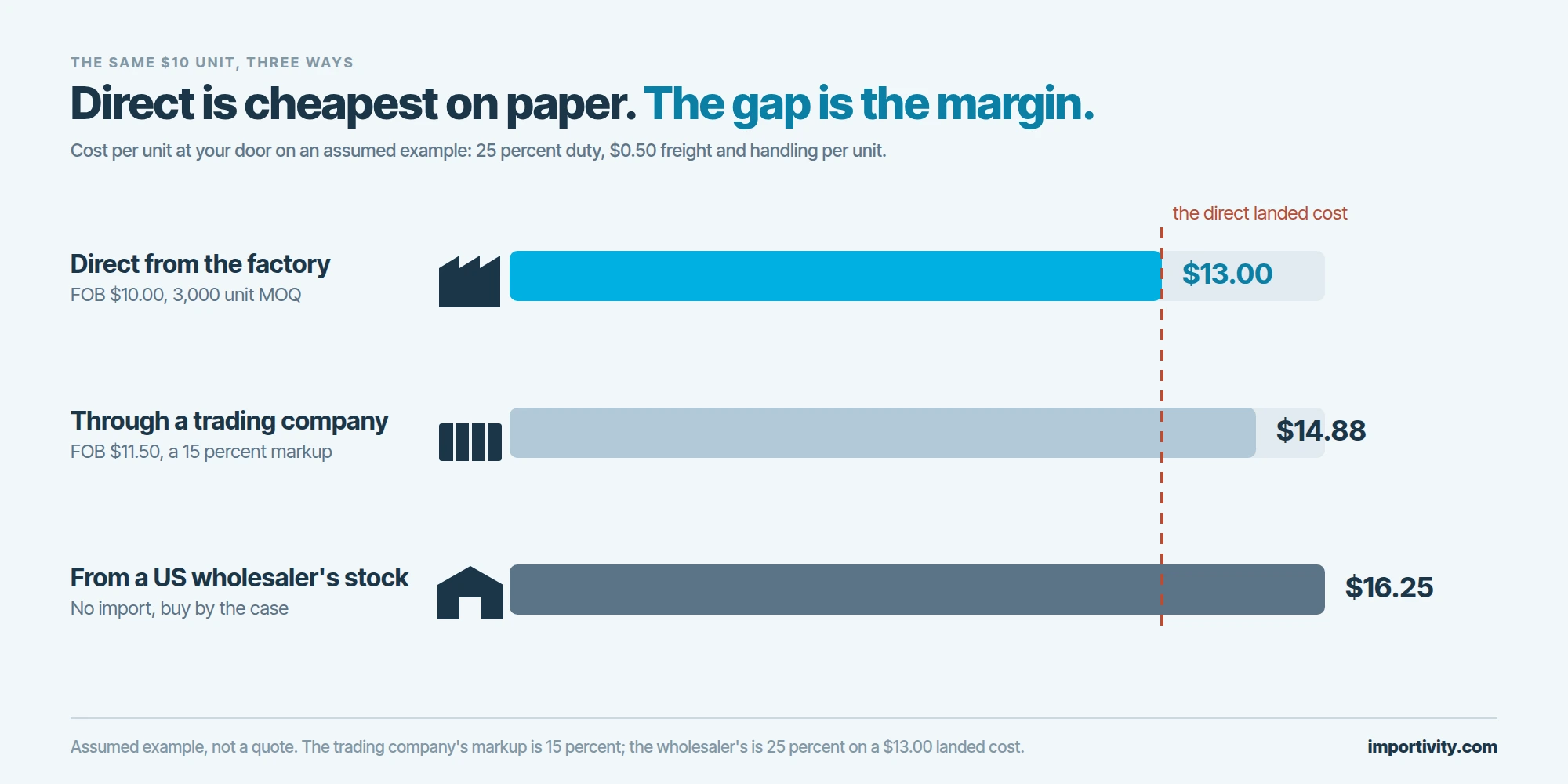
Direct from the factory the unit lands at $13.00: $10.00 plus $2.50 duty plus $0.50 freight and handling. Through a trading company that quotes $11.50, a 15 percent markup inside the usual 10 to 25 percent band, the unit lands at $14.88, because the duty is charged on the higher invoice value as well. A US wholesaler who imported that same product at $13.00 and applies a 25 percent markup sells it to you from stock at $16.25, no MOQ, no wait, no import paperwork. On a first order of 300 units the picture flips, because the factory will not sell 300 units at $10.00, or at all, and the wholesaler will.
Two things to watch inside those numbers. The trading company's markup is invisible on the invoice, so you only learn its size by getting a factory quote for the same specification, which is worth doing on any product you will reorder. And the duty stacks on whatever value the invoice shows, so a middleman's markup costs you the markup plus the duty on the markup. On a 25 percent duty line that turns a 15 percent markup into an 18.75 percent increase in landed cost.
MOQ, customization and control
Price is the argument everyone has. The other columns decide most orders.
| Path | What you get | What you give up |
|---|---|---|
| Direct from a manufacturer | Lowest unit price, full customization, your own tooling, a line you can audit and inspect | Rigid MOQ set by production economics, slower samples, you carry communication and QC |
| Through a trading company | Small and mixed orders, one contact across several factories, export handled, faster samples | A markup of 10 to 25 percent, no control of the line, the factory can change without notice |
| From a wholesaler's stock | Buy by the case, ship this week, no import, no bond, no broker | Stock product only, a markup of about 20 percent and often more, no exclusivity |
| Through a sourcing agent | Factory price you can see, someone on the ground, vetting and inspection done for you | A commission of 3 to 8 percent, and you still need the volume the factory wants |
The MOQ line deserves the most attention. A factory's minimum is anchored to a production run, a mold cycle or a fabric lot, which is why it barely moves when you push. A trading company can quote 500 units of a 3,000 unit product because it is pooling your order with other buyers or pulling from stock it already bought, and that flexibility is the thing you are paying the markup for. If your volume is close to the factory's number, the tactics in our guide to securing a lower MOQ usually close the gap without a middleman. If it is a tenth of that number, a trader or a wholesaler is the honest answer for the first run.
When a trading company is the right answer
Used openly, a trading company solves four problems a small importer cannot solve cheaply alone.
- Small mixed orders. A brand launching six SKUs across three categories cannot hit six factory minimums. One trader can pool the order, consolidate it into one container and file one entry.
- Categories where factories will not talk to you. Some product families are made by large plants that only serve large customers. A trader with an account there is the only route in below their minimum.
- Export paperwork. A factory can only export under its own name if its business scope includes import and export and it has completed customs registration and the foreign trade operator filing. Plenty of good workshops have not, and they ship through a trading company because that is who holds the license.
- No China-side capacity. If nobody on your team can manage a factory across time zones, a trader's coordination is worth part of its margin, at least until the volume justifies hiring the help directly.
The condition on all four is transparency. A trading company that tells you it is a trading company, names the factory on request and lets you inspect the line is a supplier you can manage. One that hides all three is charging you a markup for a risk it is also creating.
The risks on each path
Every channel fails in its own way, and the failures are predictable.
- Direct from the factory. The risks are MOQ and communication. A factory that takes your order below its comfortable minimum will slot it between larger runs, and small orders that disrupt production get slower dates and less attention.
- Wholesaler. You have no say over the specification, the packaging or the origin, and the product on the shelf next to yours may be the same one. When the wholesaler's own supplier changes, your product changes with it.
- Trading company. The hidden markup is the smaller problem. The larger ones are undisclosed subcontracting, a factory switched between orders without telling you, and quality that drifts because nobody you can reach is standing on the line. Payment details that change mid-order are the fraud signal on any path.
The shared fix is the same on all three: a written specification with acceptance criteria, an inspection before the balance is paid, and a supplier you have verified rather than believed. Our supplier vetting service exists because the verification step is the one most buyers skip.
How to tell a factory from a trading company
Most of the evidence is public and takes minutes to check. Company names prove nothing: traders put "industrial" in their names and real plants often carry generic trade names. The business license and the national registry are the facts, and the graphic below shows the five fields that settle it.
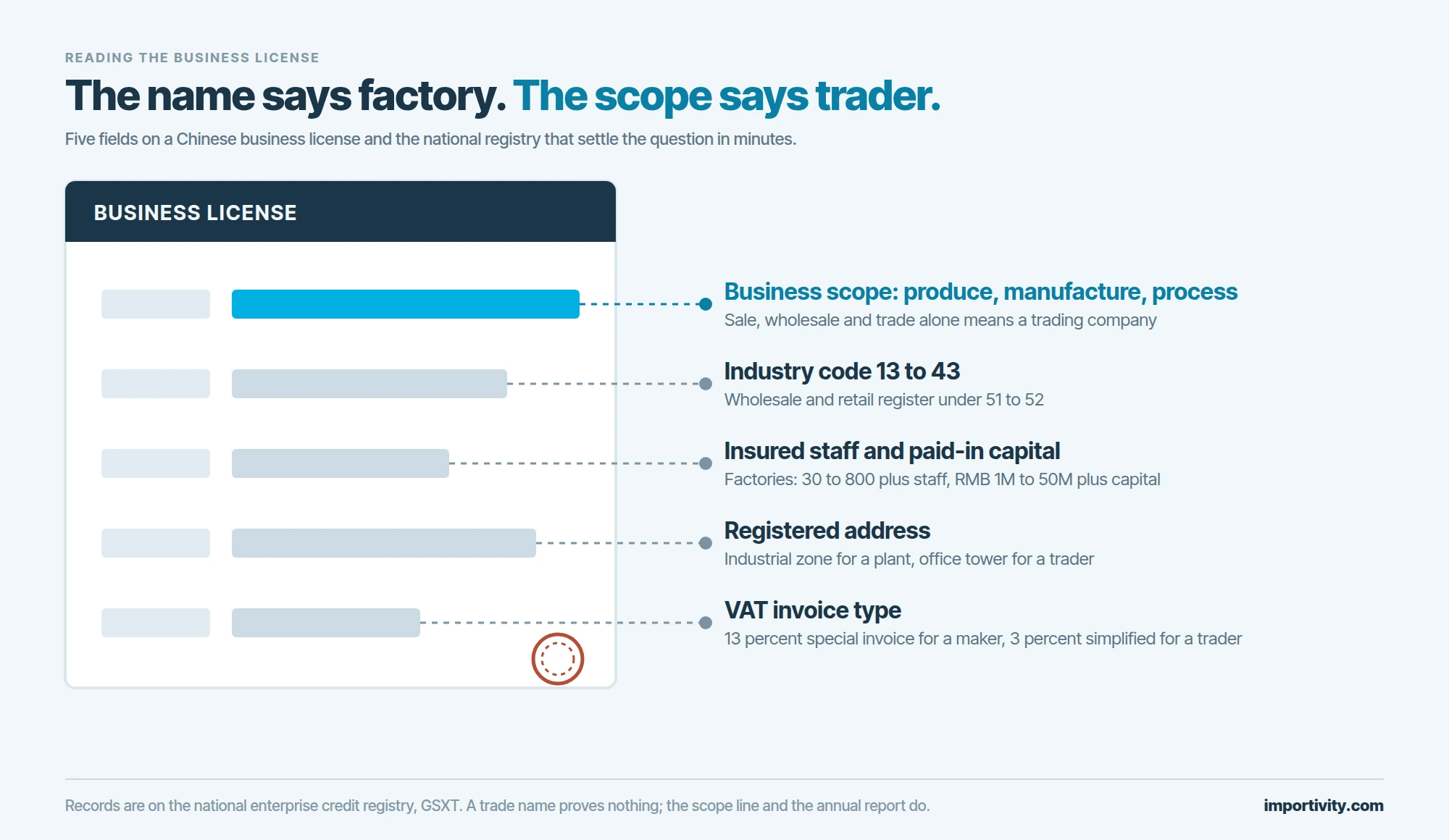
- Business scope. A factory's scope carries production verbs: produce, manufacture, process. A scope that lists only sale, wholesale and trade belongs to a trading company, whatever the name above it says. The record is on the national enterprise credit registry, GSXT.
- Industry code. Chinese company records carry a national industry classification. Manufacturing sits in codes 13 to 43 and wholesale and retail in 51 to 52. A supplier registered under a wholesale code is not making the product.
- Headcount and capital. The registry's annual report lists social insurance participants and paid-in capital. Factories report anywhere from 30 to 800 plus insured staff and paid-in capital from about RMB 1 million to 50 million or more. A "manufacturer" with four insured staff and RMB 500,000 is a desk with a phone.
- Address. Factories occupy industrial or development zones. Traders sit in office towers and shared workspaces. Put the address into a map.
- VAT invoice. A real manufacturer can issue a 13 percent VAT special invoice for the goods it makes. Traders typically issue a 3 percent simplified invoice. Ask which one they issue.
Then test the behaviour. Send a drawing with a real engineering question and time the answer: factory engineers reply in 24 to 72 hours with specifics, traders relay it and come back in 5 to 10 days with something vague. Ask for a video walk of the line on short notice, with your part on it. Notice how the MOQ behaves under pressure, because a factory's minimum is rigid for a reason and a trader's is negotiable for a reason. When the order is large enough to justify a visit, our factory visit checklist covers what to look at once you are through the gate.
How to decide for your order
Work it as a sequence rather than a preference. Start with the factory quote for your specification, even if you cannot yet meet the minimum, because it is the reference every other price gets measured against. If your volume clears the MOQ, buy direct and put the saving into inspection. If it does not, decide whether the product needs to change at all: if it does not, a wholesaler's stock is the cheapest way to test demand, and if it does, a transparent trading company or a sourcing agent gets you a custom product below the factory's minimum while you build the volume to go direct. Plan the move to the factory from the first order rather than treating the trader as permanent.
Whichever path you take, the supplier still has to be verified, the specification still has to be written down, and someone still has to look at the goods before the balance is wired. That work is what manufacturer sourcing means in practice. If you have a quote in hand and cannot tell which type of supplier sent it, Jordan runs a fit check from Austin and Guangzhou that starts by reading the license before anyone talks about price.
Frequently Asked Questions
Is it cheaper to buy direct from a manufacturer?
On the invoice, yes. A factory price is usually 5 to 15 percent below a trading company's quote for the same specification, and a wholesaler adds a markup that averages about 20 percent on top of its own landed cost. The saving only exists once your order clears the factory's minimum, and duty is charged on whatever value the invoice shows, so a middleman's markup also raises your duty bill.
How can I tell if a Chinese supplier is a factory or a trading company?
Read the business scope on its license: production verbs such as produce, manufacture and process mean a factory, while a scope limited to sale, wholesale and trade means a trader. Check the national registry for the industry code, insured headcount and paid-in capital, map the registered address, ask which VAT invoice they issue, and send an engineering question to see who answers and how fast.
When is a trading company better than buying from the factory?
When your order is too small or too mixed for a factory minimum, when the factories in a category only serve large customers, when the workshop you want cannot export under its own name, or when nobody on your team can manage a factory directly. A trading company is a good answer in those cases as long as it says what it is, names the factory on request and lets you inspect the line.
Can a small business buy directly from a manufacturer?
Yes, if it can meet the minimum order quantity or negotiate it down, which usually works when the volume is close to the factory's number and rarely works when it is a tenth of it. Below that, a wholesaler's stock is the cheapest way to test a product that does not need to change, and a transparent trading company or a sourcing agent is the way to get a custom product before the volume exists.
What is the difference between a trading company and a sourcing agent?
A trading company is a supplier: it buys from the factory, marks the goods up and sells them to you under its own name, usually without showing you the factory price. A sourcing agent works for you, charges a commission of roughly 3 to 8 percent on a factory price you can see, and handles finding, negotiating and inspection on your behalf. One sells you a product, the other sells you a service.
About the author
Jordan Lewis
Chief Operating Officer, Importivity
Runs Importivity's sourcing operations across China, Vietnam, Mexico and India, from supplier negotiation through landed delivery.
Press and media inquiries: press@importivity.com