How to Choose a Supplement Contract Manufacturer Without Getting Burned
A supplement contract manufacturer makes your product in its facility, under its FDA registration and its cGMP system, to a formula that is yours, its own stock formula relabeled for you, or a finished stock product with your name on it. The right partner for a US brand matches the engagement model to how much of the formula you need to own, shows a third-party GMP audit rather than an "FDA approved" claim, and breaks the quote into ingredients, capsule work, packaging and testing. For a 60 count capsule SKU at a small run, expect ingredients at $2 to $7 per unit, the capsule and finishing at $0.50 to $2, and the bottle at $0.75 to $3, with formulation and testing billed on top.
This guide is for founders and buyers launching or moving a supplement line in capsules, tablets, powders, gummies or liquids. It covers the three engagement models, what cGMP and the seals prove, how to read a quote, realistic MOQs and lead times, the label rules you own, when overseas makes sense, and the questions that expose a broker with a website. If you are still deciding whether to outsource production at all, start with choosing a contract manufacturing partner.
Custom, private label or white label
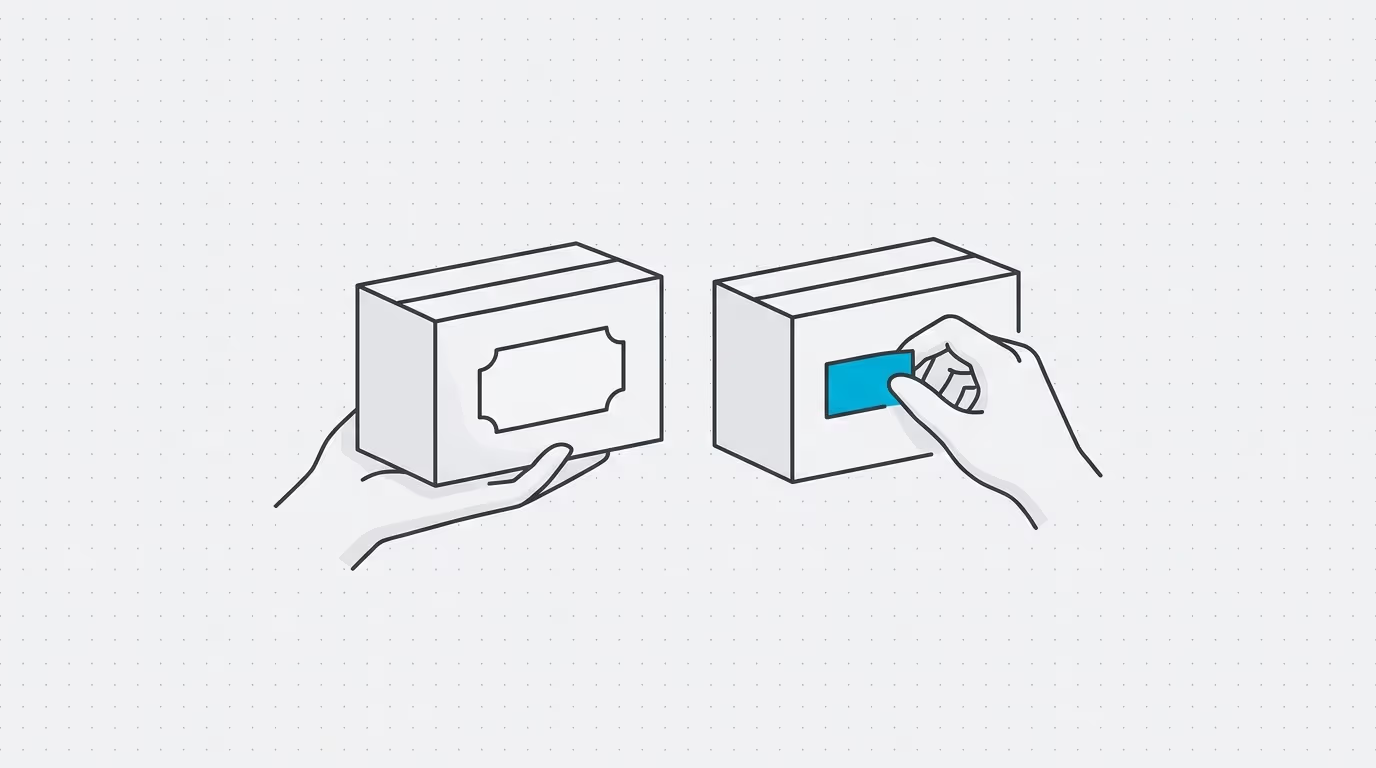
Every supplement manufacturer sells one of three things, and the word on the sales page does not always match the contract. Custom formulation means you specify the actives, doses and excipients, the plant develops and stabilizes the formula, and the formula should belong to you. Private label means you pick one of the plant's existing formulas and it runs under your brand, but the formula stays theirs. White label is a finished stock product that only gets your label. What you own drives everything downstream, the same split we walk through in private label versus white label.
| Model | What you own and what it costs | Choose it when |
|---|---|---|
| Custom formulation | You own the formula if the contract says so. Development fee of roughly $2,000 to $10,000 per SKU, MOQ commonly 1,500 to 5,000 bottles, 12 weeks is a common lead time. | The formula is the product, you may switch plants later, or your claims depend on a specific dose. |
| Private label | Plant keeps the formula. No development fee, MOQ from about 500 bottles, capsules often $1.50 to $2.50 per unit, about 4 weeks at some plants. | You are testing demand and your edge is brand and channel. |
| White label | Nothing beyond the label. Lowest MOQ, highest per-unit price, no say over specification changes. | You need product on a shelf next month and margin matters less than speed. |
Two clauses decide whether custom work is actually yours: one assigns the formula and batch records to you on payment, the other hands you the master manufacturing record, specification sheet and approved supplier list so a second plant can reproduce the product. A plant that develops a formula but will not release the specification has sold you private label at custom prices.
What cGMP, registration and the seals actually prove
Dietary supplements are regulated as a category of food, not as drugs. FDA does not approve supplements, their facilities or their labels before sale, so a plant that calls itself "FDA approved" is either confused about its own status or hoping you are. What a legitimate plant has is FDA facility registration, which is a listing, and compliance with 21 CFR Part 111, the cGMP rule for supplements, which is the legal minimum and is enforced by inspection after the fact.
One Part 111 requirement separates real plants from assemblers: every lot of every dietary ingredient must be identity tested before use, and looking at the powder or filing the supplier's certificate of analysis does not count. Ask how a prospective plant identity tests incoming botanicals and which lab runs the work. A vague answer is a finding waiting to happen.
Third-party seals sit on top of that floor, and each proves something different:
- NSF GMP registration. An independent audit that the facility's methods, equipment and controls meet Part 111. It is about the plant, not one product. Ask for this first.
- USP Verified. A product-level check of identity, potency, purity and label accuracy, with no banned-substance screen. The fit for general wellness products.
- NSF Certified for Sport. Batch testing against more than 280 substances banned in sport, plus label and contaminant checks, with retained samples.
- Informed Sport or Informed Choice. Every certified batch tested against the WADA prohibited list before release.
- Organic, non-GMO, kosher, halal. These certify ingredient sourcing, not manufacturing quality.
A plant that holds NSF GMP registration and names the certifier behind each seal has been audited by someone with the power to say no. Our supplier vetting work starts with certificates checked against the issuer's register, never a PDF on a website.
How to read a quote
A serious quote for a capsule product breaks into lines you can compare across plants: actives and excipients, capsule shell and encapsulation labor, bottle and closure, label and carton, and testing on incoming ingredients and the finished lot. At a run of 500 to 1,000 units, ingredients typically land at $2 to $7 per unit, the capsule format and finishing at $0.50 to $2, and the bottle or pouch at $0.75 to $3. Formulation and stability work on a custom SKU is a one-time fee of roughly $2,000 to $10,000, and per-lot testing is quoted per run rather than per bottle.
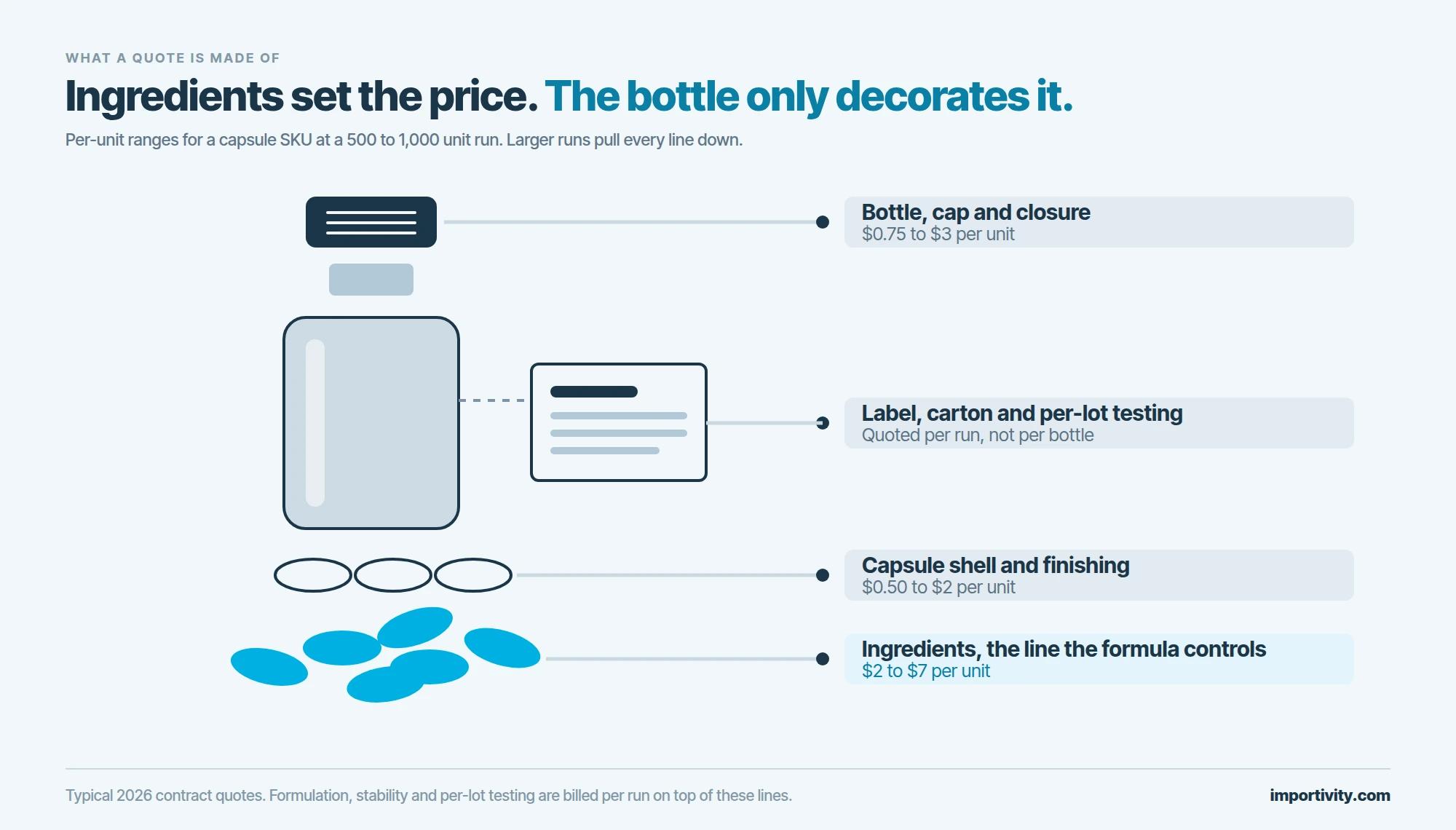
The ingredient line is where the formula decides the margin. A botanical dosed at the level the clinical literature used costs several times what it costs at a label-friendly sprinkle, and the plant will price whichever you specify. Ask for the ingredient line broken out by raw material with its country of origin, because that is also where tariff exposure sits, and ask which lines fall as the run size doubles. A first custom run of 5,000 units of one capsule SKU commonly totals $20,000 to $40,000 once formulation, testing, packaging and label design are added.
MOQs, lead times and the testing gates
Minimums come from raw material lots and testing, not machine time. A private label program on stock formulas can start at about 500 bottles because the plant already holds tested inventory of every ingredient. A custom formula usually carries a floor of 1,500 to 5,000 bottles because each ingredient must be bought in a full lot and identity tested before use, and many larger plants quote 5,000 units or more as a hard minimum. Lead times follow the same logic: about 4 weeks for a stock formula at some plants, while 12 weeks is a common quote for custom work, with botanicals in short supply pushing it further.
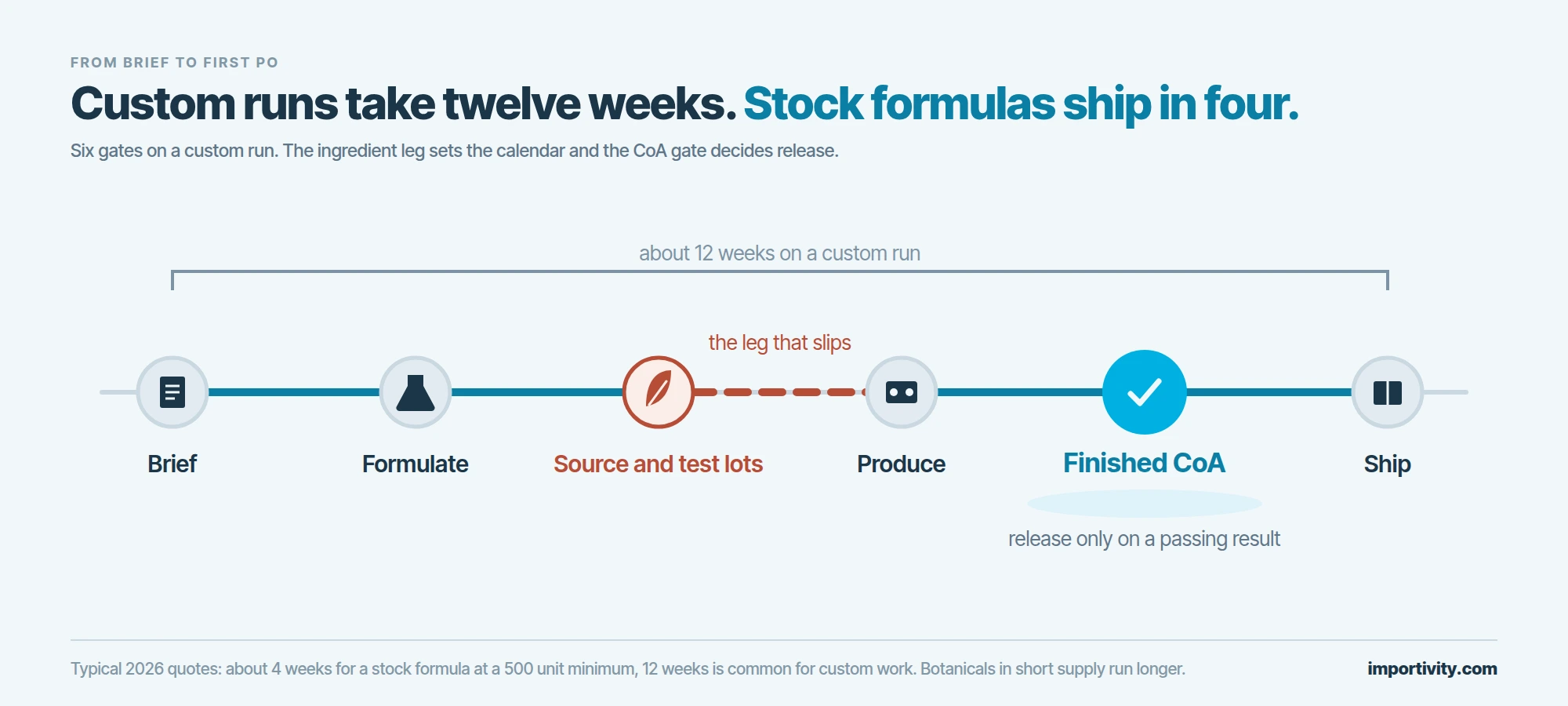
The run has six gates and two matter more than the rest. The ingredient sourcing leg is the one that slips, because raw material lots arrive on the supplier's calendar and identity testing cannot begin until they do. The finished product testing gate decides release: a certificate of analysis on the finished lot covering identity, potency against the label claim, heavy metals and microbial limits. Require it per lot in the contract and state that shipment happens only on a passing result. A plant that offers to ship on the incoming ingredient CoAs alone is asking you to carry the risk of a mislabeled bottle.
Stability data is the other document to ask for early. A "best by" date is a claim, and the plant should show the study behind it for your formula in your packaging, because a formula stable in amber glass is not automatically stable in clear PET. Our supplier onboarding checklist has the document list to close before the first purchase order.
The label is your legal problem, not theirs
Contract manufacturers print whatever artwork you approve, and the brand on the label is the party FDA holds responsible. The Supplement Facts panel has its own format under 21 CFR 101.36, which a food label designer will get wrong. Structure/function claims, the "supports healthy joints" kind, need no pre-approval, but the claim must be substantiated, the label must carry the disclaimer that the statement has not been evaluated by the Food and Drug Administration and the product is not intended to diagnose, treat, cure or prevent any disease, printed in bold and no smaller than the surrounding text, and you must notify FDA of the claim within 30 days of first marketing it. Disease claims, anything that names a condition, turn the product into an unapproved drug.
A good plant flags an obvious disease claim as a courtesy but never takes on the liability, so budget for a regulatory review before the print run. The wider duties an importer carries are covered in import product compliance.
Making it in the US or making it overseas
Most finished supplements sold by US brands are bottled domestically: a US plant is inspectable, its CoAs come from labs you can call, and a finished product does not have to clear FDA at the border. The raw materials are a different story. A large share of vitamins, amino acids and botanical extracts come from China and India regardless of where the capsule is filled, so the origin question is really about the ingredient line.
Overseas finished production makes sense for gummies, softgels and some liquid formats that US plants with limited capacity price high, and for bulk ingredient sourcing from the producing country when you have the volume to buy in lots. When you go that route, four things change:
- Registration and Prior Notice. The foreign facility must hold FDA registration, and every shipment needs Prior Notice filed before arrival with the right facility number, product code and importer details.
- FSVP. As the US importer you must run a Foreign Supplier Verification Program. FDA issued a wave of warning letters to importers for FSVP failures in early 2026.
- Import Alerts. A facility or product with a history of problems can be placed on an Import Alert, which lets FDA detain shipments without physical examination, with a typical 10 working day response window.
- Duties. Section 301 duties apply to many Chinese-origin ingredient categories at 7.5 to 25 percent, botanicals such as ashwagandha, turmeric, ginkgo and green tea extract carried some of the highest rates through the 2025 tariff changes, and vitamins, amino acids and CoQ10 were carved out. Rates keep moving, so price the landed cost on the current HTS line before you sign.
Ingredient suppliers have shifted volume toward Southeast Asia and India for exactly this reason, and a plant with qualified second sources for its key botanicals is worth more than a slightly lower unit price. Jordan's team runs this origin and second-source check from Guangzhou and Ho Chi Minh City every week, and the fit check on his page is the fastest way to learn whether an overseas plan pencils out for your formula.
The first call and the red flags
Five questions on the first call tell you most of what a site visit would:
- Who owns the formula and the batch records on a custom project, and will you put it in the contract?
- How do you identity test incoming botanicals, and which lab does it? The answer names a method and a lab, not a supplier CoA.
- What does the finished product CoA cover, and will you release only on a passing result?
- Where does each ingredient come from, and do you hold a second source?
- What is the MOQ per SKU, the lead time from approved artwork, and which of those move at double the volume?
The red flags are the mirror image: "FDA approved" anywhere on the site, a single all-in price with no breakdown, custom formulation with no assignment clause, identity testing described as "we check every lot" with no method, and pressure to skip finished product testing to hit a date. Any one is a reason to keep looking, and two together is a reason to end the call. If you would rather have the vetting, quote comparison and ingredient origin work done for you, that is what our manufacturer sourcing service is built for.
Frequently Asked Questions
How much does supplement contract manufacturing cost per bottle?
For a 60 count capsule SKU at a run of 500 to 1,000 units, 2026 quotes typically land at $2 to $7 per unit for ingredients, $0.50 to $2 for the capsule and finishing, and $0.75 to $3 for the bottle. Private label stock formulas often come in at $1.50 to $2.50 per bottle, and custom formulation adds a one-time fee of roughly $2,000 to $10,000 per SKU.
What is the minimum order quantity for a supplement manufacturer?
Private label programs built on the plant's stock formulas start around 500 bottles. Custom formulations usually carry a floor of 1,500 to 5,000 bottles because the plant has to buy raw materials in full lots and identity test every one, and many larger facilities quote 5,000 units or more as a hard minimum.
Is a supplement manufacturer FDA approved?
No. FDA does not approve dietary supplements, their facilities or their labels before sale, so a manufacturer describing itself as FDA approved is either confused about the rules or misleading you. A legitimate facility holds FDA registration, complies with 21 CFR Part 111, and can show a voluntary third-party GMP audit such as NSF GMP registration.
Which supplement certification should I ask for?
Match the seal to the buyer. USP Verified checks identity, potency, purity and label accuracy, which suits general wellness products. NSF Certified for Sport and Informed Sport add batch testing against banned substance lists, which drug tested athletes need. In every case, ask for a lot specific certificate of analysis covering identity, potency, heavy metals and microbial limits.
Can I make supplements overseas and import them into the US?
Yes, but the foreign facility must be FDA registered, every shipment needs Prior Notice before arrival, and you as the US importer must run a Foreign Supplier Verification Program. Facilities with a history of problems can be placed on an Import Alert, which lets FDA detain shipments without examining them. Price the duty on the current HTS rate before committing.
About the author
Jordan Lewis
Chief Operating Officer, Importivity
Runs Importivity's sourcing operations across China, Vietnam, Mexico and India, from supplier negotiation through landed delivery.
Press and media inquiries: press@importivity.com