Should You Choose Private Label or White Label?
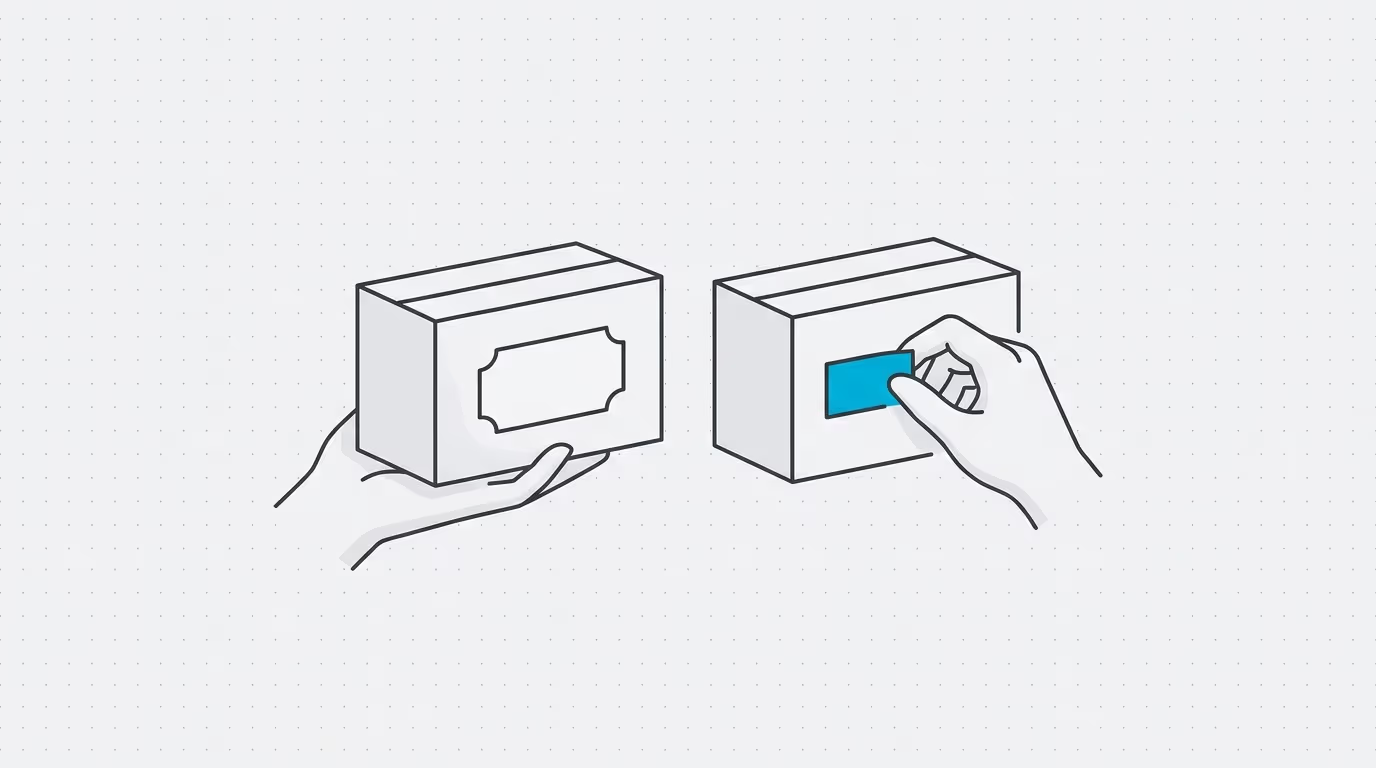
The core difference between private label vs white label is exclusivity: a private label product is manufactured to your own specification and sold only by you, while a white label product is a generic item that many resellers buy and rebrand as their own. Both let you put your name on a product without running a factory, but they lead to very different businesses. Private label builds a real moat and steady margin, and white label gets you to market fast and cheap. Our team handles both models every week inside product sourcing engagements.
This guide defines each model in plain terms, compares them side by side, and walks through the pros, costs, minimum order quantities, and margins so you can pick the right path. It is written for founders and product teams deciding how to launch a physical product on a tight timeline or a tight budget.
If you already know you want a fully custom product, our guide to private label manufacturers goes deeper on choosing a partner. Otherwise, start here.
At a glance
Private label or white label for your brand?
Match your goal to the right model:
Private Label and White Label Defined
With private label, a manufacturer produces a product exclusively to your specification. You control the formula, the design, the ingredients or materials, and the packaging. No other brand sells that exact product because it was built for you. Think of a supplement blend created to your formula, a skincare line mixed to your recipe, or apparel cut and finished to your tech pack. The upside is genuine differentiation. The trade is higher minimum order quantities and higher upfront cost, since the factory is setting up a run just for you.
With white label, a generic product that is already made gets sold to many resellers, and each one adds its own branding. The factory designed the product, holds the formula, and offers it to anyone who wants to slap a label on it. A phone charger, a basic vitamin C serum, or a stock water bottle can all be white labeled by a dozen brands at once. The upside is speed and low cost. The trade is that you own the label, not the product, so a competitor can sell the identical item under a different name.
Said simply: private label means the product is yours, white label means the brand is yours but the product is shared. That single distinction drives every cost, timeline, and margin difference that follows.
Key Differences Between Private Label and White Label
The two models get confused constantly because both end with your logo on a box. The real separation comes down to who owns the underlying product and whether anyone else can sell it. The table below lays out the six differences that matter most when you are choosing.
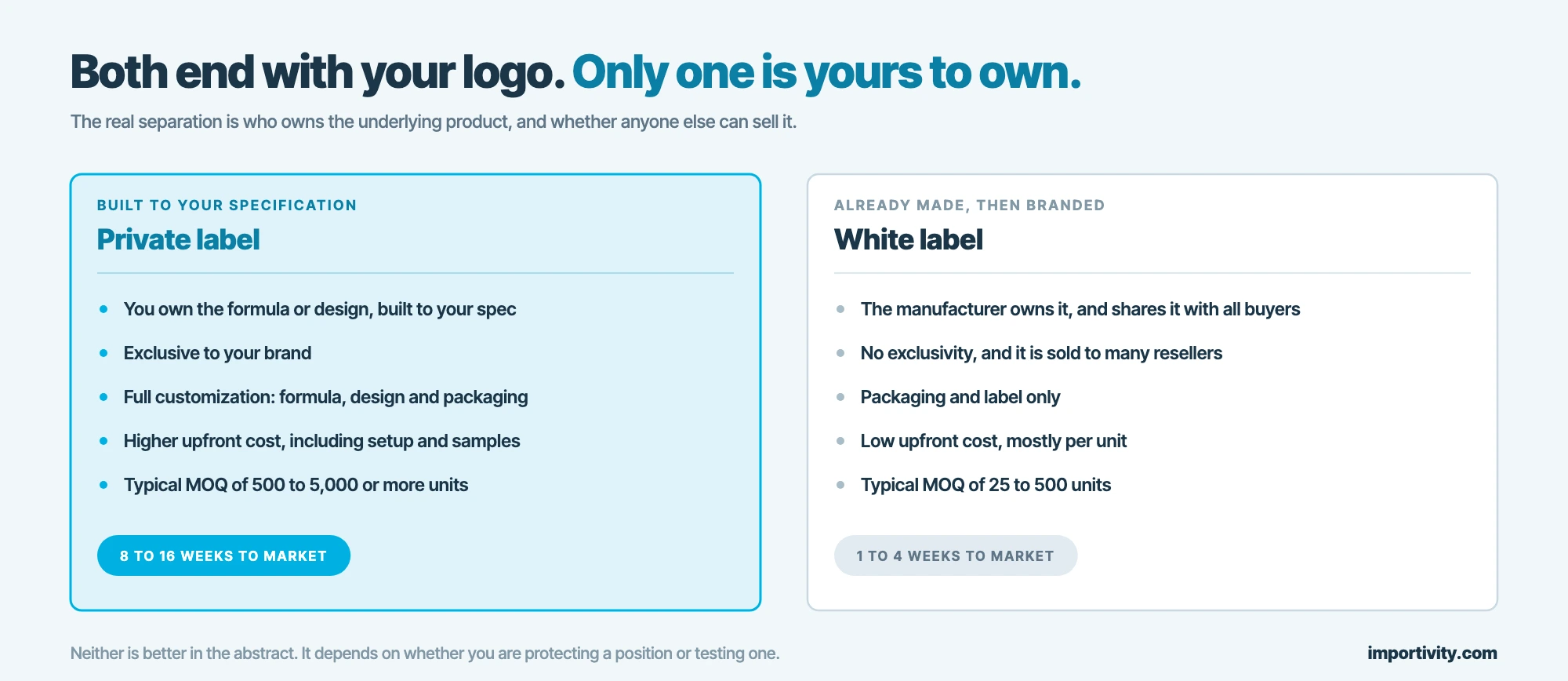
| Factor | Private label | White label |
|---|---|---|
| Who owns the formula or design | You do, built to your spec | The manufacturer, shared with all buyers |
| Exclusivity | Exclusive to your brand | None, sold to many resellers |
| Customization | Full: formula, design, packaging | Packaging and label only |
| Upfront cost | Higher, includes setup and samples | Low, mostly per unit |
| Typical MOQ | 500 to 5,000+ units | 25 to 500 units |
| Speed to market | 8 to 16 weeks | 1 to 4 weeks |
Read the table as a spectrum, not a wall. A lightly customized private label product can behave almost like white label, and some white label suppliers allow a small tweak to scent or color. But the ownership line holds: if the factory can sell your product to someone else, you are white labeling.
Pros and Cons of Each
Neither model is better in the abstract. The right choice depends on whether you are protecting a position or testing one.
Private label pros. You get a product no competitor can buy off the same shelf, which lets you defend price and build a brand customers cannot find elsewhere. You control quality, ingredients, and packaging down to the detail, and repeat customers reward that consistency. Over time, the exclusivity compounds into a moat.
Private label cons. You pay for setup, sampling, and often tooling before you sell a single unit. Minimum order quantities are higher, so you tie up more cash in inventory. The launch takes longer, commonly two to four months, because the product has to be formulated, sampled, and approved.
White label pros. You launch in days or weeks because the product already exists. Upfront cost is low, minimums are small, and you can fill a catalog gap or test a category without betting the company. It is the fastest way to see whether customers actually want the thing.
White label cons. You have no exclusivity, so competitors can list the identical product and race you to the bottom on price. Differentiation lives only in your brand, marketing, and service. Margins are thinner and easier to erode, and you are exposed if the supplier changes the product or sells to a stronger rival.
Cost, MOQ, and Margin Compared
Numbers make the tradeoff concrete. The chart below scores each model on a relative scale across the five factors that decide most launches. Private label wins on customization, margin potential, and differentiation, while white label wins on upfront cost and speed. There is no free lunch: the strengths of one are the weaknesses of the other.
White label
High
Low
High
Low
Slower
Fast
High
Low
High
Low
Illustrative relative scores. In practice, private label minimums often start near 500 to 1,000 units for cosmetics and supplements and climb into the thousands for custom apparel, while white label products can ship in lots of 25 to 250. Confirm your own numbers before you commit inventory.
On margin, the pattern is consistent. Because a white label product is available to every reseller, price competition compresses gross margin, often into the 20 to 40 percent range. A well positioned private label product, protected by exclusivity, commonly holds 50 to 70 percent or more. You are paying higher upfront cost to buy a defensible margin later.
Which Model Is Right for You
Private label suits brands building a moat and expecting steady, repeatable volume. White label suits testing demand, filling a catalog gap, or launching quickly with low capital. Use the checklist below to point yourself in the right direction.
- Choose white label if you are validating a new product idea and want proof of demand before you invest.
- Choose white label if your budget is small and you cannot tie up cash in a large first order.
- Choose white label if you need to fill a gap in your catalog fast, within a few weeks.
- Choose private label if the product is core to your brand and you need it to be exclusive.
- Choose private label if you have steady volume and want to defend margin against copycats.
- Choose private label if quality, formula, or a specific material is central to your promise to customers.
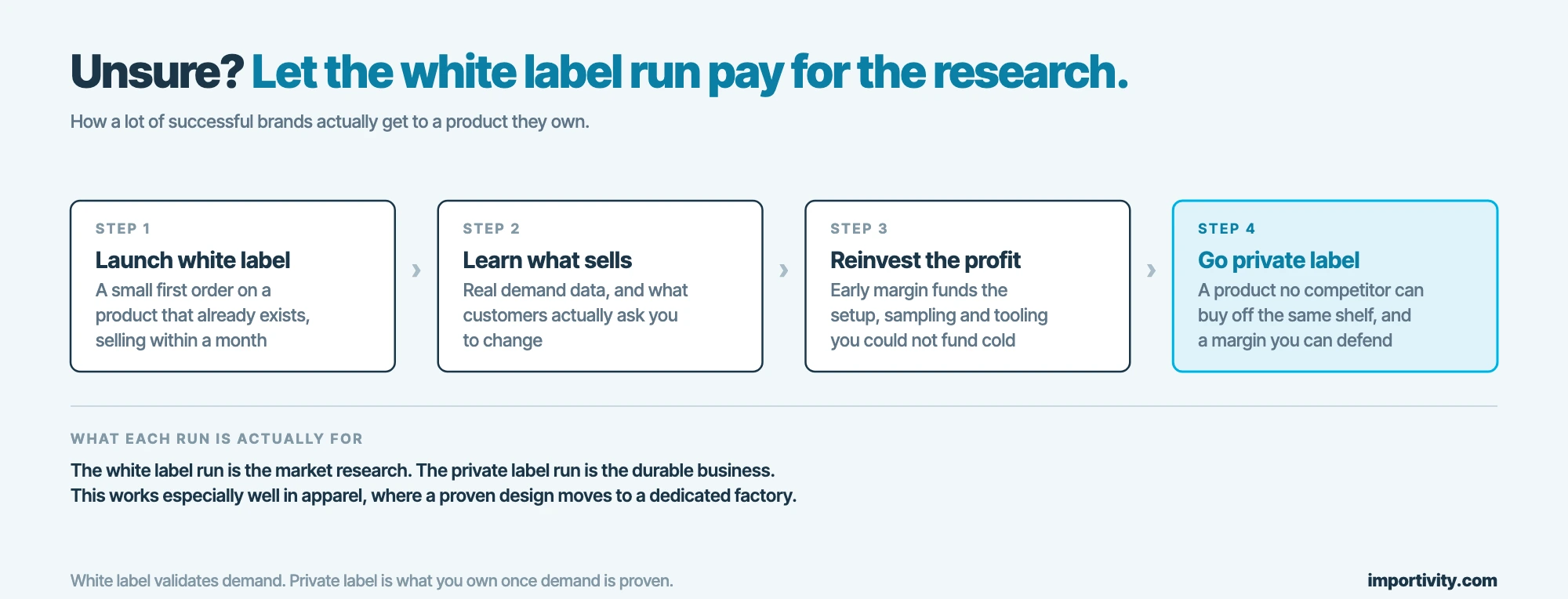
- Consider a phased path if you are unsure: start white label to prove the concept, then graduate to private label once it sells.
That last point is how many successful brands actually operate. They launch a white label version to confirm the market is real, learn what customers want, and reinvest early profit into a private label product they own outright. The white label run is the market research, and the private label run is the durable business. This works especially well in categories like apparel, where a proven design can move to a dedicated private label clothing manufacturer once volume justifies the setup.
How to Get Started With Each
The starting steps diverge because you are buying different things: a shared product versus a custom one.
To start with white label, shortlist suppliers who already produce the exact product you want, request their catalog and price breaks, and order samples to confirm quality against the listing rather than the photo. Check the minimum order quantity, the label and packaging options, and whether the supplier will restrict how many resellers they sign in your category. Then design your branding, submit your artwork, and place a small first order to test the market. Because the product exists, you can often be selling within a month.
To start with private label, you first document exactly what you want built. Write down the formula or specification, the materials, and the packaging, and for physical goods, prepare a clear bill of materials so factories can quote accurately. Send that spec to several qualified manufacturers, compare unit price, minimum order quantity, tooling, and lead time, then order a paid pre production sample and test it against your spec before committing to a full run. Agree quality standards and exclusivity in writing. This model is close in structure to contract manufacturing, and the vetting discipline is the same: verify the factory, order a real sample, and start with a modest first order before you scale.
Whichever route you take, the supplier decision is the one that makes or breaks the launch. If you want help sourcing a vetted factory for either model, that is exactly what our sourcing team does.
We qualify the plants that build this kind of product and film the visits, which go out through Source With Jordan.
Frequently Asked Questions
What is the difference between private label and white label?
Private label means a product is manufactured exclusively to your specification, so you control the formula, design, and packaging and no other brand sells it. White label means a generic, already made product is sold to many resellers who each add their own branding. The short version: with private label the product is yours, and with white label only the label is yours.
Is private label more expensive than white label?
Yes, usually. Private label carries higher upfront cost for setup, sampling, and higher minimum order quantities because the factory builds a run just for you. White label pushes almost everything into a low per unit price with small minimums. You pay more upfront for private label to earn a more defensible margin later.
Can competitors sell the same product as me with white label?
Yes. A white label product is offered to many resellers, so a competitor can buy the identical item and sell it under a different name. Your only differentiation is brand, marketing, price, and service. If exclusivity matters, you need private label, where the product is built to your spec and sold only by you.
Should I start with white label or private label?
If you are testing demand, working with a small budget, or need to launch within a few weeks, start with white label. If the product is core to your brand, you expect steady volume, and you want to protect margin, choose private label. Many brands start white label to prove the concept, then graduate to private label once the product sells.
Do private label and white label have different minimum order quantities?
Yes. White label minimums are typically small, often 25 to 500 units, because the product already exists. Private label minimums are higher, commonly 500 to several thousand units, because the factory sets up a dedicated production run. You can sometimes negotiate a lower private label first order by accepting a slightly higher unit price.
About the author
Jordan Lewis
Chief Operating Officer, Importivity
Runs Importivity's sourcing operations across China, Vietnam, Mexico and India, from supplier negotiation through landed delivery.
Press and media inquiries: press@importivity.com