Section 301 Tariff Refunds: What Importers Should Do Now

No importer is owed a Section 301 refund today. The tariffs are being challenged in court, and a lawsuit seeking their removal along with refunds of duties already paid is now in front of the judiciary, but a challenge is not a judgment. What you can do right now is make sure that if a refund window opens, your entries are still eligible for it. That means tracking liquidation dates, filing protests where the clock is running out, chasing exclusions that already apply to your products, and keeping the entry documentation that any refund claim will be built on.
This guide is for importers who have been paying Section 301 duties and want to know what the litigation could mean for them, what preserves a claim, and what is a distraction. It also draws the line that costs people the most money right now, which is the difference between the refund program that is already open and the Section 301 refunds that are not.
Do not confuse this with the refunds already being paid
There are two refund stories running at once and they have nothing to do with each other legally.
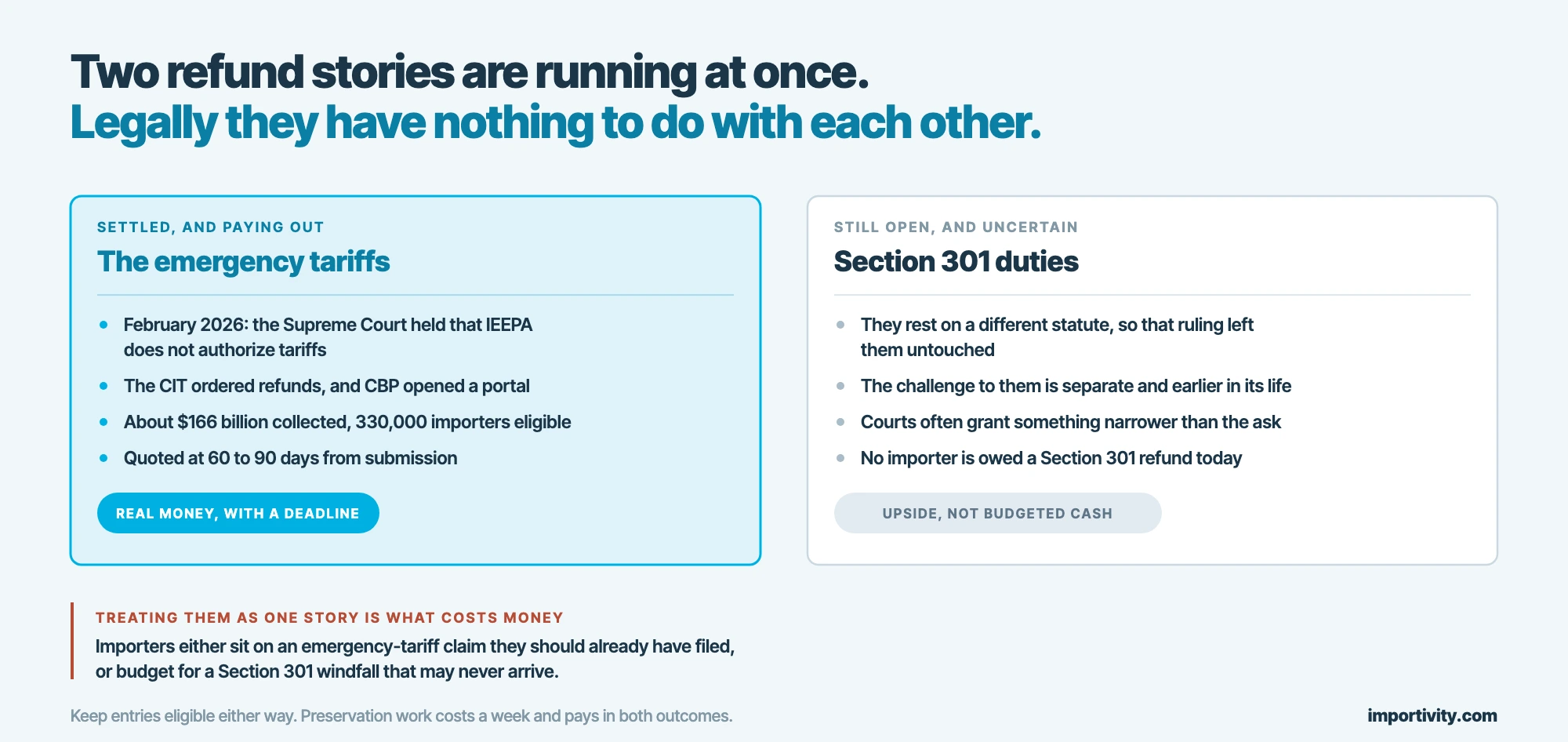
The first is settled. In February 2026 the Supreme Court held that the International Emergency Economic Powers Act does not authorize tariffs, and the emergency duties collected under it were invalidated. The Court of International Trade then ordered the government to refund them, and CBP opened a portal for importers to reclaim the roughly $166 billion collected, with over 330,000 importers eligible and refunds quoted at 60 to 90 days from submission. Details are in our note on the CBP tariff refund portal and the CIT refund order. If you imported during that period and have not filed, that is real money with a deadline.
The second is open. Section 301 duties were explicitly untouched by that ruling, because they rest on a different statute. The current litigation against them is separate, earlier in its life, and could take a long time to resolve. Treating the two as one story leads importers to either sit on an IEEPA claim they should already have filed, or to budget for a Section 301 windfall that may never arrive.
The three routes that actually produce a Section 301 refund
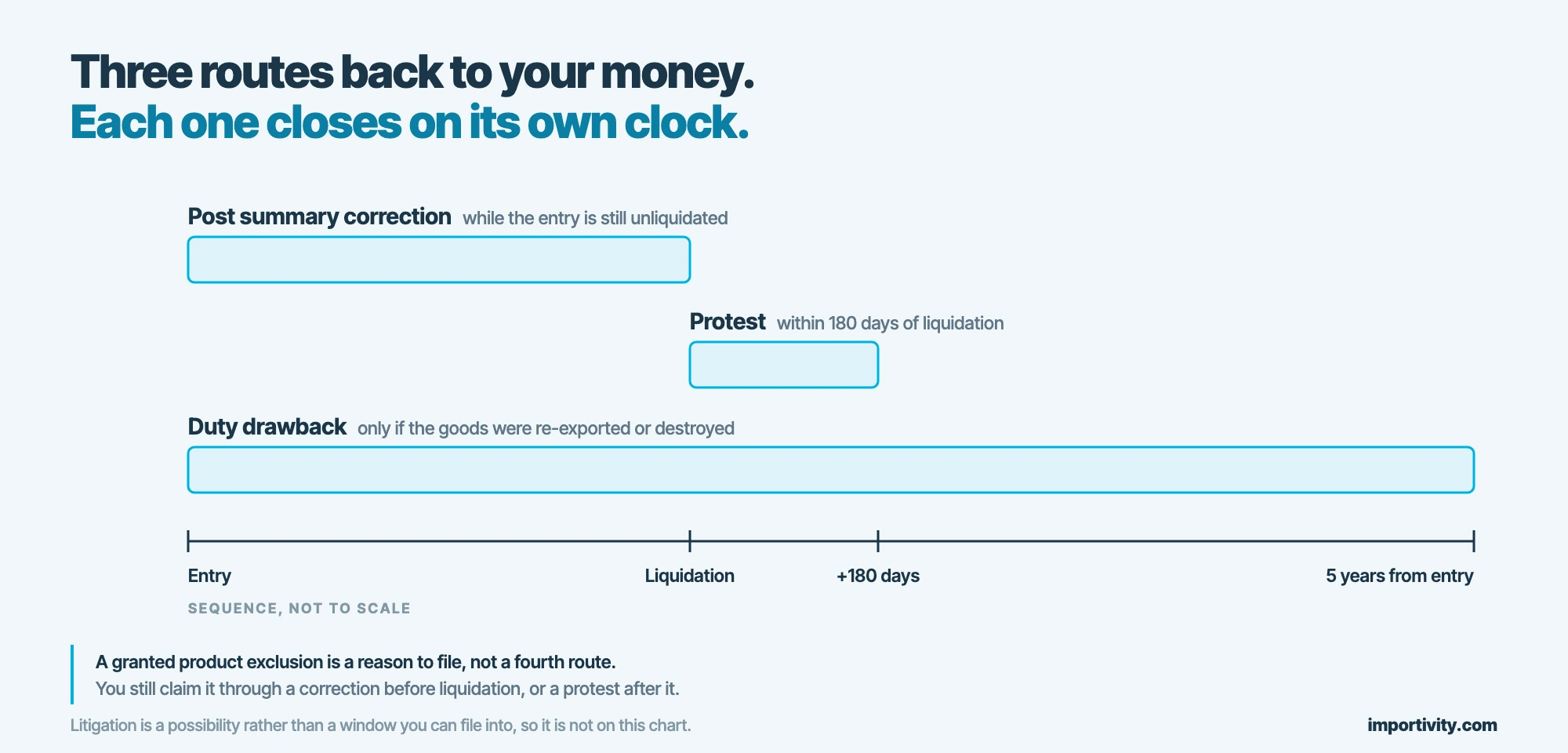
Refunds do not arrive because a tariff is unpopular or because a case has been filed. There are three mechanisms, and only the first two are within your control.
| Route | What triggers it | Timing you control |
|---|---|---|
| Product exclusion | USTR grants an exclusion covering your product description | File a post summary correction while the entry is unliquidated, or protest within the window after liquidation |
| Protest or correction | The entry was classified, valued, or flagged for origin incorrectly | Post summary correction before liquidation; protest generally within 180 days after it |
| Duty drawback | The imported goods were re-exported or destroyed | Claims are filed on your schedule, within the statutory five-year window |
Litigation is a fourth possibility rather than a route you can file into. If a court eventually orders relief, eligibility usually depends on whether your entries were still open, whether liquidation had been suspended, and whether you were a party or covered by the order. That is why the preservation work below matters more than the legal commentary.
What preserves a claim, in order of urgency
- Pull an entry summary report for every Section 301 entry. You need entry number, date, HTS code, declared value, duty paid by type, and liquidation date. Your broker can produce this from ACE, and it is the foundation of any claim.
- Watch liquidation dates. Entries generally liquidate around a year after entry, and once an entry liquidates the correction route closes and the protest clock starts. An entry that liquidates unnoticed is the most common way a recoverable claim quietly dies.
- File protests where the window is closing. If you have a genuine basis, such as an exclusion that covered the goods or a misclassification, protest rather than wait for the litigation.
- Check exclusions against your actual product descriptions. Exclusions are written narrowly. Read them against your specification, not your product name.
- Keep the origin file per SKU. Production records, bills of materials, and processing evidence. A refund claim that depends on origin is only as good as the file behind it.
- Confirm your ACH details in ACE are current. Refunds are issued electronically, and stale banking details delay payment even when everything else is right.
None of this is speculative work. Every item on that list also improves your position in an audit, a classification dispute, or a valuation review, which is the test of whether preparation is worth doing.
If you do not have this capability in house, our guide to what firms provide tariff consulting covers which type of firm actually handles refund claims and what to ask before you sign an engagement.
What the litigation could realistically change
Be careful with expectations here. The suit seeks removal of the tariffs and refunds of duties paid, which is the broadest possible ask. Courts frequently grant something narrower: relief that applies prospectively, relief limited to particular lists or products, or relief conditioned on procedural findings rather than on the tariffs being unlawful in principle. Section 301 also stands on firmer statutory ground than the emergency authority did, because tariffs are an explicit remedy in the statute rather than an implied power.
A sensible planning posture is to assume current rates continue, treat any refund as upside rather than as budgeted cash, and keep entries eligible so that upside is collectible. Importers who reprice products on the assumption that duties are about to be returned end up with the worst of both outcomes, which is lower margin now and no refund later.
Should you keep sourcing from China while this plays out
The tariff question and the sourcing question are related but not the same. Section 301 exposure is now far broader than China, because USTR's 2026 investigations reached 16 economies over manufacturing overcapacity and 60 more over forced-labor import enforcement, so a move on its own is no longer a guaranteed exit. What still works is deciding on landed cost and risk rather than on headlines.
Run the real numbers with our landed cost formula for the current rate and for a higher scenario, and compare that against a genuine alternative rather than a quoted unit price. If diversification is the answer, do it properly, with real substantial transformation and an evidence file to match, which is the subject of our guide to Vietnam origin and transshipment risk. Where the alternative is a different country entirely, the China vs Vietnam comparison is the fastest way to see the trade-offs side by side.
A short checklist for this quarter
If you do nothing else, do these five things: file any outstanding claim under the emergency-tariff refund program before that window closes, build the entry summary report for your Section 301 entries, calendar every liquidation date for the next twelve months, review current exclusions against your top ten SKUs by duty paid, and get the origin evidence file complete for anything you have already moved out of China. That is a week of work that either recovers money now or keeps a future recovery available.
For a worked example of what this costs once the duty actually lands, see our case study on scaling a US gum manufacturer through the 2025 tariff debacle, and Source With Jordan for the sourcing decisions behind it.
Frequently Asked Questions
Can I get a refund of Section 301 tariffs I have already paid?
Not automatically. Refunds come from a granted product exclusion, a successful protest or entry correction, or a drawback claim on goods you re-exported or destroyed. The pending litigation against Section 301 could create another path, but until a court orders relief nothing is owed.
Is this the same as the tariff refund portal CBP opened?
No. That portal returns duties collected under the emergency authority the Supreme Court struck down in February 2026. Section 301 duties were not part of that ruling and are not refundable through the same process. If you paid the emergency duties, file there separately and promptly.
How long do I have to protest an entry?
A protest is generally due within 180 days of liquidation, and before liquidation a post summary correction is usually the better tool. Because entries typically liquidate about a year after entry, the practical answer is to track liquidation dates rather than entry dates.
What documents will a refund claim need?
Entry summaries showing duty paid by type, commercial invoices and packing lists, the HTS classification basis, proof of origin such as production records and bills of materials, and for exclusion claims a product specification that matches the exclusion language. Assemble it per SKU rather than per shipment.
Should I pause sourcing decisions until the case is decided?
No. Litigation timelines run far longer than sourcing cycles, and Section 301 exposure now covers many countries beyond China. Decide on landed cost and supply risk, model both the current rate and a higher one, and treat any refund as upside rather than as budgeted cash.
About the author
Jordan Lewis
Chief Operating Officer, Importivity
Runs Importivity's sourcing operations across China, Vietnam, Mexico and India, from supplier negotiation through landed delivery.
Press and media inquiries: press@importivity.com