Proforma Invoice vs Commercial Invoice for US Importers

A proforma invoice is an offer to sell, issued before a sale is concluded, and it is what your bank reads when it opens a letter of credit or what you use to budget a purchase. A commercial invoice is the legal record of a completed sale, and it is the document US Customs and Border Protection uses to assess duty. The two look similar and are used for opposite purposes. CBP will accept a proforma at entry only when the commercial invoice genuinely is not available, and only against a bond, with a deadline to produce the real one.
This guide is for US importers and the people who prepare their entries. It sets out the exact data elements CBP requires, the rule that lets a proforma stand in temporarily, the valuation line that catches importers out, and what a wrong invoice is worth in penalties. If you are still working out how the numbers add up before duty, pair this with our guide to calculating landed cost.
What Each Document Is Actually For
A proforma invoice is forward looking. It quotes what a sale would be if the buyer proceeds: the goods, the quantities, the price basis, the shipping terms. Nothing is owed on it. In trade finance it is the standard basis for a buyer to apply to its bank to open a letter of credit in the exporter's favour, a use described in the US government's own guidance on letters of credit. It also travels well as a budgeting and internal approval document, and in some countries it supports an import license application, though that is a foreign requirement rather than a US one.
A commercial invoice is backward looking. The sale has happened, the price is fixed, and the document records it. Every number on it is a representation to the US government about the value, quantity, description and origin of what you are importing. That is the difference that matters. A proforma that is wrong is a bad quote. A commercial invoice that is wrong is a false statement at entry.
The other practical difference is who writes it. Both come from the seller, but the commercial invoice has to satisfy a US regulation the seller has probably never read. If you are importing from a factory that has not shipped to the United States before, expect to have to specify the invoice format yourself.
What CBP Actually Requires on a Commercial Invoice
The requirements are set out in 19 CFR 141.86 and they are more specific than most suppliers assume. The invoice must state the port of entry, the time and place of the sale and the names of the parties to it, a detailed description of the merchandise in the terms used in the tariff schedule, the quantities, the purchase price in the currency of the sale, every charge broken out by type, any rebates or drawbacks allowed, the country of origin, and the value of anything you supplied to the producer free or at reduced cost.
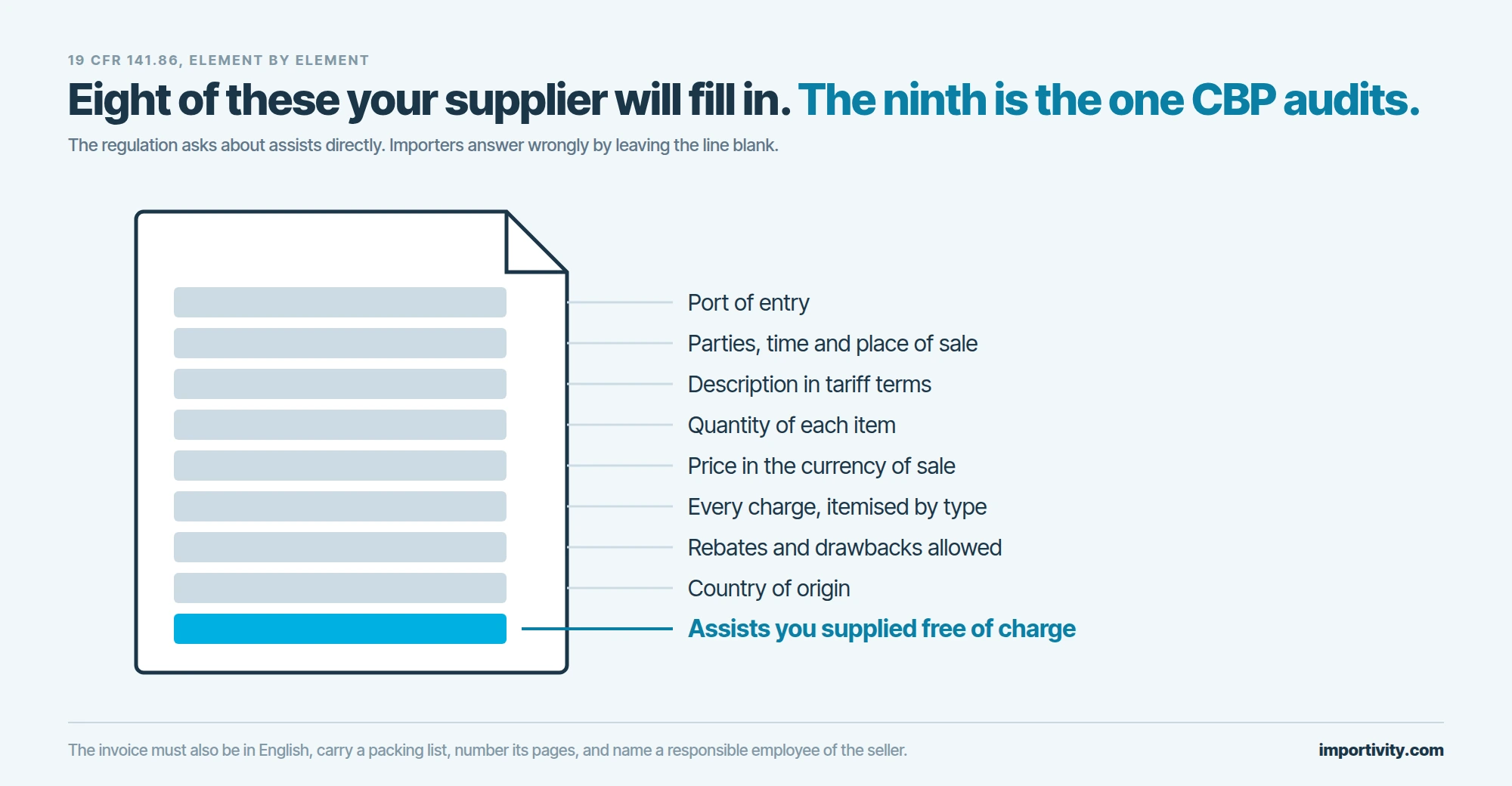
Several smaller rules in the same section trip people up. The invoice must be in English or carry a certified English translation. A packing list detailing the contents of each package is required. Discounts from the list price have to be itemised by class of merchandise. Pages must be numbered consecutively. And the invoice has to name a responsible employee of the seller or manufacturer who has knowledge of the transaction, or can get it. That last one exists so CBP has somebody to ask.
The description requirement is the one worth most attention. Writing "plastic parts" on an invoice for goods you are classifying as an injection molded housing under a specific subheading invites a question you will not enjoy answering. The description should read like the tariff language. Our guide to HTS codes and customs classification covers how to get that alignment right before the goods sail.
When a Proforma Invoice Is Legal at the Border
A proforma can carry an entry, but it is an exception mechanism rather than a choice. 19 CFR 141.85 prescribes what the document must contain, including the shipper, seller, consignee and purchaser, a statement of whether the goods were purchased and on what pricing basis, itemised quantities and prices, itemised charges, the country of origin, and a signature with the preparer's date and title, plus a declaration that the importer will file the real invoice as soon as it is received.
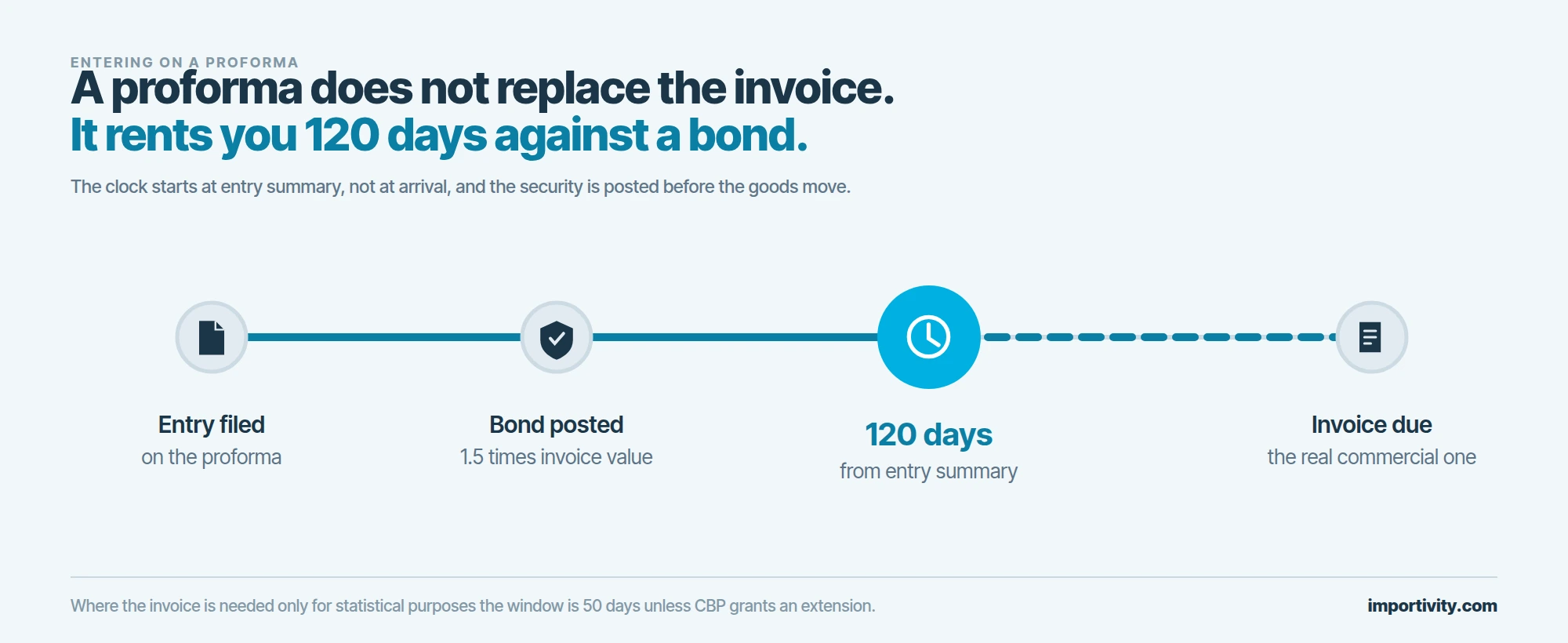
The conditions sit in 19 CFR 141.91. Entering on a proforma requires a bond on CBP Form 301 equal to one and a half times the invoice value, and the actual commercial invoice must be produced within 120 days of the entry summary filing date. Where the invoice is needed only for statistical purposes, the window is 50 days unless CBP grants an extension. A related provision, 19 CFR 141.92, conditions any waiver of the ordinary invoice requirement on an executed proforma being on file.
The practical reading is that a proforma buys you time at a cost. You are posting security, you are on a clock, and you are still going to have to produce a compliant commercial invoice. If your supplier is simply slow with paperwork, fixing that is cheaper than routinely entering on proformas.
The Valuation Line That Catches Importers Out
Duty is assessed on transaction value, meaning the price actually paid or payable for the merchandise when sold for export to the United States, plus a set of statutory additions, under 19 USC 1401a and its implementing rules at 19 CFR 152.103. The invoice price is the starting point for that calculation. It is not automatically the same number.
Assists are where the gap opens. If you supplied the factory with tooling, dies, molds, materials, or engineering and design work performed outside the United States, free or below cost, that value is a dutiable addition even though it never appears on the invoice. So are royalties owed to the seller as a condition of sale, certain packing costs, and proceeds of resale that go back to the seller. Notice that 141.86 already requires the invoice to disclose goods and services furnished for production. The regulation asks the question. Importers answer it wrongly by leaving the box blank.
A worked example makes it concrete. You pay a Chinese factory 8 dollars a unit for 50,000 units and separately pay 40,000 dollars for a mold that stays at the factory and is used only for your parts. Your invoice value is 400,000 dollars. Your dutiable value is not, because the mold is an assist. Build assists into the model before you commit, and use the landed cost calculator rather than reasoning from the invoice total alone.
What an Invoice Error Is Worth
Getting this wrong is not a paperwork issue. 19 USC 1592 prohibits entering merchandise by means of any document, statement or act that is materially false, or any material omission, which covers a wrong value, a wrong description, a wrong country of origin or an undeclared assist. The penalty depends entirely on your state of mind, and the tiers are steep.
| Culpability | Where duty was lost | Where no duty was lost |
|---|---|---|
| Negligence | Up to 2 times the lawful duties, taxes and fees lost | Up to 20 percent of the dutiable value |
| Gross negligence | Up to 4 times the lawful duties, taxes and fees lost | Up to 40 percent of the dutiable value |
| Fraud | Up to the domestic value of the merchandise | Up to the domestic value of the merchandise |
| Prior disclosure filed | Mitigation available before CBP starts a formal investigation | Mitigation available before CBP starts a formal investigation |
Two things follow from that table. Negligence is the default finding, so "our supplier filled it in" is not a defence, and the penalty is a multiple of lost revenue rather than a fixed fee. And the prior disclosure route exists precisely because self reporting an error you found yourself is far cheaper than having CBP find it. Our guide to customs documentation mistakes covers the errors that recur most.
Why This Got Sharper After August 2025
Small shipments used to sit outside all of this. That changed with Executive Order 14324, which suspended duty free de minimis treatment for shipments from all countries, effective for goods entered for consumption on or after 12:01 a.m. on 29 August 2025, as recorded in the Federal Register implementation notice and CBP's own guidance to trade.
The effect on this topic is direct. Parcels and sample orders that previously moved under the 800 dollar threshold without a formal entry now need one, which means a compliant commercial invoice, a classification, and duty paid. A lot of small importers are filing their first formal entries on documentation habits formed when nothing was checked. The invoice requirements above did not change in 2025 or 2026. What changed is how many shipments they now apply to.
A Working Checklist Before the Goods Ship
Get this done at the purchase order stage, not when the vessel is three days out.
- Send your supplier an invoice template, not a request. Build the 141.86 elements into it so compliance is the default output.
- Match descriptions to tariff language. The invoice, the packing list and your classification should use the same words.
- Break out every charge separately. Freight, insurance, commissions and packing each need their own line and a note on whether they are included in the price.
- Declare assists. List any tooling, molds, materials or foreign design work you supplied, with values.
- Confirm the currency and the terms. The price must be in the currency of the sale, and the Incoterm should match what actually happened. Our Incoterms guide covers which term puts which cost where.
- Name a real person at the seller. A generic sales address does not satisfy the responsible employee requirement.
- Treat a proforma entry as a deadline, not a solution. Diarise the 120 days from entry summary and chase the real invoice from day one.
If you are running entries through a broker, ask them to show you a recent invoice from each supplier and mark it against the list above. Most of the failures we see are a single missing element repeated on every shipment for two years. Our import and export agency service exists for importers who would rather that audit happened before CBP runs it. For the same work at programme scale, including the duty side, see our case study on scaling a US gum manufacturer through the 2025 tariff debacle, and Source With Jordan for the sourcing behind it.
Frequently Asked Questions
Can I clear US customs with a proforma invoice?
Yes, but only as an exception and only on conditions. 19 CFR 141.91 requires a bond on CBP Form 301 equal to one and a half times the invoice value, and the actual commercial invoice must be produced within 120 days of the entry summary filing date. Where the invoice is needed only for statistical purposes the window is 50 days. A proforma buys time against security, it does not replace the commercial invoice.
What must a US commercial invoice contain?
19 CFR 141.86 requires the port of entry, the time and place of sale and the parties to it, a detailed description in tariff terms, quantities, the purchase price in the currency of the sale, every charge itemised by type, any rebates or drawbacks, the country of origin, and the value of anything you supplied to the producer free or below cost. It must also be in English, carry a packing list, be numbered consecutively, and name a responsible employee of the seller.
What is an assist and why does it change my duty?
An assist is something you supply to the foreign producer free or at reduced cost for use in making your goods, such as tooling, dies, molds, materials, or engineering and design work performed outside the United States. Its value is a statutory addition to transaction value under 19 USC 1401a, so it is dutiable even though it never appears on the supplier's invoice price. A mold you paid for separately still has to be declared.
What is the penalty for a wrong commercial invoice?
Under 19 USC 1592 the penalty scales with culpability. Negligence can reach twice the lawful duties, taxes and fees lost, or 20 percent of dutiable value where no revenue was lost. Gross negligence doubles that to four times, or 40 percent. Fraud can reach the full domestic value of the merchandise. Filing a prior disclosure before CBP opens a formal investigation is the route to mitigation.
Did the 2025 de minimis change affect invoice requirements?
The invoice rules themselves did not change. What changed is how many shipments they cover. Executive Order 14324 suspended duty free de minimis treatment for all countries for goods entered on or after 29 August 2025, so parcels that previously moved under the 800 dollar threshold now require a formal entry with a compliant commercial invoice, a classification and duty paid.
About the author
Jordan Lewis
Chief Operating Officer, Importivity
Runs Importivity's sourcing operations across China, Vietnam, Mexico and India, from supplier negotiation through landed delivery.
Press and media inquiries: press@importivity.com