Section 232 Tariffs Explained for Importers and What They Do to Landed Cost

Section 232 tariffs are import duties the President imposes under Section 232 of the Trade Expansion Act of 1962, after the Commerce Department finds that imports of a product threaten national security. In September 2026 they cover steel, aluminum and copper and hundreds of products made from them, passenger vehicles and parts, heavy trucks and buses, softwood lumber, wood furniture and kitchen cabinets, a narrow set of advanced semiconductors, and patented pharmaceuticals. The metals duty reaches the most importers, and since April 6, 2026 it is charged on the full customs value of the article, not on the metal inside it: 25 percent of the whole invoice for a derivative that is 15 percent or more covered metal by weight, 50 percent for an article that is entirely or almost entirely metal.
This guide is for US importers, hardware brands and sourcing teams who buy finished goods overseas and need to know whether Section 232 touches their product, how much it adds, and what actually reduces it. It covers the statute, the current coverage, how the metals duty is calculated, what the factory must document, stacking, and the routes that hold up at entry. For the wider plan, start with our tariff mitigation strategies resource.
What Section 232 is and why it outlived every other tariff
Section 232 gives the Commerce Department up to 270 days to investigate whether imports of a product impair national security, and gives the President 90 days after the report to act. The action can be a tariff, a quota or a negotiated deal, and it carries no expiry. That last point is the whole story of 2026. The emergency tariffs under the International Emergency Economic Powers Act were struck down by the Supreme Court on February 20, 2026, and the 10 percent Section 122 surcharge that replaced them ran out on July 23, 2026. Section 232 actions were untouched by either event.
So 232 has become the backbone of US tariff policy alongside Section 301. Every 232 proclamation since 2018 stays in force until a later one changes it, which is why the covered list only grows. The deals struck with the United Kingdom, the European Union, Japan and South Korea lower the rate on several lines, but they sit on a base rate that stays. The other pillar is covered in our guide to Section 301 tariffs.
What Section 232 covers in September 2026
Nine product families now sit under 232 actions. Each step changed what an importer of an unrelated product had to check, and the April 2026 step changed how every metals duty is calculated.
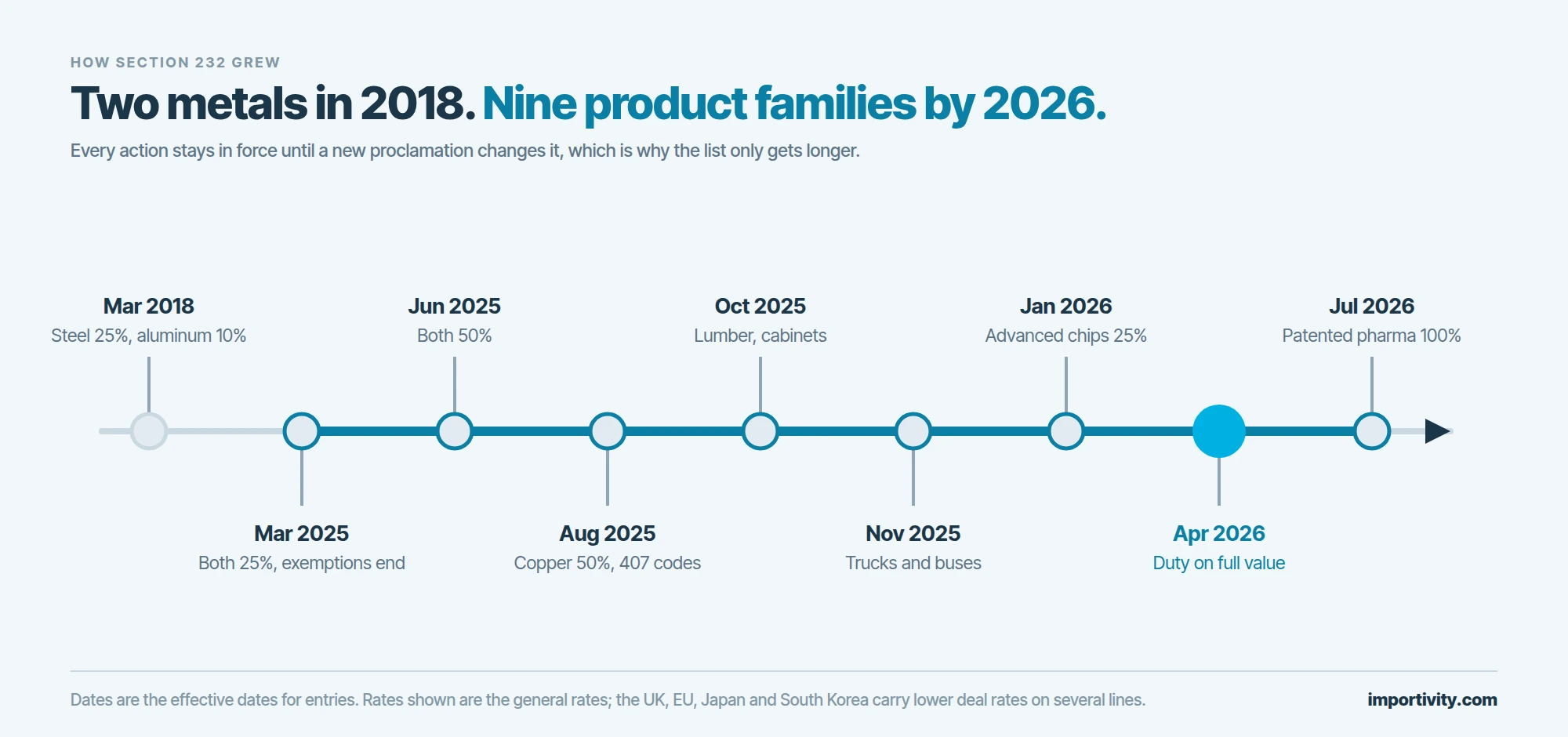
- Steel and aluminum. 25 percent on steel and 10 percent on aluminum from March 2018. Both rose to 25 percent on March 12, 2025, when the exemptions and exclusions ended, and to 50 percent on June 4, 2025. The UK stayed at 25 percent.
- Derivatives of steel and aluminum. Widened in March 2025 and again on August 18, 2025, when Commerce added 407 HTS codes across 17 steel chapters and 15 aluminum chapters: auto parts, appliances, furniture hardware, machinery. This is the expansion that pulled in products nobody thought of as steel.
- Copper. 50 percent on semi-finished copper and copper-intensive derivatives from August 1, 2025.
- Vehicles. 25 percent on passenger vehicles from April 3, 2025 and on key parts from May 3, 2025. Medium and heavy trucks at 25 percent and buses at 10 percent followed on November 1, 2025.
- Wood. 10 percent on softwood lumber, 25 percent on upholstered wooden furniture and on kitchen cabinets and vanities from October 14, 2025. The increases to 30 and 50 percent were pushed to January 1, 2027.
- Semiconductors. 25 percent on a narrow set of advanced computing chips from January 15, 2026, with exemptions for US data centers and most consumer uses.
- Pharmaceuticals. 100 percent on patented drugs and their ingredients from July 31, 2026 for seventeen named large companies and September 29, 2026 for everyone else.
If your product is a gas grill, a garage door opener, a filing cabinet or a wire harness, you are most likely in the derivative lists, which is where the 2026 rules changed the most.
How the metals duty is calculated since April 2026
Two proclamations rewrote the metals regime this year. The April 2, 2026 proclamation, effective April 6, moved the duty base from the value of the metal content to the full customs value of the article and sorted products into rate tiers. The June 1 proclamation, effective June 8 and running through December 31, 2027, added a weight threshold, lowered the bar for US-metal relief and cut the rate on industrial equipment.
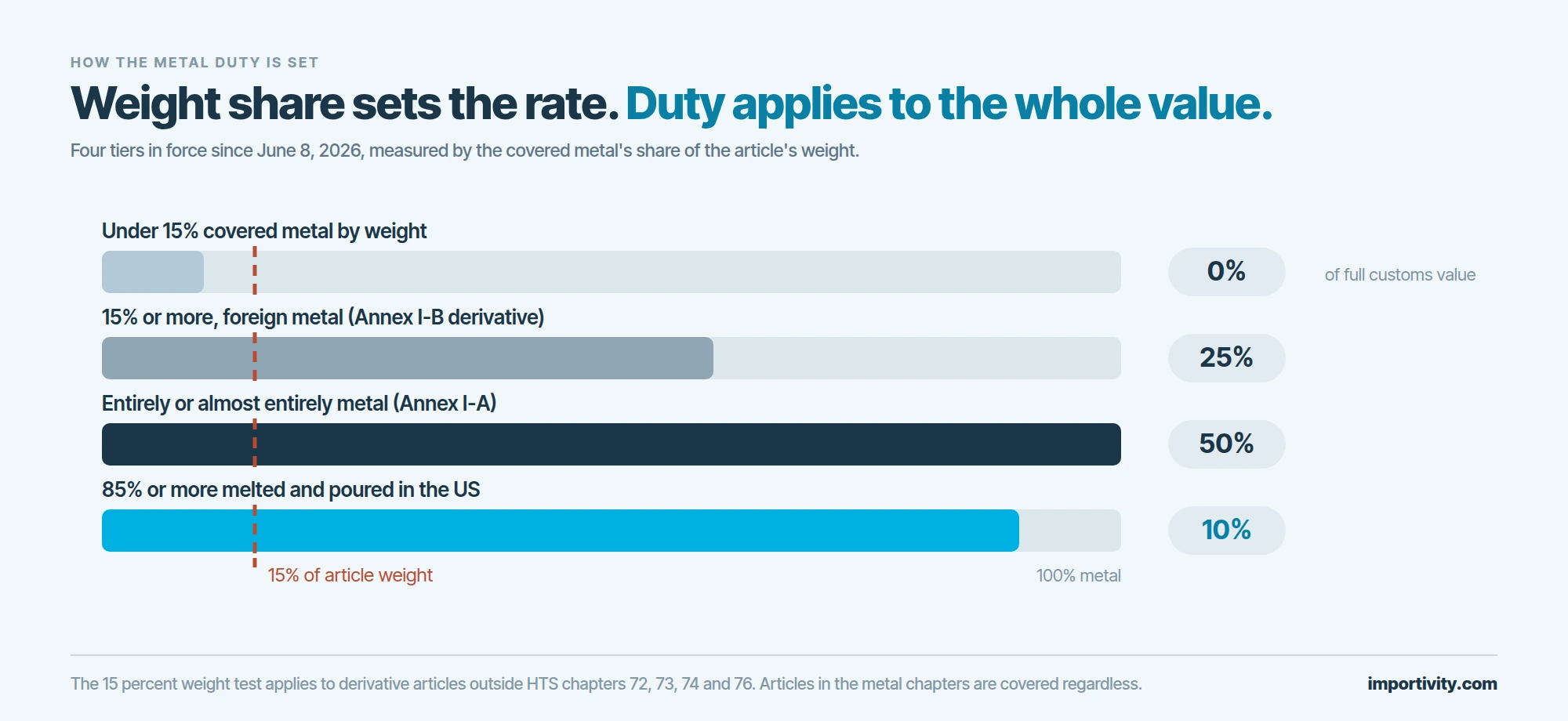
Under the old system an importer declared the value of the steel inside a $400 grill, say $90, and paid 50 percent of $90. Under the new system the grill is an Annex I-B derivative and pays 25 percent of $400. The rate halved and the duty more than doubled. That is the arithmetic behind every "the 232 went up" call since April. Our HVAC landed cost guide walks the same math for equipment.
| Article | Section 232 treatment | What the entry needs |
|---|---|---|
| Steel, aluminum or copper article (Annex I-A) | 50 percent of full customs value | Melt and pour country (steel) or smelt and cast country (aluminum, copper), mill certificate |
| Derivative with 15 percent or more covered metal by weight (Annex I-B) | 25 percent of full customs value | Metal weight by type, melt or smelt country per metal, product bill of materials |
| Derivative with under 15 percent covered metal by weight, outside chapters 72, 73, 74 and 76 | Outside the metals action since June 8, 2026 | A weight breakdown you can defend on audit |
| Derivative made from metal melted and poured in the United States (85 percent or more) | 10 percent of full customs value | US mill traceability for the metal, factory purchase records tied to the lot |
| Metal-intensive industrial and electrical grid equipment (Annex III) | 15 percent all-in transitional rate through December 31, 2027 | Confirmation the ten-digit code is on the annex |
How to find out whether your product is covered
Coverage is decided by the ten-digit HTS classification, so the first job is to be sure of the code. A product in Chapter 73 or 76 is covered outright. A product elsewhere is covered if its code appears on Annex I-A or I-B, and for codes outside the metal chapters the covered metal must be at least 15 percent of the article's weight for the duty to apply. The vehicle, wood, semiconductor and pharmaceutical actions each have their own annex and their own Chapter 99 headings.
- Pull a recent entry summary. A 9903.81, 9903.85 or 9903.82 heading against your line means your broker is already assessing 232. Check the tier; a broker who defaults to Annex I-A on a mixed product is costing you 25 points.
- Check the annex, not a blog list. The annexes live in the Federal Register with each proclamation and CBP mirrors them in its CSMS guidance. Third-party lists lag.
- Weigh the product. The 15 percent test is by weight, not value. A factory can give you a component weight table in an afternoon, and the test is yours to prove.
- Get the code reviewed before the first entry. Many derivative codes sit next to non-covered codes for the same product with a different material or function. Our HTS classification review is built around that line-by-line check.
What the factory has to document
Since 2025 every entry of a covered steel or aluminum article has carried the country where the steel was melted and poured or the aluminum was smelted and cast, reported in ACE under CBP's CSMS guidance. Copper joined on July 30, 2026 for wire and cable under headings 8544.42 and 8544.49, and from September 14, 2026 ACE rejects those entries outright with error F794 when the smelt and cast countries are missing. The data comes from the factory, which usually does not have it on the first ask.
A supplier's answer of "we are not a steel company" is not an answer. The question is where the metal in the product was melted, not who assembled it. Ask for the mill certificate for each metal input, the purchase record for that lot, and a weight breakdown by material. When the origin is genuinely unknown, ACE accepts "OTH," but the UK deal rate and the 10 percent US-metal tier both depend on a named country, so unknown metal always pays the full rate. Write the documentation into the purchase order from the start. A factory that cannot produce a mill cert at quoting will not produce one in an audit.
How Section 232 stacks with everything else
The stacking rules are the part brokers get asked about most, and they changed twice in 2026.
- MFN duty and antidumping or countervailing duties always apply on top. A 232 duty is an addition to the column 1 rate, and any AD or CVD order on the same product applies cumulatively.
- China's Section 301 duties stack with 232. A Chinese-origin steel derivative pays MFN plus 301 plus 232.
- The July 24, 2026 Section 301 forced-labor tariffs exclude 232 goods. Those duties of 10 or 12.5 percent on 60 countries carve out products already covered by 232, as the Section 122 surcharge did from February to July.
- The excess-capacity Section 301 investigation on 16 economies is still open, and whether its remedy carves out 232 goods is not yet known.
- USMCA does not exempt metal. Canadian and Mexican steel and aluminum articles pay 232 on their non-US content.
So for a Chinese-made covered product the 232 duty is one layer of at least three, and moving the product to Vietnam or Mexico removes the 301 layer but leaves the 232 layer where it was.
The mitigation routes that actually hold up
Four routes reduce Section 232 exposure. None is a form to file, and the cheap ones happen at product design and supplier selection, not at the port.
- Classification review. Confirm the code and the tier. The gap between Annex I-A and I-B is 25 points on the full value, and the gap between I-B and out of scope is the whole duty. This is the highest return per hour of any route.
- Tariff engineering. Take the covered metal under 15 percent of the article's weight, or move the metal-heavy subassembly into a separate entry with its own code. Both must be real, documented changes to the product as it crosses the border. Our tariff engineering page covers the line between a design change and a misdeclaration.
- Change the metal, not the factory. A factory in Vietnam or Mexico that buys US-melted steel puts the finished article into the 10 percent tier. Factories rarely offer this, but they will do it for a customer who specifies the mill and pays a premium that is usually smaller than 15 points of duty on the full value.
- Defer, do not expect to avoid. Covered metal admitted to a foreign trade zone since April 6, 2026 must take privileged foreign status, so the zone fixes the duty at admission and only delays payment. Neither a zone nor a bonded warehouse removes the duty; the comparison is in our guide to bonded warehouses and foreign trade zones.
The route that does not work is hoping. Section 232 actions have no sunset, the derivative list can still grow, and the transitional 15 percent rates expire at the end of 2027. The importers who are calm about it priced the duty into the quote, wrote the mill documentation into the purchase order and sourced with the tier in mind. That last step is what Jordan's sourcing desk settles before a factory is shortlisted: the metal share, the melt country and the HTS tier are known at the fit check, not discovered at the port.
Frequently Asked Questions
What is a Section 232 tariff?
A Section 232 tariff is an import duty the President imposes under Section 232 of the Trade Expansion Act of 1962 after the Commerce Department finds that imports of a product threaten national security. It has no statutory time limit, so the steel, aluminum, copper, auto, lumber, semiconductor and pharmaceutical duties in force in 2026 stay until a new proclamation changes them.
How do I know if my product is subject to Section 232?
Check the ten-digit HTS classification against the current Annex I-A and I-B lists for metals, then the separate annexes for vehicles, wood, semiconductors and pharmaceuticals. Since June 8, 2026 a derivative outside the metal chapters is out of scope when the covered metal is under 15 percent of its weight, so you also need the article's metal weight from the factory.
Is Section 232 duty charged on the whole product or only the metal?
Since April 6, 2026 the duty is charged on the full customs value of the article, not on the value of the metal inside it. A derivative that is 15 percent or more covered metal by weight pays 25 percent of its entire invoice value, and an article that is entirely or almost entirely metal pays 50 percent. Only the rate tier depends on metal content.
Do Section 232 tariffs stack with Section 301 tariffs?
Yes for China. The Section 301 duties on Chinese goods apply on top of Section 232, the normal MFN rate and any antidumping or countervailing duty. The Section 301 forced-labor tariffs that started on July 24, 2026 exclude goods already covered by Section 232, as did the Section 122 surcharge that ran from February to July 2026. Within Section 232 a product is assessed once, not once per metal.
Can a foreign trade zone avoid Section 232 duties?
No. Since April 6, 2026 any article subject to the metals action must be admitted to a foreign trade zone in privileged foreign status, which fixes its duty at admission. The zone delays payment until the goods enter US commerce and lets you re-export without paying, but it cannot turn covered metal into a duty-free product. Zones and bonded warehouses defer this duty; they do not remove it.
About the author
Jordan Lewis
Chief Operating Officer, Importivity
Runs Importivity's sourcing operations across China, Vietnam, Mexico and India, from supplier negotiation through landed delivery.
Press and media inquiries: press@importivity.com