Section 301 Tariffs Explained for Importers and Sourcing Teams
Section 301 tariffs are duties the U.S. Trade Representative can impose on imports from a country it has found to be engaging in unfair trade practices, under Section 301 of the Trade Act of 1974. Unlike the emergency tariffs that dominated 2025, Section 301 duties have no statutory rate cap and no built-in expiration date, which is exactly why they have become the main tariff authority importers now have to plan around. Your exposure comes down to three things: the country of origin of your goods, their HTS classification, and whether an exclusion applies.
This guide is for importers, sourcing managers, and finance teams who need to know whether Section 301 touches their products, how to check exposure before the next purchase order goes out, and which levers actually reduce the bill. It covers what the statute allows, how Section 301 sits alongside Section 232 and antidumping duties, the 2026 investigations that expanded its reach, and the responses that hold up under scrutiny.
What Section 301 actually is
Section 301 gives the Office of the U.S. Trade Representative (USTR) the power to investigate a foreign government's acts, policies, and practices, and to respond with tariffs or other trade measures if it finds those practices unreasonable, unjustifiable, or discriminatory. The best known use is the investigation into China's technology transfer and intellectual property practices, which produced the four tariff lists that still carry duties in the 7.5% to 25% range on tens of thousands of product lines.
Two features make it different from the tariff authorities that came and went during 2025 and early 2026. First, there is no rate ceiling written into the statute, so USTR can set duties at whatever level it determines is appropriate to the harm. Second, the action does not expire on its own. It stays in place until USTR terminates or modifies it, subject to periodic review. For a sourcing plan, that means a Section 301 rate is not a temporary surcharge you can wait out. It is a cost structure.
Where Section 301 sits in the 2026 tariff stack
Most importers are not paying one tariff. They are paying a stack, and each layer answers to a different statute with different rules about rates, exemptions, and refunds. After the Supreme Court held in February 2026 that the International Emergency Economic Powers Act does not authorize tariffs, the emergency layer disappeared and the remaining authorities became the whole picture.
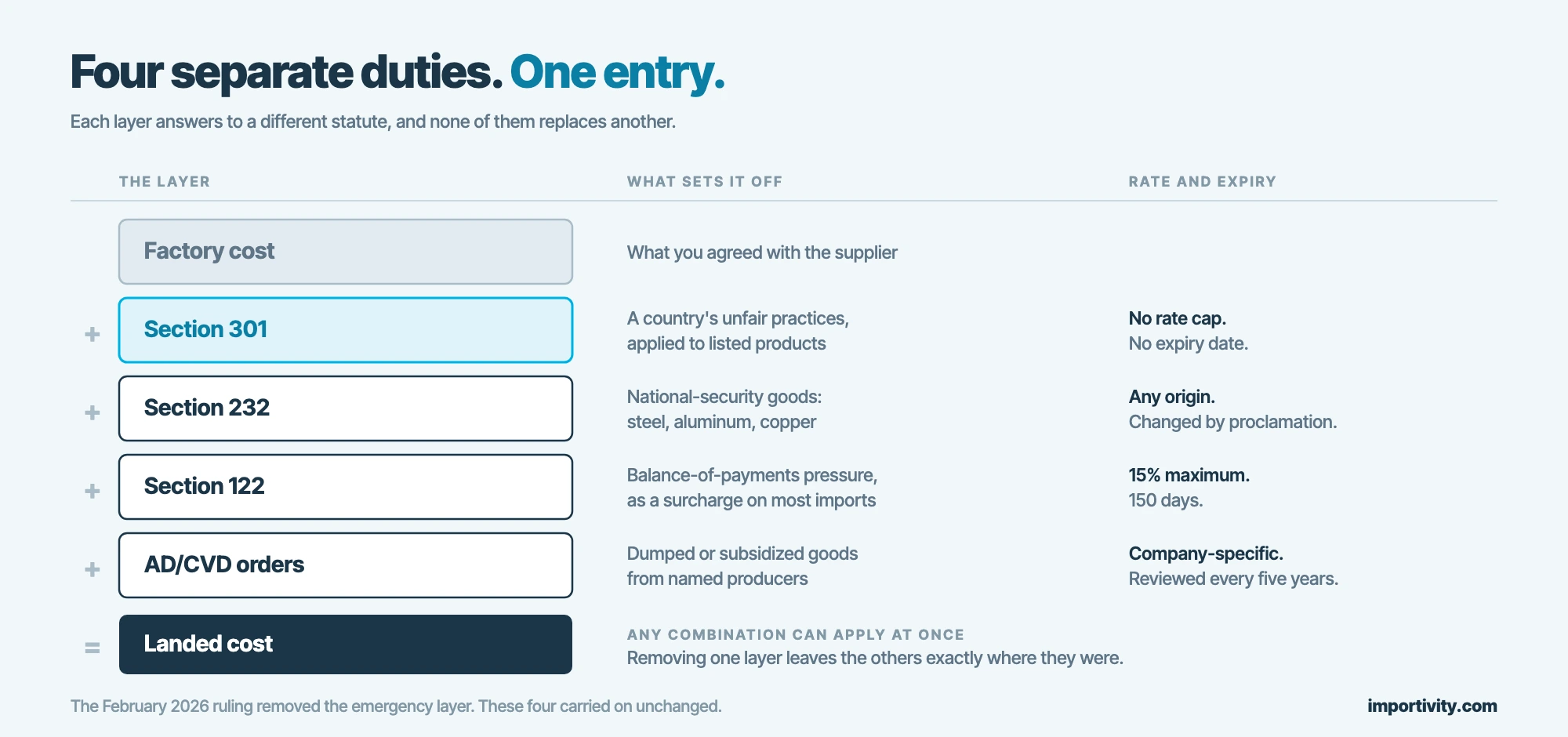
| Authority | What it targets | Rate shape | Expiry |
|---|---|---|---|
| Section 301 (Trade Act of 1974) | Unfair practices by a specific country, applied to listed products | No statutory cap; set per action and product list | None built in; ends only when USTR modifies or terminates |
| Section 232 (Trade Expansion Act of 1962) | National-security risk in specific goods, notably steel, aluminum, and copper | Product-based, applied regardless of origin country | None; revised by proclamation |
| Section 122 (Trade Act of 1974) | Balance-of-payments pressure, applied as a flat surcharge on most imports | Statutory maximum of 15% | 150 days unless Congress extends it |
| AD/CVD orders | Dumped or subsidized goods from named producers | Company-specific, often far above any general tariff | Reviewed every five years |
Two practical consequences follow. Duties from different authorities can apply to the same entry, so a metal-intensive product from a Section 301 country can carry both a 301 rate and a Section 232 rate. And because each layer has its own legal basis, a court decision that removes one layer says nothing about the others. When the emergency tariffs were struck down, Section 232, Section 301, and antidumping orders all continued unchanged.
Which countries and products are exposed now
Section 301 used to be, for most importers, a China question. That changed in March 2026, when USTR opened two separate waves of investigations that between them reach most of the sourcing map.
- Structural excess capacity, 16 economies. China, the EU, Japan, Mexico, Vietnam, India, Korea, Taiwan, Singapore, Switzerland, Norway, Indonesia, Malaysia, Cambodia, Thailand, and Bangladesh, focused on steel, aluminum, autos, batteries, semiconductors, chemicals, and electronics. Details are in our summary of the 16-economy overcapacity investigations.
- Forced-labor import bans, 60 economies. A parallel track covering countries that have not imposed and enforced bans on goods made with forced labor, including allies with existing trade agreements. See the 60-economy forced-labor investigations.
The second track is the one most sourcing teams underestimate, because it prices a country's enforcement record rather than its factories. Sri Lanka's reported tariff reduction from 12.5% to 10% after adopting an import ban on forced-labor goods is the clearest signal of how that lever is meant to work. If your diversification plan assumed that moving out of China moves you out of Section 301, both waves say otherwise. What to do about the labor side specifically is covered in our guide to forced labor import compliance.
How to check your own exposure before the next order
Exposure is calculated entry by entry, not company by company. Run this before you commit to a purchase order, not after the goods are on the water:
- Confirm the HTS code at the 10-digit level. Section 301 lists are published by 8-digit subheading, so a neighboring code can carry a completely different rate. If classification is shaky, get it right first with our HTS classification guide, or request a binding ruling.
- Establish the true country of origin. Origin follows substantial transformation, not the shipping address or the address on the invoice. Final assembly in a third country does not change origin on its own.
- Check for an applicable exclusion. Exclusions are product-specific and time-limited, and they are keyed to precise product descriptions rather than to your supplier.
- Look for stacked layers. Metals content, AD/CVD orders on the same product from the same country, and any current general surcharge all sit on top.
- Recalculate landed cost, not unit cost. Duty applies to the declared customs value, so freight terms and assists change the number. Our landed cost formula and the landed cost calculator handle the arithmetic.
The levers that actually reduce a Section 301 bill
There are five responses that survive an audit, and a long tail of ideas that do not. The real ones, roughly in order of how quickly they pay off:
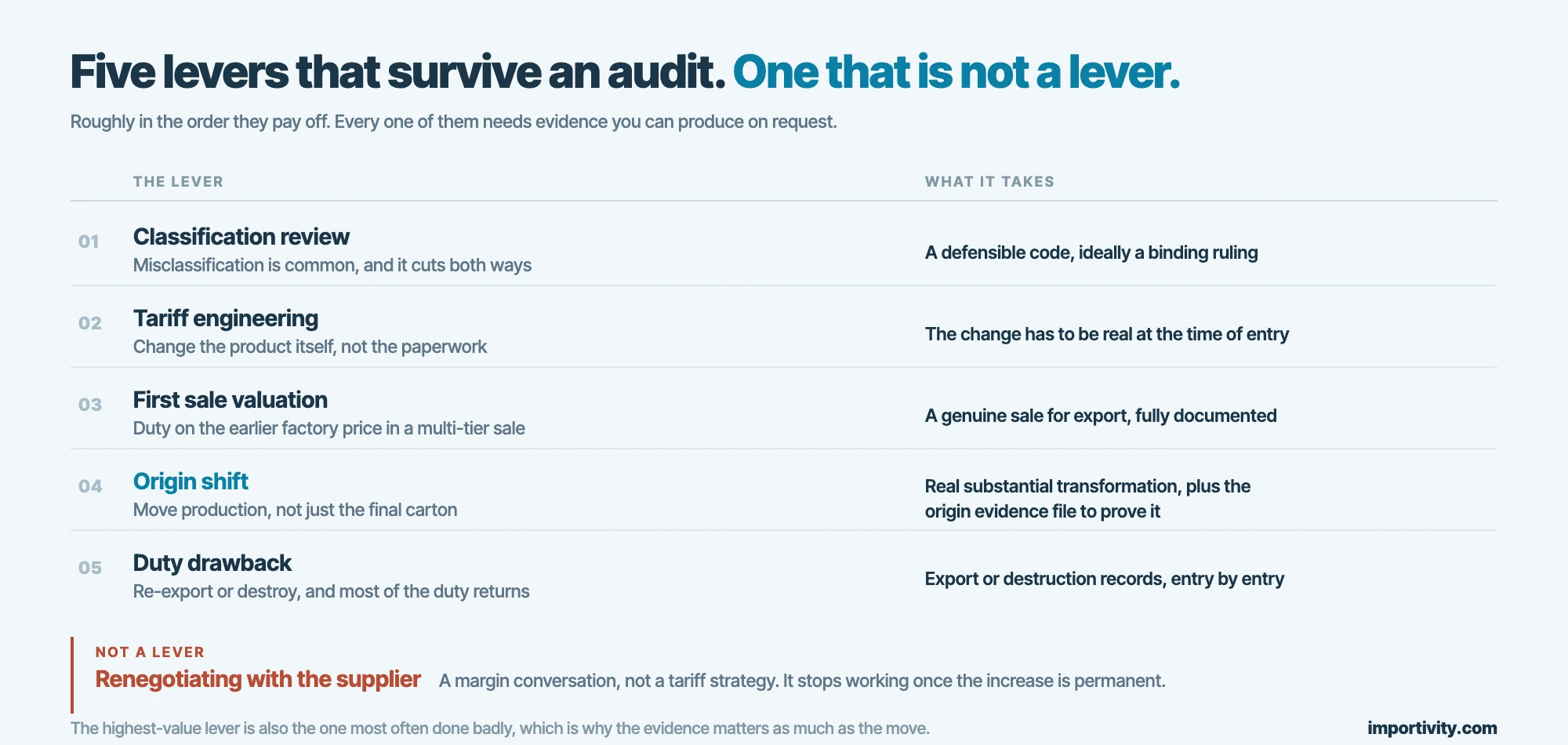
- Classification review. Misclassification is common and it cuts both ways. A defensible reclassification supported by a binding ruling can move a product off a list entirely.
- Tariff engineering. Changing the product itself, not the paperwork, so it legitimately classifies elsewhere. A different material, a different state of assembly at import, or a different packaged configuration can all be lawful. The change has to be real at the time of entry.
- First sale valuation. Duty is owed on the customs value, and in a multi-tier transaction the earlier factory price can sometimes be the dutiable value. It requires documentation discipline and a genuine sale for export.
- Origin shift with real substantial transformation. Moving production, not just the final carton. This is the highest-value lever and the one most often done badly, which is why the origin evidence file matters as much as the move.
- Duty recovery programs. If you re-export or destroy imported goods, drawback can return most of the duty paid. See duty drawback explained.
Renegotiating with the supplier belongs on the list too, but be honest about what it achieves. A factory splitting the increase with you is a margin conversation, not a tariff strategy, and it usually stops working once the increase is permanent. Our tariff mitigation strategies resource lays out the full set with the documentation each one needs.
Most importers do not run these levers in house. If you are weighing who to bring in, our guide to what firms provide tariff consulting compares the four provider types on cost, scope, speed, and conflicts of interest.
What not to assume
Three assumptions cause the most expensive mistakes. First, that a favorable court ruling on one tariff authority applies to Section 301. It does not, and the refund mechanics are entirely separate, which we cover in Section 301 tariff refunds. Second, that an exclusion once granted keeps applying. Exclusions lapse, and entries after the lapse date owe the full rate. Third, that a supplier's assurance about origin is evidence. When CBP asks, the burden is on the importer of record to prove it, with production records rather than a declaration on letterhead.
The safest planning posture is to treat current Section 301 rates as durable, model a second scenario at a higher rate for products inside an open investigation, and keep the origin and classification evidence for every SKU where it can be produced within a day. Nothing about that plan gets wasted if rates fall.
For a worked example of what this costs once the duty actually lands, see our case study on scaling a US gum manufacturer through the 2025 tariff debacle, and Source With Jordan for the sourcing decisions behind it.
Frequently Asked Questions
What are Section 301 tariffs in simple terms?
They are extra duties the U.S. applies to imports from a country whose trade practices USTR has investigated and found unfair. The tariff attaches to specific product lists for that country, so two shipments from the same factory can carry different rates depending on their HTS codes.
How much are Section 301 tariffs?
There is no fixed number. The long-standing China lists run from 7.5% to 25% depending on the list and product, and the statute sets no ceiling, so newer actions can be set higher. Always confirm the rate against your own 10-digit HTS code and origin rather than a headline percentage.
Do Section 301 tariffs apply to countries other than China?
Yes. Section 301 applies to whichever country USTR has investigated. In March 2026 USTR opened investigations covering 16 economies over excess manufacturing capacity and a further 60 over forced-labor import enforcement, so the authority now reaches most major sourcing countries rather than China alone.
Can I avoid Section 301 tariffs by shipping through another country?
No. Origin is determined by substantial transformation, not by the last port of departure. Repacking, labeling, or light finishing in a third country leaves the original origin intact, and treating it otherwise is transshipment, which carries penalties well beyond the duty saved.
Are Section 301 tariffs refundable?
Only through specific routes, and not simply because the tariffs are being challenged. Refunds can follow a granted product exclusion, a successful protest, or a drawback claim on re-exported goods. Litigation over Section 301 could eventually create a refund path, but nothing is owed to importers until a court orders it.
About the author
Jordan Lewis
Chief Operating Officer, Importivity
Runs Importivity's sourcing operations across China, Vietnam, Mexico and India, from supplier negotiation through landed delivery.
Press and media inquiries: press@importivity.com