AQL Sampling Explained and What AQL 2.5 Level II Means for Your Order

AQL sampling is the rule an inspector uses to decide whether a whole lot ships based on a sample pulled from it. "AQL 2.5 level II" means two things: level II fixes the sample size from your lot size, so a 5,000 unit order gives a sample of 200, and AQL 2.5 fixes the accept and reject numbers for that sample, which are 10 and 11 for major defects. Find 10 or fewer majors in the 200 units and the lot passes. Find 11 and it fails. The tables come from ANSI/ASQ Z1.4 and ISO 2859-1, and every third-party inspection firm in Asia uses them.
This guide is for importers who have been quoted an AQL inspection, or been told a shipment "passed AQL" and want to know how much comfort that gives. It works one lot through the tables, explains the three defect classes, shows what the plan lets through, and ends with the clause for the purchase order. If you are still choosing where in production to inspect, our note on quality control when working with factories in China covers the timing.
What AQL is and what it is not
AQL stands for acceptance quality limit. ISO 2859-1 defines it as the worst tolerable process average when a continuing series of lots is submitted for sampling. Two ideas in that sentence get missed. The number describes the factory's process over many lots, not the lot in front of you, and the plan is built so a process running at the AQL is accepted almost every time while a much worse process is rejected often enough that the factory feels it.
What AQL is not is a measurement of your lot. A 200 piece sample cannot tell you the defect rate of 5,000 units to a decimal place. It can only tell you whether the count stayed under a line. The line comes from a neutral published standard rather than an argument on the day, but it is a pass or fail gate, not an audit. The US edition is ANSI/ASQ Z1.4-2003, reaffirmed in 2018; the international edition is ISO 2859-1:1999 with a 2011 amendment, and the tables are identical.
How a 5,000 unit lot becomes a 200 piece sample
The lookup has two mechanical steps. Find the lot quantity in the sample size code letter table and read across to your inspection level. For 3,201 to 10,000 units at general level II the code letter is L. The second table turns L into a sample size of 200 and lists the accept and reject numbers for every AQL. At AQL 2.5 the pair is 10 and 11. At AQL 4.0 it is 14 and 15. At AQL 1.0 it is 5 and 6.
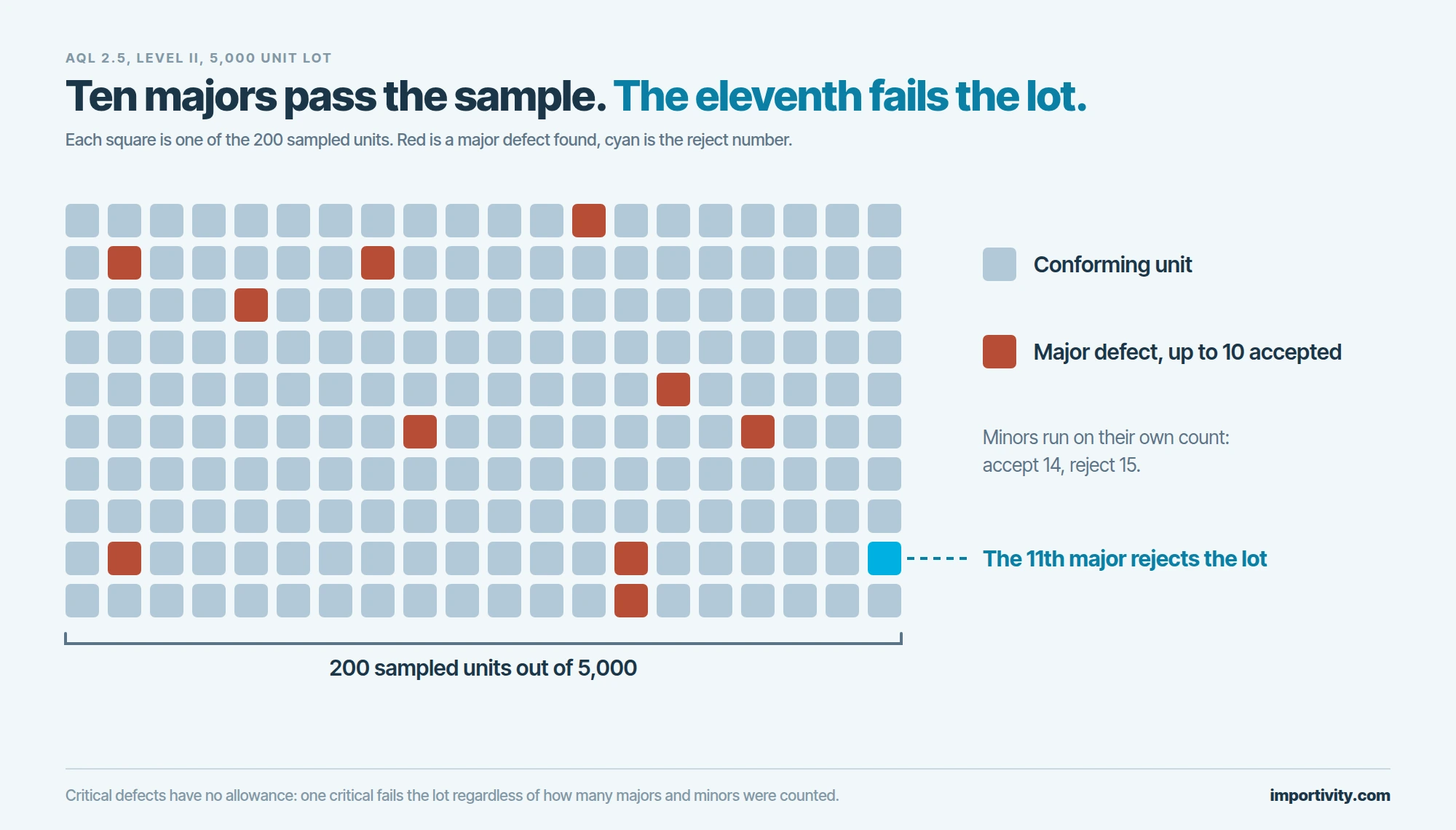
The other 4,800 units are never touched, and the same row shows what the other levels do with the lot. Level I gives code letter J and a sample of 80, with accept 5 and reject 6 at AQL 2.5. Level III gives code letter M and a sample of 315, with accept 14 and reject 15. The special levels S-1 to S-4 give 5, 8, 20 and 32 units for tests that destroy the unit or take a long time.
| Inspection level | Sample from a 5,000 unit lot | Use it when |
|---|---|---|
| General level I | 80 units, accept 5 and reject 6 at AQL 2.5 | Low value goods or a supplier with several clean lots behind them |
| General level II | 200 units, accept 10 and reject 11 at AQL 2.5 | The default for consumer goods, and what every inspection firm assumes unless you say otherwise |
| General level III | 315 units, accept 14 and reject 15 at AQL 2.5 | First order with a new factory, high value or safety related goods, or the lot after a failure |
| Special level S-3 | 20 units | Slow checks such as a function test on every port of a device or a seam strength pull |
| Special level S-2 | 8 units | Destructive tests such as drop tests and carton crush tests, where every unit tested is a unit you cannot sell |
Reading critical, major and minor with their accept numbers
The usual consumer goods plan is written "0 / 2.5 / 4.0", meaning AQL 0 for critical defects, 2.5 for majors and 4.0 for minors. Each class gets its own accept number from the same sample: in the 200 unit example majors are accepted up to 10 and minors up to 14, while one critical fails the lot. The inspector counts each unit once, at its worst defect, so a unit with a major and two minors is one major.
- Critical. The unit is unsafe or illegal to sell: exposed live parts, a sharp edge on a children's product, a missing mandatory marking. AQL 0, and the finding usually triggers a 100 percent screen at the factory's cost.
- Major. The unit does not do its job or a customer would return it: a jammed zipper, a leaking seal, a wrong color, a scratch on a face surface. AQL 2.5 for most consumer products, 1.5 or 1.0 for higher value goods and anything sold with a warranty.
- Minor. A flaw the customer would likely accept: a loose thread inside a seam, a faint mark on a hidden surface, a print slightly off register on the inner carton. AQL 4.0 is the norm, relaxed to 6.5 by many buyers on low value items.
The classification is the part you control and where most disputes start. "Scratch" means nothing until the PO says which surfaces count, how long a scratch has to be and from what distance it is judged. Write the defect list with photographs of the approved sample and of each boundary case, and the inspector can apply it without calling you from the factory floor.
What AQL 2.5 does not promise
Every sampling plan has an operating characteristic curve, which gives the probability that a lot is accepted at each possible true defect rate, and almost nobody shows it to importers. For the 200 piece plan with accept number 10, a lot that is truly 2.5 percent defective is accepted about 99 percent of the time. A lot that is 4 percent defective is still accepted about 82 percent of the time. A 5 percent lot passes about 58 percent of the time. Only at 8 percent does the acceptance chance fall to about 7 percent. Those figures follow from the binomial distribution.
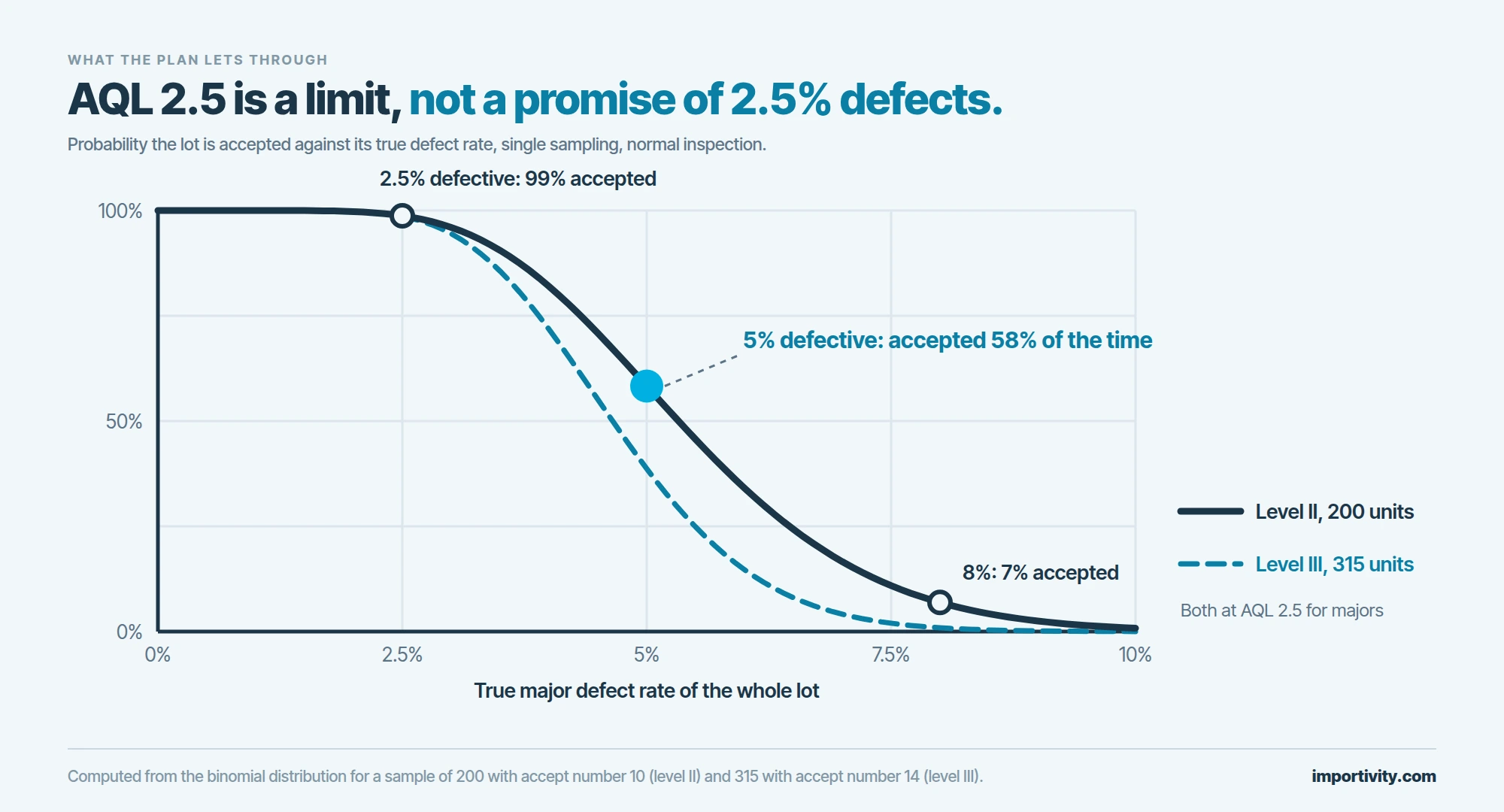
So "passed AQL 2.5" means the lot is very unlikely to be worse than 8 percent defective on majors and is probably under 5 percent. It does not mean 2.5 percent. If your product cannot tolerate a 1 in 20 failure rate, change the plan rather than arguing about the sample. Level III with its 315 unit sample drops the acceptance chance for a 5 percent lot to about 39 percent, and AQL 1.5 on the same 200 units drops the accept number to 7. Both cost more inspection time and both are cheaper than a container of returns.
The other lever is where the sample comes from. The standard assumes a random sample from a finished, packed lot. A sample the factory pre-selects, or an inspection booked at 60 percent packed, is not the plan you paid for and the curve no longer applies. Insist on at least 80 percent packed, and have the inspector pick cartons across the lot by carton number, not from the pallet nearest the door.
When to tighten and when to relax
The standard has switching rules built in: normal inspection moves to tightened when two of the last five lots have been rejected, returns to normal after five consecutive passes under the tighter plan, and reduced inspection is allowed only after ten consecutive acceptances. Few importers run the rules formally, but the logic is right: a failure buys more scrutiny on the next lot and a clean run earns a smaller sample.
In practice a first order deserves level III or a lower AQL for majors, because you have no history and the factory has every incentive to ship. A product that failed last time is re-inspected at level III, paid for by the factory, until it passes twice. A stable product with a clean run can drop to level I, with the saving spent on an in-production visit instead. Our guide to the quality control mistakes that cost importers money covers the timing of those visits.
Where the product is new tooling or a new construction, the final random inspection is the wrong first gate. Approve a pre-production sample, then run a first article inspection on the first units off the line against the drawing. A first article catches a wrong dimension when 20 units exist; AQL catches it when 5,000 do.
How to write the AQL plan into the PO and the booking
The plan only protects you if it is written in two places: the purchase order the factory signed and the booking the inspection firm works from. If they disagree, the factory argues for whichever is looser. The clause needs all of the following.
- The standard and the plan. "Final random inspection to ANSI/ASQ Z1.4, single sampling, normal inspection, general level II" or the level you chose.
- The lot definition. PO number, SKUs and quantity, with the rule that the lot is 100 percent produced and at least 80 percent packed before the inspector is called.
- The three AQLs. Critical 0, major 2.5, minor 4.0, or your own figures, per SKU where they differ.
- The defect list. Classified, with photographs of the approved sample and the boundary cases, referenced by document number so it can change without rewriting the PO.
- The on-site tests. Which functional, dimensional and packaging checks run at S-2 or S-3, and what "pass" means for each.
- What a failure triggers. Rework at the factory's cost, re-inspection at level III with the factory paying the second man-day, and no shipment without your written release.
- Who receives the report. You, directly from the inspection firm, the same day, never through the factory.
Put the same clause on the factory visit checklist you use for your own audits, so the supplier hears one standard from every direction. A factory that has seen the defect list before production starts is a factory that builds to it.
What the inspection costs and who should run it
Third-party inspection is priced by the man-day: one inspector on site for eight hours, the sampling and tests in your plan, and a written report with photographs, normally within 24 hours. In 2026 a standard accredited agency in China charges about $250 to $300 per man-day for consumer goods, budget domestic firms advertise from about $150 to $200, and the large international certification groups charge $500 or more for specialized or regulated work. Travel, overtime and laboratory tests are billed on top.
The sample size drives the man-days. One inspector can check up to about 200 simple units in a day but only around 50 units of a complex electronic product, so the lot above is one man-day for a cotton tote and two or three for a Bluetooth speaker. A re-inspection is a second booking at the same rate, so the PO should say the factory pays for it. On a $50,000 order, a $300 inspection that stops a 5 percent defective lot leaving the factory is cheap insurance.
Who runs the inspection matters more than who is cheapest. The inspector needs your defect list, an approved sample, and instructions to pick cartons across the lot. Setting the plan, briefing the inspector and reading the report is where our quality control service sits. Jordan runs it from Guangzhou and Ho Chi Minh City, so a failed lot gets a person at the factory the same week rather than an email chain, and you can see how he handles one on Source with Jordan.
Frequently Asked Questions
What does AQL 2.5 level II actually mean?
It names two choices from the ANSI/ASQ Z1.4 and ISO 2859-1 tables. Level II sets the sample size from your lot size, so a 5,000 unit lot gives a sample of 200. AQL 2.5 then sets the accept and reject numbers for that sample, 10 and 11 for major defects. Ten or fewer majors and the lot passes; eleven and it fails.
How do I find the AQL sample size for my order?
Find the lot quantity in the sample size code letter table, read across to your inspection level, and take the code letter to the second table. At general level II the common results are 50 units for lots of 281 to 500, 80 for 501 to 1,200, 125 for 1,201 to 3,200, 200 for 3,201 to 10,000 and 315 for 10,001 to 35,000.
Does AQL 2.5 guarantee that no more than 2.5 percent of my goods are defective?
No. It is a lot acceptance rule with a known error rate. For a 200 piece sample with an accept number of 10, a lot that is truly 2.5 percent defective is accepted about 99 percent of the time, but a 5 percent defective lot still passes about 58 percent of the time. If that risk is too high, move to level III or a lower AQL.
What is the difference between critical, major and minor defects in AQL?
A critical defect makes the product unsafe or non-compliant, so its AQL is normally 0 and a single one fails the lot. A major defect stops the product doing its job or would make a customer return it, usually AQL 2.5. A minor defect is a cosmetic flaw the customer would tolerate, usually AQL 4.0. Each unit is counted once at its worst defect.
When should I use inspection level III instead of level II?
Use level III for a first order with a new factory, for a product where a failure is expensive to recover from, for goods with a return history, and after any lot has failed. On a 5,000 unit lot it raises the sample from 200 to 315 and cuts the chance of accepting a 5 percent defective lot from about 58 percent to about 39 percent.
About the author
Jordan Lewis
Chief Operating Officer, Importivity
Runs Importivity's sourcing operations across China, Vietnam, Mexico and India, from supplier negotiation through landed delivery.
Press and media inquiries: press@importivity.com