Bill of Lading Explained With Types, Format and an Example
A bill of lading is the document an ocean carrier, or a forwarder acting as a carrier, issues when it takes your goods: it is the receipt for the cargo, the evidence of the contract to carry it, and, as an original, the document that decides who can collect the cargo at the destination port. For a US importer, two things on it matter most: the consignee, and whether the bill is an original, a telex release or a sea waybill, because together they decide who gets the goods and how fast.
This guide is for US brands buying from factories in China, Vietnam, India or Mexico who get a draft bill from a supplier or freight forwarder and need to know what they are approving. It walks through an annotated example of the format and ends with a checklist for the draft bill.
What a bill of lading does
Britannia P&I, a shipowners' liability insurer, lists three jobs in its guidance to ship masters. The US Carriage of Goods by Sea Act (COGSA), which covers carriage of goods by sea to or from US ports in foreign trade, sets the rules for the first one:
- Receipt for the cargo. Under COGSA section 3, the carrier must, on the shipper's demand, issue a bill showing the leading marks, the number of packages or the quantity or weight, and the apparent order and condition of the goods. That bill is prima facie evidence that the carrier received the goods as described.
- Evidence of the contract of carriage. Receivers and banks who were not party to the original deal rely on the bill to show what was agreed.
- Document of title. The carrier should deliver only to the person who presents an original bill, unless the bill was surrendered at origin or a waybill was used. Whoever holds the original controls the cargo.
Once the goods are loaded, the shipper can demand a shipped bill stating they are on board. Letters of credit check that date against the latest shipment date, and payment terms such as 60 days after B/L date count from it.
The receipt has a limit. The carrier records what a non-expert can see from the outside, the condition of the packages and not the quality of the product. For a sealed container, CBP's manifest rule accepts the shipper's declared description and weight, and the manifest can mark it SLAC, for shipper's load and count. A clean bill on a full container records that the container was in apparent good order, not that the right cartons are inside. That is the job of a pre-shipment inspection.
Master bill vs house bill of lading
Many shipments carry two bills. The ocean carrier, which operates the ship, issues the master bill. A non-vessel operating common carrier (NVOCC) issues a house bill. The Federal Maritime Commission describes an NVOCC as a carrier that issues its own house bill of lading, does not operate the vessels it uses, and is a shipper in its relationship with the ocean carrier. A forwarder that issues its own bill is acting as an NVOCC. The drawing below shows how the two bills sit on one shipment.
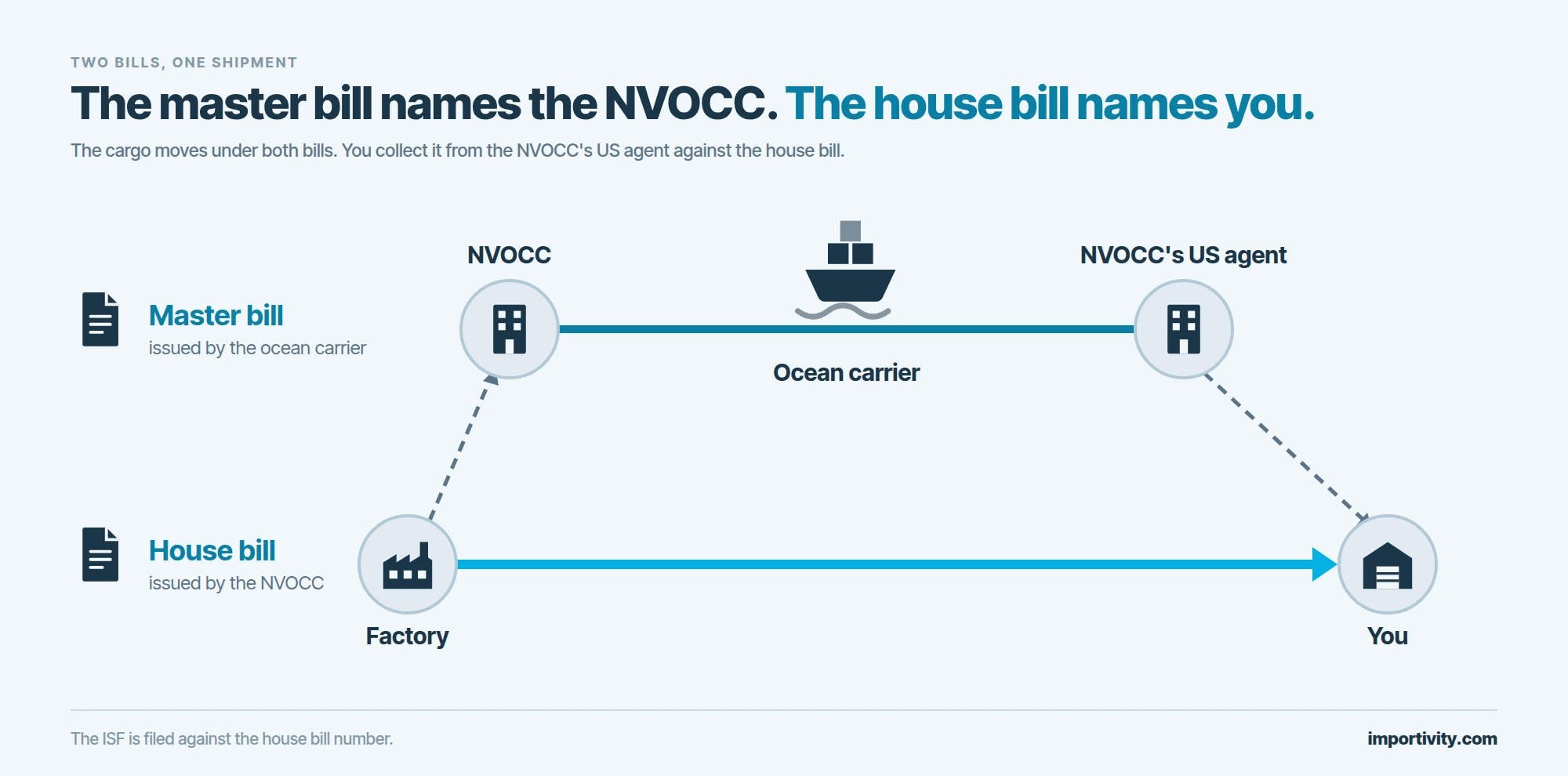
On the master bill for consolidated cargo, the NVOCC is the shipper and its US agent is the consignee, which CBP's manifest rule, 19 CFR 4.7a, allows. The house bill must name the real parties. The shipper is the foreign vendor, supplier or manufacturer, never the NVOCC or forwarder, and the consignee is the party receiving the cargo in the United States.
So you take delivery from the NVOCC's US agent, and the house bill is the one that matters to you. The Importer Security Filing is filed against the house bill number, as our ISF 10+2 guide explains. Every bill number starts with the issuer's four-character Standard Carrier Alpha Code (SCAC), followed by up to 12 letters or digits, so the prefix tells you who issued it.
Original bill, telex release or sea waybill
The bill type decides what must happen before the cargo is released at the US port.
- Original bill of lading. Originals are usually issued as a set of three, according to the ITIC cargo release guidelines, and one is surrendered at destination to take delivery. If the shipper keeps the set until you pay, it controls the cargo until then.
- Telex release, or surrendered bill. The shipper hands the originals back to the carrier at origin, and the carrier tells its destination office to release without one. The ICC Banking Commission's Briefing No. 17 of 27 January 2026 notes that surrendered is a status of the original, not a separate document, and that once one original is surrendered the carrier treats the rest as void.
- Sea waybill. Not a document of title. The consignee takes delivery without producing an original.
- Air waybill. Under the Montreal Convention it is made out in three original parts and is prima facie evidence of the contract and of the carrier's acceptance of the cargo. The consignee is entitled to delivery on arrival once charges are paid.
Original bills come in two forms. A straight bill is consigned to a named party, not to order, and is non-negotiable. A to order bill is transferred by endorsement, and the releasing agent checks that the shipper or bank has endorsed it to the party collecting the cargo.
| Document | What releases the cargo | When it fits |
|---|---|---|
| Original bill, to order | One original, endorsed over to you | Letters of credit, or cargo that may be resold in transit |
| Original straight bill | One original, presented by the named consignee | Paper control of release, no resale in transit |
| Telex release | The carrier's release instruction after surrender at origin | Balance paid before arrival, or originals would arrive late |
| Sea waybill | Delivery to the named consignee, no original | Prepaid orders from suppliers you know |
| Air waybill | Delivery to the named consignee once charges are paid | Air freight |
The words vary. TT Club, a transport insurer, notes that express bill is sometimes used for a sea waybill and advises against the term express release, while the ITIC guidelines use express bills for bills surrendered at the load port. Ask which document you are getting. Late changes cost money: Maersk announced a fee, effective 1 November 2022, for switching from an original bill to a waybill after the original has been issued.
Bill of lading format, field by field
Layouts differ between carriers, but the boxes are the same, because most of them feed the cargo manifest the carrier sends to CBP. The example below shows a typical format: the parties at the top, the voyage in the middle, the cargo grid underneath.
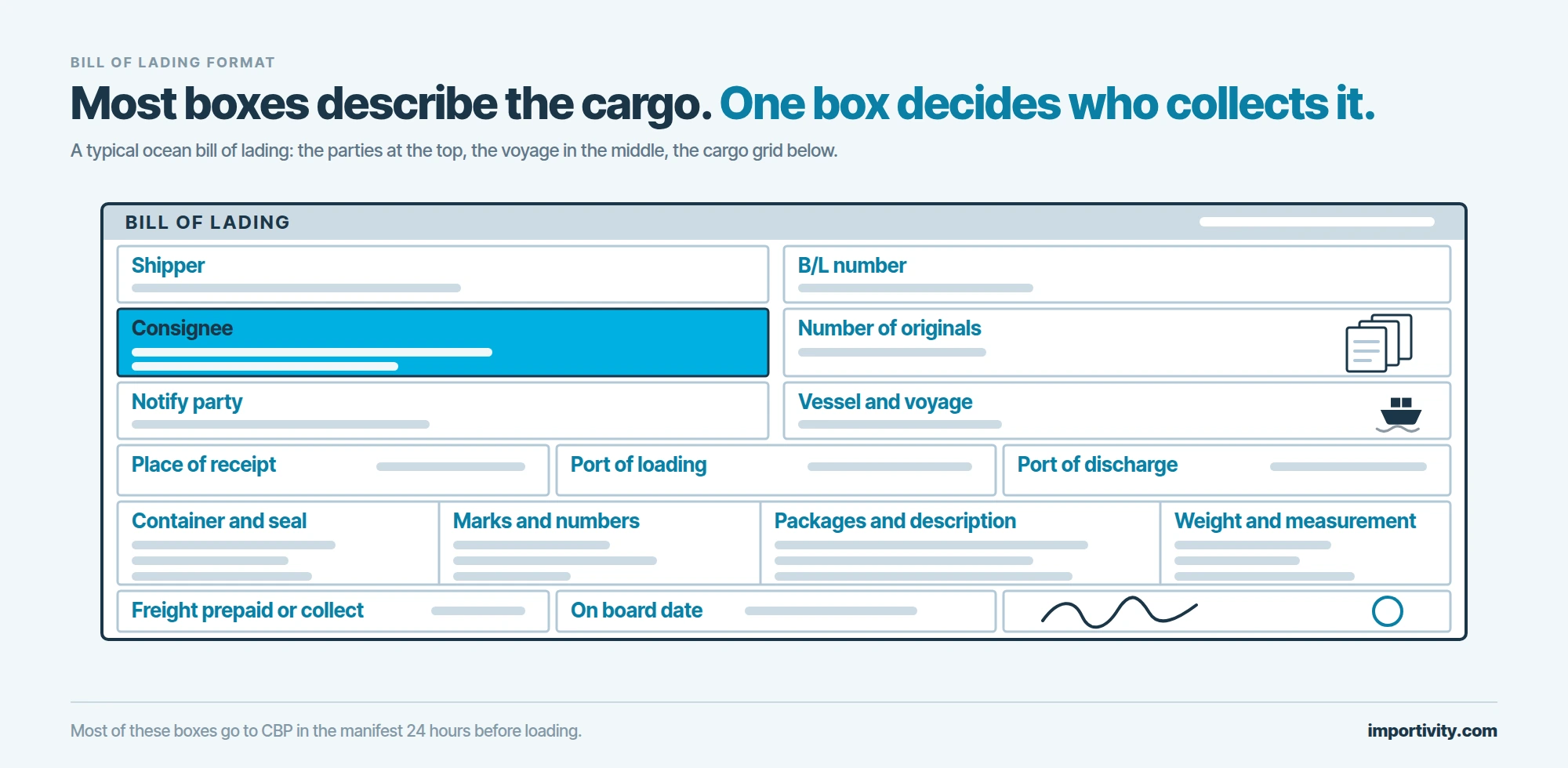
What each box holds, and what CBP's manifest rule asks of it:
- Shipper. The seller. On a house bill, the foreign vendor or manufacturer, not the forwarder.
- Consignee. The party the cargo is delivered to, or "to order of" a named party. Use your exact legal name. It is a delivery instruction, not the same role as the importer of record.
- Notify party. Who gets the arrival notice, usually you or your customs broker.
- B/L number and number of originals. The number with its SCAC prefix, and how many originals were issued, usually three.
- Vessel and voyage, and the ports. The ship and voyage, the place of receipt where the carrier takes the cargo, the port of loading and the US port of discharge.
- Container and seal. Each container number with its seal number.
- Marks and numbers. The carton marks, as in our guide to shipping marks and carton labels.
- Packages and description. The count of the lowest outer unit and a precise description, or the six-digit HTS number. In CBP's example, 10 pallets with 200 cartons are manifested as 200 cartons. FAK (freight of all kinds), general cargo and STC (said to contain) are not acceptable.
- Weight and measurement. Gross weight and volume, equal to the packing list totals.
- Freight prepaid or collect. Paid at origin, or due from the consignee. Releasing agents check that charges due are paid before issuing a delivery order.
- On board date. When the goods were loaded, with the place and date of issue and the signature.
A bill with no remarks is a clean bill. A claused bill carries written remarks on the condition of the cargo or packaging at loading, such as wet, torn or leaking cartons. The Swedish Club, a P&I insurer, notes that a letter of credit may require clean bills and that the seller may not get paid if they are claused. For you, a remark is a record that the damage happened before loading, which you can take up with your supplier before you pay the balance.
Who issues the bill of lading, and when
The carrier or its agent issues the bill at the shipper's request, and an NVOCC issues its own house bill. The shipper, normally your factory, supplies the data:
- Shipping instructions. The shipper sends parties, cargo, marks, weights and bill type before the carrier's cutoff. Ocean Network Express (ONE) lists a late SI submission fee of CNY 200 per bill in its Fujian export tariff, updated 25 June 2026.
- Draft bill. Maersk calls it the Verify Copy, a PDF the shipper approves or amends, with a new copy after each amendment.
- Manifest to CBP. The carrier, or an NVOCC filing its own data, must transmit it 24 hours before the cargo is loaded at the foreign port.
- Final bill. Issued after loading, with the on board date. ONE's Fujian tariff lists a documentation fee of CNY 450 per bill.
- Release. Originals are couriered to you or your bank, or surrendered at origin. A sea waybill needs no original at all.
The draft stage is your window, so ask to see the draft before the shipper approves it, and fix errors before the bill is issued and the manifest is filed. For changes after that, the same ONE tariff lists CNY 200 per bill for a bill amendment and USD 40 per bill for an advance manifest amendment to North America.
This is one reason it matters who books the freight. Jordan Lewis, Importivity's COO, calls letting the factory handle shipping the biggest mistake people make when shipping overseas, because "you'll have zero communication with the people actually clearing your goods through customs" (watch his short). If you buy FOB and book your own forwarder, you can ask that forwarder for the draft house bill before it is issued.
How to check a draft bill of lading
Check the draft against your purchase order, the commercial invoice, the packing list and your ISF data:
- Consignee is your exact legal name and address, or the exact wording your letter of credit asks for.
- Notify party is you or your customs broker, with contact details someone answers.
- Shipper on a house bill is the seller, not the forwarder.
- Bill type and number of originals are what you agreed.
- Description is specific and matches the commercial invoice.
- Package count, weight and volume equal the packing list totals, counted in cartons.
- Marks and numbers match your carton spec.
- Container and seal numbers match the loading photos or inspection report.
- Freight prepaid or collect matches your Incoterm.
- On board date falls inside the ship window in your purchase order or letter of credit.
- Remarks are absent. If the bill is claused, ask why before you pay.
Common bill of lading mistakes and what they cost
- The wrong consignee. A misspelled name, or the forwarder named instead of you, means an amendment at the fees above. Under a letter of credit it is a discrepancy, which can hold up payment, as our letters of credit guide explains.
- A description that does not match the invoice or ISF. 19 CFR 4.7a makes carriers and importers responsible for reconciling differences between the manifest and the entry. A carrier that fails to send required manifest data, or sends false data, can be liable for civil penalties plus $5,000 in damages under its carrier bond for each violation. Build the bill, the commercial invoice and the packing list from one carton list.
- A claused bill under a letter of credit. If the credit calls for a clean bill, a claused one can stop the supplier's payment and hold up your documents.
- Originals that arrive after the ship. Without an original or a release, the cargo waits at the terminal until free time ends and demurrage starts. If you pay the balance before arrival, agree a telex release or sea waybill at booking.
- Paying against a copy and nothing else. When you pay against a copy of the bill, ask for the originals or the telex release in the same message. Until then, the shipper controls the cargo.
Importivity's shipping and logistics team can check a draft bill against your invoice and ISF data before the cargo loads. To start, send us your product and order details.
Frequently Asked Questions
What is a bill of lading in simple terms?
A bill of lading is the document a carrier issues when it receives your goods for shipment. It is a receipt for the cargo, evidence of the contract of carriage and, as an original, a document of title, so the person holding an original can collect the cargo. The ocean carrier or an NVOCC issues it from details the shipper supplies.
Who prepares the bill of lading, the shipper or the carrier?
The shipper, usually the factory or its forwarder, sends the carrier shipping instructions with every detail that will go on the bill. The carrier, or an NVOCC for a house bill, turns them into a draft for approval and issues the final bill after the goods are loaded. As the buyer, ask to see the draft before the shipper approves it.
What is a telex release on a bill of lading?
A telex release means the shipper has handed the original bills back to the carrier at origin, and the carrier has told its destination office to release the cargo without an original. The remaining originals are then void. Importers use it when the balance is paid before arrival or when couriered originals would reach the US after the ship.
Is an air waybill the same as a bill of lading?
No. Under the Montreal Convention an air waybill is made out in three original parts and is evidence of the contract and of the carrier's acceptance of the cargo, but the consignee named on it is entitled to the goods on arrival once charges are paid. An original ocean bill of lading controls delivery, because the cargo is released only against an original or a release instruction.
What does a clean bill of lading mean?
A clean bill of lading carries no remarks about the condition of the cargo or its packaging at loading. A claused bill has written remarks, such as wet or torn cartons, and a letter of credit that calls for clean bills may then not pay the supplier. On a sealed container the carrier cannot see the cartons, so a clean bill does not confirm what is inside.
About the author
Jordan Lewis
Chief Operating Officer, Importivity
Runs Importivity's sourcing operations across China, Vietnam, Mexico and India, from supplier negotiation through landed delivery.
Press and media inquiries: press@importivity.com