What Is a Tech Pack (With a Template and a Filled T-Shirt Example)

A tech pack is the file a factory builds your product from: flat sketches, a bill of materials, a graded measurement chart with tolerances, construction details, colors, artwork, labels and packing instructions for one style, under one style number and revision date. The factory quotes from it, makes the samples from it, and the inspector measures your bulk order against it.
This guide is for brands sending a first garment to a factory. It goes through every page, gives a filled measurement spec for a crew neck T-shirt that you can copy into a spreadsheet, and covers who makes tech packs, what they cost and the gaps that lead to bad samples. If you have not picked a factory yet, start with our guide to finding a private label clothing manufacturer.
What a tech pack is and what it is not
A tech pack, short for technical package, is the written specification for one style. Apparel brands use the term most, but bag, shoe and home textile factories work from the same kind of file. It should answer every question a pattern maker would ask you, in numbers and short phrases that still mean the same thing after translation, so the factory can make the first sample without emailing you.
- It is not a pattern. The pattern is the set of pieces the cutter lays on the fabric. A pattern maker drafts it from your tech pack, often at the factory as part of sampling.
- It is not a reference garment. A shirt you like helps only if the tech pack says what to copy from it, such as the fit, and what to change.
- It contains the bill of materials. The BOM is one page inside it. Our bill of materials template shows the columns, and a garment BOM applies them to fabric, rib, thread, labels and packing.
When your manufacturing purchase order names the tech pack revision the factory accepted, the measurement chart and its tolerances become the standard the order is judged against.
Every page in a tech pack (a template you can copy)
Give each section below its own page or spreadsheet tab. The fields after each label are the template: copy them, fill them in, and send a PDF with the spreadsheet attached so the factory can copy measurements without retyping them.
Download the tech pack template
- Excel (.xlsx): one sheet per page, and the size chart grades every size from the sample size. It also opens in Google Sheets.
- Word (.docx): a clean form to type into.
- PDF: to print and fill in by hand.
The file has the eight pages below, plus the testing page and the comments page, which share page 9. The Excel file has a filled-in example for the crew neck T-shirt in the next section.
- 1. Cover page. Brand, style number, style name, season, revision number and date, size range, sample size, fabric summary, colorways, target quantity, target price, contact, change log.
- 2. Flat sketches. Front, back and close-up views in black line, drawn to proportion, with a callout at every seam, trim and label. No model, no shading.
- 3. Bill of materials. One row per material: placement, description, fiber composition, weight (GSM for knits), construction, width, color for each colorway, quantity per garment, unit, and who supplies it. Thread, labels, hangtag and polybag each get a row.
- 4. Measurement spec and grading. Each point of measure with a code letter, how to measure it, the value in every size, the grade between sizes and the tolerance. State the unit and whether values are taken flat.
- 5. Construction details. Seam and stitch type at each seam, stitches per inch, seam allowance, hem widths and how the neck rib is joined. Stitch types are numbered in ASTM D6193 and ISO 4915, which use the same numbers. A T-shirt might call for stitch 514, a four-thread overedge (overlock) stitch, on the side seams and stitch 406, a two-needle bottom coverstitch, on the hems.
- 6. Colorways. A Pantone TCX number or physical standard for every component in each colorway, and which approved lab dip is the bulk standard.
- 7. Artwork and labels. Print or embroidery method, artwork file, artwork size for each garment size, and placement measured from a fixed point such as the high point shoulder (HPS). Each label drawn to scale with its exact text and position.
- 8. Packaging. Fold method, polybag size and warning text, size sticker, units and size ratio per carton, and carton marks. Our guide to shipping marks and carton labels lists what the carton needs.
Add a testing page that names what the bulk must pass, for example shrinkage under AATCC TM150, the test method for dimensional change of garments after home laundering. Add a comments page that logs each sample round: date, measured value at each point, your comment and the fix agreed.
For goods sold in the US, the label must carry what the FTC requires under the Textile Act: fiber content by generic name and percentage, the country of origin, and the maker or seller's name or RN number. A garment with a neck shows the country of origin at the inside center of the neck, midway between the shoulder seams, or next to another label there. Stated fiber percentages may be off by up to 3%, and the Care Labeling Rule adds a permanent care label. The FTC guide Threading Your Way Through the Labeling Requirements has worked examples.
Tech pack example: a measurement spec for a crew neck T-shirt
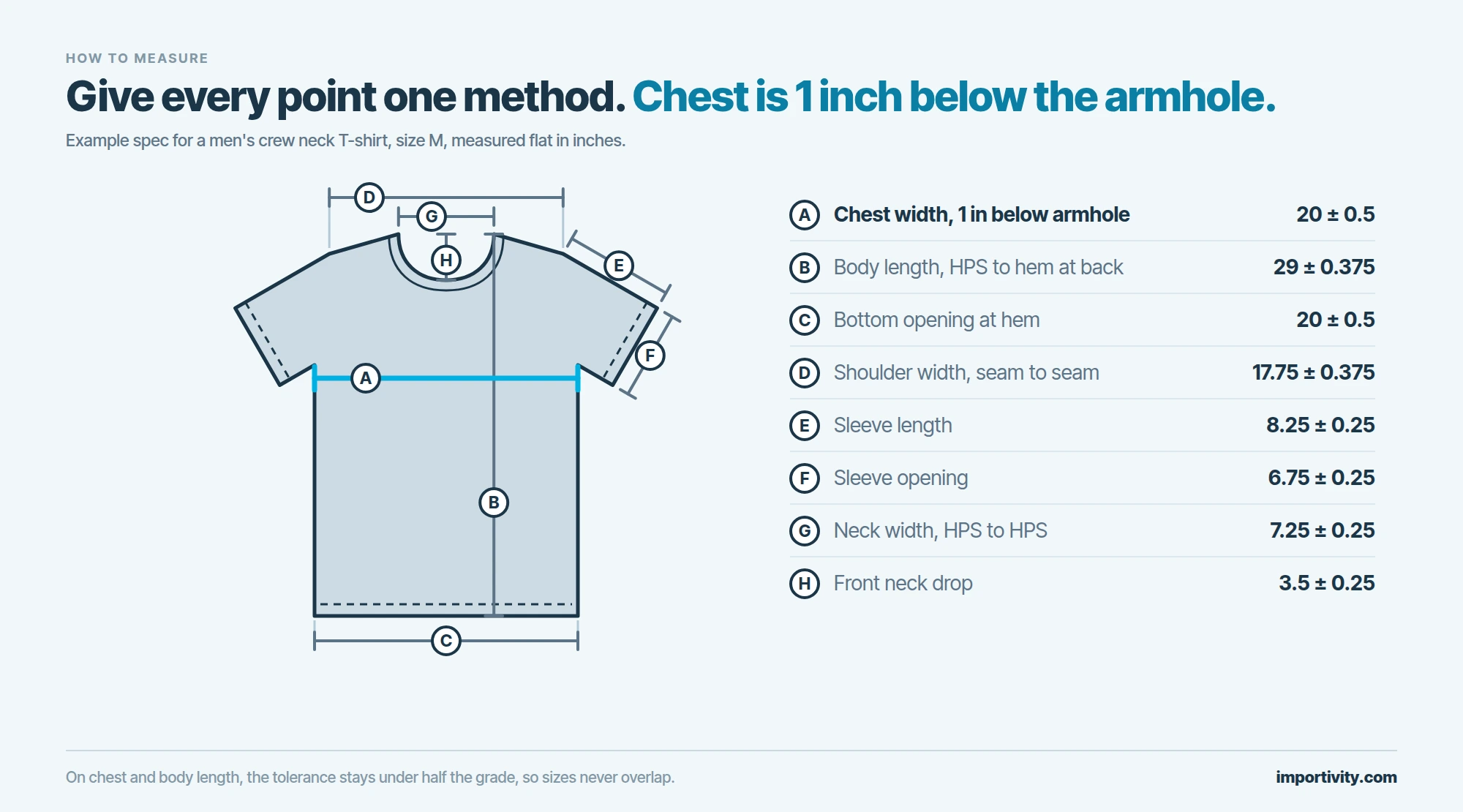
The pattern maker, the sewing line and the inspector all work from the measurement page, so finish it first. The example below is a men's regular fit crew neck T-shirt in 180 GSM cotton jersey, measured flat in inches, with M as the sample size. The drawing shows where each point of measure sits.
| Point of measure (how to measure) | S | M | L | XL | Grade | Tol. +/- |
|---|---|---|---|---|---|---|
| A. Chest width, 1 in below armhole | 18.5 | 20 | 21.5 | 23 | 1.5 | 0.5 |
| B. Body length, HPS to hem at back | 28 | 29 | 30 | 31 | 1 | 0.375 |
| C. Bottom opening, edge to edge at hem | 18.5 | 20 | 21.5 | 23 | 1.5 | 0.5 |
| D. Shoulder width, seam to seam | 17 | 17.75 | 18.5 | 19.25 | 0.75 | 0.375 |
| E. Sleeve length, shoulder seam to hem | 8 | 8.25 | 8.5 | 8.75 | 0.25 | 0.25 |
| F. Sleeve opening, flat at hem | 6.5 | 6.75 | 7 | 7.25 | 0.25 | 0.25 |
| G. Neck width, HPS to HPS | 7 | 7.25 | 7.5 | 7.75 | 0.25 | 0.25 |
| H. Front neck drop, HPS line to seam | 3.25 | 3.5 | 3.75 | 4 | 0.25 | 0.25 |
The grade is the step between sizes. Chest grades 1.5 inches per size, so the full chest around the body grows 3 inches. Body length grades 1 inch, and small points such as the neck grade 0.25 inch. Points that do not change by size still go on the chart with a grade of 0, such as a 0.75 inch neck rib height.
The tolerance is how far a finished garment may measure above or below spec and still pass. On chest and body length, keep it under half the grade. With a 1.5 inch chest grade and a 0.5 inch tolerance, an M passes from 19.5 to 20.5 and an L from 21 to 22, so one shirt can never pass as both sizes. In the example, the 0.25 inch points carry a tolerance equal to their grade, because chest and length are what tell the sizes apart. Gildan's published spec sheet for its 64000 blank tee allows plus or minus 1 inch on chest and body length with a 2 inch chest grade, so its sizes can meet at the edges. That is acceptable for a blank sold in volume. A brand that sells on fit usually needs the tighter tolerance.
Also say whether the chart is the size before or after washing, because cotton jersey shrinks and the factory has to cut bigger to reach a washed spec. If the factory works in centimeters, say which unit governs.
Who makes a tech pack and what it costs
- A freelance technical designer. Guru's pricing guide puts a standard tech pack from a US designer at $500 to $2,000, or about 5 to 20 hours of work. OnBrand, a fashion PLM software company, gave a range of $100 to more than $1,200 per style in January 2026, with simple garments near the bottom. At the low end, check whether grading and tolerances are included before you buy.
- A product development studio. Studios draft the tech pack, make the first pattern and often the first sample. Ask in writing whether you receive the pattern files.
- The factory. Full package factories often build the spec from your sketch and a reference garment. It is fast, but the spec stays in the factory's format, which makes a move to a second factory harder.
- You, with the template above. A spreadsheet plus flats drawn in a vector program is enough for a simple knit. Software such as Techpacker adds page layouts and revision history.
Judge the price against sampling. Each blank field is a question the factory answers with a guess, and a wrong guess costs a sample round: the fee, the courier and weeks of waiting. Our guide to Vietnam clothing suppliers shows how long sample rounds take there.
How a factory uses a tech pack to quote and sample
A factory prices your tech pack page by page. The merchandiser sends each page to the department that will do the work, and each department returns a cost.
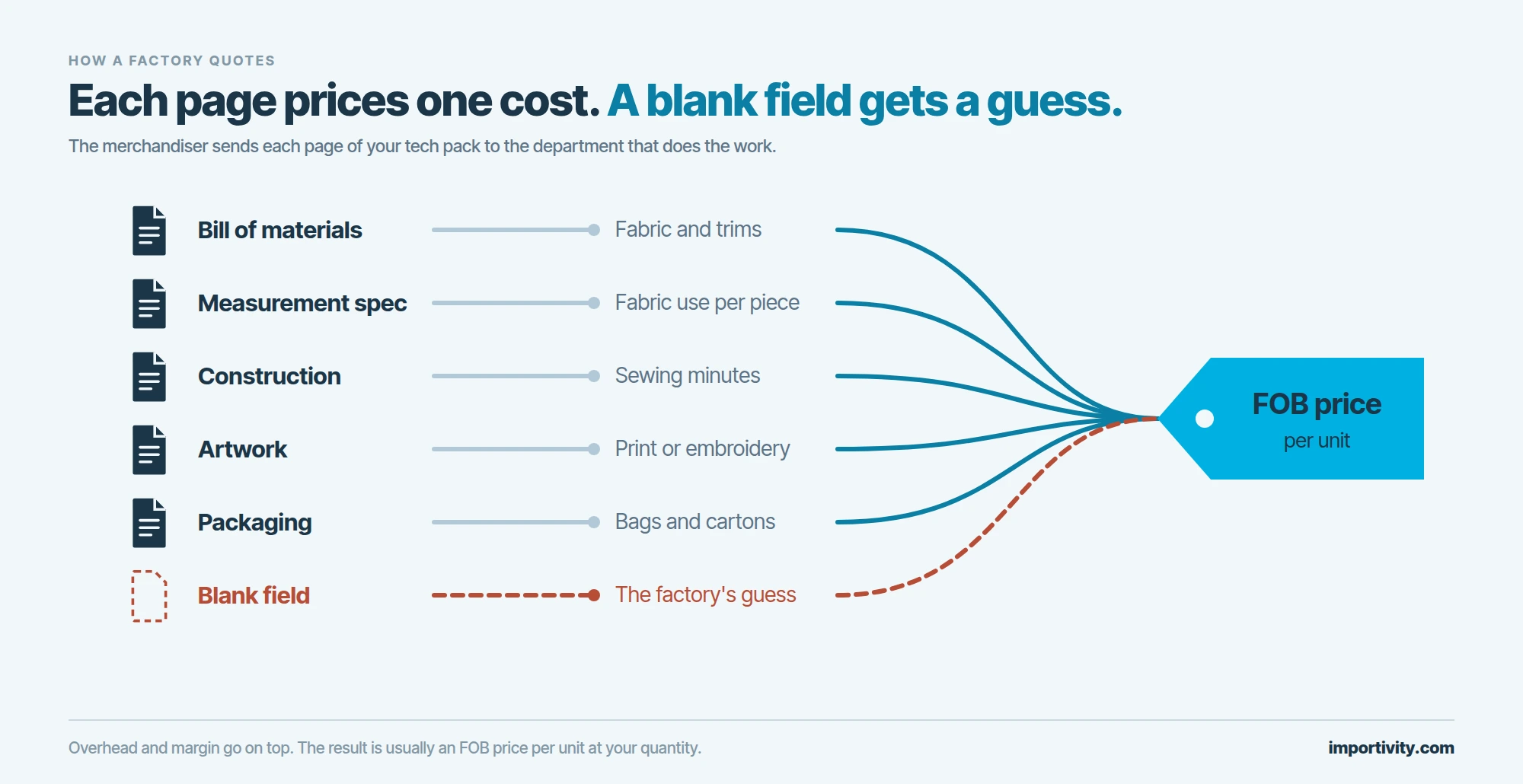
- Bill of materials. Fabric and trims are priced line by line at the quantity per garment.
- Measurement spec. The pattern room works out fabric use per piece across your size range, often in kilos per dozen for knits.
- Construction. The factory estimates sewing minutes from the seams and stitches, then multiplies them by its labor cost per minute.
- Artwork. Method, number of colors and print size set the print or embroidery cost.
- Packaging. Bags and cartons, plus the labor to fold and pack.
Overhead and margin go on top, and the result is usually an FOB price per unit at your quantity. A blank field does not drop a cost from the quote. The factory fills it with its own guess, one you did not choose. Colorways also set minimums, because knit fabric is dyed in lots and each color can carry its own fabric minimum. Send the same tech pack and quantities to every factory, as our manufacturing RFQ guide shows, so you can compare the quotes.
Sampling then works from the tech pack. You measure the first sample against the chart and reply by point of measure: "B body length 29.75, spec 29, tolerance 0.375, shorten by 0.75." Each round updates the revision number. The approved pre-production sample and its revision become the bulk standard, as our pre-production sample guide explains.
Tech pack mistakes that cause bad samples
- Numbers without a method. "Chest 20" can mean flat at the underarm, flat 1 inch below it, or around the body. Write the method next to every point.
- No tolerance. Every miss turns into an argument, and the factory falls back on its own house tolerances.
- Color by name. "Navy" covers dozens of shades. Give a Pantone TCX number, such as 19-4052 TCX, and approve a lab dip on the real fabric under a named light source such as D65.
- Fabric described by feel. "Soft heavyweight cotton" can be quoted several ways. Write 100% combed cotton single jersey at 180 GSM.
- Only the sample size. If you leave grading to the factory, its grade rules decide how your XL fits.
- Print placement with no fixed point. "Centered on chest" lands in different spots on an S and an XL. Measure from the HPS and list the print width for each size.
- Old revisions in circulation. If the factory sampled from revision 2 while you edited revision 4, your comments describe a different garment.
An inspector can only reject what the tech pack defines, so the chart you write now becomes the checklist for quality control at the end of production.
Checklist before you send a tech pack to a factory
- Style number and revision on every page and in the file name.
- Every point of measure has a method, a value for each size, a grade and a tolerance.
- Every BOM row has composition, weight, color per colorway, quantity and supplier.
- Every color has a Pantone number or a physical standard.
- Labels cover fiber content, country of origin, your name or RN number, and care.
- Files attached: the PDF, the spreadsheet and vector artwork at print size.
If you want factories that already make your garment to quote on it, send us the tech pack and your order details. We find and vet factories, then check samples and bulk against your chart.
Frequently Asked Questions
What is a tech pack in fashion?
A tech pack is the technical specification for one garment style. It holds flat sketches, a bill of materials, a graded measurement chart with tolerances, construction details, colors, artwork, labels and packing instructions. The factory uses it to quote, to make the pattern and samples, and later to inspect the bulk order.
How much does it cost to make a tech pack?
Guru's pricing guide puts a standard tech pack from a US freelance designer at $500 to $2,000, or about 5 to 20 hours of work. OnBrand, a PLM software company, gave a range of $100 to more than $1,200 per style in January 2026. Simple knits sit at the low end. With a cheap gig, check that grading and tolerances are included.
Can I make my own tech pack?
Yes, for a simple garment. Use a tech pack template: build the bill of materials and graded measurement chart in a spreadsheet, draw front and back flats in a vector program, and add pages for construction, colors, labels and packing. Give every measurement a method and a tolerance, and put a style number and revision date on each page.
Do clothing manufacturers require a tech pack?
Most factories that make custom garments ask for one before they give a firm quote, because they price fabric, sewing time and trims from it. Some full package factories will build the spec from a sketch and a reference garment, but the spec then stays in their format. Without a tech pack, expect quotes you cannot compare and more sample rounds.
What is the difference between a tech pack and a spec sheet?
A spec sheet usually means the measurement page alone: points of measure, values by size and tolerances. A tech pack contains the spec sheet plus the sketches, bill of materials, construction, colorways, artwork, labels and packing. For hard goods, a product specification sheet plays a similar role, listing dimensions, materials, tests and inspection criteria.
About the author
Jordan Lewis
Chief Operating Officer, Importivity
Runs Importivity's sourcing operations across China, Vietnam, Mexico and India, from supplier negotiation through landed delivery.
Press and media inquiries: press@importivity.com