Commercial Invoice Template (Word, Excel, Google Sheets)

This commercial invoice template is free, needs no sign-up, and comes as an Excel file, a Word file and a PDF. A commercial invoice is the seller's record of a completed sale, and US Customs and Border Protection (CBP) uses it when the goods are entered into the United States.
Download the template
- Excel (.xlsx): the totals work themselves out. It also opens in Google Sheets.
- Word (.docx): a clean form to type into.
- PDF: to print and fill in by hand.
This page is for the person who has to send or check a commercial invoice today: a first-time importer, a small exporter, or the operations person at a brand. Many of the fields follow 19 CFR 141.86, the US regulation on what an invoice must contain. Our guide to the proforma invoice and the commercial invoice explains how the two differ, so this page stays on the form. It explains a document and is not legal or customs advice. Ask a customs broker to confirm anything you are unsure about.
What the commercial invoice template includes
The form is one US Letter page in portrait. From top to bottom it has four parts: the top of the form (the parties, the sale and the shipment), eight line items, the charges and totals, and a one-sentence declaration with signature boxes.
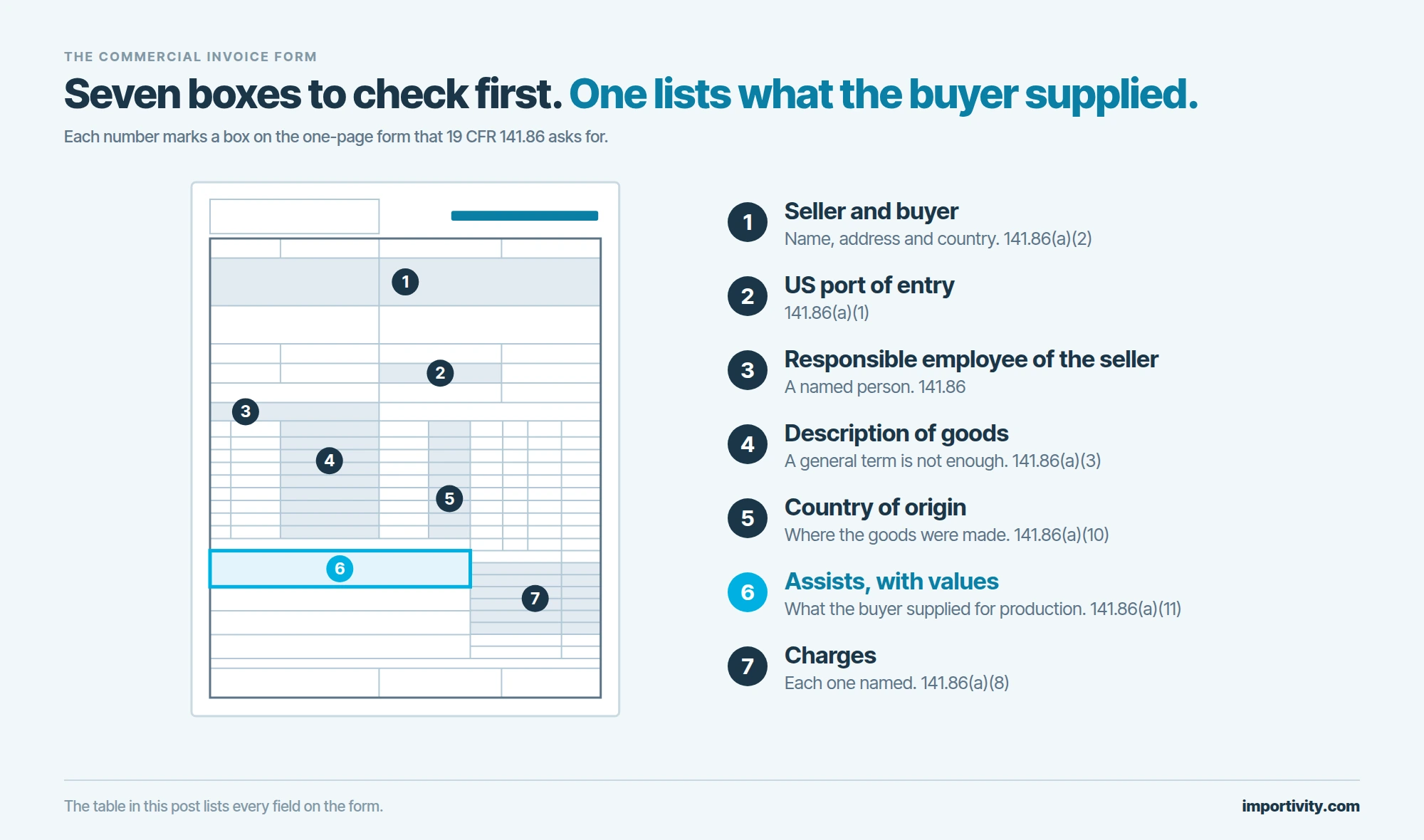
The picture marks seven boxes to check first on an invoice a supplier sends you. 19 CFR 141.86 asks for each one. Check the assists box closely. It lists what the buyer supplied for production, with values the seller may not have unless the buyer sends them.
The Excel file has three sheets: Commercial invoice, How to fill it in, and Example. You type in the shaded cells, and formulas work out each Line total, the Total quantity, the Subtotal and the Invoice total. The file uses basic formulas such as SUM and IF that Google Sheets also has. To use it there, upload the file to Google Drive and open it with Sheets. The Word and PDF files hold the blank form on page 1 and the how-to notes on pages 2 and 3, with the totals left blank to fill in by hand.
How to fill in a commercial invoice, field by field
The seller fills in the commercial invoice after the sale and sends it with the shipment. The table lists every field in the order it appears on the form. Where the last column starts with 141.86, that regulation asks for the field, and a number such as 141.86(a)(2) names the paragraph. The other fields are common trade practice.
| Field | What to write | Rule or reason |
|---|---|---|
| Top of the form | ||
| Your logo or company name | The seller's logo or company name. | The seller issues the invoice. |
| Invoice number, Invoice date | The seller's own invoice number and the date of issue. | The packing list carries the same number. |
| Purchase order number | The buyer's PO number. | Matches the invoice to the order. |
| Page | For example 1 of 2. | 141.86: number the pages consecutively. |
| Seller (name, address, country), Buyer (name, address, country) | Full legal name, street address and country of each. | 141.86(a)(2) |
| Manufacturer or shipper, if not the seller | Name and address, only when another company made or shipped the goods. | Trade practice |
| Consignee (ship to), if not the buyer | Only when the goods go to someone else, such as a warehouse or 3PL. | Trade practice |
| Date of sale, Place of sale | The date the sale was agreed, usually the date the seller accepted the purchase order, and the city and country of the sale, usually the seller's city. | 141.86(a)(2) |
| Terms of sale (Incoterms 2020), Payment terms | For example FOB Shenzhen, Incoterms 2020, then how and when the buyer pays, for example 30% deposit, 70% before shipment. | The term decides which charges the seller bills. |
| Country of export, Port of loading | The country the goods ship from and the port or airport where they are loaded. | Trade practice |
| US port of entry | For example Long Beach, CA. | 141.86(a)(1) |
| Currency of sale | For example USD. Every amount on the invoice is in this currency. | 141.86(a)(5) and (a)(7) |
| Carrier and vessel or flight, Bill of lading or air waybill number | The shipping line and vessel or the airline and flight, then the transport document number if it has been issued. | Trade practice |
| Total packages and gross weight | For the whole shipment, for example 250 cartons, 2,400 kg. | Both must match the packing list. |
| Responsible employee of the seller (name and title), That person's phone and email | A named person at the seller who knows this sale or can get the facts, with a phone number and email. | 141.86. A general sales address is not enough. |
| Line items | ||
| Line, Marks and numbers | The line number, then the marks and carton numbers on the packages that hold this line, for example EXB EB-PO-1001, cartons 1 to 150. | 141.86(a)(3) for the marks |
| Description of goods | The name the item is known by, its grade or quality, its material and its model number. | 141.86(a)(3). A general term like plastic parts is not enough. |
| HTS code | The 10-digit US tariff number the importer uses. | The invoice rule does not require it, but the customs broker needs it. |
| Country of origin | Where the goods were made, which is not always the country they ship from. | 141.86(a)(10) |
| Quantity, Unit | The number of units and the unit of count, for example pcs, sets, kg or m. | 141.86(a)(4) |
| Unit price | The price of one unit in the currency of sale. | 141.86(a)(5) |
| Line total, Total quantity | Quantity x unit price, then the sum of the quantity column. | Excel formula |
| Charges and totals | ||
| Goods or services the buyer supplied for production (assists), with values | Tooling, molds, dies, materials, or engineering and design work done outside the US that the buyer gave the factory free or at a reduced price, each with its value. Write None if there are none. | 141.86(a)(11) |
| Charges already included in the unit prices | Any packing, container or inland freight cost already inside the unit prices. It then needs no separate amount. | 141.86(a)(8) |
| Discounts, rebates, drawbacks and bounties | Every discount from the list price by class of goods, and any rebate, drawback or bounty allowed on export, each with its amount. Write None if there are none. | 141.86, including (a)(9) |
| Notes | The name of any other charge, and anything else the buyer or the customs broker asked for. | Trade practice |
| Subtotal | The sum of the line totals. | Excel formula |
| Packing, Inland freight to the port of export, International freight, Insurance, Commission, Other charges | The amount billed for each, if it is not already in the unit prices. Freight and insurance apply only if the seller pays them under the terms of sale. | 141.86(a)(8) |
| Less discount, Invoice total | The discount taken off this invoice, typed as a positive number, then the subtotal plus the charges, minus the discount. | Excel formula for the total |
| Declaration | ||
| Declaration, Name and title, Signature, Date | Leave the declaration as printed. The person who signs for the seller adds a name and title, signs by hand or signs and stamps, and writes the date. | Trade practice |
One rule in the same section has no box of its own. Under 19 CFR 141.86(d), the invoice and its attachments must be in English or have an accurate English translation attached.
A filled-in commercial invoice example
The Example sheet in the Excel file shows one made-up order: 5,000 insulated tumblers sold by a factory in Shenzhen, China, to a brand in Austin, Texas. Every company, person and number on it is invented.
- Invoice. Number EM-INV-2026-0088, dated Sep 22, 2026, for purchase order EB-PO-1001. Terms of sale FOB Shenzhen, Incoterms 2020. Currency of sale USD.
- Line 1. Marks EXB, EB-PO-1001, C/NO. 1-150. Vacuum insulated tumbler, 20 oz, 18/8 stainless steel, double wall, black powder coat, with press fit plastic lid, model TMB-20-BLK. 3,000 pcs at 4.20 gives a line total of 12,600.00.
- Line 2. Marks EXB, EB-PO-1001, C/NO. 151-250. The same tumbler with a white powder coat, model TMB-20-WHT. 2,000 pcs at 4.20 gives 8,400.00.
- Totals. Total quantity 5,000. Total packages and gross weight: 250 cartons, 2,400 kg. Subtotal 21,000.00. No separate charge is billed, so the invoice total is also 21,000.00.
- Assists. "Lid mold supplied free by the buyer (bought from a toolmaker). Value USD 3,500.00, not in the unit prices."
- Charges already included in the unit prices. Packing and inland freight to Yantian port.
Three details are easy to miss. Both lines show HTS code 9617.00.1000 and country of origin China. The code is there only to show the 10-digit format and is not classification advice. Our guide to HTS codes covers classification. The terms are FOB, so the seller bills no international freight or insurance and those boxes stay empty. Our Incoterms guide shows which charges each term puts on the seller. The mold is listed although the factory did not bill it, because the rule asks for goods the buyer supplied for production.
Commercial invoice mistakes to check for before the goods ship
Check a supplier's draft for these six gaps. Each one leaves out something 19 CFR 141.86 asks for, or makes the invoice disagree with another document.
- A description that is too general. A term like plastic parts is not enough. Name the item, its grade or quality, its material and its model number.
- The country of export in the origin column. Country of origin is where the goods were made. Our guide to country of origin rules covers goods made in more than one country.
- Charges with no name. Each charge gets its own amount, or is named as already included in the unit prices.
- An empty assists box. If the buyer supplied nothing, the box says None.
- No named person. The rule asks for a responsible employee of the seller, and a general sales address is not enough.
- Totals that differ from the packing list. The invoice number, the package count and the gross weight are the same on both.
Where the commercial invoice sits among the other documents
The commercial invoice is one of several documents for the same shipment, and each has a different writer. Three of them share fields with it: the purchase order, the packing list and the bill of lading.
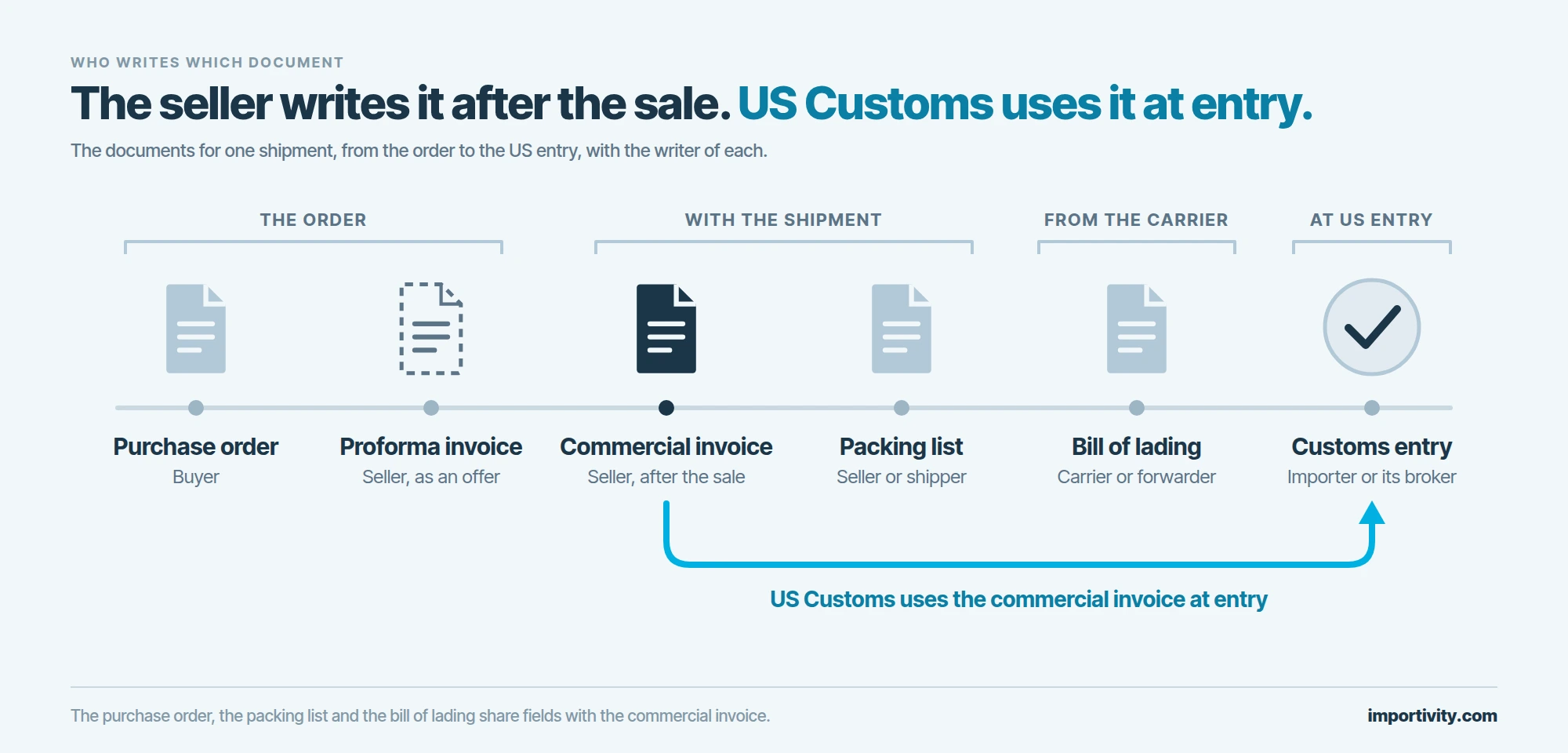
- Purchase order and proforma invoice. The buyer writes the purchase order. The seller writes the proforma invoice, its offer before the sale is final. The commercial invoice comes after the sale and carries the purchase order number.
- Packing list. The seller or shipper writes this carton-by-carton list. It travels with the invoice and shows the same invoice number, package count and gross weight.
- Bill of lading or air waybill. The carrier or forwarder issues it, and its number goes on the invoice once it exists.
- Customs entry. 19 CFR 142.3 lists a commercial invoice among the documents filed to enter goods, and a packing list where appropriate. The importer or its customs broker files the entry. Under 19 CFR 141.83(c)(2), CBP may accept a copy of the invoice in place of the original.
If the commercial invoice is not available at entry, CBP can accept a proforma invoice for a limited time. The guide linked at the top of this page covers the bond, the deadline and the penalties for a wrong invoice.
If a factory is making your order
The seller fills in this form, but CBP holds the importer responsible for what the entry says. Four steps make a correct invoice more likely.
- Send the template with the purchase order. Ask the factory to issue its invoice on this form, so the fields listed in the table above are there by default.
- Send the facts the factory may not have. The HTS code you use, the US port of entry, the consignee, and the value of any mold, material or design work you supplied.
- Ask for a draft before the goods ship. Check it against the purchase order: quantities, unit prices, the description and the terms of sale.
- Check the draft against the packing list. The invoice number, the package count and the gross weight must match.
Importivity helps US brands find and vet factories, run quality control, ship their goods and handle tariffs. If you want a product made, send us your product and order size. For the shipping and customs side of an order, see our import and export agency service.
Frequently Asked Questions
Who fills in a commercial invoice?
The seller, which on an import order is usually the factory or the exporter. It issues the invoice after the sale and sends it with the shipment. The buyer may need to send some facts first, such as the HTS code, the US port of entry and the value of anything it supplied for production.
Is a commercial invoice required by US Customs?
Yes. 19 CFR 142.3 lists a commercial invoice among the documents filed to enter goods, and a packing list where appropriate. CBP can accept a pro forma invoice in its place for a limited time when the commercial invoice is not available; our guide to the proforma and commercial invoice covers the bond and the deadline. 19 CFR 141.86 sets what the invoice must contain.
Does a commercial invoice need a signature?
Not under the invoice rule CBP applied in ruling H328583. In that ruling, dated December 14, 2023, CBP wrote that the invoice rules it was applying contain no signature requirement, and that a signature is required only on a pro forma invoice under 19 CFR 141.85. The template has a signature box, and its how-to notes ask the seller to sign.
What is the difference between a commercial invoice and a proforma invoice?
A proforma invoice is the seller's offer before the sale is final. The buyer uses it to approve an order, pay a deposit or open a letter of credit. A commercial invoice records the completed sale. The seller issues it after the sale, and it is the invoice US Customs uses at entry.
Can I use the commercial invoice template in Google Sheets?
The Excel file uses basic formulas such as SUM and IF that Google Sheets also has. To use it there, upload the .xlsx file to Google Drive and open it with Sheets. If you would rather type every number yourself, use the Word file or print the PDF.
About the author
Jordan Lewis
Chief Operating Officer, Importivity
Runs Importivity's sourcing operations across China, Vietnam, Mexico and India, from supplier negotiation through landed delivery.
Press and media inquiries: press@importivity.com