Where Is Louis Vuitton Made (Countries, Workshops and Date Codes)
Louis Vuitton makes its leather goods in its own workshops in France, Spain, the United States and Italy. Its shoes are made in Italy and its watches in Switzerland. LVMH, the group that owns the brand, counted 29 Louis Vuitton leather goods workshops in 2025: 18 in France, 4 in Spain, 4 in the United States and 3 in Italy.
This guide is for founders who want leather goods made and want to see how a brand that owns its workshops runs production. The figures come from LVMH's universal registration documents for 2025 and 2023, Louis Vuitton's customer FAQ pages as they read in November 2026, and a Reuters report from April 2025 on the Texas workshop. Many US handbag brands work the other way and buy from contract factories in Asia, as our guide to where Coach bags are made shows. Importivity is not affiliated with Louis Vuitton or LVMH.
Where Louis Vuitton bags are made (29 workshops in four countries)
Louis Vuitton bags, wallets and luggage come from workshops the company runs itself. LVMH's universal registration document for 2025, published on April 1, 2026, counts 29 Louis Vuitton leather goods workshops: 18 in France, 4 in Spain, 4 in the United States and 3 in Italy. It says these workshops make most of the brand's leather goods.
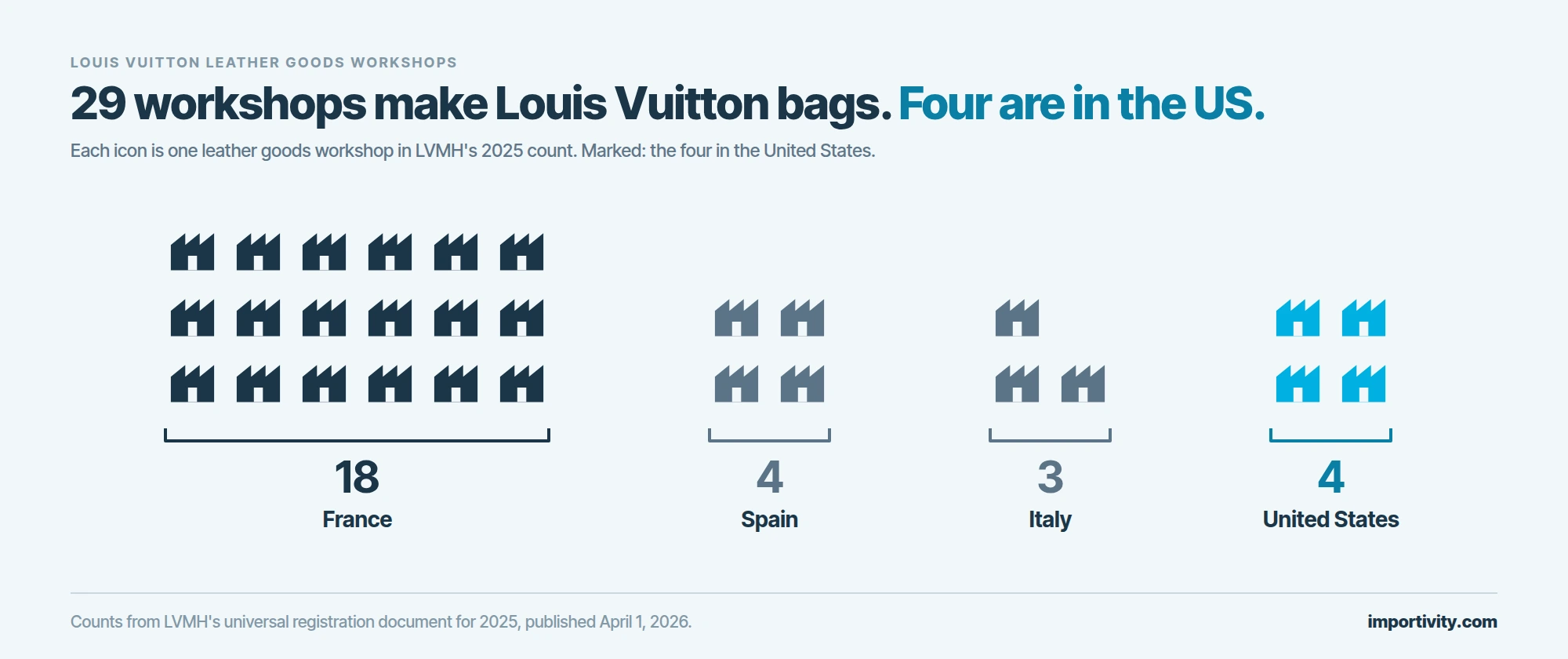
The count changes from year to year. The 2023 document listed 19 workshops in France, 4 in Spain, 3 in the United States and 2 in Italy, which is 28 in all. Two years later France had one fewer, and the United States and Italy each had one more.
Louis Vuitton does not make every piece in its own workshops. The 2023 document says the brand uses external manufacturers only to supplement its own production, and it does not name them. The same document's list of sites says most Louis Vuitton workshops are in France, with major ones near Barcelona in Spain, near Porto in Portugal, in Fiesso in Italy and in the United States. Portugal does not appear in the 2025 count of leather goods workshops or in Louis Vuitton's FAQ.
One workshop, in Asnières-sur-Seine near Paris, dates to 1859. It still makes rigid trunks and special orders.
Where Louis Vuitton shoes, clothes and watches are made
Louis Vuitton's customer FAQ says its products are made in France, Italy, Spain, Switzerland or the United States, depending on the category. The table lists each product line with its country and the source.
| Product line | Where it is made | Source |
|---|---|---|
| Leather goods (handbags, wallets, luggage) | France, Spain, the United States and Italy, in 29 company workshops | LVMH universal registration document for 2025, and the Louis Vuitton FAQ |
| Shoes | Italy, at the footwear workshop in Fiesso d'Artico near Venice | LVMH universal registration document for 2025, and LVMH's 2026 open-day listing |
| Ready-to-wear | France and Italy | Louis Vuitton FAQ |
| Watches | Switzerland, in the brand's watch workshops | Louis Vuitton FAQ |
| Extra capacity (products not stated) | External manufacturers that LVMH does not name | LVMH universal registration document for 2023 |
The 2025 LVMH document says the Italian workshops handle all development and manufacturing of Louis Vuitton footwear, plus some development work on accessories. The footwear site is in Fiesso d'Artico, in the Veneto region. LVMH's listing for its 2026 open days gives the address as Via Conte di Cavour 35. The FAQ pairs footwear with ready-to-wear and names France and Italy for the two together.
The FAQ says the watches are made only in the brand's watch workshops in Switzerland. The workshop is called La Fabrique du Temps Louis Vuitton, and it is in Meyrin, near Geneva.
We could not confirm from the company's own pages where its perfume, sunglasses or jewelry are made, so they are not in the table.
Is Louis Vuitton made in the USA (California and Texas)
Some Louis Vuitton bags are. Four of the 29 leather goods workshops in LVMH's 2025 count are in the United States. Reuters reported in April 2025 that Louis Vuitton's US workshops were in California and Texas. A bag marked as made in the U.S.A. is not a fake for that reason alone.
The Texas site sits on the 250-acre Rochambeau Ranch near Alvarado, about 30 miles south of Fort Worth. It opened in October 2019 at a ceremony attended by President Trump and Bernard Arnault, LVMH's chief executive. A second workshop on the site was completed in 2024, and a 2022 filing put its cost at $23.5 million, according to Reuters.
Reuters found problems at the Texas site. For a report published on April 10, 2025, Reuters spoke to 11 former employees. It reported that the site had consistently ranked among the worst-performing Louis Vuitton workshops worldwide, according to former workers and an industry source. Louis Vuitton's industrial director told Reuters that the ramp-up had been harder than the company expected.
Reuters also reported that Louis Vuitton planned to move at least two California production sites to Texas, and that workers at one California site had been told it would close in 2028. LVMH's 2025 document, published a year after that report, counts four US workshops.
The marking on US-made bags has changed over time. One resale guide says US-made Louis Vuitton bags carried a made in U.S.A. heat stamp from 1995 to mid-2012. Another says that after 2012 the brand removed that stamp and added a separate tag inside the bag.
Under the FTC's Made in USA Labeling Rule, a plain Made in USA claim requires that all or virtually all of the product be made in the United States. A bag sewn in the United States from imported leather or canvas needs a qualified claim that mentions the imported materials. Our guide to where Carhartt is made explains the same rule for clothing.
What the made-in stamp and the date code tell you
A Louis Vuitton bag made before 2021 usually carries two marks: a heat stamp under the logo that names the country, and a short date code on a tab or on the lining. US-made bags after 2012 are the exception: one guide says their country is on a separate tag. Louis Vuitton publishes no key to the codes, so the readings below come from guides published by resale firms such as Fashionphile. The brand used four formats, then replaced the code with a microchip.
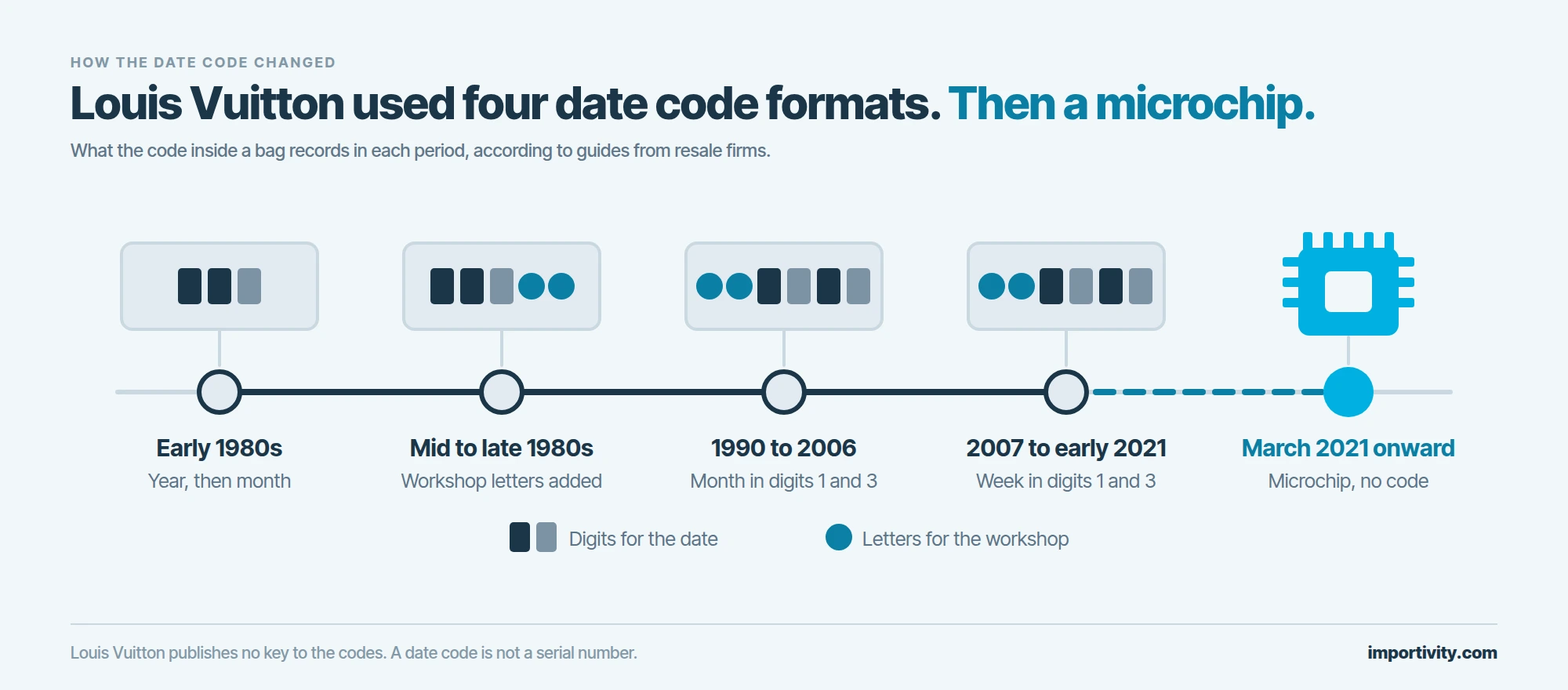
- Early 1980s. Three or four digits. The first two give the year and the rest give the month, so 836 means June 1983.
- Mid to late 1980s. Digits followed by two letters. The letters identify the workshop.
- 1990 to 2006. Two letters, then four digits. The first and third digits give the month, and the second and fourth give the year.
- 2007 to early 2021. The same layout, but the first and third digits give the week. Under that rule, a code of SD2149 reads as workshop SD, week 24 of 2019.
- March 2021 onward. Bags carry an embedded microchip and usually no code, so a newer bag with no date code is normal.
The guides make three points:
- The letters should match the stamp. A code whose letters belong to a French workshop should sit in a bag stamped made in France.
- The letters are not always obvious. One guide lists FC, FH, FL, LA, OS and SD as United States codes, and another notes that CA is a code for Spain, not California. One guide says SD stood for a French workshop before 1995 and for San Dimas, California after that.
- A date code is not a serial number. Bags made in the same workshop in the same week share a code, so a correct code does not prove that a bag is genuine.
Is Louis Vuitton made in China
No company source that we read names China. Louis Vuitton's FAQ says its leather goods are produced exclusively in its workshops in France, Spain, the United States and Italy, its footwear and ready-to-wear in France and Italy, and its watches in Switzerland. LVMH's 2023 document also mentions external manufacturers, which it does not name, and a workshop near Porto in Portugal. A bag stamped made in China does not match any of those statements.
A made-in stamp names the country where the product took its final form. Earlier steps can happen in another country. According to summaries that Romania Insider and Romania Journal published of a June 2017 Guardian report, components for some Louis Vuitton shoes were made at a factory in Cisnadie, Romania, run by an LVMH subsidiary. The summaries say the parts were then sent to Italy or France, where the soles were attached, and that EU rules allowed the finished shoes to be labeled as made there. They also say LVMH's chief executive rejected the claim, and that the company had earlier said only small parts were produced in Romania.
US customs uses a similar test: the country of origin is the last country where the product was substantially transformed. Our guide to country of origin rules explains how that test works for goods imported into the United States.
Can a small brand use these factories?
No. Louis Vuitton owns its workshops, and they make Louis Vuitton products. The external manufacturers it uses for extra capacity are not named. A smaller leather goods brand has three other routes.
- A workshop in Italy or Spain. Both countries have towns where small leather goods workshops sew for other brands, such as Scandicci in Tuscany and Ubrique in Spain. Italian Artisan, a marketplace for Italian workshops, lists a minimum of 30 to 50 pieces per style for bags, with lower prices at higher volumes. That figure comes from the seller's side, so get the minimum per style and per color in writing.
- A contract factory in Asia. Coach, Kate Spade and Michael Kors take this route. Our Coach guide names the countries, and it cites sourcing agents in China that quote about 50 pieces per color to put a logo on an existing bag and about 300 to 500 per style for a new pattern. Our guide to what MOQ means explains how factories set those minimums.
- A workshop in the United States. Plan for a slow start. Louis Vuitton opened its Texas site in 2019, and in 2025 its industrial director told Reuters that the ramp-up had been harder than expected. A factory that is new to your product needs time before its output is consistent, so place a small first order and inspect it before you order more.
Every workshop needs the same things before it can quote: a tech pack that lists the dimensions, the materials, the hardware and the stitching, a reference sample or clear photos, and the quantity per style and per color. Our tech pack guide covers the pages a factory needs. Our guide on how to find a manufacturer to make a product covers how to shortlist candidates and vet them.
If you want leather goods made under your own brand, send us your product and order size. Our manufacturer sourcing team finds and vets factories that already make similar products.
Frequently Asked Questions
Is Louis Vuitton made in China?
No company source names China. Louis Vuitton's customer FAQ says its leather goods are produced exclusively in its own workshops in France, Spain, the United States and Italy, its footwear and ready-to-wear in France and Italy, and its watches in Switzerland. LVMH's universal registration document for 2025 counts 29 leather goods workshops, all in those four countries. Its 2023 document also mentions external manufacturers, which it does not name. A bag stamped made in China does not match anything the company says about its production.
Is Louis Vuitton made in the USA?
Some of it is. LVMH's universal registration document for 2025 counts four Louis Vuitton leather goods workshops in the United States, out of 29 worldwide. Reuters reported in April 2025 that the US workshops were in California and Texas. The Texas site, on the Rochambeau Ranch near Alvarado, opened in October 2019. A Louis Vuitton bag marked as made in the U.S.A. can be genuine, so judge it by where it was bought and how it is made.
Who makes Louis Vuitton bags?
Louis Vuitton makes most of them itself. The brand belongs to LVMH, whose universal registration document for 2025 says 29 company workshops in France, Spain, the United States and Italy make most of its leather goods. LVMH's 2023 document says Louis Vuitton uses external manufacturers only to supplement its own production, and it does not name them.
Is Louis Vuitton made in France or Italy?
Both. France has 18 of Louis Vuitton's 29 leather goods workshops and Italy has 3, according to LVMH's universal registration document for 2025. Spain and the United States have 4 each. The Italian workshops also handle all development and manufacturing of Louis Vuitton shoes, at a site in Fiesso d'Artico near Venice. Ready-to-wear is made in France and Italy, according to the brand's FAQ.
What does the date code on a Louis Vuitton bag mean?
It records where and when the bag was made, according to guides from resale firms. From 1990 to early 2021 the code was two letters for the workshop and four digits for the date: month and year until 2006, then week and year. Bags made from March 2021 onward carry a microchip and usually no code. A date code is not a serial number and does not prove that a bag is genuine.
About the author
Jordan Lewis
Chief Operating Officer, Importivity
Runs Importivity's sourcing operations across China, Vietnam, Mexico and India, from supplier negotiation through landed delivery.
Press and media inquiries: press@importivity.com