Where Is Carhartt Made (US Plants, Factories Abroad and Labels)
Carhartt is made in its own sewing and cutting plants in Kentucky and Tennessee, which make its Made in the USA line, and in supplier and licensee factories in other countries, which make the rest. Carhartt says its supply chain spans 34 countries, so the label on each item is what tells you where that item was made.
This guide is for founders and product teams planning a workwear or heavy apparel line who want to see how a large workwear brand splits its production. It uses Carhartt's own statements to show where its US plants are and what they make, what its pages say about Mexico, what each origin label means under FTC rules, and what a smaller brand can copy. For US sewing options beyond Carhartt, see our guide to clothing manufacturers in the USA. Importivity is not affiliated with Carhartt or Carhartt WIP.
Where Carhartt is made in 2026
Carhartt is privately held, so it files no annual report with the SEC that would list its factories. The facts here come from its own website, its supply chain transparency statement for fiscal 2025, its supplier manual and its public factory map. Together they describe two kinds of production.
- Company-owned plants in the US. Hamilton Carhartt founded the company in Detroit in 1889. Its headquarters is now in Dearborn, Michigan, and its company profile says its US facilities are in Kentucky and Tennessee.
- Supplier and licensee factories abroad. Carhartt's corporate responsibility page says production is centered in company-owned factories and "a network of supplier and licensee factories around the world." Its fiscal 2025 statement says the supply chain spans 34 countries.
Carhartt checks those factories itself and through outside auditors. The fiscal 2025 statement says it ran 401 factory assessments in 2025 and found no forced or child labor. Its supplier manual requires third-party audits under programs Carhartt approves, including SMETA and the Fair Labor Association. Carhartt's own social responsibility staff visit factories too. The company publishes its direct finished-goods factories on a global factory map with a downloadable list, so anyone can check the countries for themselves.
One name causes confusion. Carhartt WIP is a separate business. It grew out of Work in Progress, the company Edwin Faeh set up to become Carhartt's exclusive distributor in Europe after he began selling American brands there in 1989. Carhartt WIP says the main hub of its manufacturing has been in Tunisia since 1993, with two factories and a logistics platform in the Monastir region. A WIP jacket and a Carhartt jacket can come from different factories in different countries.
Carhartt's US plants and what they make
Carhartt's US production sits in two states. Its European site says four sewing and cutting facilities still operate in Kentucky and Tennessee, and that the original Irvine, Kentucky factory now houses its supply chain operations center. A Carhartt history page gives three manufacturing facilities instead. The pages differ on the count, and both put the plants in the same two states.
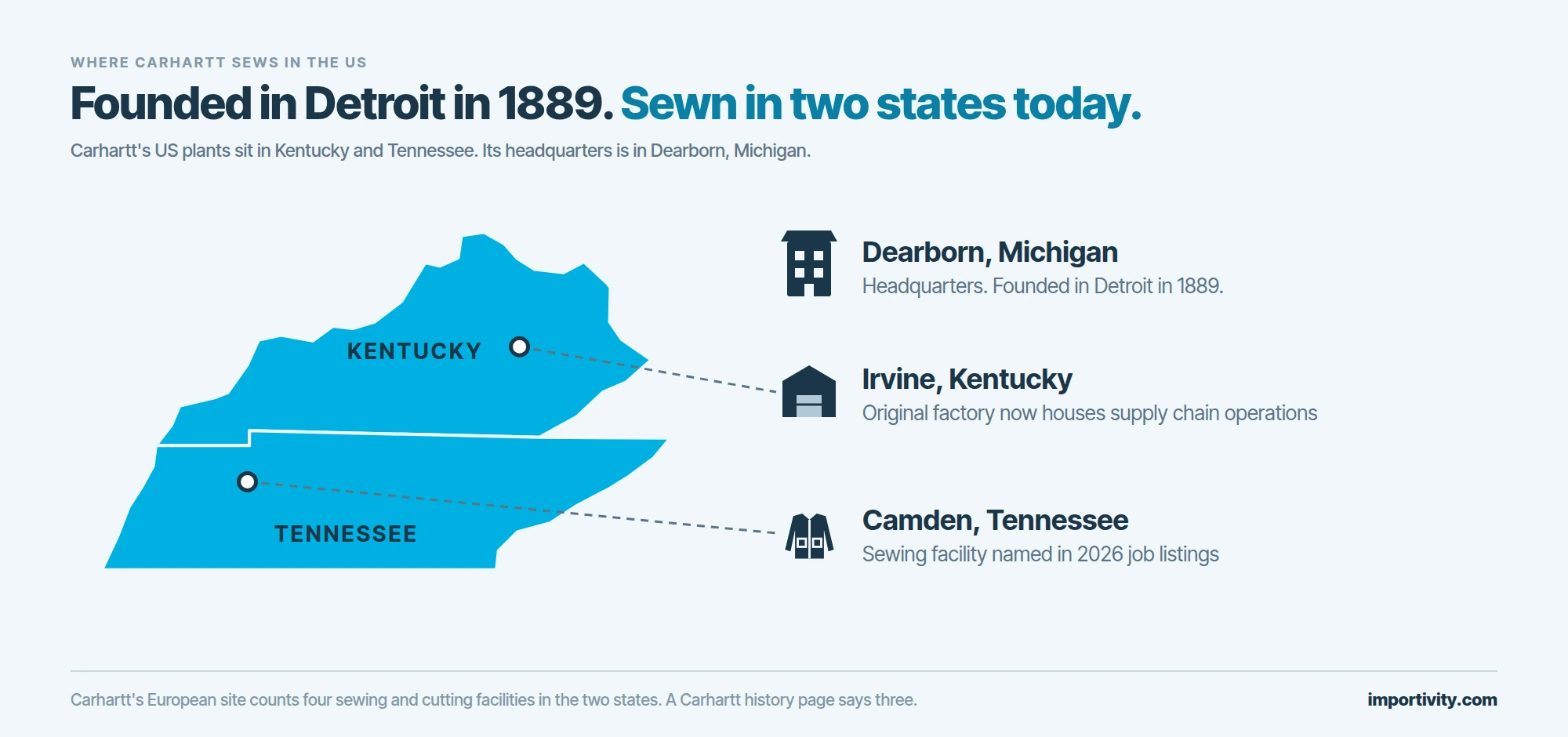
Carhartt's job listings name two of the sites. A July 2026 engineering posting is based at the "US Sewing facilities" in Camden, Tennessee, and an October 2026 listing for craft module operators is also in Camden. Carhartt has listed craft module operator jobs in Irvine as well, along with supervisor roles for a development center and a technical laundry.
Carhartt says it produces its Made in the USA line, which features "some of our most iconic garments," in its manufacturing and finishing facilities in Kentucky and Tennessee. Sewing in the US is not enough for a plain Made in USA label, though. If the fabric was made abroad, the FTC rules in the next section require the label to say so.
The split is the part worth copying. Carhartt keeps a domestic line for buyers who will pay for the claim, and buys the wider range from factories abroad. New Balance does the same with its US-made 990 line, as our guide to American manufactured shoes explains. Nike is the opposite case: it owns none of the factories that make its finished shoes and clothes, as our guide to where Nike makes its shoes and clothes shows.
What Made in USA labels on workwear mean
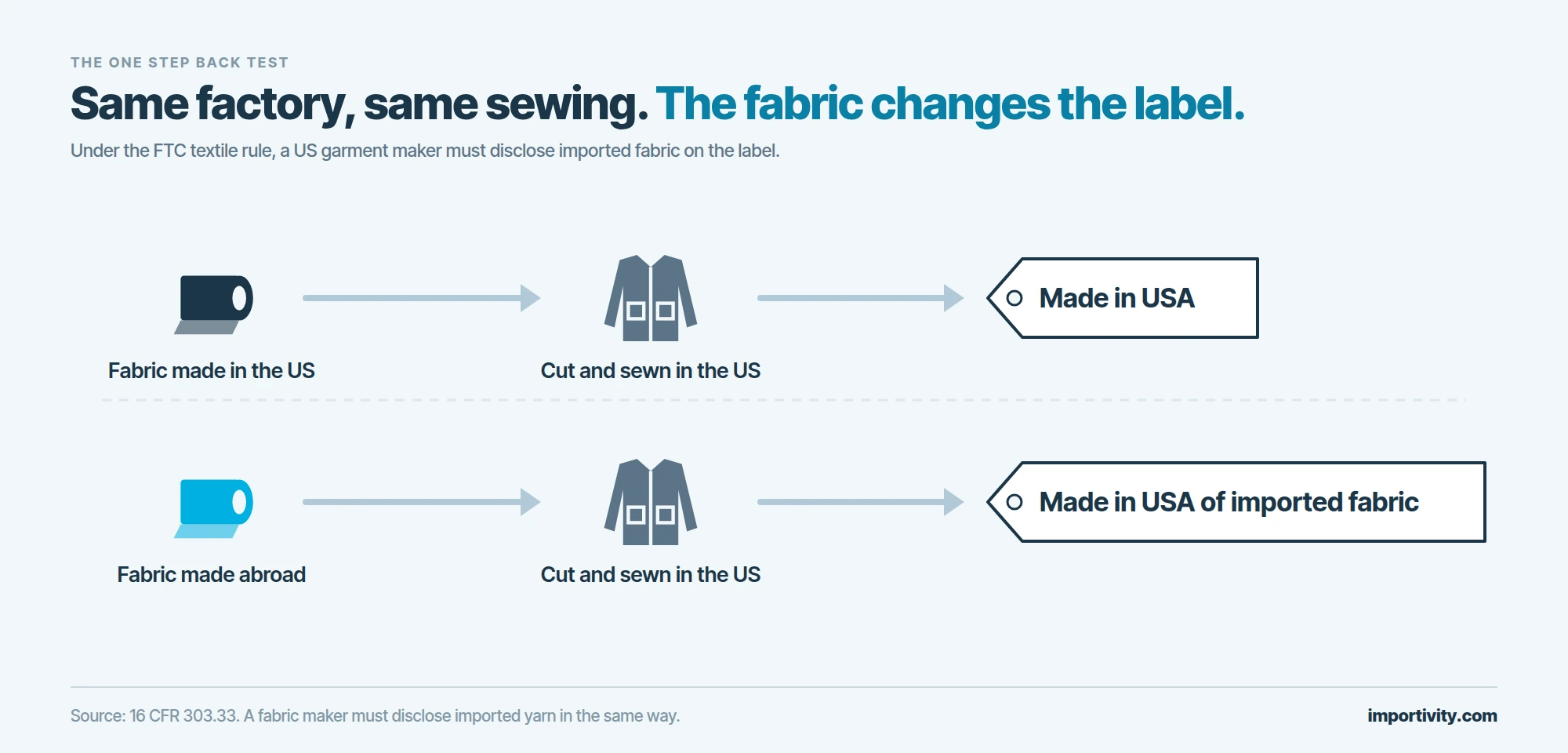
A work jacket sewn in the US can carry one of several origin labels, and federal rules set which one is allowed. For textiles, the FTC test looks one step back: a garment maker must disclose imported fabric, and a fabric maker must disclose imported yarn.
| Label wording | What it tells you | Rule behind it |
|---|---|---|
| Made in USA | Made in the US from fabric made in the US. All or virtually all of the product must be US-made. | 16 CFR 303.33 and 16 CFR Part 323 |
| Made in USA of imported fabric | Cut and sewn in the US from fabric made abroad | 16 CFR 303.33 |
| Made in USA of imported parts, or similar wording | Made in the US with some foreign parts, such as zippers or snaps | A qualified FTC claim. The wording must be accurate. |
| Made in Mexico, or another country | The garment was made or processed in that country | FTC textile rules and CBP marking rules in 19 CFR Part 134 |
| Made in USA, Imported, or both, in a catalog | Where the product was made, stated in the catalog description | 16 CFR 303.34 |
Two rules matter most. Under the FTC's textile rule, 16 CFR 303.33, a garment made in the US from imported fabric must say so, for example "Made in USA of imported fabric." Under the Made in USA Labeling Rule, 16 CFR Part 323, an unqualified Made in USA claim requires that all or virtually all of the product be made in the US. Each violation can bring a civil penalty of up to $53,088 under the FTC's 2025 inflation adjustment.
Enforcement picked up in 2026. Executive Order 14392, signed on March 13, 2026, told the FTC to make false Made in America claims a priority, and on April 14, 2026 the FTC announced actions against three companies over unqualified claims.
To check one Carhartt item, read the sewn-in label, because it names the country where the item was made. Carhartt's factory map shows which countries hold its direct finished-goods factories.
Does Carhartt make clothes in Mexico?
Carhartt's own pages do not give one answer. Its corporate responsibility page has appeared in two versions. One says production is centered in company-owned factories "in the U.S. and Mexico." The other names only the US. The company profile lists US facilities in Kentucky and Tennessee and no plant in Mexico.
If Mexican production matters to your decision, check the current list on Carhartt's factory map. On any Carhartt item you own, the label will say Made in Mexico if it was made there.
Why Mexico matters for a workwear brand
Whatever Carhartt does there now, Mexico is worth pricing first for heavy sewn goods, because of duty and distance. Goods that qualify under USMCA enter free of the base duty rate and of the 10% Section 301 forced-labor duty on Mexican goods that started on July 24, 2026. Goods that do not qualify pay both.
- The duty gap. A cotton T-shirt under HTS 6109.10.00 has a 16.5% base rate. As of November 13, 2026 it pays 0% from Mexico if it qualifies under USMCA, 26.5% from Mexico if it does not, 29% from Vietnam and 36.5% from China, where Section 301 List 4A adds 7.5% and the forced-labor duty adds 12.5%. Our guide to tariff stacking shows how each layer is figured.
- The yarn-forward rule. Under USMCA, the yarn must be spun, and every later step done, in the US, Mexico or Canada. The sewing thread, narrow elastic and pocket bag fabric must also come from the region. A chore coat sewn in Mexico from Asian duck canvas does not qualify. One sewn from duck woven in the region from yarn spun in the region can. Our guide to importing from Mexico covers the certification of origin.
- The trip. A truck from Monterrey reaches Dallas in 2 to 3 days, against about 30 to 40 days door to door by ocean from Shanghai to Los Angeles. Our analysis of nearshoring to Mexico works through cost and speed together.
- The agreement itself. USMCA is still in force. On July 1, 2026 the United States declined to extend it for a new 16-year term, which moves it to annual reviews until the parties extend it or it expires on July 1, 2036.
Mexico has an apparel and textile base in Puebla and nearby Tlaxcala, as our guide to manufacturing plants in Mexico shows. A Mexican quote is often higher per piece than a Chinese one, so compare landed cost, not unit price.
What a workwear brand can take from Carhartt
Carhartt is far larger than a new brand, but its setup answers three questions every workwear startup faces: where to sew, how to back up the origin claim, and how to check the factories.
- Keep a US line only where the claim pays. Carhartt sews one named line at home. A small brand can do the same with one or two styles. Keep mill invoices that show where the fabric and yarn were made before you print Made in USA.
- Price heavy goods in Mexico against Asia. Duck canvas and denim workwear can enter duty free from Mexico when the yarn and the fabric are made in the region. Ask each Mexican plant where its fabric and yarn come from before you compare quotes.
- Check factories the way Carhartt does. Ask for a recent third-party audit, such as SMETA or SLCP, before the first order, and send an inspector before you pay the balance. Our supplier vetting work covers these checks.
- Write the label wording before production. Decide whether the label will read Made in USA, Made in USA of imported fabric or Made in Mexico, because that decision limits which fabric you can buy.
Before you ask any factory for a price, prepare these:
- A tech pack. List the fabric weight and fiber, the stitch types and the graded measurements, and mark where each rivet and bar tack goes. Our tech pack guide covers the pages a factory needs.
- A bill of materials with origins. Name the country for the yarn, fabric, thread, zippers, snaps and labels. A USMCA claim and a Made in USA claim both depend on it.
- Quantities per style and color. Minimums are often set per color, so a style in three colors can need three times the units.
- A target landed cost. Include the duty for each origin you are pricing, using the rates above.
To compare US, Mexico and Asia quotes on the same garment, send us your tech pack and quantities. We help US brands find and vet factories and run quality control. We also handle shipping and tariffs.
Frequently Asked Questions
Is Carhartt made in the USA?
Part of it is. Carhartt says it makes its Made in the USA line in its own manufacturing and finishing facilities in Kentucky and Tennessee. The rest of the range comes from supplier and licensee factories in other countries, across a supply chain Carhartt says spans 34 countries. The sewn-in label on each item shows where that item was made.
Where are Carhartt's factories in the US?
Carhartt's US plants are in Kentucky and Tennessee. Its European site counts four sewing and cutting facilities in those states, while a Carhartt history page says three. A July 2026 Carhartt job listing names a US sewing facility in Camden, Tennessee, and the original factory in Irvine, Kentucky now houses its supply chain operations center. Its headquarters is in Dearborn, Michigan.
Is Carhartt made in Mexico?
Carhartt's own pages disagree. Its corporate responsibility page has appeared in two versions: one says production is centered in company-owned factories in the US and Mexico, and the other names only the US. Its company profile lists US facilities in Kentucky and Tennessee and no plant in Mexico. Check the label on the item, or Carhartt's public factory map, which lists its direct finished-goods factories.
Is Carhartt WIP the same company as Carhartt?
No. Carhartt WIP grew out of Work in Progress, the company Edwin Faeh set up to become Carhartt's exclusive distributor in Europe after he began selling American brands there in 1989. Carhartt WIP says the main hub of its manufacturing has been in Tunisia since 1993. A WIP item and a Carhartt item with a similar name can come from different factories in different countries.
What does Made in USA of imported materials mean?
It means the product was made in the US, but some of its inputs came from abroad. Under the FTC textile rule, a garment sewn in the US from imported fabric must say so, for example Made in USA of imported fabric. An unqualified Made in USA label requires that all or virtually all of the product be made in the US, under 16 CFR Part 323.
About the author
Jordan Lewis
Chief Operating Officer, Importivity
Runs Importivity's sourcing operations across China, Vietnam, Mexico and India, from supplier negotiation through landed delivery.
Press and media inquiries: press@importivity.com