Where Are Hoka Shoes Made (Countries, Factories and Tariff Costs)
Hoka shoes are made mostly in Vietnam and Indonesia, by independent factories that Hoka's owner, Deckers Brands, hires. Deckers says its finished goods came mainly from those two countries in fiscal 2026, the year that ended March 31, 2026, and less than 5% came from China or from any other single country.
This guide is for founders and product teams who want to see how a running shoe brand with $2.59 billion of yearly sales gets its shoes made, and which parts of that a small footwear brand can copy. The figures come from Deckers' 10-K filings, its earnings releases and news coverage of its earnings calls. For a larger network built the same way, see our guide to where Nike makes its shoes and clothes. Importivity is not affiliated with Hoka or Deckers Brands.
Who makes Hoka shoes
Hoka is one of the brands of Deckers Brands, the NYSE-listed company that also owns UGG and Teva. Deckers designs and sells the shoes, but it does not make them. Its fiscal 2026 10-K says independent third-party contractors manufacture all of its products.
In fiscal 2026 Deckers reported revenue of about $5.47 billion, and Hoka brought in $2.59 billion of it, up 16% from the year before. That is about 47% of the company's revenue. Growth has slowed since. In the quarter that ended September 30, 2026, Hoka sales were $677 million, up 6.8%, and in its October 22, 2026 results Deckers said it expects Hoka sales to grow at a high single digit rate in fiscal 2027.
Deckers has its own offices near the factories. The fiscal 2026 10-K lists supervisory offices in Vietnam, China and Indonesia.
Where Hoka shoes are made in fiscal 2026
Deckers' fiscal 2026 10-K says its finished goods came mainly from Vietnam and Indonesia, and that less than 5% came from China or from any other single country. The filing does not give a percentage for each country. It also covers every Deckers brand together, so there is no separate figure for Hoka. With Hoka at about 47% of revenue, the company figure is the closest public answer.
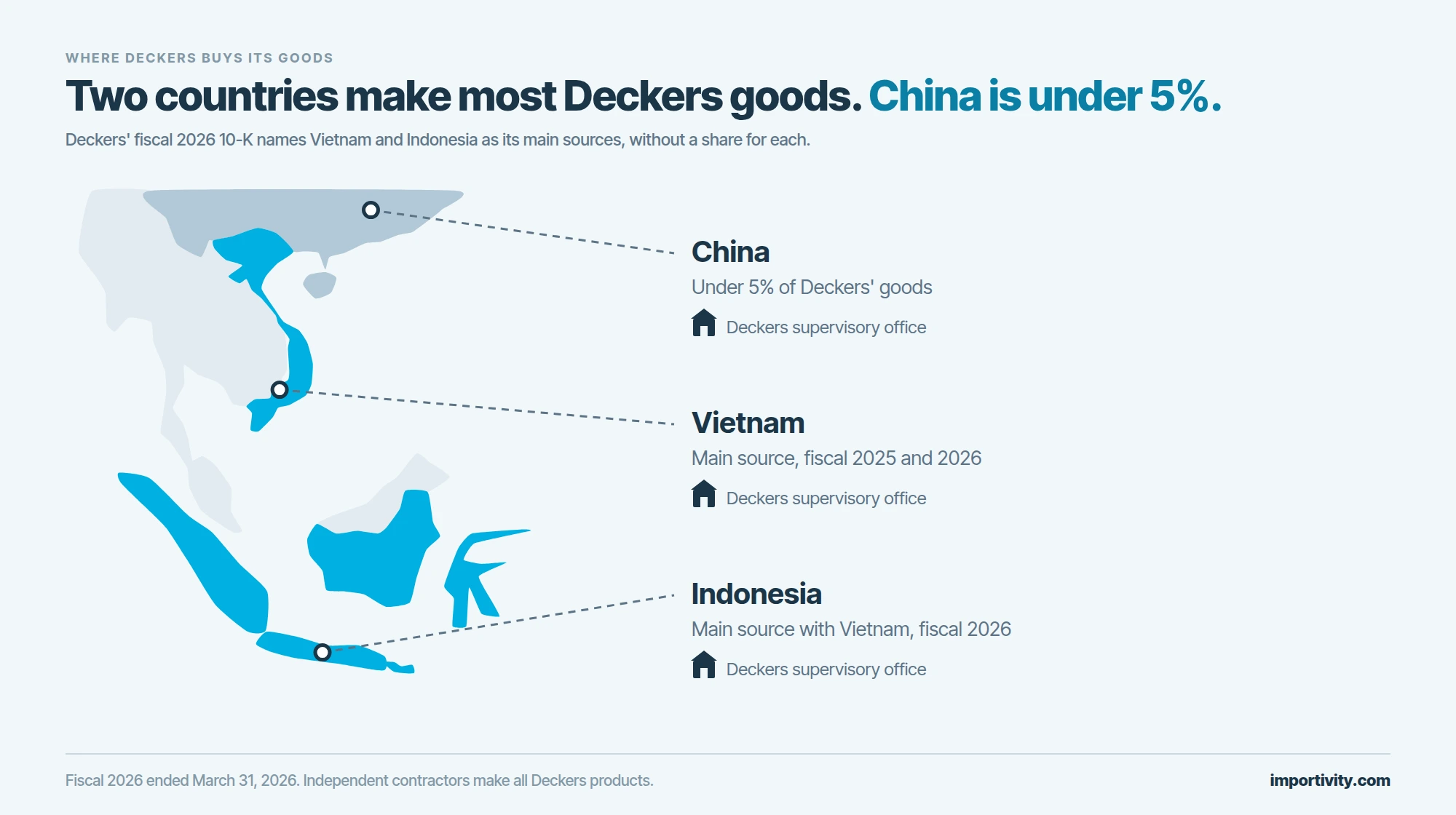
The wording changed from the year before. Deckers' fiscal 2025 10-K said less than 5% of its footwear came from China and the rest came from Southeast Asia, mainly Vietnam. The fiscal 2026 filing names Indonesia next to Vietnam as a main source.
Next to Nike, Deckers buys less from China. Nike's fiscal 2026 filing puts China at about 16% of Nike Brand footwear, behind Vietnam at about 52% and Indonesia at about 27%. Deckers keeps China under 5%. Both companies rely on the same two Southeast Asian countries, and our guide to where Jordans are made shows how that split appears on the labels of one Nike line.
Why running shoes like Hoka are made in Vietnam and Indonesia
A running shoe takes a lot of hand work. Workers cut the upper from mesh and synthetic panels, stitch it, pull it over a last and glue it to a molded foam midsole and a rubber outsole. A factory that does this at volume needs trained sewing and lasting lines, plus nearby suppliers for each material in the shoe. Vietnam and Indonesia have both, because the large athletic brands built their supply chains there.
- The factories are already there. Nike's fiscal 2026 10-K counts 15 contract manufacturers running 95 footwear factories in 11 countries, and Vietnam and Indonesia together made about 79% of Nike Brand footwear. Many of the largest footwear groups are headquartered in Taiwan or South Korea and run plants in these two countries, as our Nike guide shows.
- Materials are bought nearby. Nike's filing says its contract manufacturers buy most of their principal materials in the country where they assemble the product, which cuts transit time for foam, rubber and textiles. We could not find a materials breakdown for Hoka in Deckers' filings, so read this as how the industry works, not as a Hoka figure.
- Wages. Vietnam's highest regional minimum wage rose to 5.31 million dong a month, about $200, on January 1, 2026. Factory pay runs above the minimum once overtime and allowances are added. In the south, footwear plants cluster around Ho Chi Minh City and Dong Nai, as our guide to manufacturers in Vietnam shows.
- Duty. Shoes made in Vietnam or Indonesia do not pay the China Section 301 list duties. They do pay the newer forced-labor duty, covered below.
Buying from two main countries also means that a new duty, a port delay or a factory problem in one country affects only part of the volume.
What the "Made in" label on a Hoka shoe means
The country printed on the tag and the box is the country of origin under US customs law. Under 19 U.S.C. 1304, an imported product must show its country of origin where the buyer will see it. CBP treats the last country where the product was substantially transformed as its origin, meaning the place where it became a new article. A pair cut, stitched and assembled in Vietnam is labeled Made in Vietnam, even if some of its foam or mesh came from another country. A shoe that only gets its laces or insoles added in a second country keeps its first origin.
Given Deckers' fiscal 2026 split, expect most Hoka tags to say Vietnam or Indonesia. A pair marked Made in China is not a sign of a fake. Deckers still buys some goods there and keeps an office there.
The country alone cannot tell you whether a pair is genuine, because a copy can print any country on its tag. Buy from Hoka or a retailer it supplies, and check that the details on the tag match the box. For a brand, the label carries more weight. The origin you print and the origin you declare to customs come from the same test, and that origin sets the extra duty in the next section. Our guide to country of origin rules covers shoes built from parts made in two countries.
What Deckers has said about tariffs and prices
Deckers has said more about tariffs than about its factories. In late July 2025, it raised its estimate of unmitigated tariff costs for fiscal 2026 to about $185 million, up from $150 million. It planned to offset about $75 million of that through selective price increases and by sharing costs with its factory partners. In January 2026, on its earnings call for the quarter that ended December 31, 2025, it cut the estimate to about $110 million before offsets. It put the net cost at about $25 million after its price increases and the timing of when the affected inventory was sold.
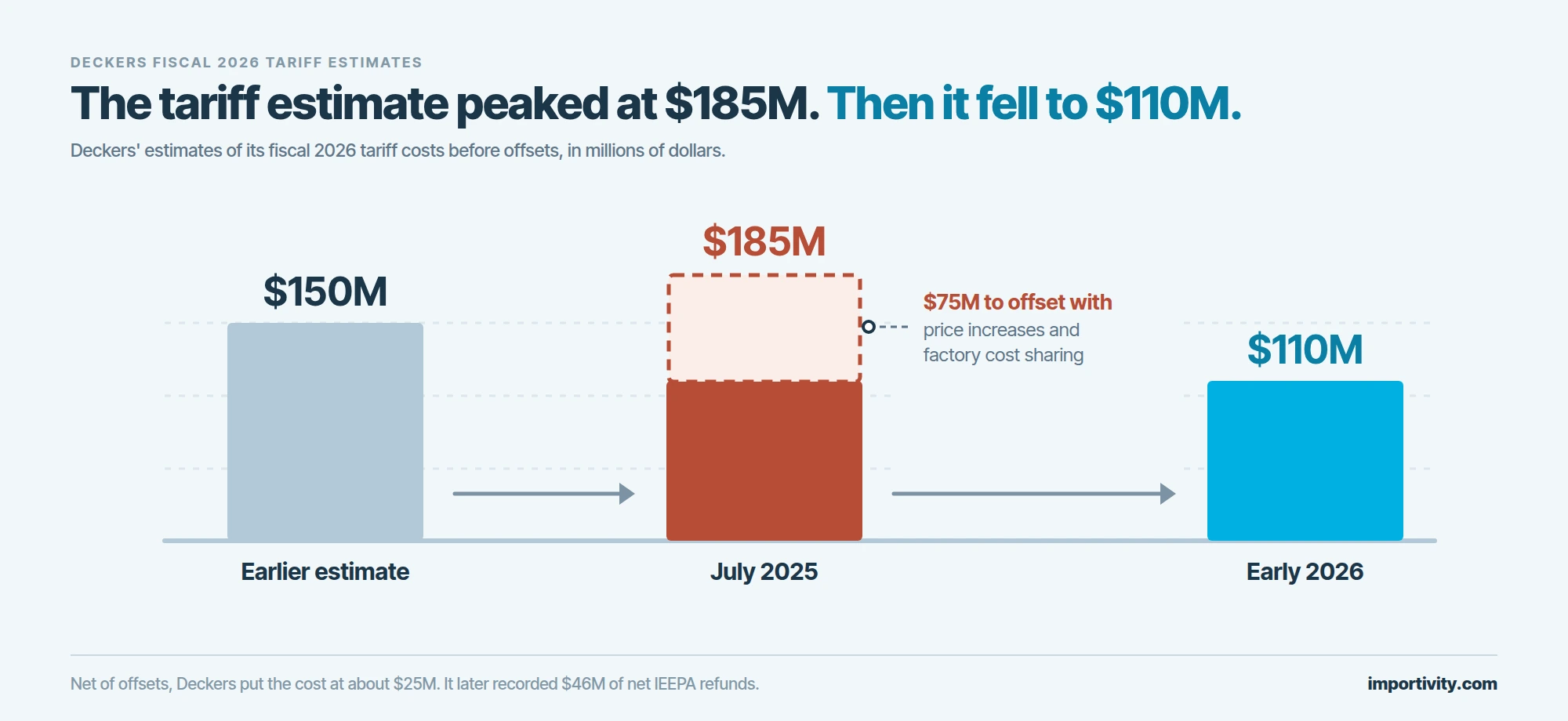
Then the rules changed. The Supreme Court struck down the IEEPA tariffs on February 20, 2026, and CBP stopped collecting them on goods entered from February 24. In the quarter that ended September 30, 2026, Deckers recorded $46 million of net IEEPA tariff refunds plus $3 million of interest, which added about 310 basis points to its gross margin. The full-year earnings outlook it gave on October 22, 2026 includes about $0.52 a share from refunds received through October 8, 2026, and assumes no more. Our guide to IEEPA tariff refunds explains who can claim them.
A different duty applies now. Since July 24, 2026, goods from 60 economies pay a Section 301 forced-labor duty on top of the normal rate unless an exemption applies: 12.5% for Vietnam and China, and 10% for Indonesia. The normal rate depends on the HTS code. A running shoe with a textile upper and a rubber or plastic sole, valued over $12 a pair, usually falls under HTS 6404.11.90, which the US tariff schedule lists at a general rate of 20%. The table uses an example pair with a $30 customs value.
| Country | What Deckers' fiscal 2026 10-K says | US duty on HTS 6404.11.90, Nov 11, 2026 | Duty on a $30 pair |
|---|---|---|---|
| Vietnam | A main source of finished goods; supervisory office | 32.5% (20% + 12.5%) | $9.75 |
| Indonesia | A main source of finished goods; supervisory office | 30% (20% + 10%) | $9.00 |
| China | Less than 5% of finished goods; supervisory office | 32.5% (20% + 12.5%), plus any China Section 301 list duty on the code | $9.75 or more |
| Mexico | Less than 5%, if any, like every country other than Vietnam and Indonesia | Free if the shoe qualifies under USMCA rules of origin; otherwise 30% (20% + 10%) | $0 if it qualifies, $9.00 if not |
Each rate is charged on the same customs value, and the amounts are added, not compounded. Our guide to tariff stacking walks through the method. On the example pair, Indonesia costs 75 cents less in duty than Vietnam. A Vietnamese factory that quotes $1 less per pair than an Indonesian one still comes out ahead, so compare landed cost, not the rate alone.
What a footwear startup can take from Hoka
A new brand cannot buy from Deckers' factories on Deckers' terms, and it does not need to. These habits work at a small scale.
- Look in the same countries, not the same factories. Smaller factories in Vietnam and Indonesia also make cemented running and training shoes. Ask for plants that already make your construction at your price per pair.
- Plan for a second country. Deckers names two main countries and keeps every other country under 5%. A startup usually begins with one factory. Qualify a second one for your best seller, in another country if your volume allows, before a duty change forces a move.
- Agree on tariff sharing in writing. Deckers planned to cover part of its tariff bill through cost sharing with its factories. A small brand has less buying power, but it can still write into the purchase order how a duty that changes after the order date will be split. Decide who is importer of record too, because that party receives any refund.
- Start on stock soles. Running shoes sit on molded foam midsoles and rubber outsoles, and each size needs its own mold. Shoemakers Academy, a footwear development school, prices rubber outsole molds at $1,500 to $2,000 per size, so ten sizes cost $15,000 to $20,000 before the first pair, as our Jordans guide shows. A sole unit the factory already owns avoids most of that until the shoe sells.
- Send every factory the same package. Include a tech pack with every material and measurement, the size run, pairs per colorway, your target price per pair, and whether you will use stock or custom soles. Identical requests give you quotes you can compare line by line.
To get quotes from footwear factories in Vietnam, Indonesia or China that fit your volume, send us your product and order details. Our manufacturer sourcing team finds and vets factories that make your product type.
Frequently Asked Questions
Are Hoka shoes made in China?
Only a small share of Deckers' goods comes from China. Deckers, which owns Hoka, says in its fiscal 2026 10-K that less than 5% of its finished goods came from China or from any other single country, and that most came from Vietnam and Indonesia. Deckers still keeps a supervisory office in China, so a Hoka marked Made in China is not a sign of a fake on its own.
Are Hoka shoes made in Vietnam?
Yes, many are. Deckers named Vietnam as the main source of its footwear in its fiscal 2025 10-K, and it named Vietnam and Indonesia as the main sources of its finished goods in fiscal 2026. The filings cover all Deckers brands together and give no percentage for each country, so there is no exact Vietnam share for Hoka.
Who owns Hoka?
Hoka is owned by Deckers Brands, the NYSE-listed company that also owns UGG and Teva. In fiscal 2026, the year that ended March 31, 2026, Hoka brought in $2.59 billion of Deckers' revenue of about $5.47 billion. That is about 47% of the total, and Hoka sales rose 16% from the year before.
Who manufactures Hoka shoes?
Independent contract factories make them. Deckers' fiscal 2026 10-K says independent third-party contractors manufacture all of its products, and that its finished goods came mainly from Vietnam and Indonesia. Deckers keeps supervisory offices in Vietnam, China and Indonesia. The filing covers all Deckers brands together, so it gives no separate figures for Hoka.
Did tariffs raise the price of Hoka shoes?
Deckers said in late July 2025 that it planned to offset about $75 million of an estimated $185 million in fiscal 2026 tariff costs through selective price increases and cost sharing with its factories. It later cut the estimate to about $110 million before offsets. Since July 24, 2026, shoes from Vietnam pay an extra 12.5% Section 301 duty and shoes from Indonesia an extra 10%.
About the author
Jordan Lewis
Chief Operating Officer, Importivity
Runs Importivity's sourcing operations across China, Vietnam, Mexico and India, from supplier negotiation through landed delivery.
Press and media inquiries: press@importivity.com