Where Are Jordans Made (Countries, Factories and How to Read the Tag)
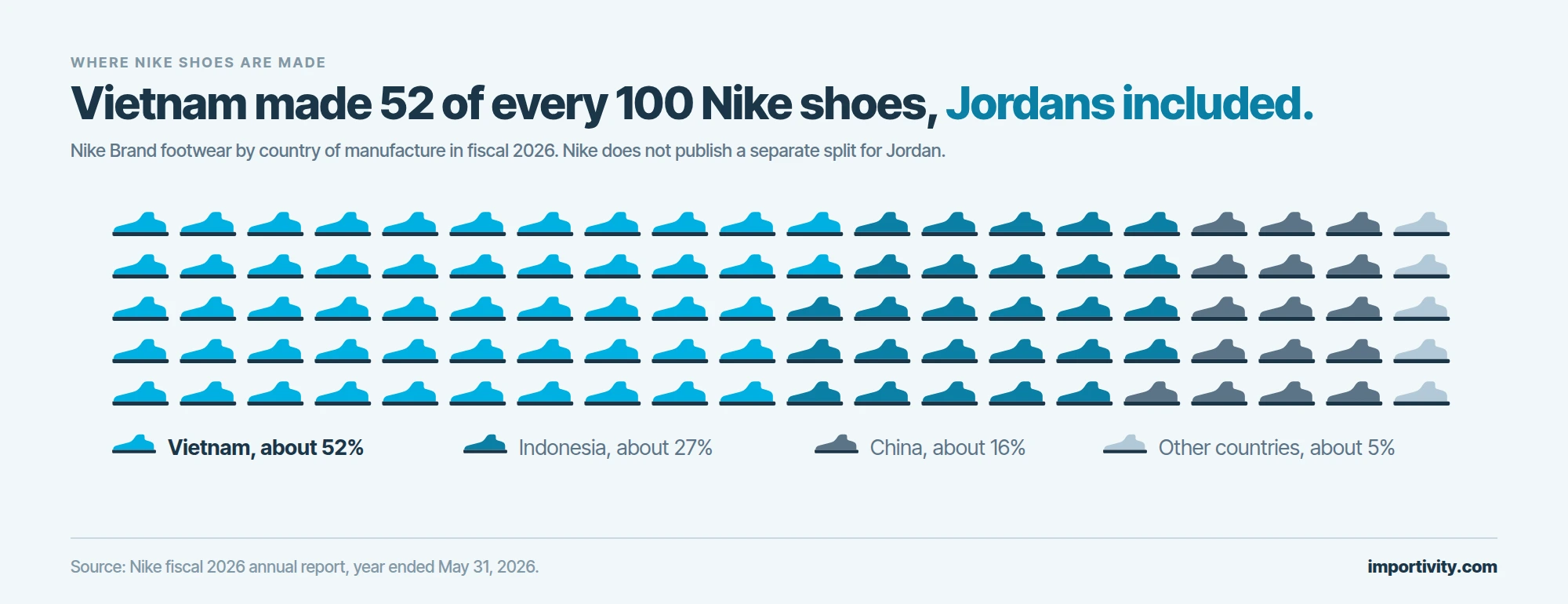
Jordans are made in Vietnam, China and Indonesia by independent factories that Nike hires, not by Jordan Brand itself. Nike does not publish a separate split for Jordan, but across all Nike Brand footwear in fiscal 2026, factories in Vietnam made about 52% of pairs, Indonesia about 27% and China about 16%.
This guide is for buyers checking a label and for founders who want to know how a shoe like this gets made. Our guide to where Nike makes its shoes and apparel names the factory groups behind Nike. This one stays on Jordans: what the label and size tag tell you, where the first pairs were made, and what a new sneaker brand can copy. Importivity is not affiliated with Nike or Jordan Brand.
Who makes Jordans
Jordan Brand is part of Nike, Inc. Nike's fiscal 2026 annual report, for the year ended May 31, 2026, puts Jordan Brand revenue at $7,034 million, down 3% from $7,270 million the year before. That is about 15% of Nike's $46.4 billion in total revenue. Nike reports Jordan inside its Nike Brand results, and its manufacturing figures cover Nike Brand footwear as a whole, so Jordan pairs are counted in them.
The same report says nearly all Nike products are made by independent contractors. For footwear in fiscal 2026, that meant 15 contract manufacturers running 95 finished goods factories in 11 countries. Four of those manufacturers each made more than 10% of Nike Brand footwear, and together they made about 60%.
Nike does not say which of those factories make Jordans. So the answer to "who makes Jordans" is the same as for any Nike shoe: a contract manufacturer that Nike does not own builds it to Nike's design. Our Nike guide lists the largest of those manufacturers by name, using the factory list Nike publishes.
Where Air Jordans are made today
Because Jordan is counted inside Nike Brand footwear, Nike's country split is the best public measure of where Jordans come from. In fiscal 2026, factories in Vietnam made about 52% of Nike Brand footwear, Indonesia about 27% and China about 16%. That is 52 of every 100 Nike shoes from one country. The last 5% or so came from the other countries in Nike's footwear network.
Nike's product pages for current Jordans match that split. Each page includes a country of origin line, and the Jordan pages we checked on Nike's regional sites in November 2026 list Vietnam, China or Indonesia. Origin is set per style code, so two pairs in the same colorway can come from different countries.
| Jordan style (code) | Country on Nike's product page | What it shows |
|---|---|---|
| Air Jordan 1 Retro High OG "Black and Gold" (DZ5485-071) | China | A core retro made in China is a genuine Nike product. |
| Air Jordan 11 Retro "Legend Blue," men's (CT8012-104) | China | Listed as China on Nike's sites in Singapore, Malaysia, India and Japan. |
| Air Jordan 11 Retro "Legend Blue," big kids (378038-104) | Vietnam | The kids' version has its own style code and its own country. |
| Air Jordan 4 Retro women's "Vivid Sulfur" (AQ9129-101) | Vietnam | Listed as Vietnam on Nike's sites in Japan, Australia and Canada. |
| Air Jordan 1 Low women's (DC0774-101) | Indonesia and Vietnam | One style code can come from two countries under one product page. |
Two patterns show up. Adult and kids' sizes of one colorway are separate products with separate style codes, and Nike often makes them in different countries. And one style code can carry two countries: most of Nike's regional sites list the women's Air Jordan 1 Low DC0774-101 as made in Indonesia and Vietnam, while its Japan site lists only Vietnam. To know where your own pair was made, read its tag, not the model name. In Vietnam, footwear factories cluster in the south around Ho Chi Minh City and Dong Nai, as our guide to manufacturers in Vietnam shows.
Are Jordans made in China?
Some are. China made about 16% of Nike Brand footwear in fiscal 2026, and Nike lists China as the country of origin for current Jordans such as the Air Jordan 1 Retro High OG "Black and Gold" and the men's Air Jordan 11 Retro "Legend Blue." A "Made in China" tag on its own does not mean a pair is fake.
Counterfeit shoes are still a real risk. US Customs and Border Protection seized 604,553 counterfeit footwear items in fiscal 2024, according to its annual intellectual property seizure statistics, and a fake can print any country on its tag. The country line cannot settle the question, so check the things a copy has to get exactly right:
- The seller. Pairs bought from Nike or a retailer Nike supplies carry the lowest risk. A resale pair needs the two checks below.
- The style code. The nine-character code on the size tag should match the box label and Nike's own product page for that code.
- The country for that code. The country on the tag should be one that Nike lists for that style code. If it is not, ask the seller for proof of purchase before you pay.
How to read the size tag on a pair of Jordans
The size tag sewn inside the tongue holds most of what a buyer, reseller or importer wants to know: the country, the style code and the production dates. The label on the box repeats the style code and the country.
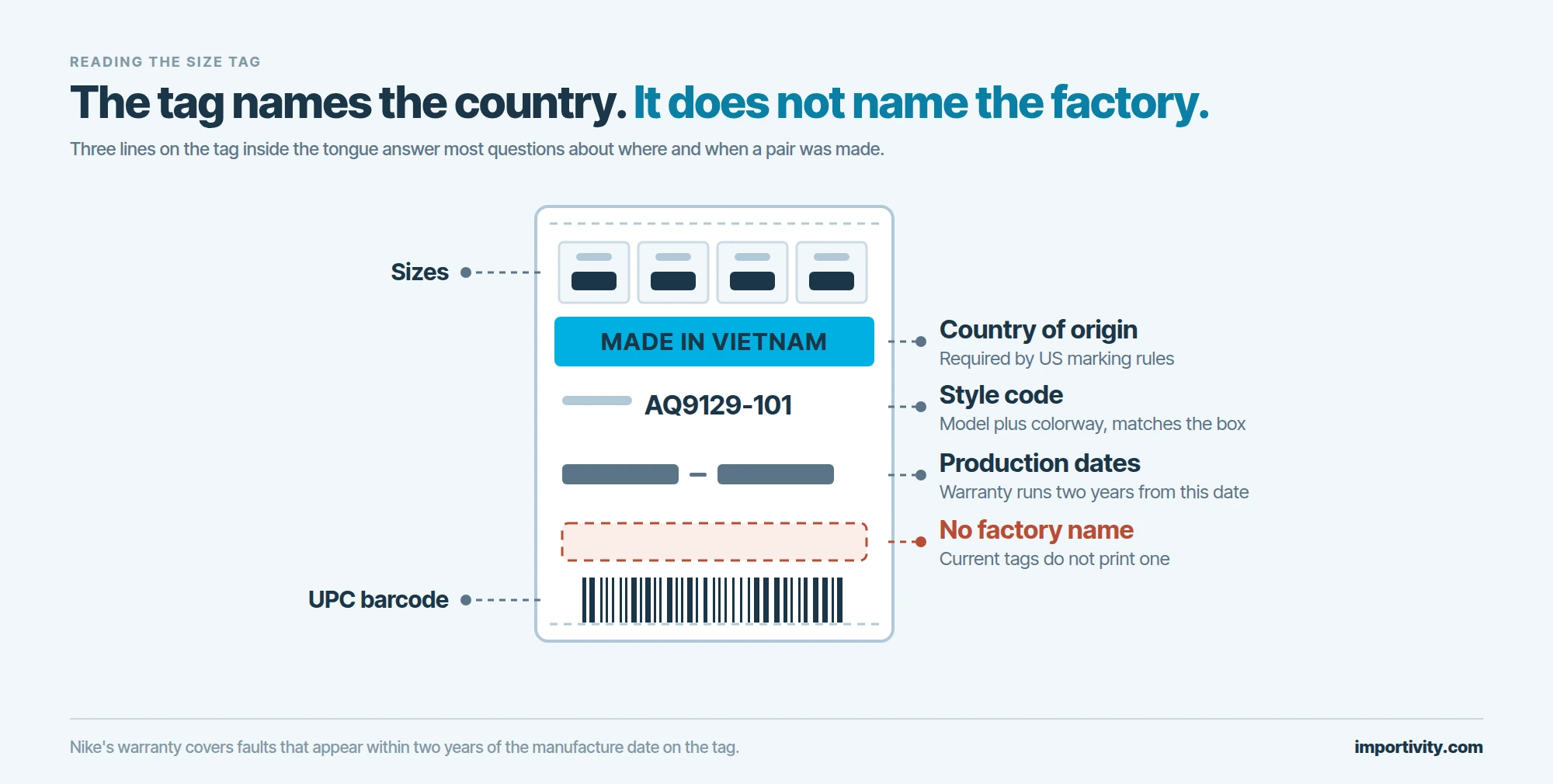
- Country of origin. The "Made in" line. US marking rules under 19 U.S.C. 1304 require imported goods to show their country of origin where the buyer will see it. Our guide to country of origin rules explains how customs decides that country.
- Style code. Nine characters printed as six and three, such as AQ9129-101. Sneaker guides read the first six as the model and the last three as the colorway, which is why the men's and kids' "Legend Blue" 11s both end in 104. Search the code on Nike's site to see the product page and the country Nike lists.
- Production dates. The tag prints the manufacture date, often as two dates, which sneaker guides read as the start and end of the production run. Nike's warranty page covers material and workmanship faults that appear within two years of the manufacture date on the tag, so keep this line readable.
- Sizes and UPC barcode. The size in US, UK, European and centimeter measures, plus a UPC barcode for that exact size and colorway.
- No factory name. Current tags do not name the factory. Tags on the 1985 Air Jordan 1 printed a short abbreviation for the factory that made the pair, as Sotheby's noted when it cataloged early pairs.
So the tag tells you the country and the production window, not the company that built the shoe. For an importer, the same line matters in a different way: the country you print on the tag has to match the origin you declare to customs, and that origin sets the duty.
What the country says about quality
Nike does not treat the countries as different. It sells the women's Air Jordan 1 Low DC0774-101 from Indonesia and from Vietnam under one style code and one product page, so both countries build that shoe to the same specification. Differences between pairs come from the factory and the production run, and those can differ inside one country.
That was true from the start. Complex reported in 2025 that the original 1985 Air Jordan 1s were produced in five different factories, so not every pair from that year is alike, and Jordan Brand said there was not one consistent height across the original pairs. If two pairs of one code look or fit slightly differently, compare the production dates on the tags before you blame the country. For a brand, the lesson is the same: write the specification down, approve a sample, and inspect each production run, wherever the factory is.
Where the first Air Jordans were made
The first Air Jordans were made mainly in South Korea. A pair of 1985 Air Jordan 1s in the collection of The Henry Ford museum lists South Korea as its place of creation. A Jordan Brand spokesperson told Complex that a Nike team in Tokyo worked as the link to the factories making the Jordan 1 in Indonesia and South Korea. Complex also reported that members of the original design team in Beaverton, Oregon traveled to Korean factories in Pusan to refine the shoe.
South Korea is no longer one of Nike's main shoe countries. In fiscal 2026 the top three were Vietnam, Indonesia and China, which together made about 95% of Nike Brand footwear. Several of the groups that make Nike shoes today are still headquartered in South Korea or Taiwan and run their plants in Vietnam and Indonesia, as our Nike guide shows.
What a new sneaker brand can take from Jordans
A new brand can make sneakers in the same countries as Jordan, but rarely in the same factories. The four manufacturers that make about 60% of Nike Brand footwear plan their lines around very large programs. Look instead for smaller factories in Vietnam, Indonesia or China that already make your construction, such as a cupsole court shoe or a cemented runner. Our guides to manufacturers in China and to American manufactured shoes cover the other routes.
Three numbers decide whether a first run is affordable. Shoemakers Academy, a footwear development school, puts a typical minimum at around 500 pairs per model or colorway, and quotes factory minimums of 500 to 6,000 pairs per style. The school says material minimums drive much of that, because a factory may have to buy about 1,000 square feet of one suede to make your color. A custom outsole needs a mold for each size. The school's guide to development contracts prices rubber outsole molds at $1,500 to $2,000 per size and calls for ten or more sizes, so molds for a new outsole in ten sizes cost $15,000 to $20,000 before the first production pair. A stock outsole that the factory already owns avoids most of that.
Then price the duty. As of November 2, 2026, shoes made in Vietnam pay their base rate plus a 12.5% Section 301 forced-labor duty, and shoes made in Indonesia pay their base rate plus 10%. Chinese shoes pay the 12.5% layer as well and can also carry a China Section 301 list duty. Base rates under HTS chapter 64 vary widely with the upper material, the sole and the price, so get the code right first. Our guide to tariff stacking shows how the layers add up.
Prepare these before you ask a footwear factory to quote:
- A tech pack. Drawings, materials, colors and measurements for each style. Our tech pack guide lists every page.
- Pairs per colorway. Minimums are set per colorway, so state how many pairs of each color you will order.
- Size run. List every size you will sell. Each extra size can mean another outsole mold.
- Outsole plan. Say whether you will use a stock outsole or pay for your own molds.
- Target price. Give the factory price you need per pair, so the factory can quote materials that fit it.
- Sample budget. Factories often charge for development samples. Ask whether the fee is credited against the first order.
To get quotes from footwear factories that fit your volume, send us your product and order details. Our manufacturer sourcing team finds and vets factories that make your product type.
Frequently Asked Questions
Where are Nike Jordans made?
Nike Jordans are made by independent contract factories, mainly in Vietnam, China and Indonesia. Nike does not publish a separate split for Jordan, but across all Nike Brand footwear in fiscal 2026, Vietnam made about 52% of pairs, Indonesia about 27% and China about 16%. The country for a specific pair is printed on the size tag inside the tongue and on the box label.
Are Jordans made in China?
Some are. China made about 16% of Nike Brand footwear in fiscal 2026, and Nike's own product pages list China as the country of origin for current Jordans such as the Black and Gold Air Jordan 1 Retro High OG and the men's Legend Blue Air Jordan 11. A Made in China tag does not mean a pair is fake. Check the style code against Nike's product page instead.
Who makes Jordans?
Jordans are made by contract manufacturers that Nike hires. Jordan Brand is part of Nike, Inc., which has nearly all of its products made by independent contractors. In fiscal 2026, Nike footwear came from 15 contract manufacturers running 95 factories in 11 countries, and four of them made about 60% of Nike Brand footwear. Nike does not say which of those factories make Jordans.
Are Jordans made in Vietnam better than ones made in China?
No country is better by default. Nike sells some Jordan style codes from two countries under one product page, so both countries build that shoe to the same specification. Differences between pairs come from the factory and the production run. Even the original 1985 Air Jordan 1s came from five factories and varied from pair to pair. If two pairs differ, compare the production dates on their tags.
Where were the original Air Jordans made?
The original 1985 Air Jordan 1s were made mainly in South Korea. A 1985 pair held by The Henry Ford museum lists South Korea as its place of creation, and Complex reported that the first run came from five different factories. South Korea is no longer one of Nike's main shoe countries: Vietnam, Indonesia and China made about 95% of Nike Brand footwear in fiscal 2026.
About the author
Jordan Lewis
Chief Operating Officer, Importivity
Runs Importivity's sourcing operations across China, Vietnam, Mexico and India, from supplier negotiation through landed delivery.
Press and media inquiries: press@importivity.com