Manufacturers in Vietnam (Who Makes What, Where, and How to Find One)

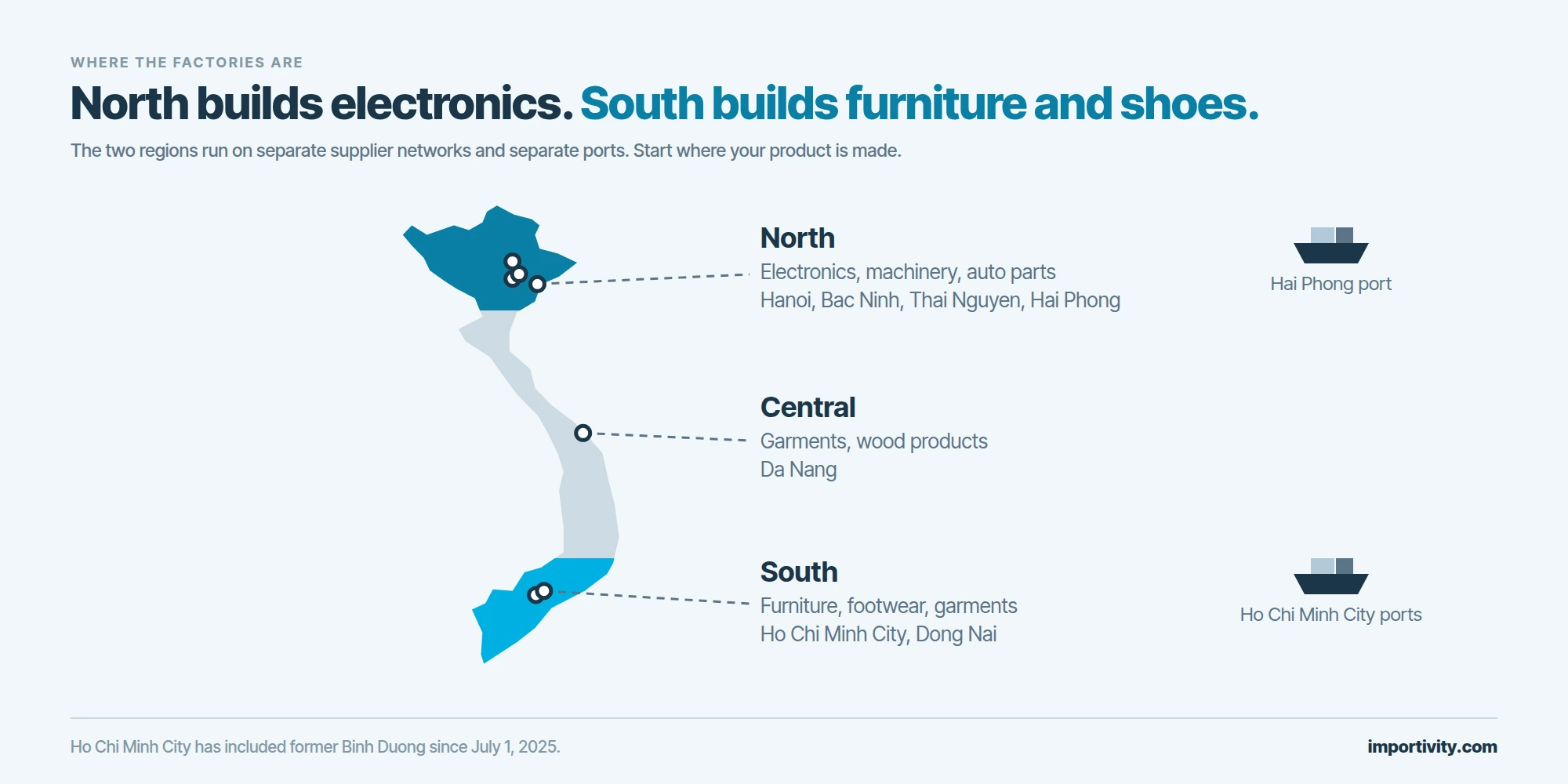
Manufacturers in Vietnam cluster in two regions: the north around Hanoi, Bac Ninh and Hai Phong, which leads in electronics, and the south around Ho Chi Minh City and Dong Nai, which leads in furniture, footwear and garments. Most of the export capacity is foreign owned. Foreign-invested firms shipped 77.3% of Vietnam's $475 billion in 2025 exports. The factories that take smaller US orders are rarely the famous names, so the search comes down to matching your product and volume to the right region and owner.
This guide is for US brands looking for a factory in Vietnam, either as a first overseas supplier or as a second source alongside China. It covers who makes what, where the factories are, what wages and duties look like as of October 31, 2026, and how to find and check one. If you are still choosing a country, start with our China vs Vietnam comparison.
What is manufactured in Vietnam
Vietnam makes four main groups of goods for export, and each one has its own supplier base.
- Electronics. Phones, computers, components and accessories. Samsung builds phones in Bac Ninh and Thai Nguyen, and Foxconn, Luxshare, LG and Pegatron also run plants in the north.
- Footwear. Nike's fiscal 2025 annual report says factories in Vietnam made about 51% of Nike Brand footwear, more than any other country. Pou Chen, one of the largest contract shoemakers, has large plants in the south.
- Apparel and textiles. Cut-and-sew work is spread across the country, and many factories import their fabric. Vinatex and TNG are two of the better-known Vietnamese names. See our guide to Vietnam clothing suppliers.
- Furniture and wood products. Mostly in the south. See our guide to furniture manufacturers in Vietnam.
Plastics, packaging, bags, ceramics and light metal goods are also made there, usually by smaller firms. The companies named here show who is in the market. They are not recommendations, and most will not take small orders.
Where manufacturers in Vietnam are located
Vietnam is long and narrow, so the two main regions run on separate supplier networks and separate ports. Hai Phong serves the north, and the ports around Ho Chi Minh City serve the south. Pick the region that already makes your product.
| Area | What it makes most | Watch out for |
|---|---|---|
| Bac Ninh and Thai Nguyen | Phones, electronics assembly, components | Large plants hold most of the capacity and labor. Smaller orders need a smaller supplier nearby. |
| Hai Phong and Hanoi | Electronics, machinery, auto parts, plastics | Check whether key components are imported, because that affects lead time and origin. |
| Da Nang and central Vietnam | Garments, wood products, some electronics | A smaller supplier base, so fewer choices for each product. |
| Ho Chi Minh City, including former Binh Duong | Furniture, footwear, garments, plastics | Wages sit in the top bands, and old documents may show the former province name. |
| Dong Nai | Footwear, furniture, industrial goods | Many plants compete for the same workers, so ask about turnover and overtime. |
Check addresses with care. On July 1, 2025, Vietnam merged provinces: Binh Duong and Ba Ria-Vung Tau became part of Ho Chi Minh City, Hai Duong became part of Hai Phong, and Bac Giang became part of Bac Ninh. A supplier's older documents may show the old province. Confirm the company by its registration number, not only its address.
Who owns the factories
Vietnam's export numbers mostly belong to foreign-owned plants. Foreign-invested firms shipped $367.1 billion of the $475 billion total in 2025, which is 77.3%. That is about $77 of every $100, and it leaves about $23 for Vietnamese-owned firms.
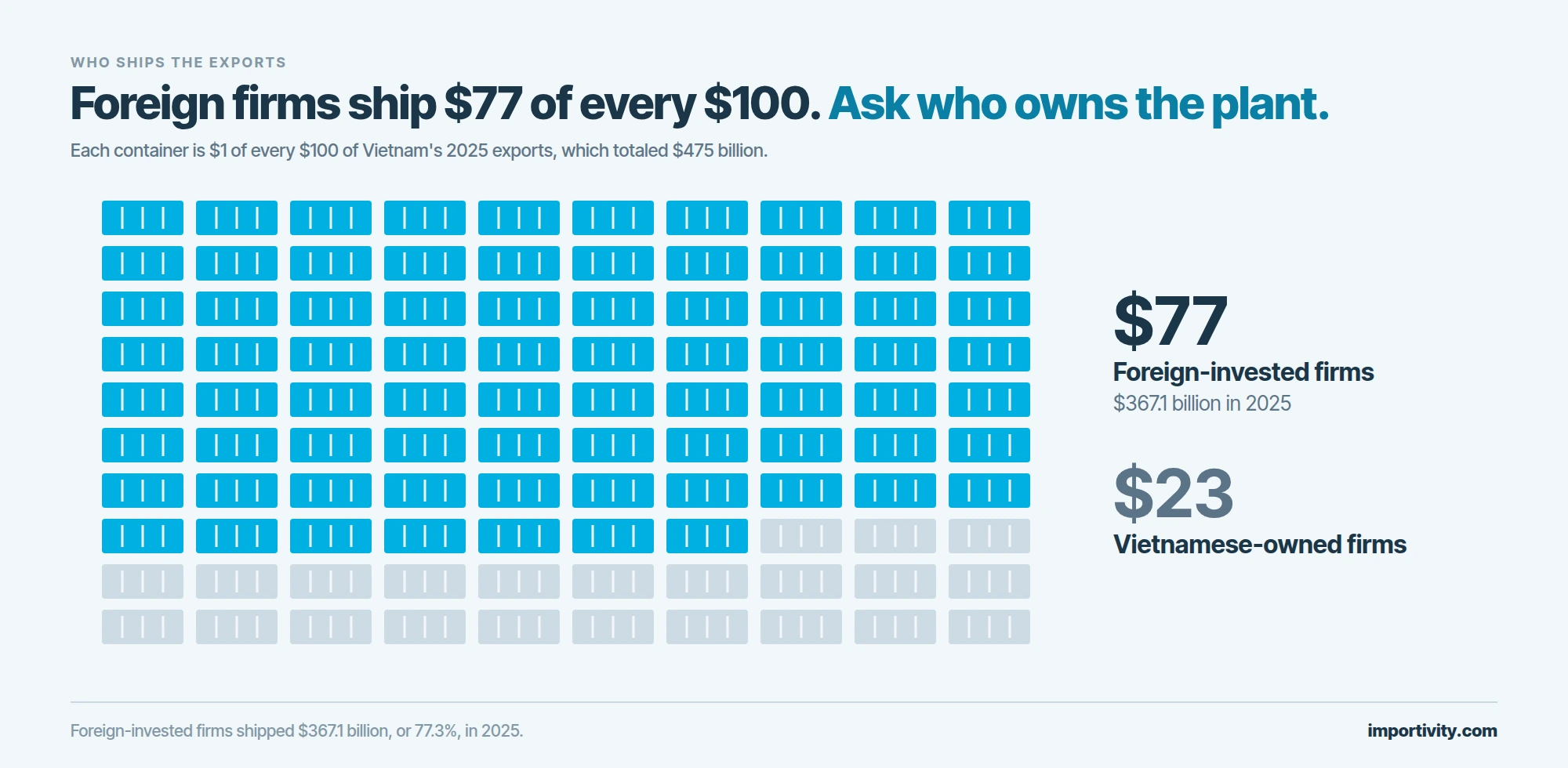
The owner shapes how the factory works with you. Owners often come from South Korea, Taiwan, Singapore, Japan or China.
- Foreign-owned plants. Many already supply global brands, so they tend to have written quality systems and English or Chinese speaking managers. Many also buy their inputs from their home country, and the sales decision may sit in an office abroad.
- Vietnamese-owned factories. They are common in furniture, garments and packaging, and often accept smaller orders. Quality systems vary more, so plan more time for audits and samples.
- Trading companies. They can look like factories online. Ask to see the production floor on a live video call, and read our guide to auditing a factory before you pay.
What manufacturing in Vietnam costs in 2026
Labor. The regional minimum wage rose 7.2% on January 1, 2026 under Decree 293/2025/ND-CP. The top band is 5.31 million dong a month, about $200, and it covers parts of Hanoi, Ho Chi Minh City and Hai Phong. Factory pay runs above the minimum once overtime and allowances are added.
Lead time. Our comparison puts sample-to-shipment at about 25 to 45 days in Vietnam, against about 18 to 35 days in China. The gap often comes from inputs, because fabric, zippers and components may have to arrive from abroad first.
US duty. As of October 31, 2026, goods made in Vietnam pay the normal base rate plus a 12.5% Section 301 forced-labor duty, unless an exemption applies. They do not pay the China Section 301 lists. The 20% reciprocal tariff and the 40% transshipment penalty ended when the Supreme Court struck down the IEEPA tariffs in February 2026.
Here is the difference on a $10.00 backpack with a 17.6% base rate. Made in China on List 3, it pays 17.6% plus 25% plus 12.5%, which is 55.1%, or $5.51. Made in Vietnam, it pays 30.1%, or $3.01. Our guide to tariff stacking walks through the same example. That saving assumes the same factory price, which is rarely true, so compare your own landed cost.
One of our published cases shows the size of the saving: an $18,000 backup mold in Vietnam took about 30% of a brand's output out of a 25% Section 301 duty and avoided about $480,000 a year.
The rate may change. USTR opened a Section 301 case on industrial excess capacity in March 2026 that includes Vietnam, and we could not find a published action in that case as of October 31, 2026. A separate Section 301 case on Vietnam and intellectual property has a final determination due by November 29, 2026.
Origin also has to be real. A product finished in Vietnam from Chinese parts can still be Chinese for US customs. Read Vietnam origin and transshipment risk before you place an order on that basis.
How to find a manufacturer in Vietnam
- Start from US import records. Bill of lading data services such as ImportGenius and Panjiva show which Vietnamese exporters ship products like yours to US buyers. A supplier that already ships to the US knows the paperwork.
- Go to a trade show. Shows are organized by industry. NEPCON Vietnam in Hanoi covers electronics manufacturing, and our furniture guide lists the main furniture shows.
- Use industrial park tenant lists. Many parks publish their tenants, which helps when you already know the region.
- Treat online marketplaces as a starting list. Fewer Vietnamese factories list online than Chinese ones, and many listings are trading companies.
- Work with a sourcing partner. You pay a fee, and you skip checking suppliers one by one. Our Vietnam manufacturing sourcing page explains how we do it.
How to check a Vietnamese factory before you pay
- Check the registration. Ask for the Enterprise Registration Certificate and look up the company on Vietnam's National Business Registration Portal.
- Send one RFQ to three to five factories. Use the same manufacturing RFQ so you can compare the quotes.
- Ask where each input comes from. Keep the answers in your origin file.
- Pay for a sample before tooling. Confirm the factory can hit your specification, then agree the final standard in writing.
- Inspect the first order. Book a pre-shipment inspection before you pay the balance.
To find out what your product would cost from Vietnam, send us your product and order details. We shortlist factories that already make something close to it and vet them before you pay a deposit.
Frequently Asked Questions
What major brands are manufactured in Vietnam?
Nike is the best documented case: factories in Vietnam made about 51% of Nike Brand footwear in fiscal 2025. Samsung builds phones in Bac Ninh and Thai Nguyen. Many other global footwear, apparel, furniture and electronics brands also buy from factories there.
What are the top manufacturing companies in Vietnam?
The largest are mostly foreign owned, such as Samsung, Foxconn, LG, Luxshare and Pegatron in electronics, and large contract footwear groups that supply global brands. Vietnamese firms such as Hoa Phat in steel and VinFast in vehicles are also large. Most will not take small orders.
What products are manufactured in Vietnam?
The main export groups are electronics and phones, footwear, apparel and textiles, and furniture and wood products. Plastics, packaging, bags, ceramics and light metal goods are also made there. The north leads in electronics, and the south leads in furniture, footwear and garments.
How can I find suppliers from Vietnam?
Start with US bill of lading data to see who already ships products like yours, then add trade shows, industrial park tenant lists and online marketplaces. Check each company's Enterprise Registration Certificate, confirm it is a factory on a live video call, and order a sample before you commit.
Do factories in Vietnam accept small orders?
Some do. Vietnamese-owned factories in furniture, garments and packaging often accept smaller orders than large foreign-owned plants. Minimums vary by product and factory, and imported inputs such as fabric can raise them. Put your order size in your RFQ so each factory can answer directly.
About the author
Jordan Lewis
Chief Operating Officer, Importivity
Runs Importivity's sourcing operations across China, Vietnam, Mexico and India, from supplier negotiation through landed delivery.
Press and media inquiries: press@importivity.com