Clothing Manufacturers in the USA (Where They Are, Minimums and Costs)
Clothing manufacturers in the USA are concentrated in Los Angeles, which holds about 23% of the country's 72,600 apparel manufacturing jobs, with a smaller cluster in New York City and large numbers of yarn and fabric mill jobs in Georgia and the Carolinas. US factories suit runs of about 25 to 500 pieces a style, fast reorders and Made in USA lines, while Mexico, Central America and Asia usually cost less per piece on large runs.
This guide is for US brands deciding whether to make clothing at home or overseas. It covers where the factories are, what they cost against Mexico and Asia as of November 9, 2026, how to find one, and what the FTC requires before you sew "Made in USA" into a label. For our wider view of domestic production across industries, see manufacturing in the USA.
Where clothing manufacturers in the USA are located
The US makes very little of the clothing it buys. The American Apparel & Footwear Association says roughly 97% of clothes and shoes bought in the US are imported. Bureau of Labor Statistics figures reported by Glossy in August 2026 put US apparel manufacturing at about 72,600 jobs in June 2026, and BLS data show about 17,000 of them were in the Los Angeles-Long Beach-Glendale area. That is about 23 of every 100 jobs. The other 77, about 55,600 jobs, are spread across the rest of the country.
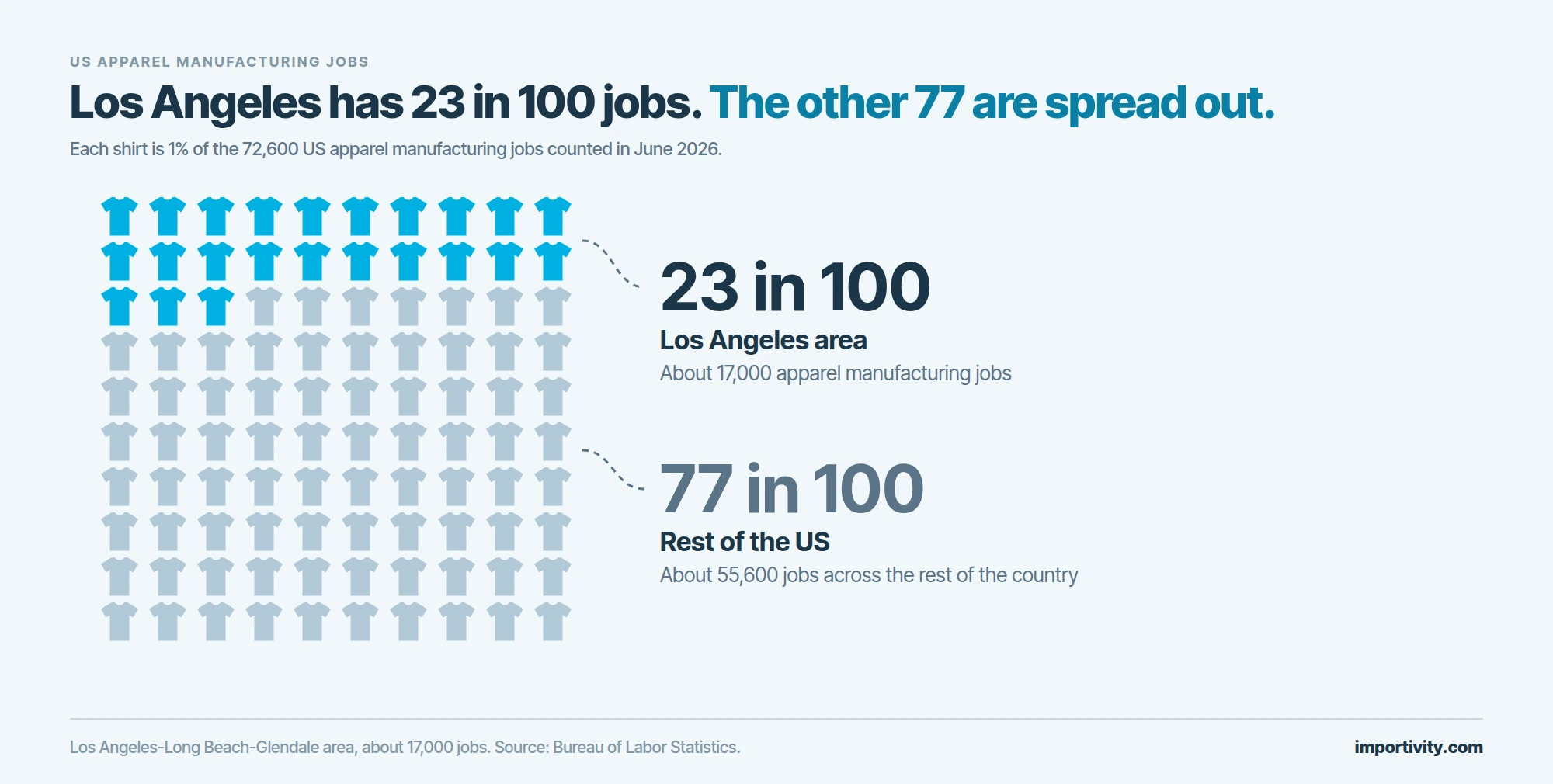
- Los Angeles. California's Employment Development Department counts just over 1,500 apparel manufacturing businesses in Los Angeles County. Most of the work is cut and sew, along with the trades around it: pattern makers, cutters, pressers and packers. Local garment employment peaked at around 100,000 in the 1990s, against about 17,000 in June 2026.
- New York City. The Garment District in Midtown Manhattan has the city's main group of cut-and-sew shops and pattern makers. It suits samples and short runs for designer brands.
- The Southeast. This is where the textile mills are. The National Council of Textile Organizations counts 38,007 textile jobs in Georgia, 25,334 in North Carolina and 14,360 in South Carolina, from BLS data for September 2025. Their yarn and fabric matter even if you sew elsewhere, because the trade deals covered below look at where the yarn was spun.
- Other states. Smaller shops are spread across the rest of the country, so a directory search by product type works better than a search by city. To see where one workwear brand makes its clothes, read our post on where Carhartt is made.
Pick the shop by product first, then by city. Many contractors only cut and sew, so you buy and deliver the fabric.
The kinds of US clothing factories
US apparel makers fall into five groups, and each one needs different inputs from you.
- Cut-and-sew contractors (CMT). They cut, make and trim to your pattern, using fabric and trims you buy. The price per piece is lower than full package, but you manage the fabric order, its timing and any shortfall.
- Full-package manufacturers. They buy the fabric and trims, make the pattern and samples, and ship finished goods. You pay more per piece and see less of the fabric source, which matters if you plan a Made in USA claim.
- Knitting mills. They knit fabric, or whole garments such as sweaters and socks. Fabric is sold by the yard or pound, with its own minimum for each color.
- Blank makers and decorators. Decorators print or embroider your logo on stock blanks. Many blanks sold in the US are sewn abroad, and printing them here does not change their origin. In a 2011 ruling, CBP said imported plain T-shirts must be marked with their real country of origin and rejected a proposed "Printed in U.S.A." mark.
- Pattern makers and sample rooms. They turn a sketch and a tech pack into a graded pattern and a first sample. You can develop the pattern and sample here and still make the bulk order somewhere else.
US clothing factories against Mexico, Central America and Asia
The table compares the three choices on the points that decide most orders. The Asian minimums come from our guides to private label clothing manufacturers and Vietnam clothing suppliers. Minimums are per style and often per color too, so a style in three colors can need three times the units.
| Factor | United States | Mexico and Central America | Asia |
|---|---|---|---|
| Typical minimum per style | 25 to 500 pieces, per Maker's Row's 2026 guide | No published range. Output leans to basic cotton T-shirts and sweaters, so ask each plant. | 100 to 300 pieces at many private label factories, 3,000 or more at large export plants in Vietnam |
| Transit to a US warehouse | Ground freight with no customs entry | Monterrey to Dallas by truck in 2 to 3 days | Shanghai to Los Angeles in about 30 to 40 days door to door |
| Labor cost reference | Sewing operators earn a median $16.56 an hour (BLS, May 2023) | Mexico's general minimum wage is 315.04 pesos a day in 2026 | Vietnam's top minimum wage band is 5.31 million dong, about $200, a month in 2026 |
| US duty on a cotton T-shirt, November 2026 | None | 0% from Mexico if it qualifies under USMCA, 26.5% if it does not | 29% from Vietnam, 36.5% from China |
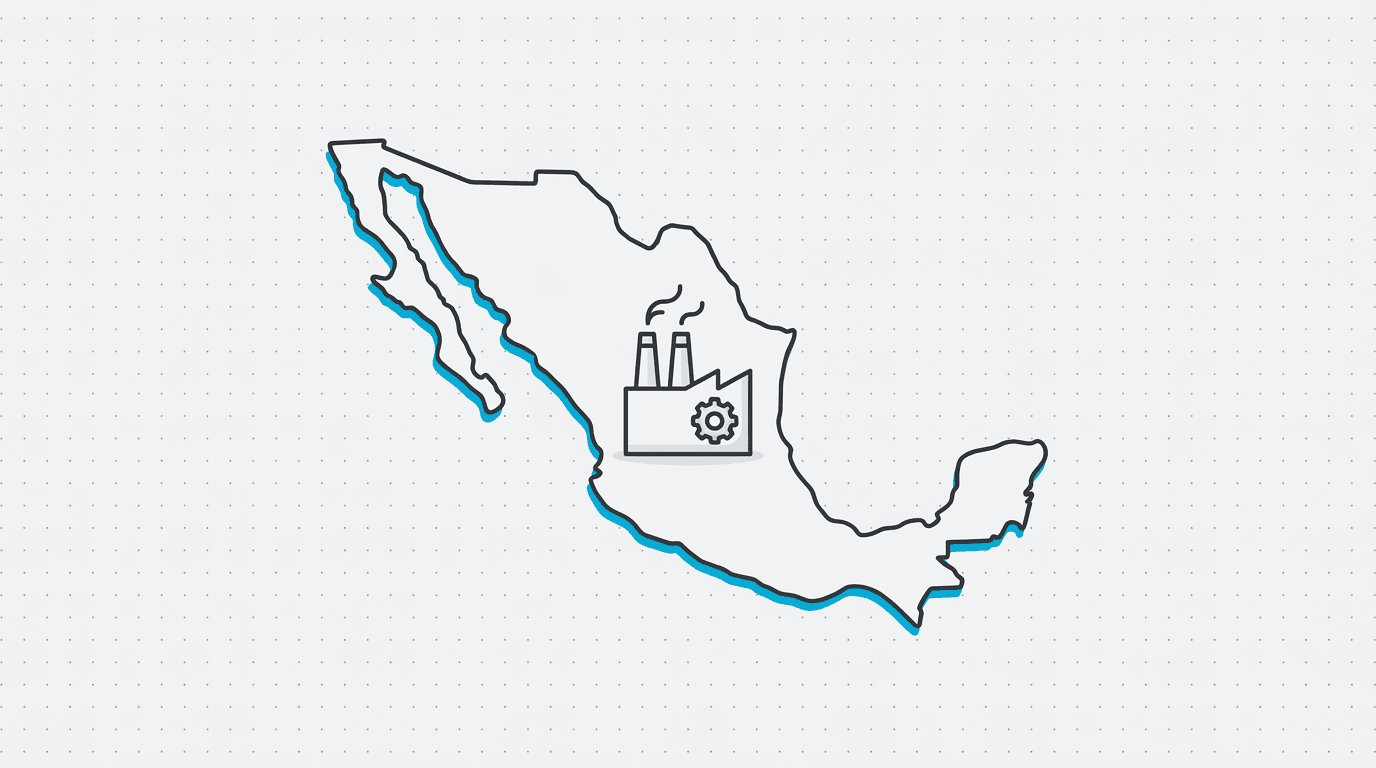
| Best fit | Small runs, fast reorders and Made in USA lines | Basics at volume, duty free when the yarn rule is met | Large runs and the widest choice of fabrics and factories |
Read the labor row with care. The US figure is a median paid wage, while the Mexican and Vietnamese figures are legal minimums, and factory pay in both countries runs above them. Even so, the gap per hour is large. At the BLS median of $16.56 an hour, every 10 minutes of sewing adds $2.76 in wages to a garment, before payroll taxes, benefits and the shop's overhead and margin. Ask each US shop for a price per garment, and ask how many minutes of sewing that price assumes. Wages also differ from state to state, as our manufacturing cost comparison by state shows.
How tariffs change the math in November 2026
Clothing made in the US pays no import duty. Imported clothing pays the base rate for its HTS code plus any 2026 additions. A cotton T-shirt under HTS 6109.10.00 has a 16.5% base rate, and the additions depend on the country.
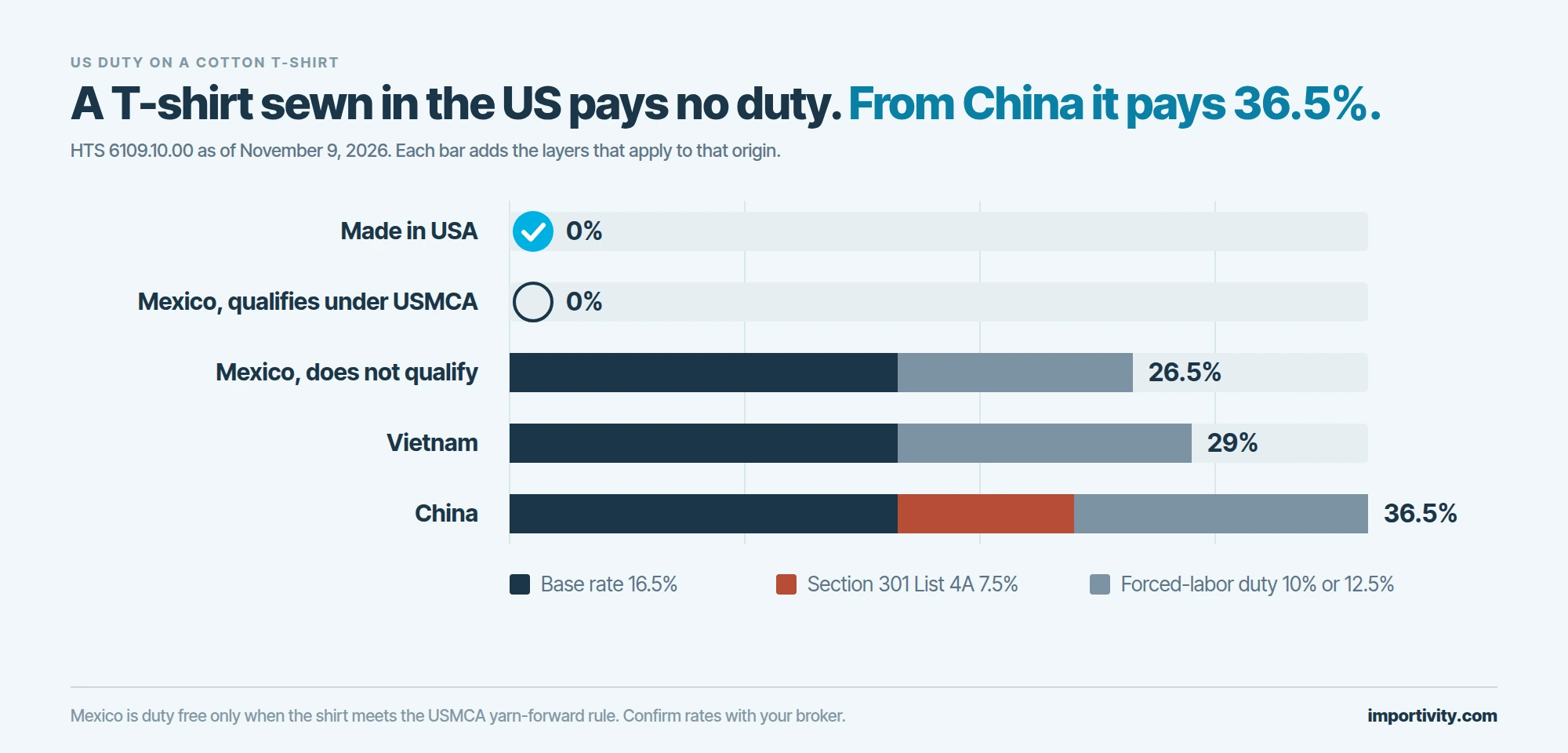
- Made in China. The 16.5% base rate, plus 7.5% under Section 301 List 4A, plus the 12.5% forced-labor duty that started on July 24, 2026, for 36.5% in total.
- Made in Vietnam. The 16.5% base rate plus the 12.5% forced-labor duty, for 29%.
- Made in Mexico. Free of both the base rate and the 10% forced-labor duty if it qualifies under USMCA. If it does not qualify, it pays 16.5% plus 10%, or 26.5%.
- Made in Guatemala, Honduras or El Salvador. The forced-labor rate for these countries is also 10%. Law firm summaries of the July 2026 notice say it exempts textiles and apparel that enter duty free under CAFTA-DR, but they read its scope differently for some of these countries, so get your broker's answer before you price.
Our private label guide puts a basic cut-and-sew tee from China at $3.50 to $7 FOB. At a $5.00 factory price, the 36.5% stack adds $1.83 a shirt. That $1.83 pays for about 6.6 minutes of a US sewing operator's time at the median wage, before overhead. So a US-sewn shirt beats the Chinese one on cost only if its extra labor and overhead come to less than $1.83 plus the freight saved. Our tariff stacking guide shows how each layer is figured.
Duty-free entry from Mexico depends on the yarn-forward rule. Under USMCA, the yarn must be spun, and every later step done, in the US, Mexico or Canada. The sewing thread, narrow elastic and pocket bag fabric must also come from the region. A shirt sewn in Mexico from Asian fabric does not qualify, while one sewn from yarn spun in the Carolinas can. CAFTA-DR uses the same yarn-forward approach for Central America.
How to find clothing manufacturers in the USA
No single list covers every US sewing shop, so use three or four sources and compare what you find.
- Directories. Maker's Row lists US apparel factories with their minimums and services. SEAMS, the trade association for the US sewn products industry, has a member search that includes contractors.
- Trade shows. LA Textile runs in Los Angeles, and Texworld runs editions in New York and Los Angeles. Sourcing at MAGIC in Las Vegas connects brands with manufacturers from many countries.
- Your state's MEP center. NIST's Manufacturing Extension Partnership funds centers in nearly every state and in Puerto Rico. Their advisers work with local manufacturers, so ask which sewing shops in your state take outside work.
Before you place an order, run every shop on your list through the same checks:
- Confirm the work is done in-house. Ask whether any step goes to a subcontractor, and visit the floor where your order will be sewn.
- Ask how operators are paid. US Labor Department investigations have found Los Angeles garment workers paid less than $2 an hour, so ask about pay method and any open wage claims.
- Send one tech pack to three shops. Use the same tech pack and quantities so the quotes compare.
- Pay for a sample. Approve fit and construction on a physical sample before you buy fabric for bulk.
- Get the fabric plan in writing. Agree who buys it, when it arrives, and who pays for shortages and waste.
- Collect origin records. If you plan a Made in USA claim, keep mill invoices that show where the fabric and yarn were made.
Made in USA clothing labels and the FTC standard
Clothing sold in the US must carry a label that shows the country of origin, and the FTC enforces the wording. Two rules matter most.
- The textile rule. Under 16 CFR 303.33, a garment made in the US from imported materials must say so, for example "Made in USA of imported fabric." The check goes one step back: a garment maker must disclose imported fabric, and a fabric maker must disclose imported yarn.
- The Made in USA Labeling Rule. Under 16 CFR Part 323, an unqualified "Made in USA" claim requires that all or virtually all of the product be made in the US. Each violation can bring a civil penalty of up to $53,088 under the FTC's 2025 inflation adjustment.
Enforcement picked up in 2026. Executive Order 14392, signed on March 13, 2026, told the FTC to make false Made in America claims a priority, and on April 14, 2026 the FTC announced actions against three companies over unqualified claims. Apparel has been a target before. In 2022 the FTC ordered a Utah apparel seller to pay about $211,000 after it cut the foreign tags out of imported blank T-shirts and printed "Made in USA" in their place.
If you cut and sew in Los Angeles from fabric knit in North Carolina from US yarn, the label can say Made in USA. If the fabric came from Asia, the label must say Made in USA of imported fabric.
When making clothes in the USA makes sense
US production pays off when speed, small quantities or the origin claim are worth more to you than the lower unit price overseas.
- Small or test runs. Minimums from 25 pieces let you test a style before you commit to an overseas minimum of 100 to 300 pieces or more.
- Fast reorders. A truck from a US shop arrives in days, against about 30 to 40 days door to door by ocean from Shanghai.
- A Made in USA line. If customers pay more for the claim, you can price the higher sewing cost into the product.
It is harder to justify for large runs of styles with many sewing operations, such as lined jackets, because every extra minute is paid at US wages. Many brands keep a US shop for samples, launches and reorders and buy core volume abroad. Our guide to whether local sourcing is cheaper works through that comparison, and our reshoring service helps brands move production home when the numbers work.
To compare US and overseas quotes on the same garment, send us your tech pack and quantities. We help US brands find and vet factories and run quality control. We also handle shipping and tariffs.
Frequently Asked Questions
Where are most clothing manufacturers in the USA located?
Los Angeles is the largest cluster. BLS data show about 17,000 of the 72,600 US apparel manufacturing jobs were in the Los Angeles area in June 2026, or about 23%, and Los Angeles County has just over 1,500 apparel manufacturing businesses. New York City's Garment District has a smaller group of cut-and-sew shops and pattern makers, and Georgia, North Carolina and South Carolina have large numbers of textile mill jobs.
What is the minimum order for a clothing manufacturer in the USA?
Minimums at US cut-and-sew shops commonly run from about 25 to 500 pieces per style, according to the 2026 guide from the Maker's Row directory. Many shops also set a minimum per color, and fabric mills set their own minimum per color, which can push the real order higher. Many private label factories in Asia start at 100 to 300 pieces per style, and large export plants want 3,000 or more.
Is it cheaper to make clothes in the USA or overseas?
On most garments the overseas factory price is lower, because US sewing operators earn a median of $16.56 an hour. Duty narrows the gap. A cotton T-shirt from China pays 36.5% as of November 2026, while one sewn in the US pays nothing. Compare the landed cost per piece, including freight, duty and the time your cash is tied up in stock, before you decide.
Can clothing be labeled Made in USA if the fabric is imported?
Not without a qualifier. Under the FTC textile rule, a garment sewn in the US from imported fabric must say so, for example Made in USA of imported fabric. An unqualified Made in USA claim requires that all or virtually all of the product be made in the US, and each violation of the FTC labeling rule can carry a civil penalty of up to $53,088 under the FTC's 2025 inflation adjustment.
How do I find a clothing manufacturer in the USA?
Start with directories such as Maker's Row and the SEAMS member search, then visit trade shows such as the LA Textile Show and Texworld. Your state's Manufacturing Extension Partnership center can suggest local shops. Send the same tech pack and quantities to three shops, pay for a sample, and visit the floor where your order will be sewn before you commit.
About the author
Jordan Lewis
Chief Operating Officer, Importivity
Runs Importivity's sourcing operations across China, Vietnam, Mexico and India, from supplier negotiation through landed delivery.
Press and media inquiries: press@importivity.com