How to Start a Clothing Brand (Production Options, Costs and Steps)
To start a clothing brand, first decide how the clothes will be made: print on demand, blank garments that you have printed, a factory's private label styles, or cut and sew from your own patterns. The two factory routes then follow the same steps: a tech pack, a factory shortlist, paid samples, an order sized to the minimum, inspection, shipping, US duty and the labels federal rules require.
This guide is for founders who have the designs and now need the production side, which store-platform guides tend to skip. It compares what each route costs to start and works through the minimum order and pricing math on a basic cotton T-shirt. If you already know your route, our tech pack guide shows the file a factory quotes from.
The four ways to get your clothes made
The route you pick sets three numbers: how many pieces you must buy per design, how much cash goes out before the first sale, and how much of each sale you keep. Each step down the list costs more up front and gives you more control over the garment.
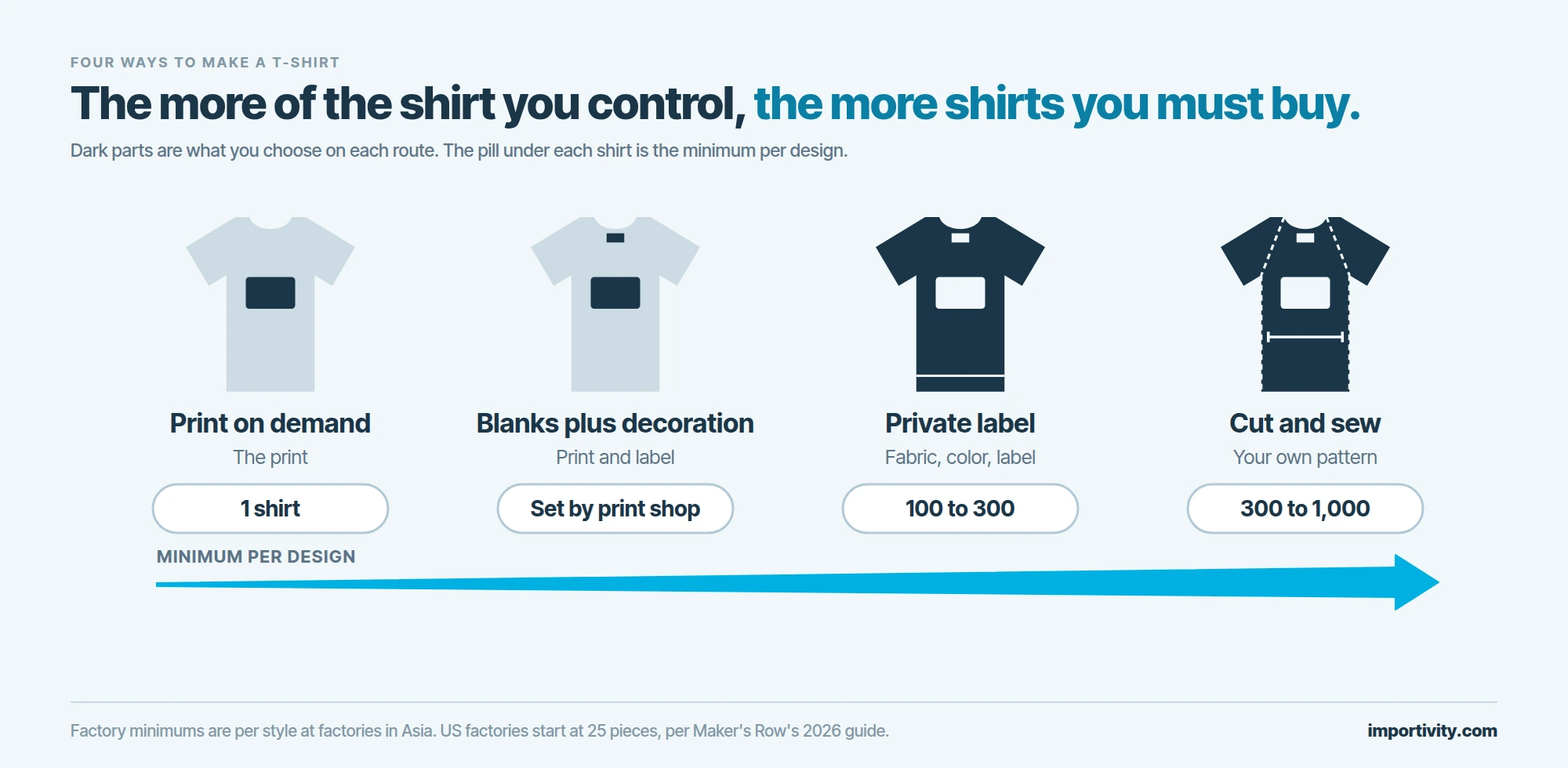
- Print on demand. A print-on-demand company prints your design on one of its blanks after a customer orders, then ships it. You hold no stock. As of November 2026, Printful lists T-shirt printing from $7.78 a shirt, and its US shipping rate for T-shirts is $4.95 for the first shirt and $2.20 for each extra shirt in the order. The $7.78 is an entry price, so check the blank you want.
- Blanks plus decoration. You buy blank garments and pay a shop to screen print or embroider them. Underground Shirts, a custom print shop, puts 100 standard T-shirts with a one-color front print at $8 to $15 a shirt, a price that includes the blank shirt and all print costs.
- Private label. A factory makes one of its existing styles in your fabric color, with your labels and small changes such as length. Our private label clothing manufacturer guide puts the floor at 100 to 300 pieces per style at most factories in Asia, and a basic T-shirt from China at $3.50 to $7 FOB, the price before freight and duty.
- Cut and sew. A factory makes your own design from your tech pack and pattern, in fabric you choose. Our private label guide puts overseas cut-and-sew minimums at 300 to 1,000 pieces per style, and Maker's Row's 2026 guide puts US factories at 25 to 500. You pay for the tech pack, pattern and samples before any bulk order.
Factories use "private label" and "white label" loosely, so confirm in writing whose pattern they will use. Our comparison of private label and white label explains the difference.
| Route | Minimum per design | Cash out before the first sale | Cost per shirt, and what you keep at a $30 price |
|---|---|---|---|
| Print on demand | 1 shirt | About $12.73 for one sample shipped to you ($7.78 plus $4.95) | From $7.78, so you keep $22.22, or $17.27 if you pay the $4.95 shipping |
| Blanks plus a one-color screen print | Set by the print shop | $800 to $1,500 for 100 printed shirts | $8 to $15, so you keep $15 to $22 |
| Private label, made in China | 100 to 300 per style | $1,433 to $2,867 for 300 shirts with duty, before samples and freight | $4.78 to $9.56 with duty, so you keep $20.44 to $25.22 before freight |
| Cut and sew, made in China | 300 to 1,000 per style | The private label figure plus $500 to $2,000 for a tech pack, and pattern and sample fees | The same factory price range, but the first run also carries the development costs |
"What you keep" is $30 minus the cost per shirt, before fees, returns and shipping to your customer. The factory rows add the 36.5% US duty that applies to a cotton T-shirt from China as of November 2026: 300 shirts at $3.50 is $1,050, and $1,433.25 with duty. Our guide to import tax from China to the US shows each layer of that rate. Print on demand needs the least cash, because you pay for each shirt only after it sells. A factory run can keep the most per shirt, $25.22 at the low end of the price range, but you pay for all 300 shirts whether they sell or not.
Step 1: turn the design into a tech pack
For print on demand and blanks, the blank's published spec is your garment spec, and you supply the artwork, print size and placement. For private label and cut and sew, a factory needs a tech pack before it can give a firm quote: flat sketches, a bill of materials, a graded measurement chart with tolerances, construction details, colorways, artwork, labels and packing.
- Who makes it. Guru's pricing guide puts a standard tech pack from a US freelance designer at $500 to $2,000, or about 5 to 20 hours of work. For a simple knit, you can fill in the template in our tech pack guide.
- Fabric. Write the fiber, construction and weight, such as 100% combed cotton single jersey at 180 GSM. A mill's stock colors usually carry lower minimums, because each custom color is dyed as its own lot.
- Sizes and styles. Each size takes a share of the minimum, and each style carries its own minimum and samples. Start with two or three styles in the sizes your customers buy most.
Step 2: find a factory and get samples
Ask at least three factories to quote on the same tech pack and the same quantities, so you can compare the prices.
- In the US. Maker's Row and the member search of SEAMS, the US sewn products association, list sewing contractors. Our guide to clothing manufacturers in the USA compares US shops with Mexico and Asia.
- Overseas. Sourcing at MAGIC, a trade show in Las Vegas, connects brands with factories from many countries. Our guide to Vietnam clothing suppliers puts small-batch factories there at 50 to 300 pieces per style.
Get these answers in writing: the minimum per style, color and size; the sample fee and whether it is credited against the bulk order; the fabric source and its minimum; the lead time from sample approval to shipping; and the payment terms.
Plan for two sample rounds: a first sample for fit and construction, then a pre-production sample in the bulk fabric, trims and labels. Our pre-production sample guide puts a first sample of most soft goods at $50 to $300 and a cycle with two revision rounds at 8 to 12 weeks. Approve only a sample you have measured in hand, because it becomes the standard for the bulk order.
MOQ and pricing math for your first order
You pay for the tech pack and samples once, and on a first run that cost is spread over a small number of shirts. Take one style of 300 cotton T-shirts in one color, made in China at a $5.00 factory price, inside the $3.50 to $7 range above.
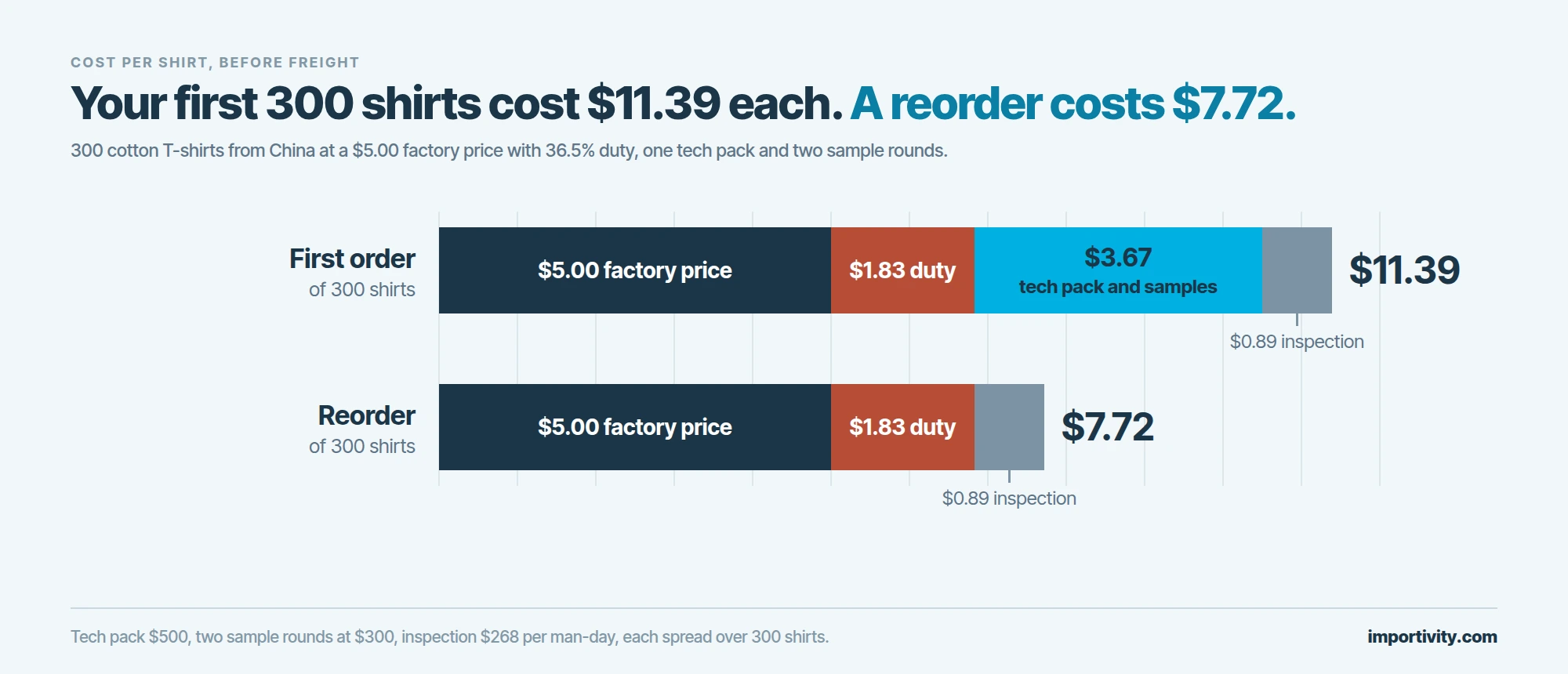
- Factory price. 300 shirts at $5.00 is $1,500.
- Duty. 36.5% of $1,500 is $547.50, or $1.83 a shirt: the 16.5% regular rate for HTS 6109.10.00, 7.5% under Section 301 List 4A and the 12.5% forced-labor duty in force since July 24, 2026. From Vietnam the rate is 29%, or $1.45 a shirt.
- Tech pack. $500, the low end of Guru's range, or $1.67 a shirt.
- Samples. Two rounds at $300 each, the top of our sampling guide's range: $600, or $2.00 a shirt.
- Inspection. One man-day at V-Trust's published rate of $268, or $0.89 a shirt.
That is $3,415.50, or $11.39 a shirt before freight, and the tech pack and samples account for $3.67 of it. A reorder skips them and costs $2,315.50, or $7.72 a shirt. Freight is extra: at the Freightos Air Index rate for China to North America, $6.88 per kg on October 20, 2026, each 100 kg of cartons costs about $688 before fees. Our guide to calculating landed cost lists the other charges.
The minimum also multiplies. If a factory sets 300 pieces per color, one T-shirt in black, white and gray is 900 shirts. Our guide to what MOQ means covers the kinds of minimum and why factories set them.
Price from the landed cost. If you sell direct at $30, the $11.39 shirt leaves you $18.61 before freight, payment fees and marketing. Stores need their own margin: Shopify's guide to keystone pricing describes a retail price at two times the wholesale cost, so a $30 shirt in a store means a $15 wholesale price. That leaves you $3.61 a shirt on the first run and $7.28 on a reorder, before freight.
Production, inspection, shipping and duty
Many factories take a deposit with the order and the balance before shipping. The steps below protect that payment.
- Write the standard into the order. Name the tech pack revision, the approved sample, the quantity by color and size, the ship date and what happens if the inspection fails.
- Inspect before you pay the balance. Book a pre-shipment inspection for when production is 100% complete and at least 80% packed. Our quality control service runs these inspections.
- Choose air or ocean. Air suits a first order of a few hundred shirts. Ocean costs less per kilo but takes about 30 to 40 days door to door from China, by Freightos's estimate.
- Know who pays the duty. The importer of record pays. If you buy FOB, that is you, through your customs broker. Under DDP, the seller pays and builds the duty into your price. Duty-free entry for shipments of $800 or less ended for all countries on August 29, 2025. Confirm the rate for your exact HTS code with your broker before you order.
- Add the entry fees. For fiscal year 2027, the merchandise processing fee is 0.3464% of value, with a minimum of $34.58 and a maximum of $670.86 per formal entry. Ocean cargo also pays a 0.125% harbor maintenance fee, and a formal entry needs a customs bond.
US label rules for clothing
Clothing sold in the US needs a label inside it, whichever route you choose. Under the FTC's Textile Act rules and its Care Labeling Rule, the labels must show four things.
- Fiber content. Generic fiber names with the percentage of each by weight, such as 100% cotton.
- Country of origin. On a garment with a neck, at the inside center of the neck, midway between the shoulder seams, or next to another label there.
- Your name or RN number. The business responsible for the garment, or the Registered Identification Number the FTC issued to it.
- Care instructions. On a label permanently attached to the garment.
The FTC guide Threading Your Way Through the Labeling Requirements has worked examples. Printing a blank in the US does not change where it was made: in 2022 the FTC ordered a Utah apparel seller to pay about $211,000 after it cut the foreign tags out of imported blanks and printed "Made in USA" in their place. A shirt sewn in the US from imported fabric must say so, for example "Made in USA of imported fabric."
Clothing for children 12 and under adds CPSC rules. Each product needs a Children's Product Certificate based on tests by a CPSC-accepted third-party lab, and permanent tracking labels on the garment and its packaging. All clothing must meet the flammability standard in 16 CFR part 1610, and children's sleepwear in sizes 0 to 14 must meet the stricter parts 1615 and 1616 unless it is an infant garment or is tight fitting and labeled "Wear Snug-fitting, Not Flame Resistant." Since 2011 the CPSC has treated hood and neck drawstrings on children's upper outerwear as a substantial product hazard. Its overview of textile and apparel requirements shows which rules apply to which garments.
Checklist before your first production order
- Budget. Cash for the full minimum, tech pack, samples, inspection, freight and duty.
- Tech pack. A revision number on every page and the fabric written by fiber, construction and GSM.
- Quotes. Three, from the same tech pack and quantities, with minimums per style, color and size.
- Sample. A pre-production sample measured against your chart and kept as the standard.
- Price. A landed cost per shirt, and direct and wholesale prices that both leave a margin.
- Labels. Fiber, origin, name or RN and care, plus a certificate and tracking labels for children's clothing.
- Inspection and customs. An inspection booked before the balance is due, and a broker and bond in place.
If you want factories that make your garment to quote on your tech pack, send us your designs and quantities. We help US brands find and vet factories and run quality control. We also handle shipping and tariffs.
Frequently Asked Questions
How much does it cost to start a clothing brand?
It depends on how the clothes are made. Print on demand needs about $12.73 for a sample T-shirt. A run of 100 screen printed blanks costs $800 to $1,500 at one print shop's prices. At factory prices of $3.50 to $7 a shirt, a run of 300 T-shirts from China costs $1,433 to $2,867 with duty, before samples and freight. A custom design adds a $500 to $2,000 tech pack.
How do I start a clothing line with no money?
Start with print on demand. The printer makes and ships each shirt after a customer pays, so you buy no stock. Printful listed T-shirt printing from $7.78 in November 2026, plus $4.95 to ship one shirt in the US. You pay for a shirt only after it sells, so you can test designs before you buy a factory minimum.
What is the minimum order for a clothing manufacturer?
Factories set minimums per style and often per color. Our private label guide puts the floor at 100 to 300 pieces per style at most factories in Asia, and 300 to 1,000 for cut and sew. Maker's Row's 2026 guide puts US factories at 25 to 500. At 300 per color, one T-shirt in three colors is 900 shirts.
Do I need a tech pack to start a clothing brand?
Not for print on demand or printed blanks, where the blank's own spec is the garment spec. A factory needs one to quote a private label or cut-and-sew style: sketches, materials, a graded measurement chart with tolerances, construction, colors, labels and packing. Guru's pricing guide puts one from a US freelance designer at $500 to $2,000.
What labels does clothing need to be sold in the US?
FTC rules require the fiber content by percentage, the country of origin, and your business name or RN number, plus a permanent care label. On a garment with a neck, the origin goes at the inside center of the neck. Clothing for children 12 and under also needs a Children's Product Certificate and permanent tracking labels.
About the author
Jordan Lewis
Chief Operating Officer, Importivity
Runs Importivity's sourcing operations across China, Vietnam, Mexico and India, from supplier negotiation through landed delivery.
Press and media inquiries: press@importivity.com