How to Buy From 1688 as a US Company and What It Really Costs
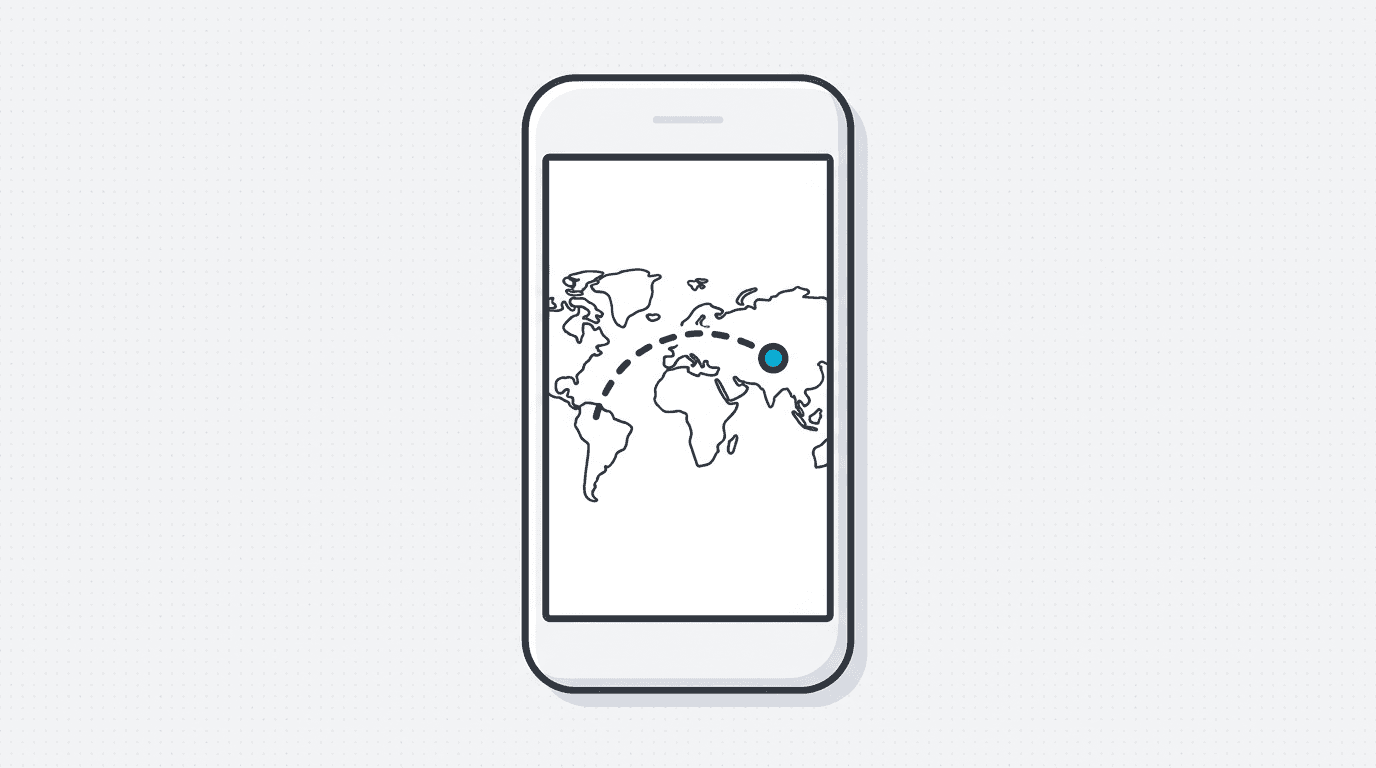
To buy from 1688 as a US company, you order through a buying agent or a China-based forwarder that holds a 1688 account: the agent pays each seller in yuan, the sellers ship to the agent's warehouse in China, and the agent checks, repacks and exports the goods to you. You need that middle step because 1688 is Alibaba's domestic wholesale marketplace, and most of its sellers work in Chinese, take Chinese payment methods and deliver only inside China.
This guide is for US brands and product companies looking at 1688 for samples, small runs, components, packaging or stock items. It covers what 1688 is, how an order gets from a seller to your door, what the price gap with Alibaba.com looks like once every cost is added back, the risks, and when Alibaba.com or a direct factory is the better route. If you are still choosing between platforms, our guide to Alibaba alternatives covers the others.
What 1688 Is and How It Differs From Alibaba.com
Alibaba Group runs two wholesale sites for two different buyers. Its fiscal 2026 annual report describes 1688.com as an integrated domestic wholesale marketplace in China, and Alibaba.com as an integrated international online wholesale marketplace. 1688 connects manufacturers and wholesale sellers with wholesale buyers inside China, and the way it is built follows from that.
- Language. The whole site is in Chinese, and most sellers have limited English, according to the payments company WorldFirst, which offers a way to pay 1688 suppliers from outside China.
- Payment. Prices are in yuan. Many sellers expect Alipay, WeChat Pay or a mainland China bank transfer, and only some accept international cards.
- Delivery. Most sellers deliver only to addresses inside China, and few of them export, file customs paperwork or quote FOB.
- Order size. Many listings take very small orders, some as few as two pieces. For a buyer who needs a few hundred units, that is the attraction.
- Seller status. Sellers can buy an annual China TrustPass membership to list and sell. The fee buys selling rights. It does not show whether the seller makes anything.
Alibaba.com is built for the opposite buyer. Suppliers there typically quote in US dollars, write to you in English, handle export and can take payment through Trade Assurance, the order protection program covered in our guide to whether Alibaba is safe. That program belongs to Alibaba.com and does not reach a 1688 order.
On both sites, the seller behind a listing may or may not make the product. A 1688 shop can be a factory selling its own catalog line or a reseller several steps away from the production line. Our guide to buying from a manufacturer, wholesaler or trading company shows how to tell which one you are dealing with from its business license.
How a US Buyer Actually Places a 1688 Order
Every route into 1688 has the same shape. Several sellers ship to one warehouse in China, the goods are checked and packed together there, and one export shipment leaves for the US. The graphic below shows that path and the one point where someone working for you can still look at the goods.
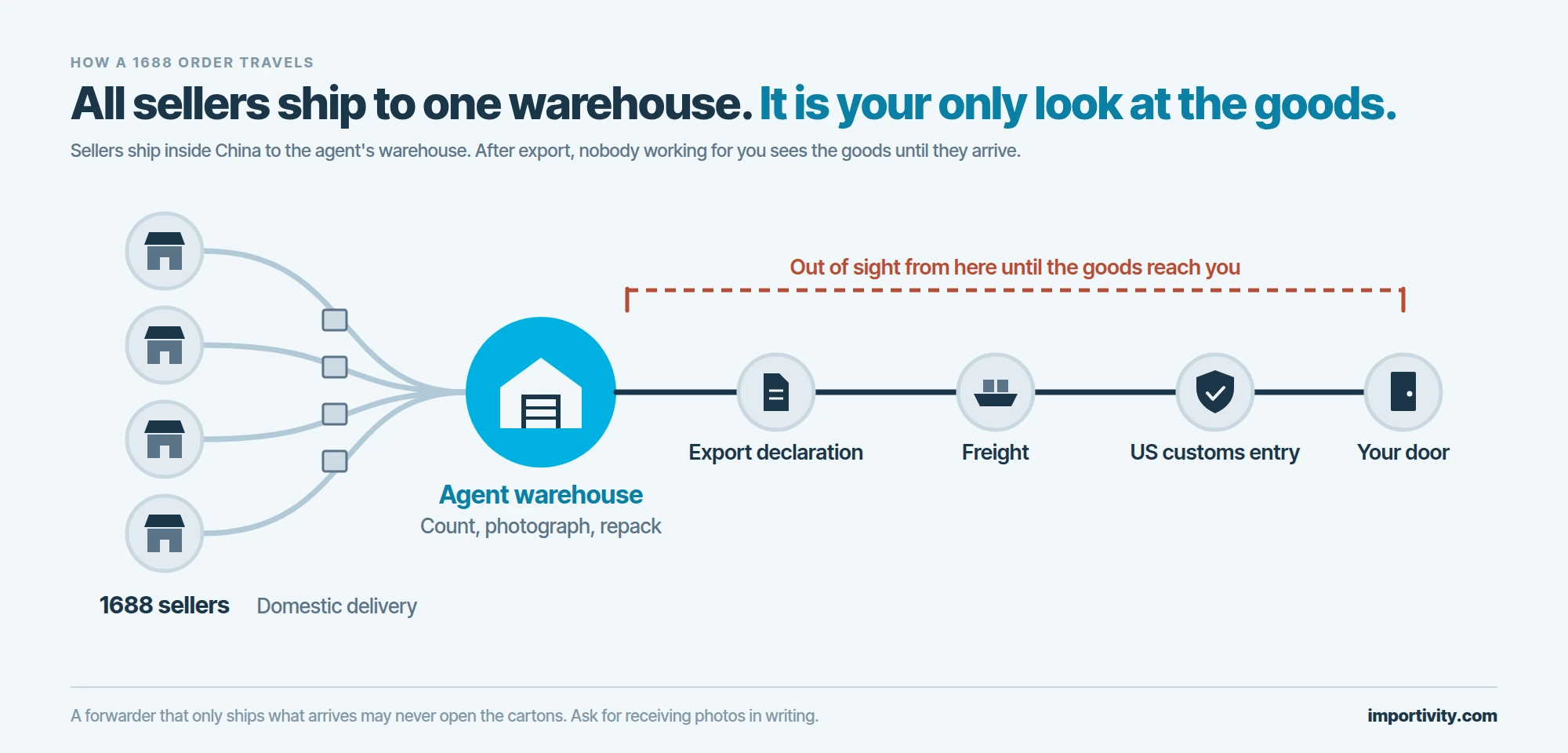
The routes differ in who does the searching and who carries the risk. A full-service buying agent finds products, talks to sellers, pays, inspects and ships. A purchasing service or forwarder orders only from the links you send and ships whatever arrives. A sourcing partner may use a 1688 listing only to find the factory behind it and then buy from that factory directly. Our guide to what a China sourcing agent costs covers the fee models, including the seller rebate problem, which applies to 1688 agents as well.
A typical order runs in seven steps:
- Send the links or the spec. The agent confirms price, stock or production time, domestic shipping, and whether the price includes a VAT invoice.
- Pay the agent. You pay in dollars and the agent pays each seller in yuan. Ask which exchange rate it uses and what it charges for the conversion.
- Domestic delivery. Each seller ships to the agent's warehouse by courier or truck. A seller far from the warehouse costs more to ship from and takes longer to arrive.
- Receiving and inspection. The agent counts the cartons, opens them and sends photos or a short inspection note. This is the last time anyone on your side sees the goods in China.
- Repacking and labels. Orders from several sellers go into export cartons. Goods made for the Chinese market usually need English labels and a country of origin mark, because US law requires imported goods to show where they were made.
- Export and freight. The agent or its forwarder files the Chinese export declaration and books express, air or ocean freight.
- US customs entry. Your carrier, your broker or you file the entry and pay duty. Since the de minimis exemption was suspended, even a small express shipment needs an entry, as our guide to the end of de minimis explains. Shipments valued at $2,500 or less can use an informal entry, and anything above that needs a formal entry and a customs bond.
The Real Price Gap With Alibaba.com
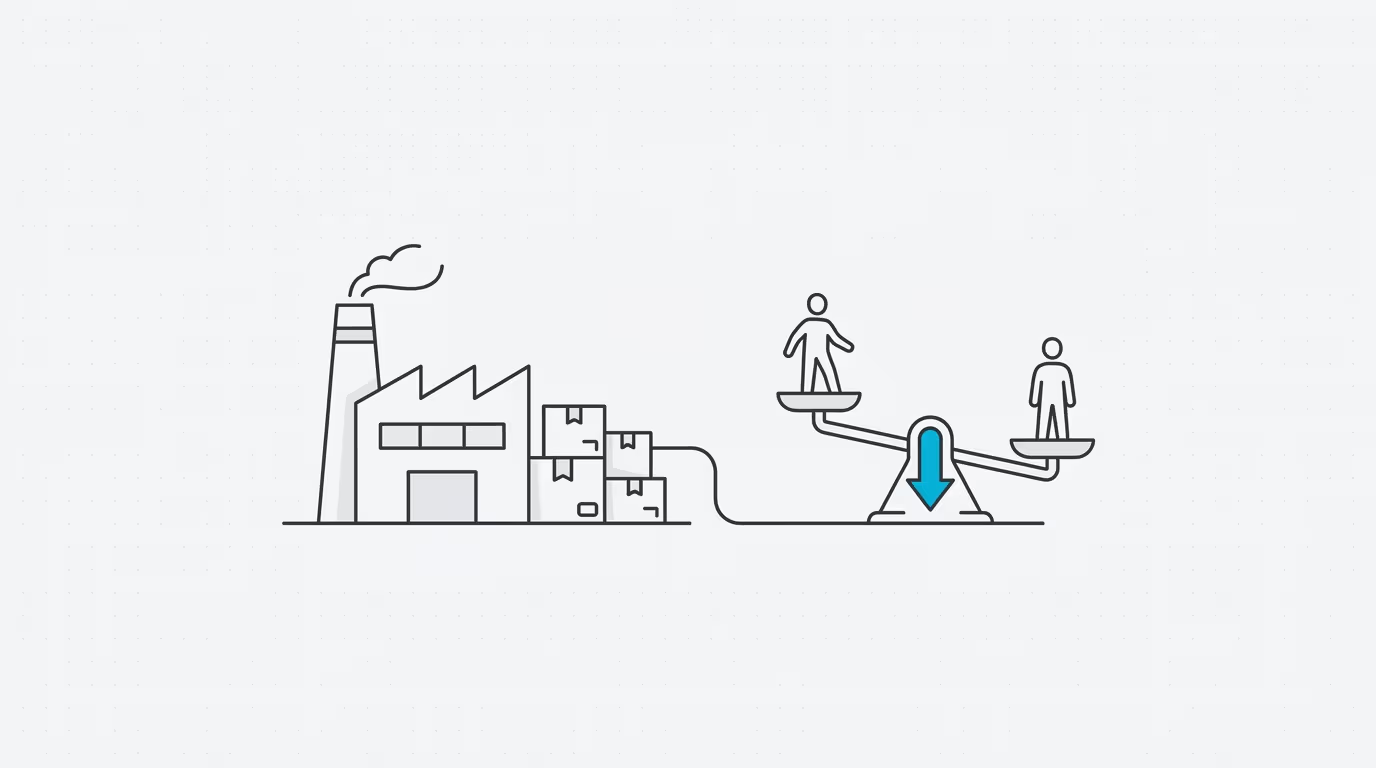
The 1688 price is lower because it is a different kind of price. It is what a Chinese wholesale buyer pays for goods delivered inside China, sometimes without a tax invoice and always without export work. An Alibaba.com quote for the same item usually includes an English-speaking sales team, export paperwork and delivery to a Chinese port. To compare them fairly, you have to add back the seven costs the 1688 number leaves out.
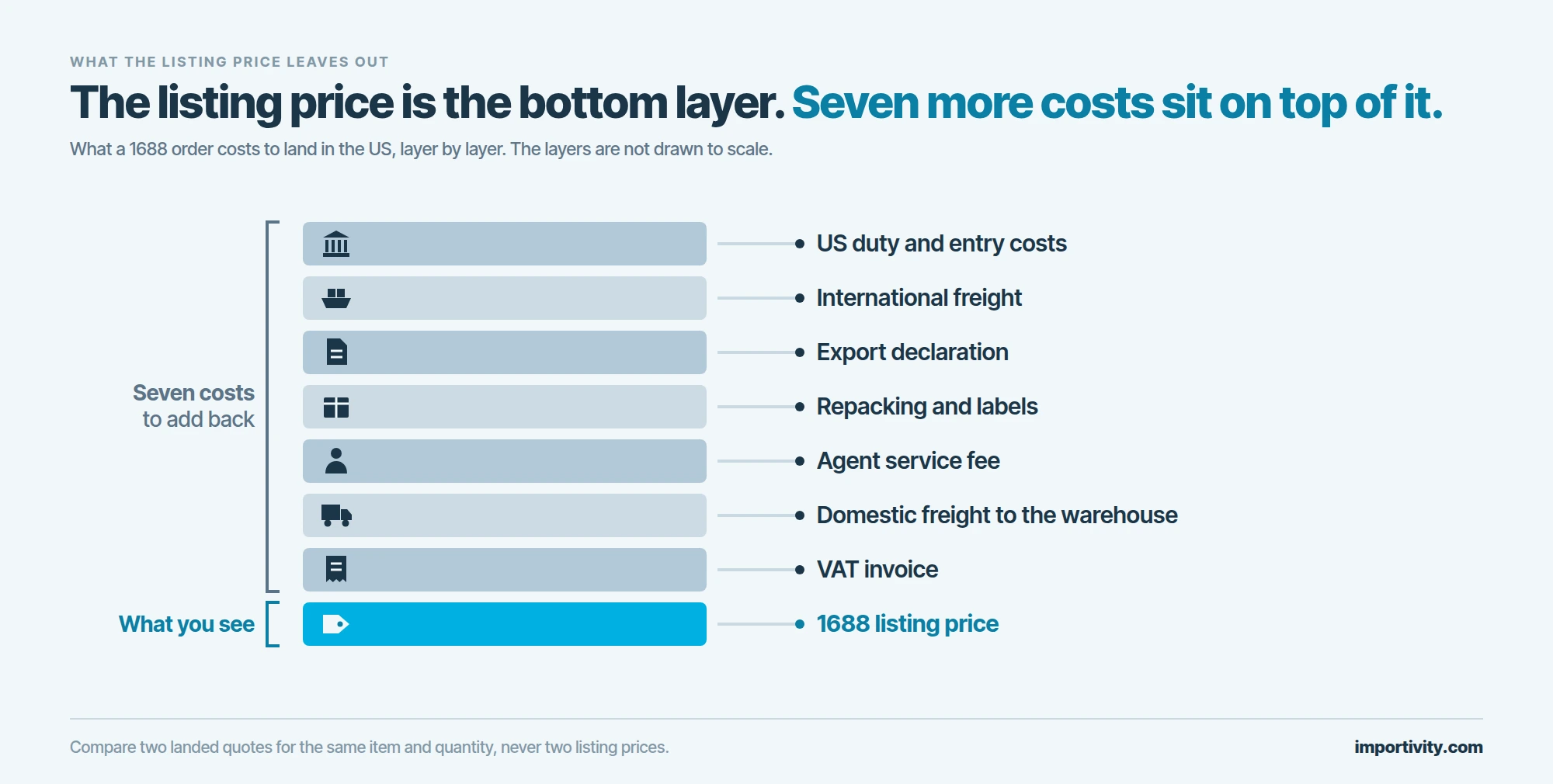
Here are the seven, in the order they hit:
- VAT invoice. China's standard VAT rate on goods is 13 percent, according to PwC's China tax summary. Some listing prices leave VAT out and the seller adds it if you need an invoice. Exports are zero rated, with VAT refund rates from 0 to 13 percent depending on the product, which is one reason an export quote can sit close to a domestic one.
- Domestic freight from each seller to the warehouse. It is charged per seller, so five small sellers cost more than one large one.
- The agent's service fee, usually a percentage of the goods value, sometimes with handling, inspection or storage charges on top.
- Repacking and labels, including export cartons, English labels and origin marking.
- Export declaration, filed by the agent or its forwarder.
- International freight. Express is the fastest and the most expensive per kilo, and a small order rarely fills enough space to make ocean freight cheap.
- US duty and entry costs. Many China-origin goods carry Section 301 duties on top of the regular rate, and every entry carries processing fees and usually a broker fee.
Where that leaves the gap depends on the order. On a few hundred units of stock items from three or four sellers, 1688 through an agent can land cheaper, partly because a factory on Alibaba.com may ask for 1,000 units or more and will not quote that small. On a custom product at production volume, the gap mostly closes, because you are paying for the same factory hours either way and the factory will quote a real export price once your volume is worth its time. A fixed percentage saving quoted by an agent is a sales figure, not a measurement. The only fair test is two landed quotes for the same item and quantity, which is what our landed cost calculator is for.
The Risks That Come With a Domestic Marketplace
Most 1688 problems trace back to one fact: the goods, the sellers and the buyer protections were all built for buyers inside China.
- You are not the customer. The order sits in the agent's account. Any refund or dispute runs in Chinese, through that account, under 1688's domestic rules. If the agent will not pursue a claim, you have no direct route to the seller.
- The product was made for China. Electrical goods come with Chinese plugs and ratings, instructions are in Chinese, and nothing was tested to US rules. If the product needs a US certificate, such as a Children's Product Certificate, you as the importer have to produce it. Since July 8, 2026, importers of products that need a CPSC certificate must also file the certificate data electronically with the customs entry. Our guide to import product compliance covers which rules apply to what.
- Copies of branded products. Many listings copy well-known products. Goods that infringe a US trademark can be seized at the border, and the loss is yours, not the seller's.
- Quality that changes between batches. A 1688 shop can switch materials or its own supplier without telling anyone, and a stock listing has no specification you agreed to. The warehouse photos are your only check, so ask for measurements and close-ups rather than pictures of closed cartons.
- Undervalued paperwork. Some parcel forwarders declare low values to cut the duty. The importer of record is responsible for the value on the entry, so an undervalued entry is your legal problem. Ask to see the commercial invoice before it is filed.
- Payment diversion. Pay agents only to a company account in the agent's registered name. The tricks described in our guide to Alibaba scams work just as well on 1688 buyers.
When Alibaba.com or a Direct Factory Is the Better Choice
1688 is a good tool for a narrow set of jobs: samples, stock items, small mixed orders and parts you will use as they are. It is a poor fit for a custom product, because a stock listing carries no specification you agreed to and gives you no production line to audit.
| Route | When it fits | What you give up |
|---|---|---|
| 1688 through a buying agent | Samples, stock goods, small mixed orders, packaging and accessories, testing demand before a custom run | Direct contact with the seller, platform protection in your own name, US labels and certificates |
| Alibaba.com supplier | A first order of a standard or lightly customized product from an exporter that already ships to the US | A higher unit price than the domestic listing, and protection only for what you write into the order |
| The factory behind a 1688 listing | A listing is close to what you want and the seller turns out to be the manufacturer | Time to verify the factory and agree a written spec, and a higher minimum than the listing shows |
| Direct factory through a sourcing partner | Custom products, your own tooling, production volume and repeat orders | Factory minimums, longer sample rounds, and the cost of vetting and inspection |
A common path is to use 1688 for samples and a first small run, then move the product to a factory once it sells. If you do, write the spec down before the first reorder and treat the factory as a new supplier to qualify, not a cheaper version of the old one. Our product sourcing team handles that move from listing to factory, and a 1688 link is a fine starting point for an RFQ.
A Checklist for Your First 1688 Order
Run through this before you send the first payment:
- Decide what the order is for. Samples, a demand test or a stock product. If it is a custom product, use the factory route instead.
- Get the agent's terms in writing. Service fee, handling, inspection, storage, exchange rate, and a written statement that it takes no rebates from sellers.
- Ask for the seller's business license if you plan to reorder, and check whether it is a manufacturer.
- Confirm what the price includes: VAT invoice or not, and domestic shipping to the warehouse.
- Require receiving photos with measurements, labels and close-ups before anything is repacked.
- Plan US labels and origin marking while the goods are still in the warehouse.
- Check compliance for anything electrical, anything for children and anything that touches food or skin.
- Read the commercial invoice and confirm the value matches what you paid.
- Price the landed cost with duty and entry fees before you pay for freight.
Frequently Asked Questions
Can I buy from 1688 directly from the US?
Not easily. 1688 is in Chinese, many sellers expect Alipay, WeChat Pay or a Chinese bank transfer, and most deliver only to addresses inside China. Even with a seller who takes an international card, you still need someone in China to receive the goods. In practice US buyers use a buying agent or forwarder that receives, checks and exports the order.
Is 1688 cheaper than Alibaba?
The listing price usually is, because it is a domestic price with no export work in it and sometimes no VAT invoice. Once you add the agent fee, domestic freight, repacking, export filing, international freight and US duty, the gap shrinks, and on custom products at volume it often disappears. Compare two landed quotes for the same item and quantity before you decide.
Is 1688 safe to buy from?
1688 is a legitimate Alibaba Group marketplace, but its protections were built for buyers inside China. Your agent is the customer on the order, disputes run in Chinese, and Alibaba.com Trade Assurance does not apply. Keep first orders small, use an agent with written terms, and get the goods checked at the warehouse before they are exported.
What is the minimum order on 1688?
Each listing sets its own minimum, and many take very small orders, some as few as two pieces. That is why 1688 is popular for samples and mixed orders. A factory making a custom version of the same product will usually ask for far more, sometimes 1,000 units or above.
Do I pay US duty on goods bought from 1688?
Yes. The de minimis exemption that let small shipments enter duty free is suspended, so every shipment needs a customs entry and pays duty, including Section 301 duties on many China-origin goods. Shipments valued at $2,500 or less can use an informal entry. The importer of record is responsible for the value declared on the entry.
About the author
Jordan Lewis
Chief Operating Officer, Importivity
Runs Importivity's sourcing operations across China, Vietnam, Mexico and India, from supplier negotiation through landed delivery.
Press and media inquiries: press@importivity.com