How to Import From China for Beginners (Step by Step, With Costs)
To import from China, you confirm the product meets US rules and work out its landed cost, then vet a factory, approve a sample, pay a deposit and inspect the goods before you pay the balance. After that you ship and clear US customs with an importer number, a customs bond and usually a licensed broker. A first order of a simple custom product takes about 16 weeks, and in the worked example below a backpack quoted at $10.00 costs $18.33 by the time it reaches your warehouse.
This guide is for US businesses placing a first order with a factory in China. Rules and rates are as of November 1, 2026. Duty is the largest cost after the goods in the example below. Our guide to import tax from China to the US covers every layer in detail.
Do you need a license to import from China
No. The United States has no general import license, CBP does not require one, and USA.gov says most goods need none at all. The real check is product by product, because federal agencies set rules that apply at the border.
- CPSC for consumer products. Children's products must be tested by a CPSC-accepted third-party lab and covered by a Children's Product Certificate. Since July 8, 2026, importers must file certificate data electronically with the entry for about 600 HTS codes, with no low-value exemption.
- FDA for food and cosmetics. Food needs a registered facility and a Prior Notice filed before the shipment arrives. Cosmetics need facility registration and product listing under MoCRA. Many medical devices also need FDA clearance before sale.
- FCC for electronics. A device that emits radio frequency energy must be authorized before it is imported or marketed. Wireless products such as Bluetooth speakers need Certification and an FCC ID. Most other electronics use a Supplier's Declaration of Conformity.
- Labels and origin. Each item must show its country of origin in English, such as "Made in China", and clothing needs fiber content and care labels under FTC rules. Under the Uyghur Forced Labor Prevention Act, goods made wholly or partly in Xinjiang are presumed to be made with forced labor and can be detained.
Ask the factory for test reports that name your exact model before you pay. Our import product compliance guide lists the certificates by product type.
Work out the landed cost before you order
Landed cost is everything you pay to get one unit into your warehouse. Work it out before you send a deposit, because duty on Chinese goods is often larger than the freight. In the order worked through at the end of this guide, a backpack quoted at $10.00 lands at $18.33, and $5.51 of that is duty.
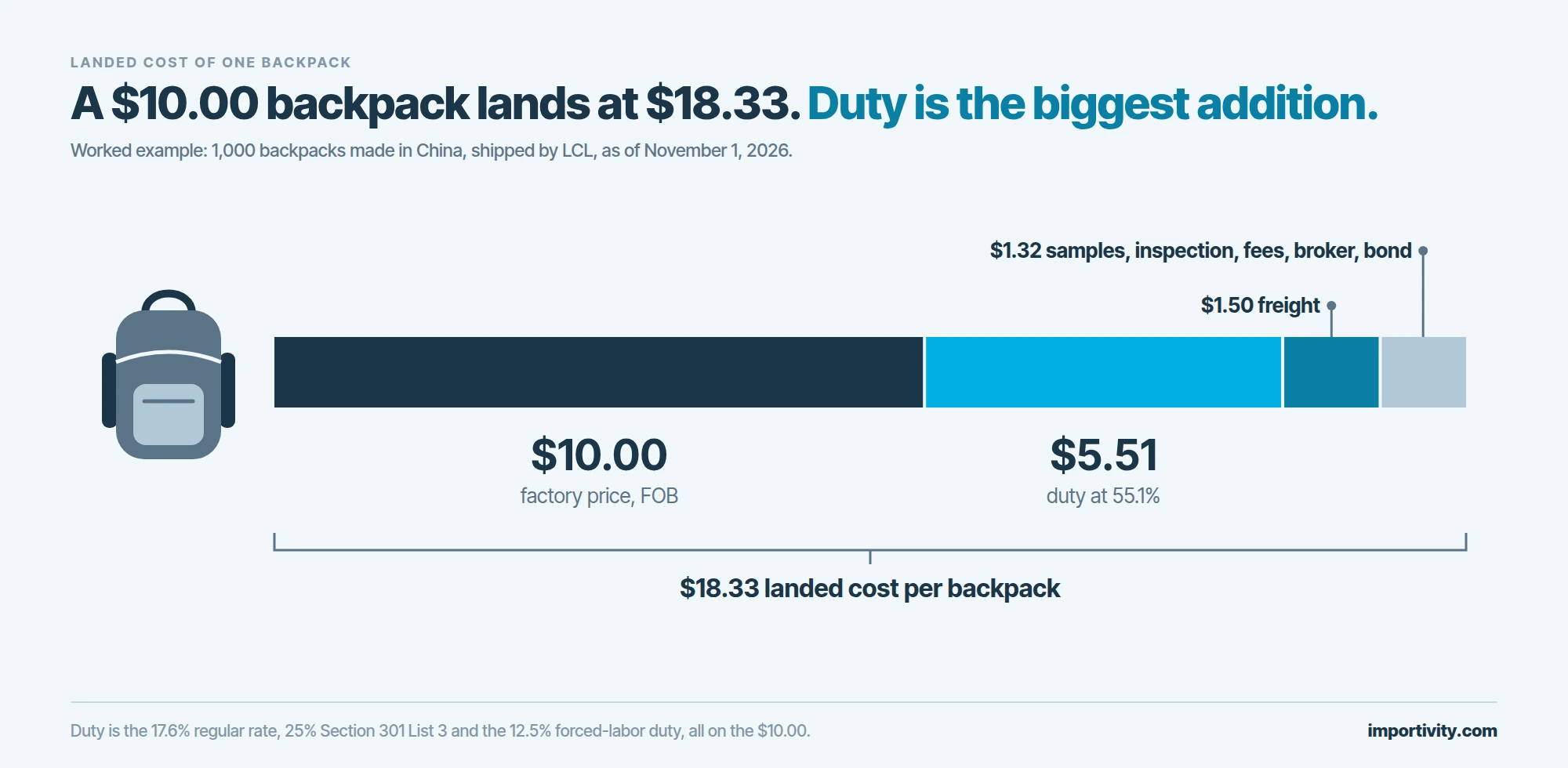
Duty starts with the HTS code, the 10-digit number that sets the rate. A Chinese product can carry several duties, each charged on the customs value, usually the factory price without international freight. As of November 1, 2026, a backpack with an outer surface of man-made fiber, HTS 4202.92.3120, made in China pays:
- The regular duty rate. 17.6% for this code.
- The China Section 301 duty. 25%, because the code is on List 3. Products on List 4A pay 7.5%, and some products are on no list.
- The Section 301 forced-labor duty. 12.5% on most Chinese goods since July 24, 2026.
That is 55.1% in total. Products that are at least 15% steel, aluminum or copper by weight can also owe Section 232 duty of 25% or 50% of their full value, and goods that pay it are exempt from the forced-labor duty. Every formal entry also pays a merchandise processing fee of 0.3464% of value, at least $34.58 and at most $670.86 from October 1, 2026, and ocean cargo adds a 0.125% harbor maintenance fee. Our landed cost calculator runs the numbers for your own product.
How to buy from China: find and test a supplier
Most first-time buyers find suppliers on Alibaba.com, at trade fairs such as the Canton Fair, or through a sourcing agent. Send the same written spec to three to five suppliers so the quotes compare line by line. Our guide on how to buy from Alibaba covers the platform, and our guide to manufacturers in China shows which regions make which products. Before you pay anyone:
- Check the business license. Look up the 18-character unified social credit code on China's National Enterprise Credit Information Publicity System. The company name must match your contract and the bank account you pay.
- Find out if it is a factory or a trading company. A trading company adds a margin and a layer between you and production. A live video call that walks from raw materials to the packing line settles it.
- Order samples from two or three factories. Alibaba.com's seller guides put stock samples at about 7 to 15 days by air, and a sample made to your spec takes longer. Samples cost far less than a bad production run.
Sign and date the sample you approve and keep it as the reference for inspection.
Place the order: purchase order, payment and inspection
The purchase order is your contract with the factory, so write down everything you would want to enforce later:
- Spec and reference sample. Materials, colors, sizes, artwork and labels, including the origin marking.
- Quantity, price and Incoterm. For example, 1,000 units at $10.00 FOB Shanghai.
- Ready date and packing. When the goods must be packed, units per carton and the shipping marks.
- Payment and inspection terms. The balance falls due only after a passed inspection at a stated AQL level, and the factory pays for a second inspection after a fail.
Payment is usually a deposit before production, such as 30%, and the balance before the goods leave the factory. On Alibaba.com, paying into a Trade Assurance order lets you claim a refund through Alibaba if the goods ship late or do not match the order. Alibaba's fee table, read in late October 2026, lists 2.99% for card payments and only your own bank's fee, around $40, for a wire. Never pay a bank account held in a different name from the supplier on your contract.
Book a pre-shipment inspection for when production is finished and packed. One inspection firm, V-Trust, publishes a rate of $268 per man-day in the main Asian manufacturing areas, with the report within 24 hours. Pay the balance only after the report passes; our guide to pre-shipment inspection covers what to do if the goods fail.
Choose FOB or DDP and a way to ship
The Incoterm decides who books the freight and who clears US customs. Under FOB, the factory loads the goods onto the ship at a named port in China and you pay for everything after that, including duty. Under DDP, the seller delivers to your door with duty paid, and the seller or its forwarder files the entry as importer of record.
DDP looks simpler, but you cannot see the declared value or the duty paid, and any refund goes to whoever filed the entry, which left DDP buyers with no claim of their own when the IEEPA tariffs were refunded in 2026. FOB with your own forwarder and broker keeps those decisions with you, as our FOB vs DDP page explains. Then pick the mode by weight and deadline, using the latest published figures:
- Express courier. About 3 days door to door, and the cheapest option up to about 150 kg on Freightos's rule of thumb, so it suits samples.
- Air freight. About 8 to 10 days. The Freightos Air Index for China to North America was $6.88 per kg on October 20, 2026.
- LCL ocean. You share a container and pay per cubic meter, usually the cheaper choice below about 13 to 15 cubic meters.
- FCL ocean. Drewry's World Container Index put a 40 ft container from Shanghai to Los Angeles at $8,007 on October 22, 2026. Plan on 15 to 20 days port to port and 30 to 40 days door to door.
Our guide to shipping from China to the US lists the port fees and costs a full container door to door.
What US customs needs from a first-time importer
Four things have to be in place before your goods reach a US port, and the order matters, because each one is filed against the one before it.
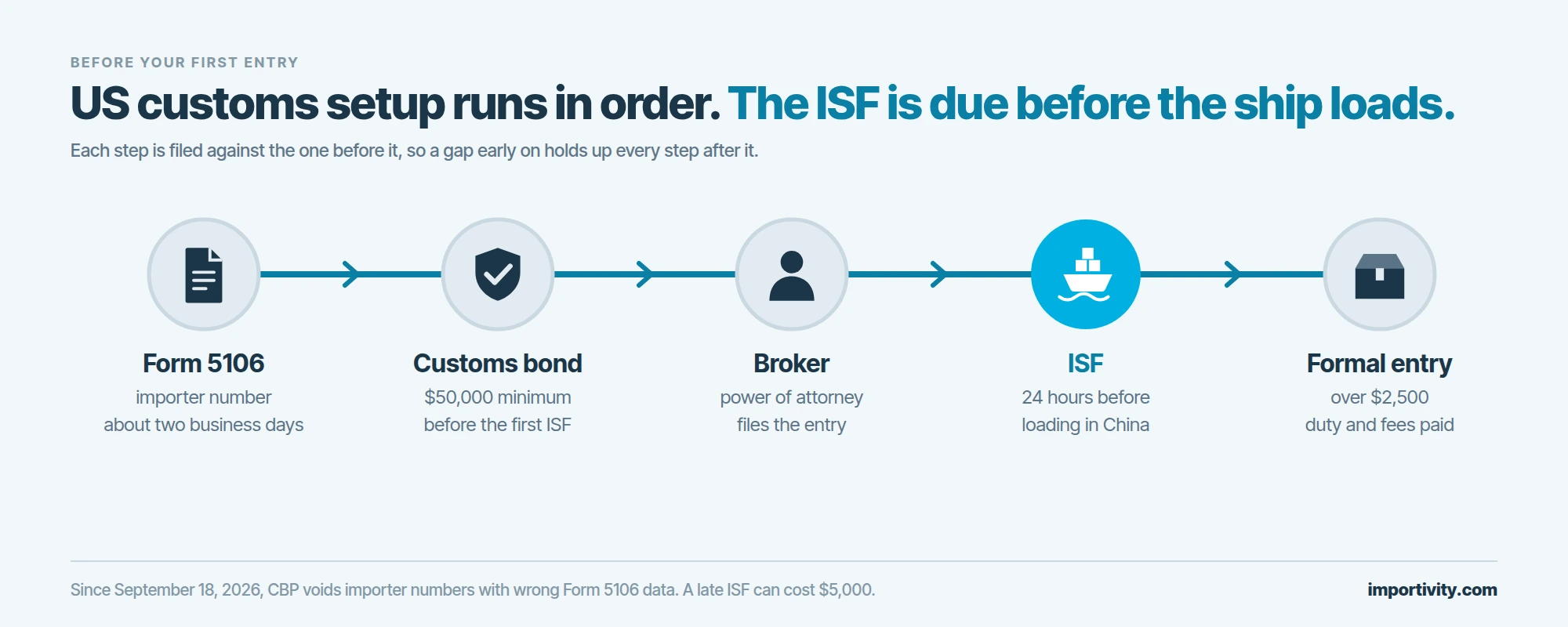
- An importer number. This is usually your company's IRS EIN, which becomes your importer number once you file CBP Form 5106. CBP typically activates a new record in about two business days, and since September 18, 2026 it voids numbers whose form data is wrong. Our guide to CBP Form 5106 walks through each block.
- A customs bond. Any shipment valued over $2,500 needs a formal entry, and a formal entry needs a bond. A continuous bond covers a year of entries and your ISF filings, has a $50,000 minimum and must be on file before your first ISF. Our guide to what a customs broker costs puts that minimum bond at $400 to $600 a year, and one online customs broker's published price list (September 2026) shows $500.
- A customs broker. The law does not require one, but most importers sign a power of attorney so the broker files the entry. That guide puts a formal ocean entry at $125 to $175, and the fee on any duty a broker pays for you at 2% to 3%. The same price list shows $149.95 for an ocean entry with up to three HTS codes plus a $25 handling fee, and a 5% charge on any duty that broker pays for you, so set up your own ACH payment to CBP.
- The Importer Security Filing (ISF). For ocean cargo, ten data elements must reach CBP at least 24 hours before the container is loaded in China. A late or missing ISF can cost $5,000 in liquidated damages. The broker guide puts an ISF filing at $50 to $85, and the same price list charges $50.
Small orders no longer skip duty. The $800 de minimis exemption ended for all countries on August 29, 2025, and CBP wrote the suspension into its regulations in June 2026. An unregulated shipment worth $2,500 or less can still clear on an informal entry without a bond, which is how most samples arrive.
Your first order, week by week and dollar by dollar
Here is one first order: 1,000 backpacks at $10.00 each FOB Shanghai, so $10,000 of goods, shipped by LCL to a US warehouse. Four figures are assumptions you would replace with your own quotes: the $10.00 price, $200 for samples and courier, 30 to 45 days of production and $1,500 for LCL freight door to door. The rest come from the published rates above.
| Week | What happens | What you pay |
|---|---|---|
| Week 1 | Check agency rules and the HTS code, work out landed cost, send the spec to 3 to 5 suppliers | $0 |
| Weeks 2 to 3 | Samples made and sent by courier | $200 (assumed) |
| Week 4 | Approve the sample and pay the deposit; file Form 5106, buy the bond, sign the broker's power of attorney | $3,000 deposit, $40 wire, $500 bond |
| Weeks 5 to 10 | Production, assumed at 30 to 45 days from sample approval | $0 |
| Week 10 | Pre-shipment inspection, then the balance | $268 inspection, $7,000 balance, $40 wire |
| Week 11 | Freight booked, ISF filed at least 24 hours before loading | $50 ISF |
| Weeks 11 to 16 | Goods at sea and on the road, about 30 to 40 days door to door | $1,500 freight (assumed) |
| Week 16 | The broker files the entry, and you pay duty and fees to CBP by ACH before delivery | $5,510 duty, $47.14 CBP fees, $174.95 broker |
The order costs $18,330.09, or $18.33 per backpack: $10.00 for the goods, $5.51 of duty, $1.50 of freight and $1.32 for samples, wire fees, inspection, CBP fees, the broker, the ISF and the bond. Duty costs more than freight and every fee combined. Paying CBP from your own ACH account avoids the broker's 5% charge on that duty, which would have added $275.50.
Mistakes that cost beginners the most
- Pricing from the factory quote. The $10.00 backpack cost $18.33 landed. Work out duty before you set a selling price.
- Paying in full before inspection. Once the balance is paid, you have nothing left to hold back if the goods fail.
- Accepting DDP without asking who files the entry. The duty, the declared value and any refund belong to the importer of record.
- Undervaluing the invoice to cut duty. It is a customs violation, and the importer of record owes the duty and the penalty.
If you want us to find and vet factories that make your product type, send us your product details.
Frequently Asked Questions
Do I need a license to import from China?
No. The United States has no general import license, and CBP does not require one. You need an importer number, usually your EIN linked to your company through CBP Form 5106, and a customs bond for any formal entry over $2,500. Some products also need agency approvals, such as CPSC certificates for regulated consumer products, FDA registration and Prior Notice for food, and FCC authorization for electronics.
How much does it cost to import from China?
Plan on the factory price plus duty, freight and fees. In our example, 1,000 backpacks at $10.00 each cost $18,330.09 delivered, or $18.33 a unit. Duty was the largest addition at 55.1% of the factory price, followed by $1,500 of LCL freight, $500 for a one-year customs bond, $268 for an inspection and $224.95 for the broker and the ISF.
How long does it take to import products from China?
A first order of a simple custom product takes about 16 weeks from the first quote request to delivery. That is about 4 weeks to choose a supplier and approve a sample, 30 to 45 days of production in our example, a week for inspection and booking, and 30 to 40 days door to door by ocean. Air freight cuts the shipping leg to about 8 to 10 days.
How do I find a reliable supplier in China?
Send the same written spec to three to five suppliers found on Alibaba.com, at a trade fair or through an agent. Check each business license on China's National Enterprise Credit Information Publicity System, confirm on a live video call that you are dealing with the factory, and pay for samples from the best two or three. Then inspect the first order before you pay the balance.
Can I still import small orders from China duty free?
No. The $800 de minimis exemption ended for goods from China on May 2, 2025 and for all countries on August 29, 2025, and CBP made the suspension part of its regulations in June 2026. Every parcel now pays duty on its full value. Shipments of $2,500 or less can use an informal entry, but putting more units on one entry keeps the fees per unit lower.
About the author
Jordan Lewis
Chief Operating Officer, Importivity
Runs Importivity's sourcing operations across China, Vietnam, Mexico and India, from supplier negotiation through delivery to the client's door.
Press and media inquiries: press@importivity.com