Bill of Materials Template: What to Include (With Example)
A bill of materials (BOM) is the complete, structured list of every part, material, and sub-assembly a factory needs to build your product, with the quantity and specification for each one. It is the document a factory quotes against. If your BOM is vague, every quote you receive is a guess, and the cheapest guess usually turns into the most expensive order.
This guide gives you the exact column structure a manufacturing BOM needs, a filled-in example you can copy, and the specific fields that cause quoting errors when they are left blank. If you would rather not build the spreadsheet by hand, our BOM template generator produces a formatted one for you.
What a Bill of Materials Actually Does
The BOM's job is to remove ambiguity. When a factory receives an RFQ, it prices the risk it cannot see. A part described as "plastic housing" could be ABS or polycarbonate, could be 2mm or 4mm wall thickness, could need a texture finish or not. Each of those choices moves the price, and a factory quoting a blind spec will either pad the number or quote low and renegotiate after tooling.
A complete BOM does three things at once. It makes quotes comparable across factories, because everyone is pricing the same product. It becomes the reference for incoming quality inspection, because you can only reject a part against a written spec. And it protects you in a supplier switch, because a BOM is portable and a factory's tribal knowledge is not.
The Columns Every Manufacturing BOM Needs
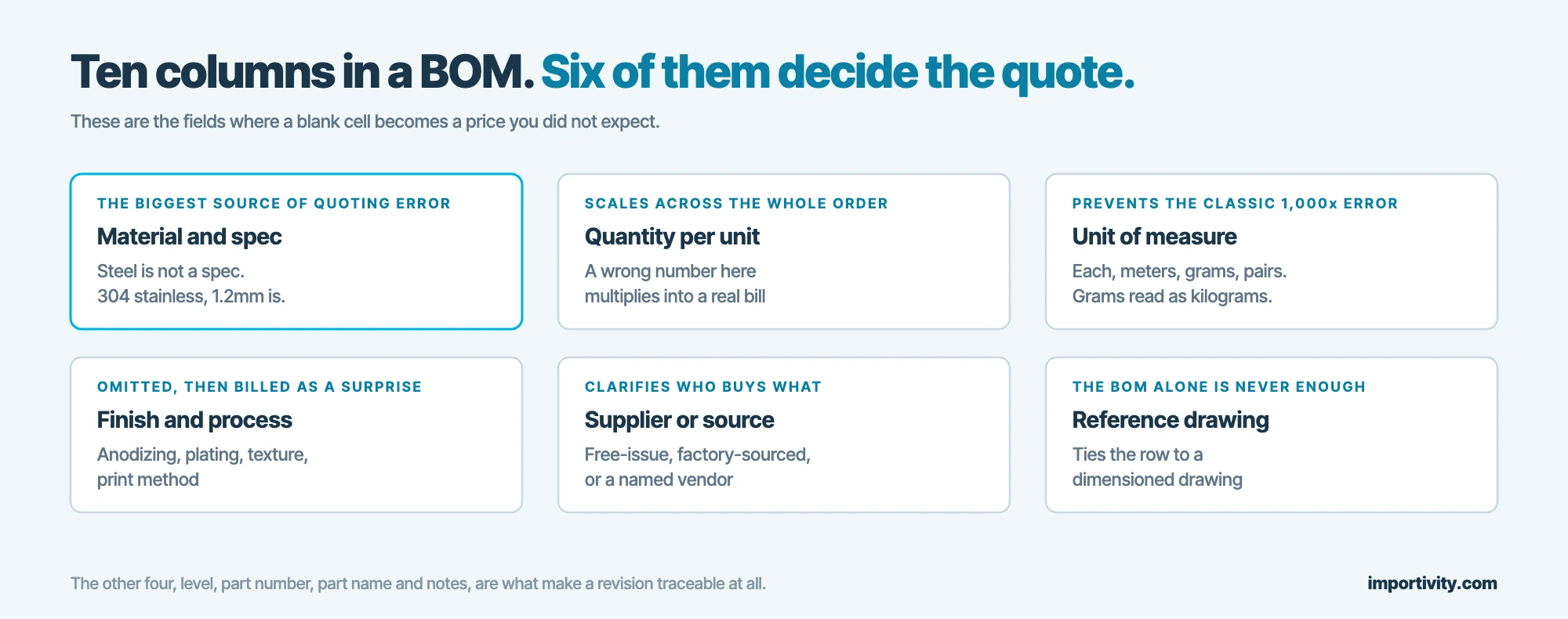
Most BOM templates you will find online are built for internal engineering, not for sourcing. A sourcing BOM needs a few columns that engineering BOMs usually skip, because it has to survive contact with a factory that has never seen your product.
| Column | What it holds | Why it matters when sourcing |
|---|---|---|
| Level | 1, 2, 3 — where the part sits in the assembly hierarchy | Tells the factory what is a sub-assembly vs a loose component; drives assembly labor cost |
| Part number | Your internal SKU for the component | The one field that makes revisions traceable; without it, "the new version" is meaningless |
| Part name | Plain-language description | What a human reads; keep it unambiguous across languages |
| Material / spec | Grade, alloy, resin, fabric weight, tolerance | The single biggest source of quoting error. "Steel" is not a spec; "304 stainless, 1.2mm" is |
| Quantity per unit | How many go into one finished product | Multiplied across the order; a wrong quantity here scales into a large cost error |
| Unit of measure | Each, meters, grams, pairs | Prevents the classic 1,000x error when a factory reads grams as kilograms |
| Finish / process | Anodizing, plating, texture, print method | Secondary processes are frequently omitted, then billed as a surprise |
| Supplier / source | Free-issue, factory-sourced, or a named vendor | Clarifies who buys what; ambiguity here creates double-charging |
| Reference drawing | File name or drawing number | Ties the row to a dimensioned drawing; the BOM alone is never enough for a machined part |
| Notes | Compliance, certification, critical dimensions | Where CE, FCC, RoHS, or food-contact requirements get flagged before tooling starts |
A Filled-In Bill of Materials Example
Here is a simplified BOM for a consumer product, a rechargeable desk lamp, showing how the levels nest and how specific the material column has to be. Notice that no row says "plastic" or "metal" on its own.
| Level | Part no. | Part name | Material / spec | Qty | UoM | Notes |
|---|---|---|---|---|---|---|
| 1 | DL-100 | Desk lamp, finished | Final assembly, boxed | 1 | Each | Retail-ready |
| 2 | DL-110 | Base housing | ABS, 2.5mm wall, matte texture | 1 | Each | Tooling owned by buyer |
| 2 | DL-120 | Arm tube | 6063 aluminum, 18mm OD, anodized black | 1 | Each | Drawing DL-120-RevC |
| 2 | DL-130 | LED module | 3000K, 8W, CRI 90+ | 1 | Each | Must be RoHS compliant |
| 3 | DL-131 | Driver board | 12V DC, UL-recognized | 1 | Each | Sub-assembly of DL-130 |
| 2 | DL-140 | Power cord | US 2-pin, 1.5m, black | 1 | Each | UL listed; region-specific |
| 2 | DL-150 | Retail box | E-flute corrugate, 4C print | 1 | Each | Artwork supplied by buyer |
The lesson is in the notes column. "Tooling owned by buyer," "must be RoHS compliant," and "artwork supplied by buyer" are the lines that prevent arguments later. A BOM is a commercial document as much as a technical one.
How to Build Your BOM, Step by Step
- Start from the finished product and work down. List the assembly first, then its sub-assemblies, then loose components. Numbering the levels as you go prevents orphaned parts.
- Give every part a number, even the trivial ones. Screws and labels get revised too, and an unnumbered part cannot be revised.
- Write the material spec as if the reader has never seen your product. They have not. Include grade, thickness, color reference, and tolerance where it matters.
- Flag every secondary process explicitly. Plating, printing, polishing, and heat treatment get forgotten, then appear as line-item surprises.
- Mark who supplies each item. Free-issue components you provide, versus items the factory buys, must be unambiguous.
- Version it and date it. "BOM v1.3, 14 Jul 2026" costs nothing and settles disputes instantly.
- Attach the drawings. A BOM references drawings; it does not replace them.
BOM Mistakes That Cost Real Money
The failures below are the ones we see most often, and they are all avoidable at the spreadsheet stage, which is the only stage where fixing them is free.
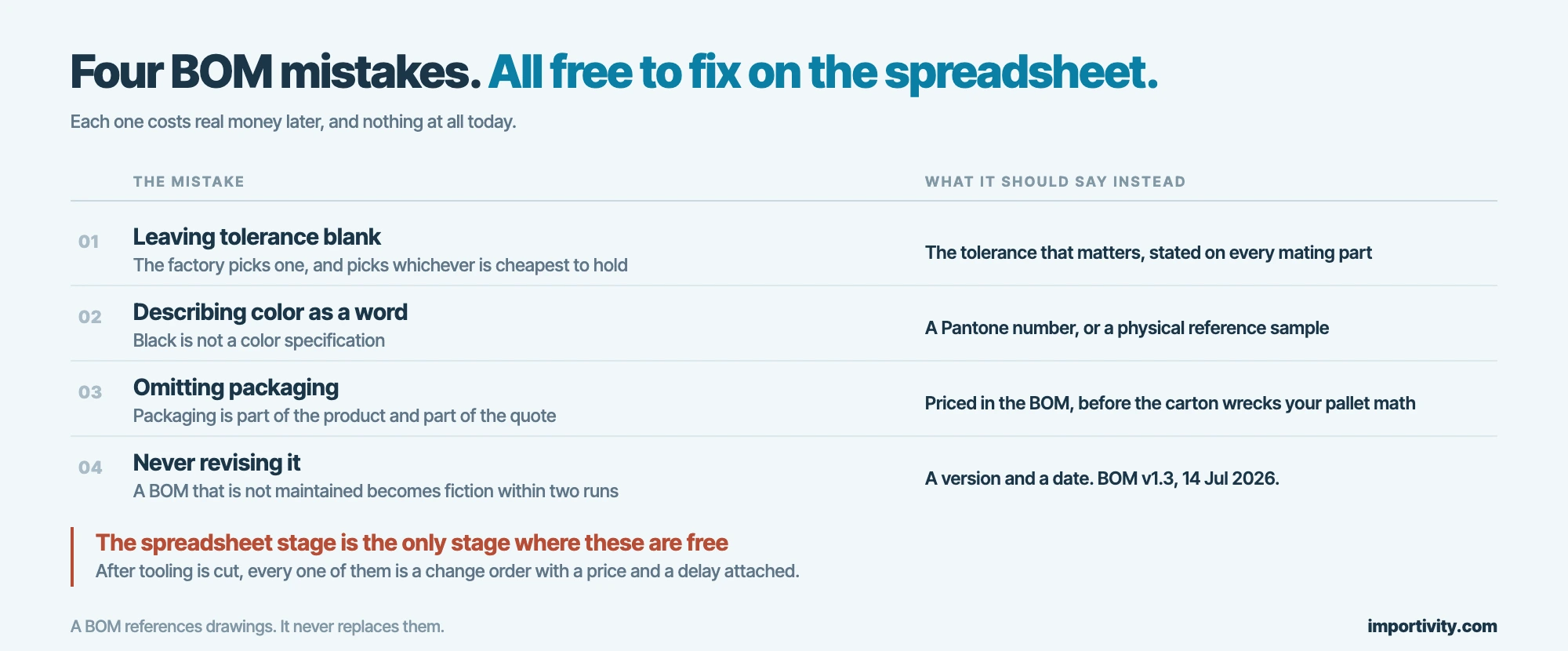
Leaving tolerance blank. If you do not state a tolerance, the factory chooses one, and it will choose the one that is cheapest to hold. On mating parts, that is how you end up with a housing that does not close.
Describing color as a word. "Black" is not a color specification. Pantone or a physical reference sample is. Color rejection at inspection is one of the most common and most preventable reasons for a delayed shipment.
Omitting packaging. Packaging is part of the product and part of the quote. Leaving it off the BOM means it gets priced late, usually badly, and often in a way that wrecks your landed cost because the carton does not palletize efficiently.
Never revising it. A BOM that is not maintained becomes fiction within two production runs. The version in the factory's hands must be the version you think it is, which is why the version number is not a formality.
How the BOM Fits Into the Rest of Sourcing
The BOM is the first document in the chain, not a standalone artifact. It feeds the RFQ, which produces comparable quotes; it feeds the quality inspection standard, because you cannot inspect against a spec you never wrote; and it feeds the tooling discussion, because the parts that need tooling are visible on the BOM before anyone quotes.
In practice, a complete BOM plus a real RFQ is what separates buyers who get firm, comparable quotes from buyers who get a spread of numbers they cannot reconcile. If you are still choosing a factory, the BOM is also your best vetting tool: a serious factory will come back with questions about your BOM, and a factory that quotes a thin BOM without asking anything is telling you something important about how it will handle your production. That is worth reading alongside how to find and vet an OEM factory.
For a worked example running from a drawing to a first article, see our 420seven prototyping case study, and Source With Jordan for the sourcing behind it.
Frequently Asked Questions
What is a bill of materials?
A bill of materials is the structured list of every part, material, and sub-assembly needed to build a product, with the quantity and specification for each. It is the document a factory quotes and builds against, and it becomes the reference for quality inspection once production starts.
What should a BOM template include?
At minimum: assembly level, part number, part name, material and specification, quantity per unit, unit of measure, finish or secondary process, supplier or source, reference drawing, and a notes column for compliance requirements. The material and notes columns are where most quoting errors originate, so they deserve the most detail.
What is the difference between a BOM and an RFQ?
The BOM describes what the product is made of. The RFQ asks a factory what it would charge to make it, and includes the BOM as an attachment along with quantities, target timelines, and quality requirements. You cannot write a meaningful RFQ without a BOM.
Do I need a BOM if my product is simple?
Yes. A simple product just means a short BOM. Even a single-component item has a material grade, a finish, a color reference, a tolerance, and packaging, and every one of those is a variable a factory will otherwise decide for you, in whichever direction is cheapest to produce.
Should the BOM include packaging?
Always. Packaging is part of what the factory produces and part of what you pay for, and carton dimensions directly affect how efficiently your goods palletize and ship. A BOM that omits packaging produces a quote that will change later, and the change is rarely in your favor.
About the author
Jordan Lewis
Chief Operating Officer, Importivity
Runs Importivity's sourcing operations across China, Vietnam, Mexico and India, from supplier negotiation through landed delivery.
Press and media inquiries: press@importivity.com