Manufacturing Plants in Mexico (Where They Are and How US Brands Use Them)
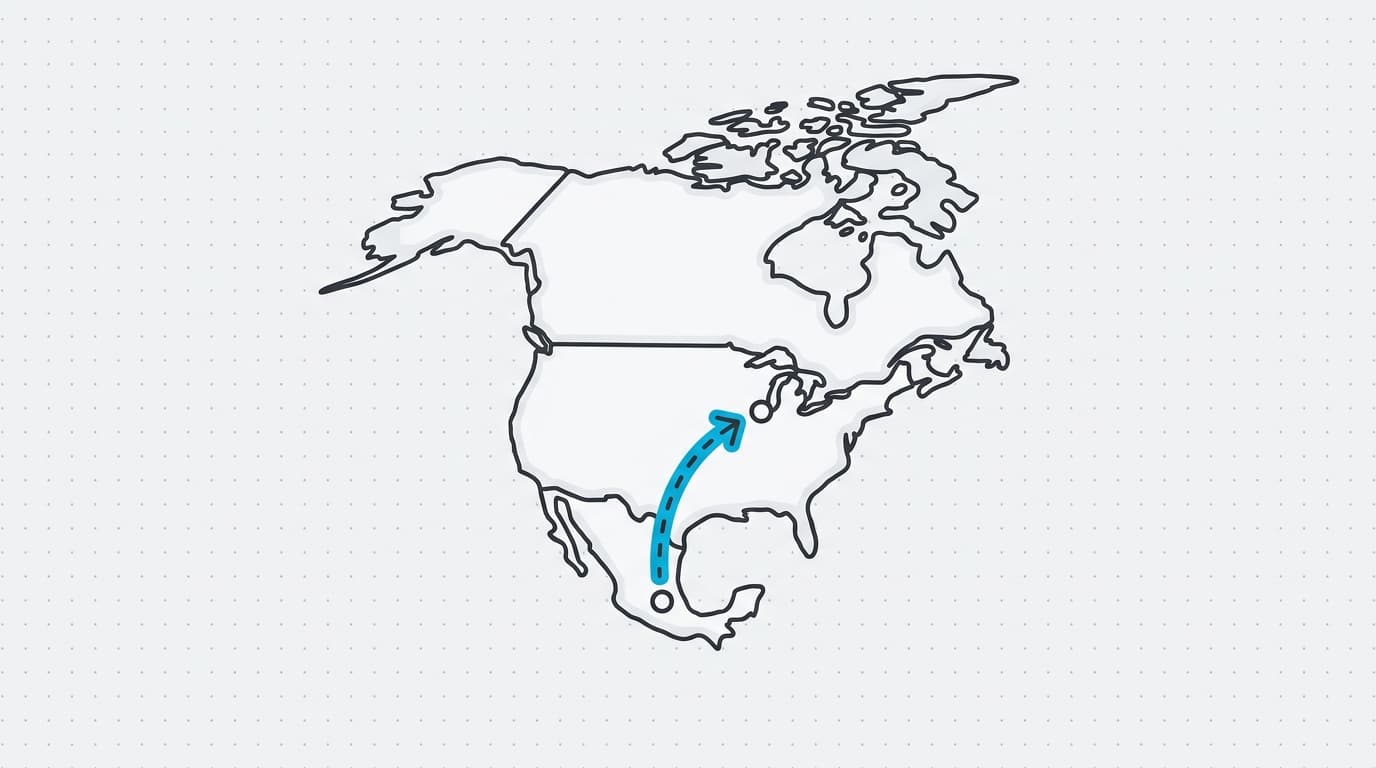
Mexico's manufacturing plants are concentrated in five areas: the northern border (Tijuana, Ciudad Juárez, Reynosa), the northeast around Monterrey and Saltillo, the Bajío (Querétaro, Guanajuato, San Luis Potosí, Aguascalientes), Guadalajara in the west, and central Mexico around Puebla and Toluca. Autos are the largest industry, and electronics, appliances, aerospace and medical devices are also large. A US brand does not need its own plant to build there. Most start with a contract manufacturer that already runs one.
This guide is for US brands that pay US prices today and want production closer than Asia. It covers where the plants are, who runs them, what labor and duties look like as of October 31, 2026, and the ways to use a plant in Mexico. For the wider case for moving production, read our guide to nearshore manufacturing in Mexico.
Where the manufacturing plants in Mexico are
Location sets your labor cost, your truck time to the US and which suppliers are nearby. Each area grew around one or two industries, so your product usually points to the right region.
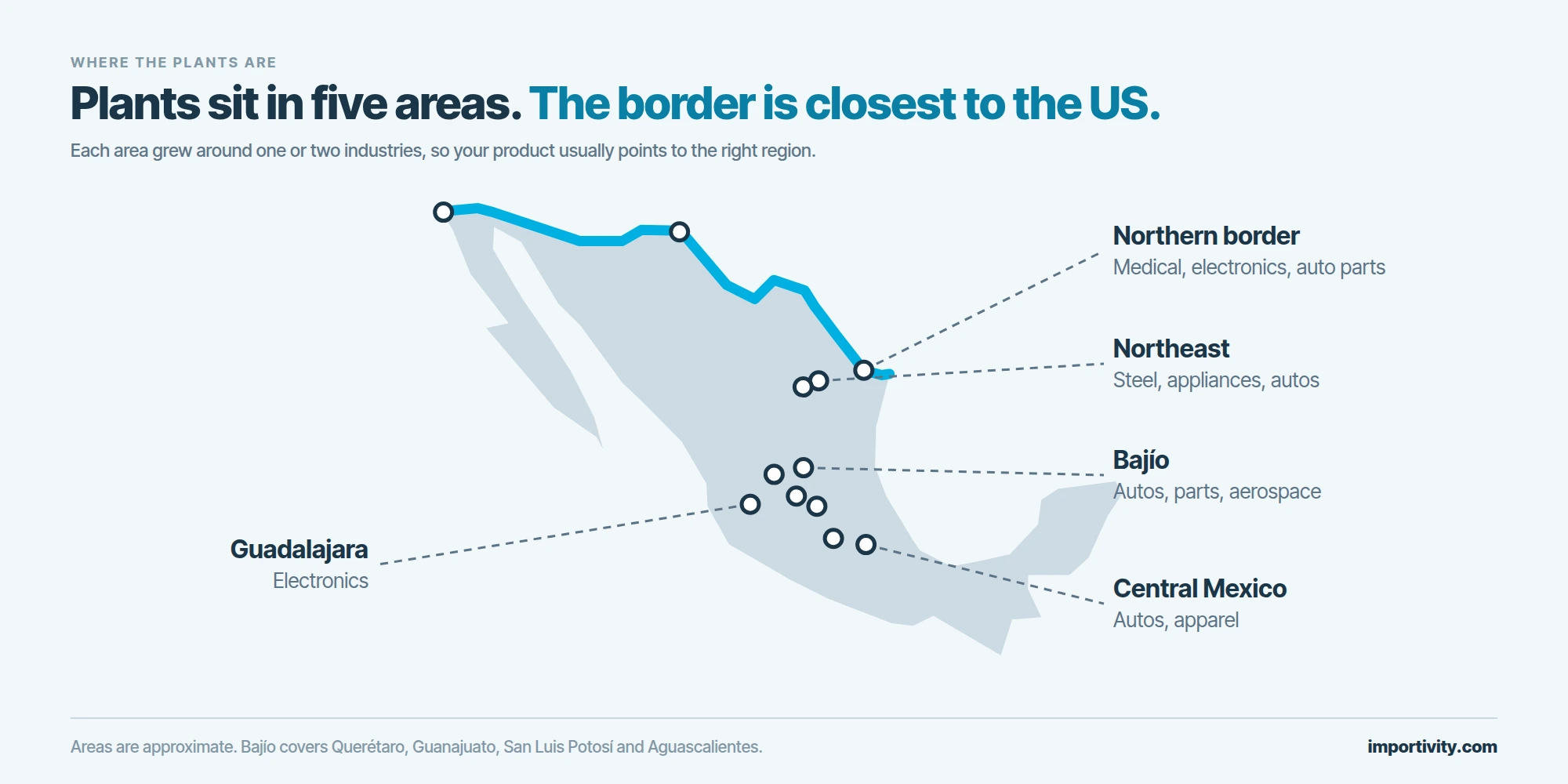
- Northern border. Tijuana, Mexicali, Ciudad Juárez, Nogales, Reynosa and Matamoros. These cities hold many export assembly plants, known as maquiladoras, that build medical devices and electronics as well as auto parts. They are the closest plants to the US, and they pay more. The 2026 minimum wage is 440.87 pesos a day in the border zone and 315.04 pesos a day in the rest of the country.
- Northeast. Monterrey and the nearby Saltillo and Ramos Arizpe area. It is strong in steel, appliances and autos, and trucks reach the Laredo crossing by highway.
- Bajío. Querétaro, Guanajuato, San Luis Potosí and Aguascalientes. Auto assembly and parts dominate, and Querétaro also has an aerospace base. Plants here are farther from the border, so truck time is longer.
- Guadalajara. The main electronics area in western Mexico, with board assembly and computer hardware plants and a local supplier base for both.
- Central Mexico. Puebla, Toluca and the area around Mexico City. Autos lead here too, and Puebla and nearby Tlaxcala have an apparel and textile base.
Which companies have plants in Mexico
The largest plants belong to automakers. GM builds Silverado and Sierra pickups in Silao, Guanajuato. Ford assembles vehicles in Hermosillo and Cuautitlán. Stellantis builds Ram trucks in Saltillo and Jeep models in Toluca. Volkswagen's plant in Puebla is one of the largest auto plants in the country, and Audi builds the Q5 in San José Chiapa. Kia runs a plant in Pesquería, near Monterrey, BMW runs one in San Luis Potosí, and Toyota builds the Tacoma in Mexico. Nissan closed its CIVAC plant in Morelos in March 2026 and moved that production to Aguascalientes.
These names answer the question of who is there, but most brands will never deal with them. The plants that take outside orders are the contract manufacturers and parts suppliers around them: injection molders, metal stampers, board assemblers and cut-and-sew shops. A company building pickups will not take your order. A molder that supplies its trim might.
Ways a US brand can use a plant in Mexico
The choice comes down to who owns the building, who employs the workers and how much of the daily work you run yourself.
| Option | Best for | Watch out for |
|---|---|---|
| Contract manufacturer | Brands that want a product made and do not want to run a factory. You pay per unit, and the plant owns the machines and employs the staff. | You share line time with its other customers. Agree in writing who owns the tooling. |
| Shelter company | Companies that want their own production team without forming a Mexican entity. The shelter provider handles payroll and permits, plus customs and often the building. | You pay a monthly service fee and you still run production, so you need people who know how to run a line. |
| Your own plant under IMMEX | Large, steady volume where you want full control of process and staff. | Highest cost and slowest start. You take on Mexican entity, labor, tax and customs compliance yourself. |
| Final assembly only, with parts from Asia | Products where speed to the US matters more than the duty rate. | Assembly alone may not meet the USMCA rule of origin for your product, which changes the duty. |
IMMEX is the Mexican program behind most export plants. A registered company can bring in materials, parts and equipment temporarily without paying import duty, as long as the finished goods are exported. A maquiladora is the common name for a plant that works this way.
Do not assume IMMEX covers every input. On January 1, 2026, Mexico raised duties on 1,463 tariff lines, at rates from 5% to 50%, for imports from countries with no trade agreement with Mexico, including China and South Korea. The law firm Foley warned that maquiladoras are not automatically exempt and that the destination of the finished goods matters. If your bill of materials uses Asian parts, ask the plant how it imports them and who pays any duty.
What it costs to build in Mexico in 2026
Labor is the first number brands ask about. American Industries Group, a shelter operator, publishes a 2026 benchmark of $5.00 to $6.50 an hour for an entry-level operator, including mandatory contributions and benefits. Tetakawi, another shelter operator, publishes $5.44. Both sell Mexican manufacturing services, so use these figures as a starting point and confirm with a real quote.
Wages are rising. The Dallas Fed reports that Ciudad Juárez maquiladora wages rose 87% from August 2018 to August 2025, while maquiladora jobs there fell from 317,000 in August 2023 to 259,500 in August 2025. In Tijuana, the maquiladora industry projects raises of close to 6% for 2027.
Compare landed cost, not the factory price. Take a $20.00 unit with a 5% base duty rate on List 3 of the China tariffs. From China it pays 5% plus 25% plus the 12.5% forced-labor duty, which is 42.5%, or $8.50. The same product from Mexico, if it qualifies under USMCA, pays no duty. So before freight, a Mexican quote of up to $28.50 matches the Chinese one. That is an illustration, and your rates depend on your product, so run yours through our landed cost guide.
How duties work on goods from a Mexican plant
The plant's address does not set your duty. Whether the goods qualify under USMCA, and whether you claim it, does.
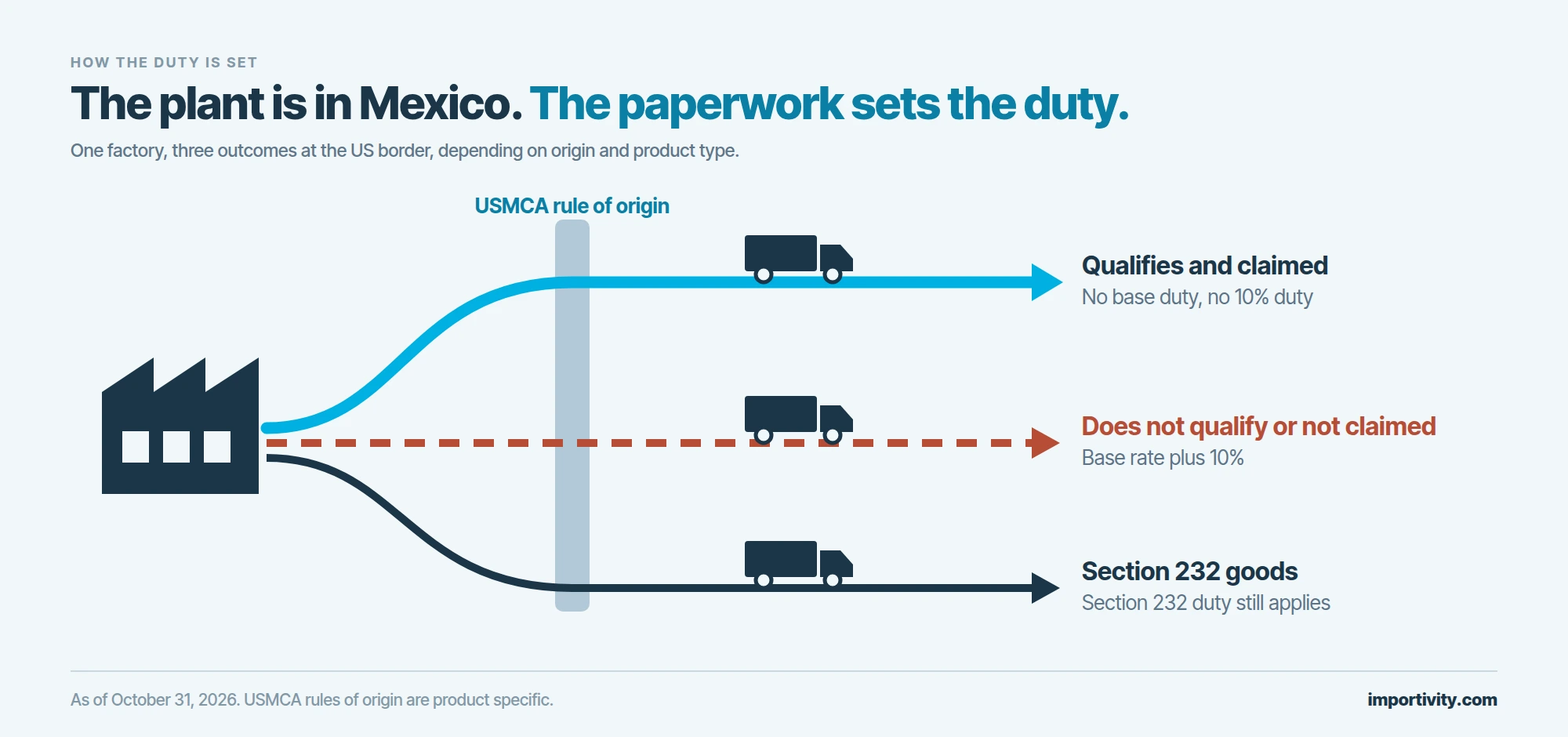
- Goods that qualify and are claimed under USMCA. They enter free of the base duty rate. They are also exempt from the 10% Section 301 forced-labor duty on products of Mexico that began on July 24, 2026. Mexico's Economy Ministry said about 85% of its exports to the US would stay exempt.
- Goods that do not qualify, or where nobody claims USMCA. They pay the base duty rate plus the 10% duty.
- Steel, aluminum and other Section 232 goods. The Section 232 duty still applies, and USMCA does not remove it. See our guide to tariff stacking for how the layers combine.
Rules of origin are product specific, so check yours before you choose a plant. A product assembled in Mexico from mostly Asian parts may not qualify. Our guide to country of origin rules explains the test.
USMCA itself is under review. At the July 1, 2026 joint review the United States declined to extend the agreement. It stays in force until July 1, 2036, with a review each year until the three countries agree on an extension or it expires. Plan on today's treatment and recheck it each year.
How to find and check a plant in Mexico
- Send the same RFQ to three to five plants. Use one manufacturing RFQ and one bill of materials so the quotes compare line by line.
- Ask what runs on the line today. A plant that already makes a product close to yours will have the right machines, operators and suppliers.
- Check the company. Ask for its RFC tax registration and, if it says it works under IMMEX, its program number.
- Ask who signs the USMCA certification. Ask which parts come from where, and who keeps the records that support the origin claim.
- Visit before you commit. Our factory audit checklist lists what to look at on the floor.
- Inspect before you pay the balance. Book a pre-shipment inspection on the first production order.
One of our published programs is a Dallas home builder that buys custom ironwork from Monterrey, with more than 40 containers a year and lead times of 2 to 3 weeks. To see how sourcing from Mexico compares with your current cost, send us your product and order details.
Frequently Asked Questions
What major manufacturers have plants in Mexico?
GM, Ford, Stellantis, Volkswagen, Audi, Kia, BMW, Nissan and Toyota all build vehicles in Mexico. Foxconn and other large electronics firms also run plants there. Thousands of smaller contract manufacturers and parts suppliers work around them, and those are the plants that take orders from outside brands.
Where is most manufacturing done in Mexico?
Manufacturing is concentrated along the northern border, in the northeast around Monterrey and Saltillo, in the Bajío states of Querétaro, Guanajuato, San Luis Potosí and Aguascalientes, in Guadalajara, and in central Mexico around Puebla and Toluca. Each area grew around one or two industries.
What are the major manufacturing industries in Mexico?
Autos and auto parts are the largest. Electronics, computer hardware, appliances, aerospace, medical devices, steel and apparel are also large. Each tends to sit in a certain area, such as medical devices in Tijuana, electronics in Guadalajara and steel and appliances in Monterrey.
Do I need to own a plant to manufacture in Mexico?
No. Most brands use a contract manufacturer that owns the plant and employs the staff, and they pay per unit. A shelter company suits companies that want their own production team without a Mexican entity. Owning a plant under IMMEX suits large, steady volume where you want full control.
What is a maquiladora?
A maquiladora is a plant in Mexico that imports materials and parts, processes or assembles them, and exports the finished goods. Most work under the IMMEX program, which lets them bring inputs in temporarily without paying import duty, subject to the program's rules.
About the author
Jordan Lewis
Chief Operating Officer, Importivity
Runs Importivity's sourcing operations across China, Vietnam, Mexico and India, from supplier negotiation through landed delivery.
Press and media inquiries: press@importivity.com