Tariff Stacking Explained and How US Duties Add Up on One Import
Tariff stacking is what happens when several US duties apply to the same imported product at once: each duty is a percentage of the same customs value, and the amounts are added together. As of October 17, 2026, one entry line can carry the MFN rate, Section 301 duties, Section 232 duties and antidumping or countervailing duties, plus the MPF and HMF fees, but some pairs do not combine, most importantly that goods paying Section 232 are exempt from the 2026 Section 301 forced-labor duty.
This guide is for US brands and operations teams pricing a product made in China, Vietnam, Mexico or elsewhere who need the duty rate that will actually print on the entry, not a headline number. It covers which layers apply, which ones exclude each other, how they appear on your entry summary, and one worked landed cost example. For the rate tiers inside the metals duty, see our guide to Section 232 tariffs.
The layers that can land on one entry line
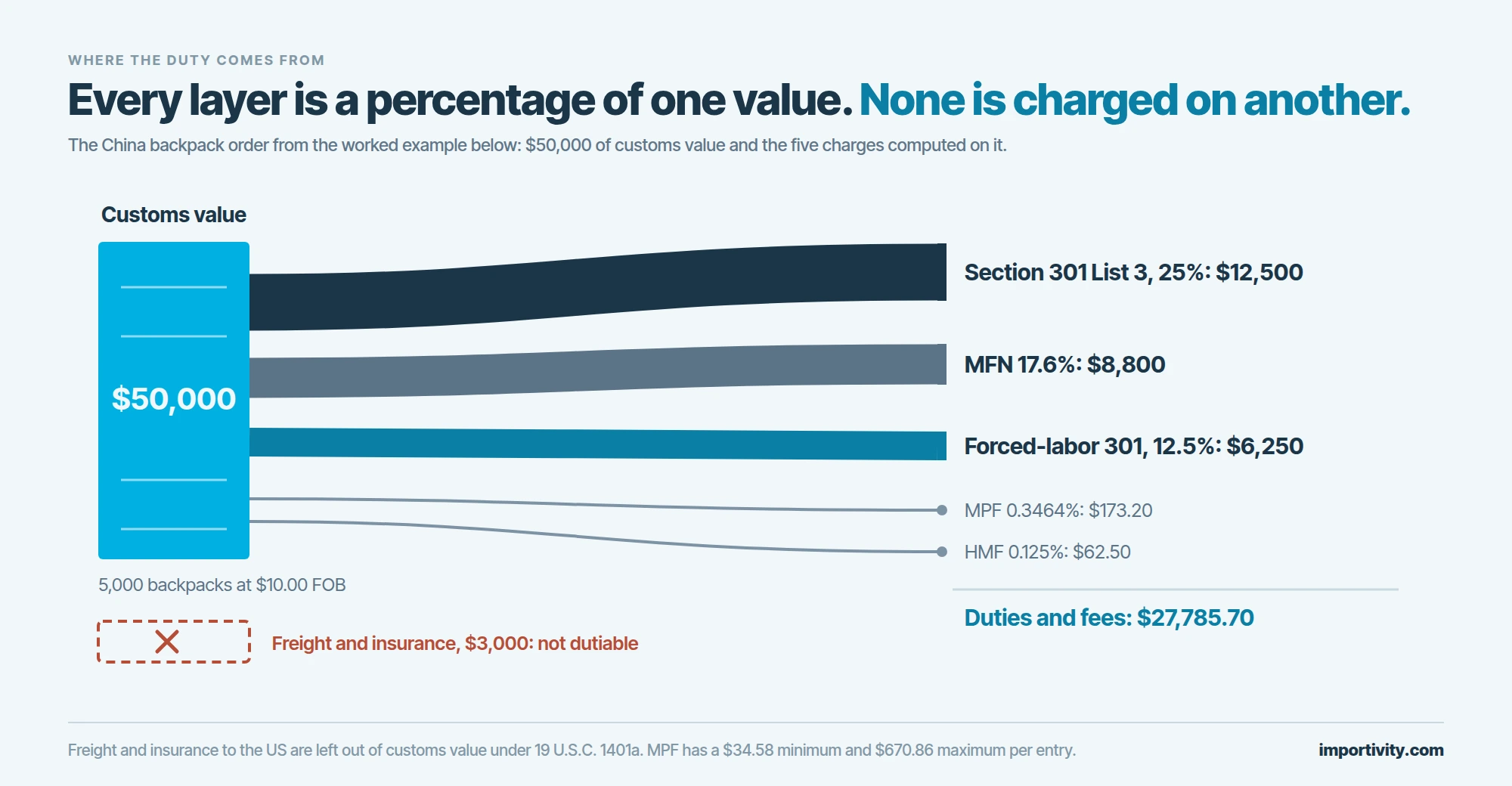
Every layer is an ad valorem rate on one base: the customs value, which for most purchases is the price paid to the seller, excluding international freight and insurance under 19 U.S.C. 1401a. The layers are added, not compounded. No duty is charged on another duty. The tariff schedule says so in its own wording: the Chapter 99 heading for a China List 3 product reads "the duty provided in the applicable subheading + 25%."
Here is what can sit on that base as of October 17, 2026:
- MFN duty. The column 1 general rate for your 10-digit code. It applies unless a trade program such as USMCA removes it, so the classification sets the floor for everything else. Our HTS classification guide covers how to get the code right.
- Section 301 on China. Lists 1 to 3 add 25%, List 4A adds 7.5%, and the 2024 four-year review raised some lines to 25%, 50% or 100%. USTR confirmed on October 7, 2026 that these actions remain in effect. The 178 product exclusions expire at 11:59 p.m. Eastern on November 9, 2026, as our exclusion tracker explains.
- Section 301 forced-labor duties. Since 12:01 a.m. Eastern on July 24, 2026, all products of 60 economies pay an extra duty unless exempted: 12.5% for China, Vietnam, Thailand and others, and 10% for Mexico, Canada, India, Indonesia, Malaysia and others. The EU and Taiwan are topped up to 10% combined with MFN, and goods of Japan, Korea or Switzerland to 12.5%. Our summary of the 60-economy action lists the rest.
- Section 232. Since April 6, 2026 the metals duty is charged on the full customs value of the product, regardless of metal content: 50% for Annex I-A articles and 25% for Annex I-B derivatives, with lower tiers for some goods. Separate 232 actions cover autos and parts, trucks, wood products and semiconductors, plus patented pharmaceuticals.
- Antidumping and countervailing duties. Cash deposit rates set per producer and country. They apply on top of every other layer.
- Fees. The merchandise processing fee is 0.3464%, with a minimum of $34.58 and a maximum of $670.86 per formal entry from October 1, 2026. The harbor maintenance fee is 0.125% on ocean cargo only. Both use the same value as the duty.
Two layers from earlier in 2026 no longer apply to new entries. IEEPA duties stopped on February 24, 2026 after the Supreme Court ruling, and the Section 122 surcharge expired at the close of July 23, 2026. Smaller country actions also exist, such as a 25% Section 301 duty on Brazil and Section 338 duties on listed Canadian goods.
Which duties do not stack
Most layers simply add. A few are written to exclude each other, and these are where entries go wrong in both directions: a broker who misses an exclusion overpays, and one who claims an exclusion that does not apply creates a debt that CBP can bill later. The rules below come from the tariff schedule itself, Revision 21, in force on October 17, 2026.
| Combination | Stacks? | Where the rule sits |
|---|---|---|
| China Section 301 lists plus the forced-labor 301 duty | Yes. A China List 3 product pays 25% plus 12.5%. | HTSUS Chapter 99, U.S. note 52(a) |
| China Section 301 plus Section 232 | Yes. Both apply on the full customs value. | Executive Order 14289, sec. 4(b), and the CBP reporting order |
| Forced-labor 301 plus Section 232 | No. Goods paying the metals, auto, truck, wood, semiconductor or patented pharmaceutical duties are exempt. | Heading 9903.05.90 |
| Steel, aluminum and copper on one product | No. The metals duty is charged once, at one rate. | Proclamation 11021, clause 9, and U.S. note 16(a) |
| Auto or truck parts plus the metals duty | No. Covered vehicle and truck parts skip the metals duty. | U.S. notes 33 and 38 |
| USMCA goods from Mexico or Canada plus forced-labor 301 | No, if entered free of duty under USMCA. | Headings 9903.05.93 and 9903.05.94 |
Read the forced-labor exemption narrowly. It covers goods that actually pay a Section 232 duty. A product that falls outside the metals duty because its covered metal is under 15% of its weight is filed under a different heading, 9903.82.03, which is not on the exemption list, so confirm with your broker how it is treated before you assume it escapes both duties. Antidumping and countervailing duties have no exemption in either direction: the tariff schedule says goods under the forced-labor action "shall continue to be subject to antidumping, countervailing or other duties."
How stacking shows up on your entry summary
Each layer appears as its own Chapter 99 number on the same entry summary line, reported ahead of the regular 10-digit code. CBP set the order in CSMS 69668138 on August 27, 2026: any Chapter 98 number first, then Chapter 99 additional duties, then trade remedies in this sequence: Section 301, then Section 338, then Section 232, then Section 201. The Chapter 1 to 97 classification comes last, and the entered value is reported against it.
For a backpack of man-made fiber made in China, that means three numbers on one line: 9903.88.03 for List 3, 9903.05.31 for the forced-labor duty, then 4202.92.3120 carrying the value. Pull the CBP Form 7501 for a recent entry and check four things:
- Every Chapter 99 number has a reason. Match each one to a layer above. An unexplained heading is either a missed exclusion or a wrong one.
- The value appears once. It belongs on the Chapter 1 to 97 line. Duties computed on a value that includes ocean freight are overpaid.
- The Section 232 tier matches the product. Annex I-A at 50% versus Annex I-B at 25% is a 25-point difference on the full value.
- Exempt goods carry the exemption heading. A 232 product from Vietnam should show the 232 number and the 9903.05.90 exemption, not a 12.5% forced-labor line.
A worked landed cost example
Take 5,000 backpacks of man-made fiber, HTS 4202.92.3120, at $10.00 each FOB, so $50,000 of customs value. The MFN rate is 17.6%. Assume $3,000 for ocean freight and insurance, which is part of your landed cost but not of the dutiable value. Here is the same order made in China and in Vietnam, entered by ocean on or after October 1, 2026.
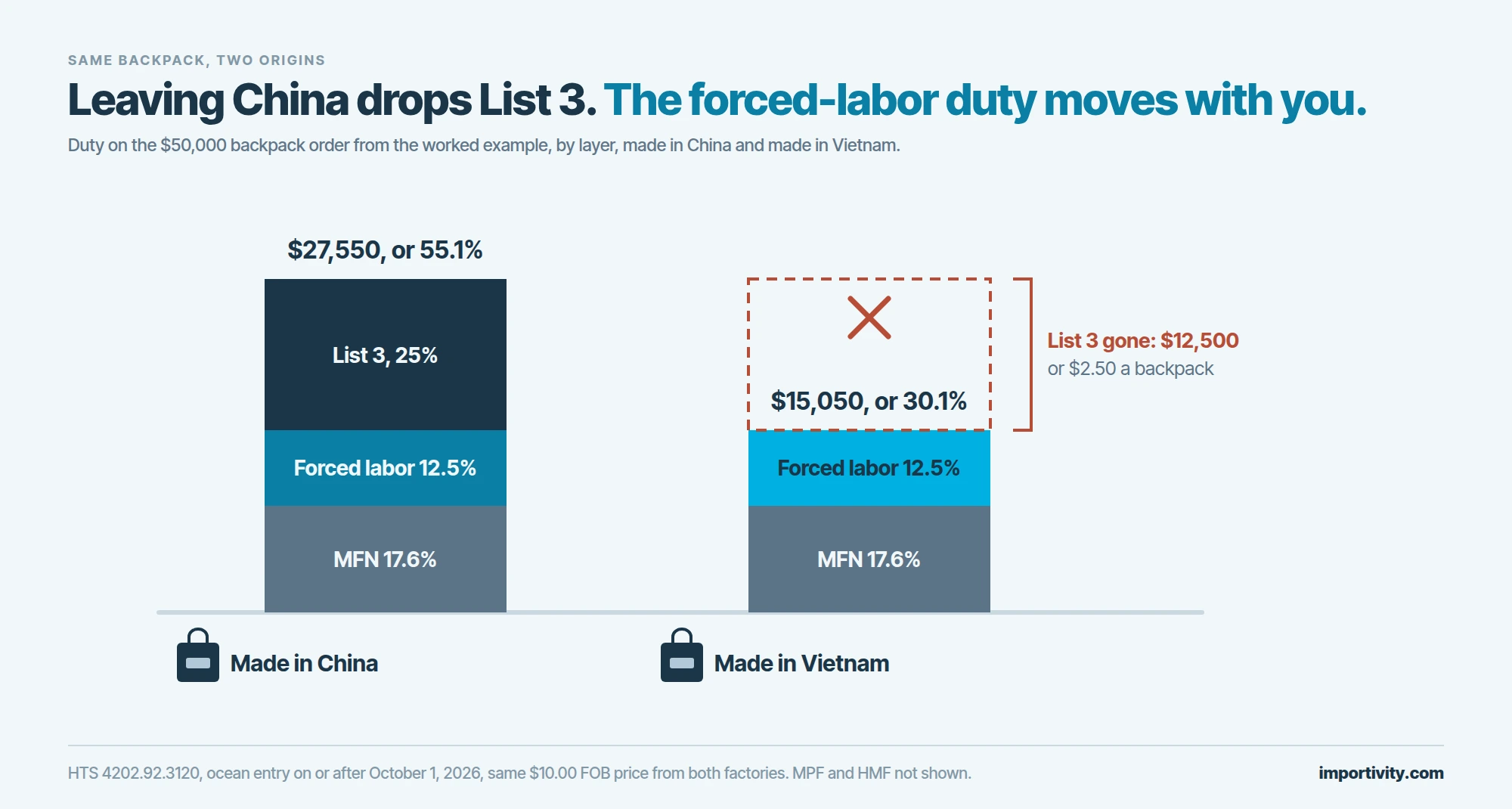
- Made in China. MFN 17.6% is $8,800. List 3 at 25% is $12,500. The forced-labor duty at 12.5% is $6,250. Duty totals $27,550, or 55.1% of value. Add MPF of $173.20 and HMF of $62.50, and duties and fees come to $27,785.70. With freight, the landed cost before domestic delivery is $80,785.70, or $16.16 per backpack.
- Made in Vietnam. MFN 17.6% is $8,800 and the forced-labor duty at 12.5% is $6,250. There is no List 3 layer. Duty totals $15,050, or 30.1%. With the same fees and freight, landed cost is $68,285.70, or $13.66 per backpack.
The move saves $2.50 a unit, which is the List 3 layer and nothing more. The forced-labor duty follows the product to Vietnam, so the Vietnamese backpack still pays 30.1%, not the 17.6% MFN rate alone. It also assumes the Vietnamese factory quotes the same $10.00, which is rarely true, and that the backpacks are genuinely Vietnamese under the country of origin rules. A Mexican backpack that qualifies under USMCA would enter free of the MFN rate and the forced-labor duty, and USMCA originating goods are also exempt from MPF.
Now change the product. Suppose it is a Section 232 Annex I-B steel derivative, still made in China and still on List 3. The 25% List 3 duty stays, 25% under Section 232 is added on the full value, and the 12.5% forced-labor duty drops away because 232 goods are exempt from it. Made in Vietnam, the same product pays its MFN rate plus the 232 duty and no forced-labor duty. Run your own numbers in our landed cost calculator, and see how to calculate landed cost for the costs beyond duty.
Mistakes that make a stack cost more than it should
Most overpayment comes from four errors, and each can be checked in an afternoon with one entry summary and your purchase order.
- Duty on the wrong value. US customs value excludes international freight and insurance. A model that applies 55.1% to a CIF figure overstates duty on the $3,000 of freight in the example by $1,653.
- A default 232 tier. A mixed product filed as Annex I-A pays 50% where Annex I-B would pay 25%, and a product under 15% metal by weight may be outside the metals duty altogether.
- Assuming a country move removes every layer. The forced-labor duty covers 60 economies, so leaving China removes the China 301 lists but rarely the whole stack.
- Relying on an exclusion with an end date. If your China product sits under one of the 178 exclusions, price the order as if the full list rate applies from November 10, 2026, unless USTR extends them.
How to lower a stacked duty bill
Each layer has its own trigger, so each needs its own fix. Classification sets MFN and decides which lists and annexes apply, which is why a classification review comes first. Origin decides the Section 301 layers, but only a real change in where the product is made changes origin, and USMCA preference removes the MFN and forced-labor layers for goods that qualify, though not the metals duty. Product design decides the Section 232 tier, since the 15% weight test and the US-metal tier both depend on what the factory buys. A foreign trade zone delays duty but does not remove the metals duty, as the Section 232 guide explains.
The order of work matters more than any single trick. Confirm the code, list every layer with its Chapter 99 number, check which exclusions and exemptions apply, then model each sourcing option at full landed cost. If you are weighing a move out of China, our supply chain management team helps US brands compare options using factory quotes and the duty stack for each country.
Frequently Asked Questions
What is tariff stacking?
Tariff stacking is when more than one US duty applies to the same imported product. Each duty is a percentage of the same customs value, and the amounts are added, not compounded. As of October 2026 the usual layers are the MFN rate, Section 301, Section 232 and any antidumping or countervailing duty, plus the MPF and HMF fees.
Do Section 301 and Section 232 tariffs stack?
The China Section 301 lists do stack with Section 232, so a covered Chinese steel derivative on a 301 list pays MFN plus the list rate plus the 232 rate. The 2026 Section 301 forced-labor duty does not stack with Section 232. Goods that pay a Section 232 duty are exempt from it under heading 9903.05.90.
Does the 12.5% forced-labor tariff apply on top of China's List 3 tariff?
Yes. U.S. note 52(a) to Chapter 99 says goods under the forced-labor action are also subject to any other additional duty in that subchapter. A China List 3 product pays MFN plus 25% plus 12.5%, unless an exemption applies, for example because it pays a Section 232 duty.
Are import duties calculated on the price including freight?
No. US customs value is generally the price paid to the seller, excluding international freight and insurance to the United States, under 19 U.S.C. 1401a. Every stacked duty and the MPF and HMF fees use that same value. A landed cost model that applies duty to freight overstates the duty.
Does moving production from China to Vietnam stop tariff stacking?
It removes the China Section 301 lists, but Vietnam is one of the 60 economies under the 2026 forced-labor action at 12.5%. Section 232 and antidumping duties depend on the product, not only the country. The origin also has to be real, which means the product must be substantially transformed in Vietnam.
About the author
Jordan Lewis
Chief Operating Officer, Importivity
Runs Importivity's sourcing operations across China, Vietnam, Mexico and India, from supplier negotiation through landed delivery.
Press and media inquiries: press@importivity.com