Import Tax From China to the US (Current Tariffs, November 2026)
Import tax from China to the US is a stack of duties, not one rate. As of November 12, 2026, most Chinese goods pay the regular duty rate for their HTS code, plus 25% or 7.5% if the product is on a China Section 301 list, plus a 12.5% Section 301 forced-labor duty and a 0.3464% processing fee. That puts the duty on a $10.00 backpack at $5.51 and on a $4.00 cotton T-shirt at $1.46.
This guide is for US brands and buyers pricing a product made in China. It lists each layer with its date, the layers that ended in 2026, the fees on top, who owes the money and how to check your own product. How the layers combine on one entry summary is covered in our guide to tariff stacking.
Current tariffs on China, layer by layer
Each layer is a percentage of the same customs value, which for most purchases is the price paid to the factory without international freight and insurance. The layers add, and no duty is charged on another duty. This is what can apply to a product of China entered on November 12, 2026.
| Duty layer | Rate on Chinese goods, November 12, 2026 | Status and scope |
|---|---|---|
| Regular (MFN) duty | Set by the 10-digit HTS code: 17.6% on the backpack below, 16.5% on the T-shirt | Applies to every import unless a trade program removes it |
| Section 301, Lists 1 to 3 | 25% | In force since 2018; continued on October 7, 2026; 178 exclusions run to January 9, 2027 |
| Section 301, List 4A | 7.5% | In force since 2019; covers consumer goods such as apparel |
| Section 301, lines raised in the 2024 review | 25%, 50% or 100% | Named lines only |
| Section 301 forced-labor duty | 12.5% | Since July 24, 2026, on top of any list rate; not on Section 232 goods or products in its exemption annexes |
| Section 232 | 50% or 25% of full value for metals; other rates for vehicles, wood products and more | Any origin, decided by the product |
| Antidumping and countervailing duties | Set per producer | Only products under an order; added to every other layer |
| IEEPA tariffs and the Section 122 surcharge | 0% | IEEPA ended on February 24, 2026; Section 122 expired after July 23, 2026 |
Three of these layers need more detail.
- China Section 301 lists. USTR said on October 7, 2026 that the 2018 actions continue while it runs their four-year review. The 178 product exclusions, claimed under headings 9903.88.69 and 9903.88.70, were due to end on November 9. On November 10, USTR extended all 178 through January 9, 2027, citing ongoing talks with China. Our guide to Section 301 tariffs explains how the lists work.
- The forced-labor duty. Since 12:01 a.m. Eastern on July 24, 2026, products of China pay 12.5% under heading 9903.05.31, on top of any list rate, under USTR's notice of July 28, 2026. Goods that pay a Section 232 duty are exempt, and so are products listed in the notice's exemption annexes. Check your 10-digit code against those annexes before you count on an exemption. The Court of International Trade heard argument in a challenge to the duty on September 30, 2026. The case is pending, and CBP keeps collecting the duty.
- Section 232. Since April 6, 2026, the metals duty is charged on the full customs value: 50% for articles entirely or almost entirely of steel, aluminum or copper, and 25% for derivatives that are at least 15% covered metal by weight. Separate 232 actions cover vehicles and parts, trucks, wood products, some chips and patented drugs. Our Section 232 guide has the full tier table.
What no longer applies, and what could change next
Two tariff layers that applied to Chinese goods in 2025 and 2026 have ended for new entries, and small parcels no longer enter duty-free.
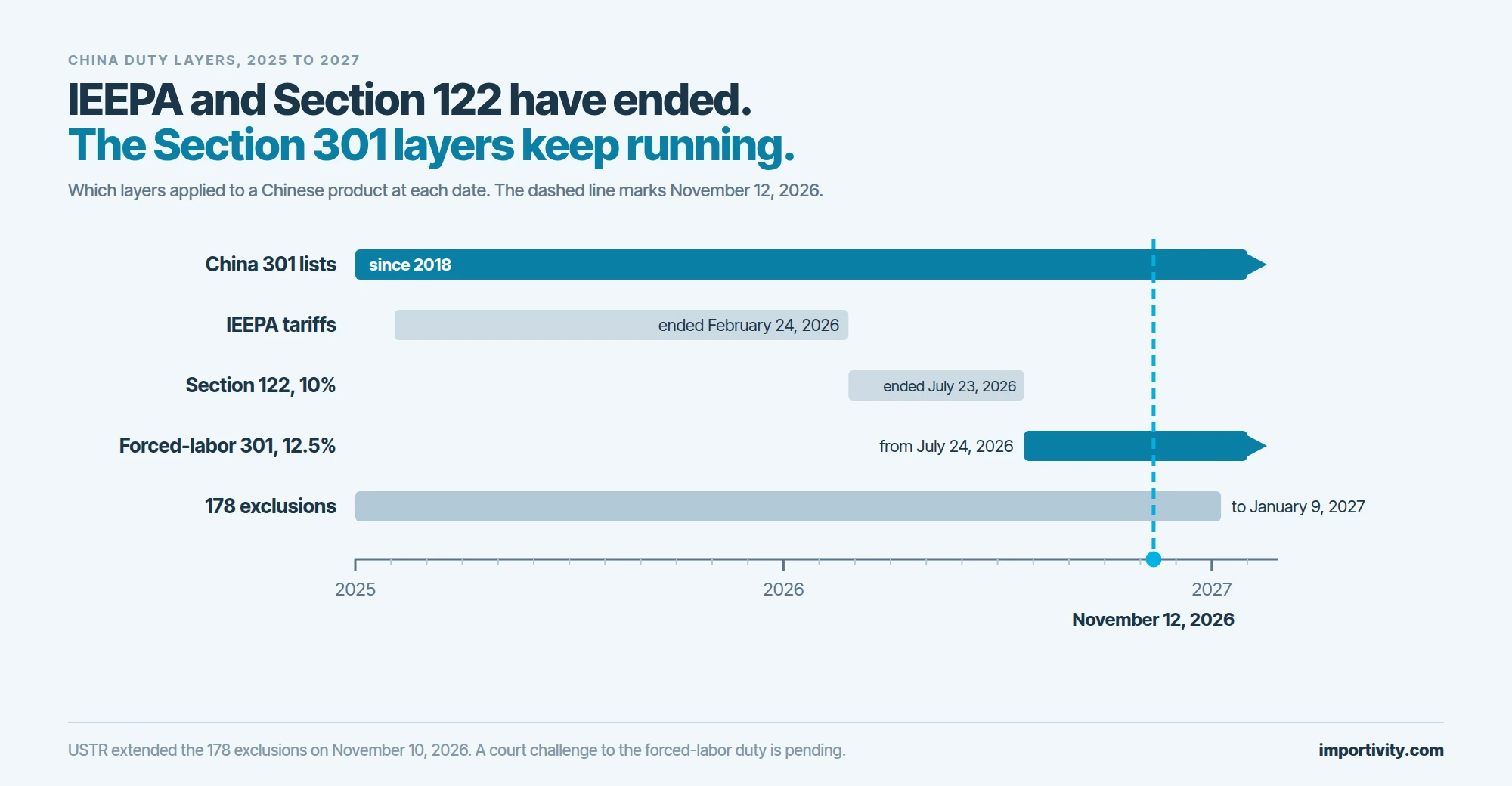
- IEEPA tariffs. The Supreme Court held on February 20, 2026 that IEEPA does not authorize tariffs. CBP stopped collecting them on goods entered from 12:00 a.m. Eastern on February 24, 2026, about a year after the first IEEPA duties on China in February 2025. Refunds go to the importer of record on each entry, as our guide to IEEPA tariff refunds explains.
- The Section 122 surcharge. A 10% surcharge ran from February 24, 2026 and expired at the close of July 23, 2026. It is not refunded through CBP's IEEPA refund process.
- De minimis. Duty-free entry for shipments of $800 or less ended for China on May 2, 2025 and for all countries on August 29, 2025, and CBP wrote the suspension into its regulations in June 2026. A parcel from China now pays the same duty rates as a full container, as our guide to the end of de minimis shows.
Dates to watch
- January 1, 2027. Section 232 duties on upholstered wooden furniture rise from 25% to 30%, and on kitchen cabinets and vanities from 25% to 50%, except for countries with a wood products agreement.
- January 9, 2027. The 178 exclusions end unless USTR extends them again, and excluded goods would then pay their full list rate.
- January 10, 2027. The end date the Treasury Secretary announced for the US-China truce. It was announced, not published as a rule.
- June 23, 2027. A separate Section 301 action on Chinese semiconductors, set at 0% since December 23, 2025, rises to a rate USTR has not yet announced.
- No date set. On September 27, 2026 the US-China Board of Trade named 77 US tariff lines, about $30 billion of Chinese goods such as toys, small kitchen appliances and Christmas articles, for possible tariff cuts. No rate has changed, and USTR says any cut needs a Section 301 notice and public comment first.
China tariff rate on two common products
Both examples below are entered by ocean on November 12, 2026, with the customs value equal to the FOB factory price. Each layer is shown with its heading.
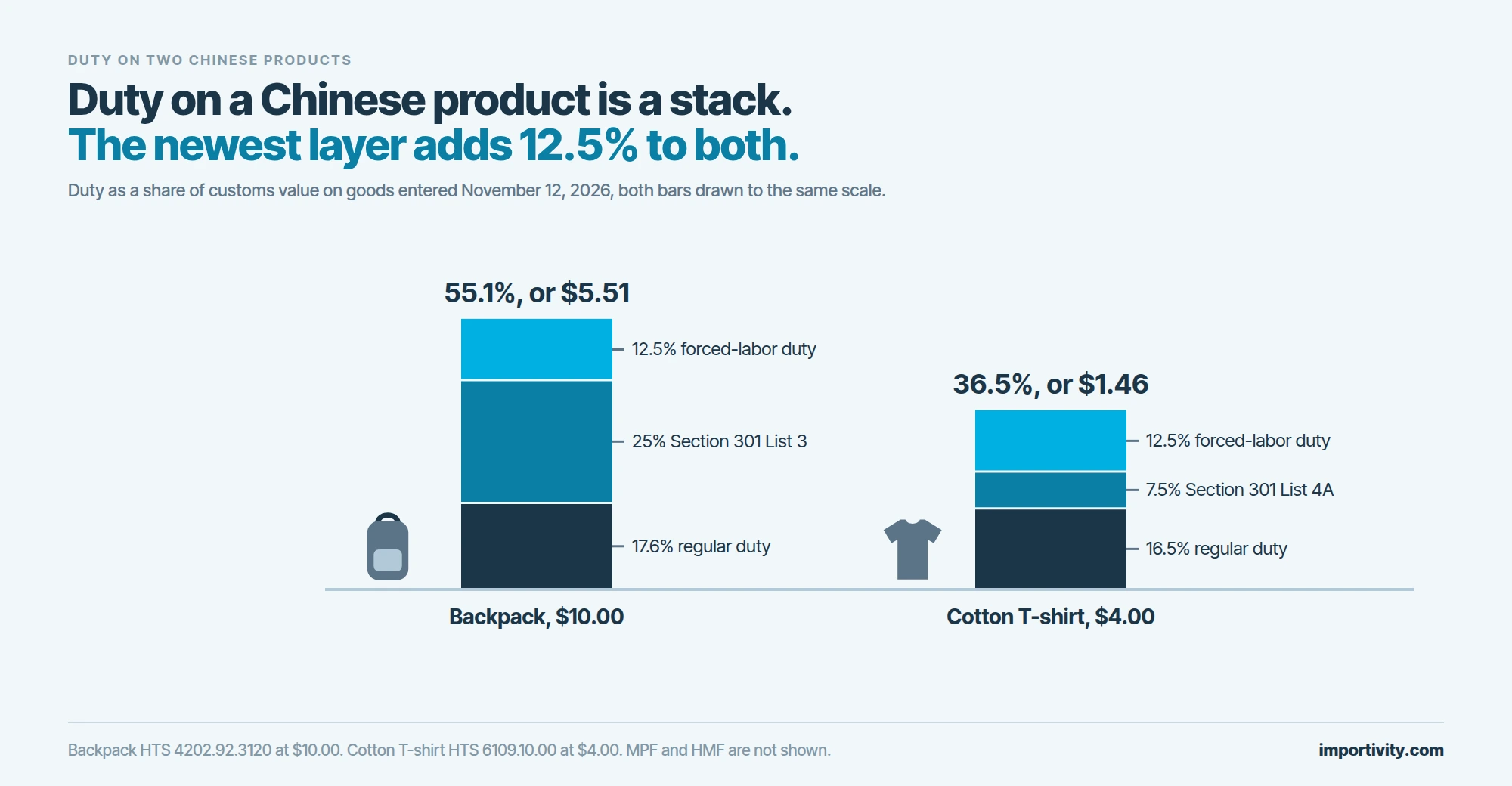
Backpacks, HTS 4202.92.3120
5,000 backpacks with an outer surface of man-made fiber at $10.00 each, so $50,000 of customs value:
- Regular duty, 17.6%. $8,800.
- Section 301 List 3, 25%, heading 9903.88.03. $12,500.
- Forced-labor duty, 12.5%, heading 9903.05.31. $6,250.
- Fees. MPF of $173.20 and HMF of $62.50.
Duty is $27,550, or 55.1% of value. With the fees, the bill to CBP is $27,785.70, about $5.56 per backpack.
Cotton T-shirts, HTS 6109.10.00
10,000 knitted cotton T-shirts at $4.00 each, so $40,000 of customs value:
- Regular duty, 16.5%. $6,600.
- Section 301 List 4A, 7.5%, heading 9903.88.15. $3,000.
- Forced-labor duty, 12.5%, heading 9903.05.31. $5,000.
- Fees. MPF of $138.56 and HMF of $50.00.
Duty is $14,600, or 36.5% of value, and the bill to CBP is $14,788.56, about $1.48 per shirt. Most of the gap between the two products is the list rate: 25% on the backpack and 7.5% on the T-shirt. Made in Vietnam at the same price, the backpack would pay 30.1% and the T-shirt 29%, because the forced-labor duty covers Vietnam too. A steel product from China on List 3 works differently: it pays the regular rate, the 25% list rate and the Section 232 duty, but no forced-labor duty.
MPF, HMF and what is not charged
Two fees sit on top of duty, charged on the same value. For fiscal year 2027, which began October 1, 2026, CBP's fee notice sets the merchandise processing fee at 0.3464% of value, with a minimum of $34.58 and a maximum of $670.86 per formal entry. The harbor maintenance fee is 0.125% of value on ocean cargo only, so air shipments do not pay it. Informal entries, for shipments of $2,500 or less, pay a small flat MPF instead.
The United States charges no VAT and no federal sales tax at the border, apart from federal excise taxes on goods such as alcohol and tobacco. State sales tax applies later, when the goods are sold. The broker's fee, the ISF filing and the customs bond are service costs, not taxes.
Who pays the import tax on goods from China
The importer of record pays. That is the party named on the entry, and under 19 CFR 141.1 the duty is its personal debt to the United States. If you buy FOB or EXW and your broker files in your company's name, you pay CBP.
Under DDP, the seller or its forwarder is the importer of record. It pays CBP and builds the duty into your price, so you still pay it, but you cannot see the classification or the rate, and any refund goes to the importer of record. That is why DDP buyers had no claim of their own to the IEEPA refunds. Our FOB vs DDP page sets out what changes with each term. An invoice that shows less than the real price is undervaluation, and the importer of record owes the unpaid duty and the penalty.
How to look up the tariff on your own product
Run these checks before you place the order, and again whenever a rule changes.
- Get the 10-digit HTS code. Search the Harmonized Tariff Schedule and CBP's rulings database, CROSS, for products like yours. For a close call, ask CBP for a binding ruling under 19 CFR Part 177. Our HTS classification guide explains the rules.
- Read the regular rate. It is the General rate in column 1 of your line.
- Find the Section 301 list. A footnote on the line points to the list heading, such as 9903.88.03 for List 3 or 9903.88.15 for List 4A.
- Check for an exclusion. Compare your product with the descriptions under headings 9903.88.69 and 9903.88.70. Relief applies only to an exact match, and only through January 9, 2027.
- Check the forced-labor exemptions. The 12.5% applies unless your code is in one of the notice's exemption annexes or the goods pay Section 232.
- Check Section 232 and antidumping orders. Weigh the metal in the product, look for your code on the 232 annexes, and search for antidumping or countervailing orders on the product from China.
- Confirm on a real entry. Ask your broker for the CBP Form 7501 of your last shipment and match each Chapter 99 heading to a layer.
Legal ways to lower the import tax on Chinese goods
Each layer has its own trigger, so each needs its own fix. Our guide to reducing import duties legally walks through six methods. In short:
- Correct the classification. The code sets the regular rate and the list, so a wrong code can overcharge you.
- Use an exclusion while it lasts. Claim one only when your product matches the description exactly.
- Change the product design. A real change can move a product to a different code, or take covered metal under 15% of its weight and out of the metals duty.
- Move production where origin really changes. The backpack drops from 55.1% to 30.1% in Vietnam. Goods made in Mexico that qualify under USMCA enter free of the regular rate, the forced-labor duty and MPF, though not Section 232.
- Use first sale or drawback. Buying through a trading company can let you declare the factory's lower price, and drawback refunds up to 99% of duty on goods you export.
A foreign trade zone or bonded warehouse delays the bill but rarely lowers it. Our tariff mitigation strategies resource covers each route. If you are weighing a move out of China, send us your product details for a landed cost by country.
Frequently Asked Questions
How much is the import tax from China to the USA?
There is no single rate. As of November 12, 2026, most Chinese goods pay the regular duty for their HTS code, plus 25% or 7.5% if the product is on a China Section 301 list, plus a 12.5% Section 301 forced-labor duty and a 0.3464% processing fee. A $10.00 man-made fiber backpack pays 55.1%, or $5.51, and a $4.00 cotton T-shirt pays 36.5%, or $1.46.
What are the current tariffs on China?
As of November 12, 2026, products on Section 301 Lists 1 to 3 pay 25%, List 4A products pay 7.5%, and some lines raised in the 2024 review pay 25%, 50% or 100%. A 12.5% Section 301 forced-labor duty has applied to most Chinese goods since July 24, 2026. Section 232 duties apply to metals, vehicles and some wood products. The IEEPA tariffs ended on February 24, 2026.
Do I pay sales tax or VAT on goods imported from China?
No. The United States charges no VAT and no federal sales tax at the border, apart from federal excise taxes on goods such as alcohol and tobacco. You pay customs duty, the merchandise processing fee and, for ocean cargo, the 0.125% harbor maintenance fee. State sales tax applies later, when the goods are sold to a buyer in a state that charges it.
Who pays the tariff on goods imported from China?
The importer of record pays CBP. If you buy FOB or EXW and your broker files in your company's name, that is you. If you buy DDP, the seller or its forwarder is the importer of record, pays the duty and builds it into your price. Either way the US buyer bears the cost, and any refund goes to the importer of record.
Did the Supreme Court ruling end the tariffs on China?
It ended only the IEEPA tariffs. CBP stopped collecting them on goods entered from February 24, 2026, and refunds go to importers of record. The China Section 301 lists, the 12.5% Section 301 forced-labor duty, Section 232 duties and antidumping duties rest on other laws and still apply. The 10% Section 122 surcharge that followed expired after July 23, 2026.
About the author
Jordan Lewis
Chief Operating Officer, Importivity
Runs Importivity's sourcing operations across China, Vietnam, Mexico and India, from supplier negotiation through landed delivery.
Press and media inquiries: press@importivity.com