IEEPA Tariff Refunds and Who Can Actually Claim the Money
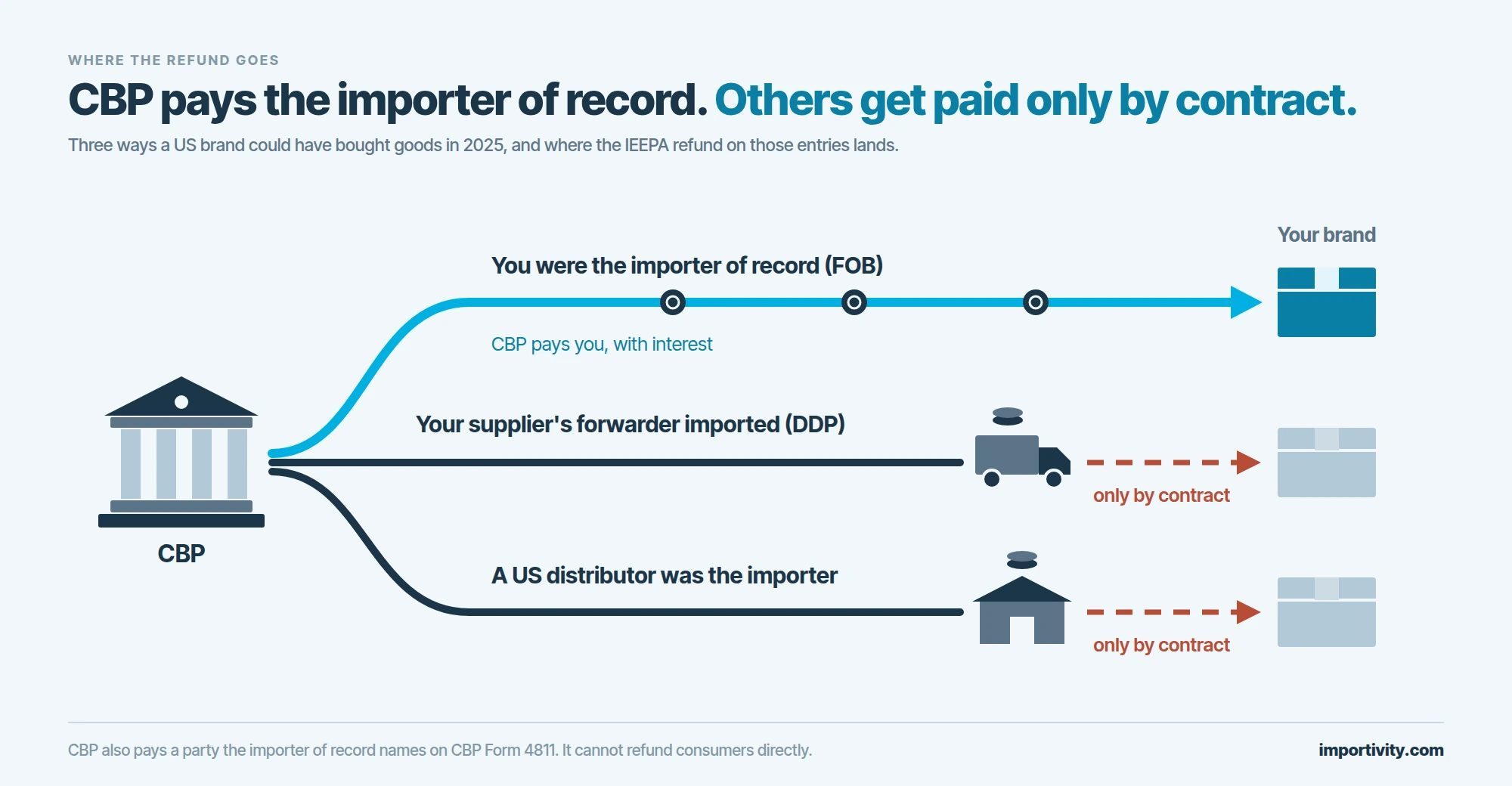
An IEEPA tariff refund is paid by CBP to the importer of record on each entry, or to a party that importer named on CBP Form 4811, after a CAPE declaration is filed in the ACE Portal, and it includes interest. If you bought DDP and your supplier's forwarder was the importer of record, the refund goes to that importer, and anything you get back depends on your contract with it.
This guide is for US brands that imported between February 2025 and February 2026 and want to know whether money is owed to them, who holds the claim, and what to do about it. It reflects the CBP rules and court orders in place on October 9, 2026. If you are not sure whose name went on your entries, start with our explainer on the importer of record, because that name decides everything below.
The refund follows the name on the entry
CBP pays IEEPA refunds to one of two parties: the importer of record on the entry, or a party that importer designated on CBP Form 4811. CBP's own guidance says it cannot refund consumers directly, and the party receiving the money must have refund bank details in an ACE Portal account. Who paid the factory, who paid the freight and who owns the goods today do not change where the money goes. Anyone else gets paid by contract, if at all.
The Supreme Court held on February 20, 2026 that IEEPA does not authorize the President to impose tariffs, in Learning Resources, Inc. v. Trump. CBP stopped collecting the duties on goods entered on or after 12:00 a.m. Eastern on February 24, 2026. A CBP declaration filed with the Court of International Trade put the total at about $166 billion, paid by more than 330,000 importers on more than 53 million entries as of March 4, 2026. Our note on the ruling covers the decision itself.
Filing is just as narrow as payment. Only the importer of record, or the licensed customs broker that filed the entries, can submit a CAPE declaration. CBP's guidance says attorneys cannot file one on an importer's behalf. A refund service that offers to "file your claim" still has to go through one of those two parties.
If you bought DDP, the claim sits with someone else
Under a DDP quote the seller arranges the import and pays the duty, so the importer of record is the seller or a company its forwarder uses. The IEEPA refund on those entries goes to that company. You paid a delivered price, not a duty to CBP, so you have no refund claim with CBP for those shipments. The same is true if a US distributor imported the goods and sold them to you. Our guide to FOB vs DDP explains how the two terms split the importer role.
What you can do is commercial, not legal. Ask the importer of record for these, in writing:
- The entry numbers for every shipment of your goods between February 2025 and February 2026, and the IEEPA duty shown on each entry summary.
- The importer of record name and number on each entry, so you know which company holds the claim.
- Whether a CAPE declaration was filed, on what date, and what has been paid so far. CBP's REV-615 report in ACE lists CAPE refunds once they issue.
- What share they will pass back and how, whether as cash or a credit against your next order, and when.
Your position depends on the paperwork. If the quote or invoice listed the tariff as a separate surcharge line, or your contract says duty changes pass through to the price, you have something written to point to. If you paid one all-in delivered price with no duty line, you are negotiating, and the importer may simply decline. Expect an importer that never went to court to be careful about paying out, for a reason covered in the section on what is still unsettled.
The lasting fix is to buy FOB and hold the importer of record role yourself, so refunds, protests and audits all come to you. Our shipping and logistics team sets that up for US brands as part of a sourcing project.
Which entries CAPE takes, by liquidation date
Whether an entry can be refunded through CAPE turns on one date: when it liquidated. CBP told the court that ACE liquidates entries automatically 314 days after the date of entry unless liquidation is extended or suspended. After liquidation, CBP can reliquidate on its own for 90 days under 19 U.S.C. 1501, and an importer can protest for 180 days under 19 U.S.C. 1514. An entry past that 90-day window is what the court calls finally liquidated. CAPE draws a shorter line inside that window: it accepts entries that are unliquidated or that liquidated in the past 80 days.
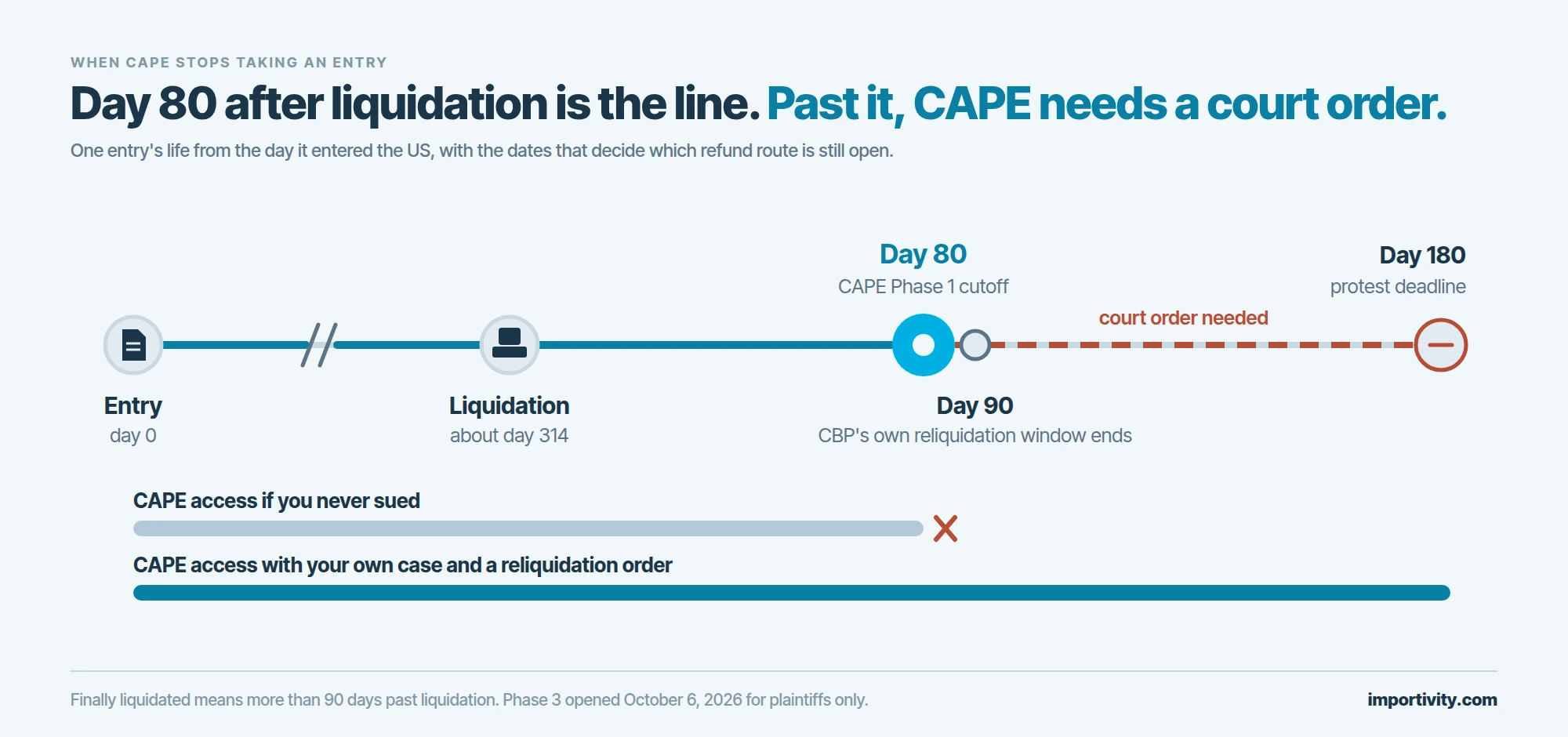
CBP has opened CAPE in phases. Phase 1 went live on April 20, 2026 for unliquidated entries and entries no more than 80 days past liquidation. Phase 2 began June 29, 2026 for entries flagged for reconciliation where the reconciliation entry is not yet on file. Phase 3 opened on October 6, 2026 for finally liquidated entries, but only for importers that filed their own case at the Court of International Trade and received a reliquidation order. The court said more than 4,000 such cases had been filed, covering around 7,000 plaintiffs, as of October 7.
| Status of the entry on October 9, 2026 | Route that exists today | What to do |
|---|---|---|
| Unliquidated | CAPE Phase 1 | File a CAPE declaration. If liquidation is suspended or extended, the refund issues when the entry liquidates. |
| Liquidated 80 days ago or less | CAPE Phase 1 | File now. Once the entry passes day 80, CAPE rejects it as final liquidation status. |
| Flagged for reconciliation, no reconciliation entry filed | CAPE Phase 2, since June 29 | File, and watch the reconciliation filing deadline. |
| Liquidated more than 80 days ago, and you have your own court case | CAPE Phase 3, since October 6 | Your counsel and broker file under the reliquidation order in your case. |
| Liquidated more than 80 days ago, and you never sued | No CAPE route yet | Ask trade counsel now about a protest while you are inside 180 days, your own case, or the class. |
| Under an open protest or on a drawback claim | Not accepted yet | CBP lists both for a later phase. Ask your broker before withdrawing anything. |
The program has paid most of the money. The court's October 8 opinion cites a CBP declaration saying that as of October 2, 2026, about $136.6 billion in potential and certified refunds had been accepted in CAPE and about $126 billion, including interest, had been refunded. The same opinion says that if CAPE stopped working that day, about $30 billion would still be on deposit with the Treasury. Our Phase 3 update has the earlier figures and the July 30 cutoff that applied to plaintiffs.
How to file a CAPE declaration
If you were the importer of record, the filing itself is short. The work is in getting your ACE account and bank details right first, because a refund with no refund bank account on file is held, not paid. Work through these in order:
- Set up the ACE Portal account. You need a verified account with an importer sub-account. Refund bank details go there, and they can differ from the account you use to pay CBP.
- Pull your entries. Run the ES-003 report (Entry Summary Line Tariff Details) to find entries that carried IEEPA duties.
- Sort them by liquidation status. Unliquidated, liquidated within 80 days, liquidated more than 80 days ago, under protest, on a drawback claim. Each group follows a different route in the table above.
- Fix other errors first. Once an entry is on a CAPE declaration you cannot remove it, and no post summary correction or protest can be filed on it until the refund issues. CBP also bars using a post summary correction to ask for an IEEPA refund.
- Upload the file. The declaration is a .csv file of entry numbers only, 11 characters with no dashes, up to 9,999 entries per declaration, uploaded on the CAPE tab. It is not filed through ABI.
- Or have your broker file it. A broker can file only for entries it filed, matched by the first three characters of the entry number to its filer code. Our guide to choosing a customs broker covers what to expect from one.
- Track the money. REV-603 shows pending and paid refunds, REV-613 shows refunds rejected for missing bank details, and ES-022 splits principal from interest by entry.
CBP says valid refunds generally issue 60 to 90 days after a declaration is accepted, which includes 45 days for its own review plus Treasury time. Interest is included in the refund, not paid separately, and it runs from the date you deposited the duty to the date the entry liquidates or reliquidates. CBP does not charge a fee for any of this, and its IEEPA duty refunds page warns that anyone claiming to be CBP and asking for a fee or bank details is running a scam.
What is still unsettled as of October 9, 2026
Four open questions decide whether the remaining money reaches the importers who have not been paid. None of them had been resolved on October 9.
- The appeal. On June 3, 2026 the government appealed the part of the court's April 17 order that covers all importers, not only those that sued. The case is No. 26-1895 at the Federal Circuit, both sides have filed briefs, and no decision had issued. The government's position is that CBP has no authority to reliquidate a finally liquidated entry without a court order specific to that importer.
- The class. On October 8, 2026 the Court of International Trade certified a class in Freestyle World, Inc. v. U.S. Customs and Border Protection, Court No. 26-01088. It covers all importers of record who paid duties under the challenged tariff orders between February 1, 2025 and February 19, 2026, excluding any entity that filed its own suit. A class of this type has no opt-out, so the only way out is to file your own case. Certification is not a refund: the government had not yet answered the class complaint. The full opinion, Slip Op. 26-123, and our summary of the class ruling set out the details.
- Which orders the class reaches. The class definition points to the trafficking and reciprocal tariff orders the Federal Circuit ruled on. If you paid IEEPA duties under a different order, ask counsel whether you are inside it.
- The deadline for a new suit. Cases like these carry a two-year limit under 28 U.S.C. 2636(i). Trade lawyers put the earliest likely cutoff at about February 4, 2027 for the first trafficking-tariff entries and about April 5, 2027 for reciprocal-tariff entries. When the clock started on your entries is a question for counsel.
A fifth point matters most to DDP buyers. The government has not said it will try to take back refunds already paid through CAPE to importers that never sued. Some trade lawyers have still raised the question in case the Federal Circuit rules for the government, and they note it matters to any importer deciding whether to pass refunds on to its customers. To check status yourself, use CBP's refunds page, CBP's CSMS messages and the Court of International Trade's class action page, not reposted summaries.
What this refund does not cover
CAPE returns IEEPA duties and the interest on them, nothing else. When CBP ended IEEPA collection it said the change affected IEEPA duties only and did not affect any other duties, naming Section 232 and Section 301. Any Section 232, Section 301 or antidumping and countervailing duty paid on the same entry stays paid. The Section 122 surcharge collected from February 24, 2026 to about July 24, 2026 rests on a different statute and is not refunded through CAPE.
Two other refund routes run on their own rules. Section 301 tariff refunds are a separate question with their own litigation, and duty drawback covers goods you re-exported or destroyed. An entry already on a drawback claim cannot go into CAPE yet. Do not price your next order as if refund cash is guaranteed. Price it on the duties that still apply, and our tariff mitigation strategies cover the legal ways to lower them.
Frequently Asked Questions
Who receives an IEEPA tariff refund?
CBP pays the refund to the importer of record on each entry, or to a party that importer designated on CBP Form 4811. CBP says it cannot refund consumers directly, and the party receiving the money needs refund bank details in an ACE Portal account. Only the importer of record or the licensed broker that filed the entries can submit the CAPE declaration.
I bought DDP. Can I claim the IEEPA refund myself?
No. Under DDP the seller or its forwarder's company was the importer of record, so the refund on those entries goes to that company. Ask it for the entry numbers, the IEEPA duty on each, whether it filed in CAPE and what it will pass back. Your position is strongest if the invoice showed the tariff as a separate line or your contract passes duty changes through to the price.
Do I need to sue at the Court of International Trade to get an IEEPA refund?
Not for entries that are unliquidated or liquidated within the past 80 days, which CAPE Phase 1 accepts without a court case. As of October 9, 2026, finally liquidated entries could go through CAPE only for importers with their own case and a reliquidation order. Importers that never sued depend on a pending Federal Circuit appeal or the class certified on October 8, 2026, so talk to trade counsel.
How long does an IEEPA refund take, and does it include interest?
CBP says valid refunds generally issue 60 to 90 days after a CAPE declaration is accepted, including 45 days for CBP review plus Treasury processing. Interest is built into the refund, not paid separately. It runs from the date the duty was deposited to the date the entry liquidates or reliquidates.
Is there a deadline to claim an IEEPA tariff refund?
CAPE Phase 1 takes an entry only until 80 days after it liquidates, so that is the first deadline most importers hit. A new court case carries a two-year limit under 28 U.S.C. 2636(i), and trade lawyers put the earliest likely cutoff at about February 4, 2027. Confirm the date for your own entries with counsel.
About the author
Jordan Lewis
Chief Operating Officer, Importivity
Runs Importivity's sourcing operations across China, Vietnam, Mexico and India, from supplier negotiation through landed delivery.
Press and media inquiries: press@importivity.com