What an Importer of Record Is Liable For and How to Become One

The importer of record is the party that owes U.S. Customs and Border Protection for a shipment: the duties, the accuracy of the classification, value and country of origin on the entry, the security filing before the vessel loads, any other agency's permits, and the records for five years afterward. Under 19 CFR 141.1 that liability is a personal debt to the United States, discharged only by payment in full. The importer of record can be the owner of the goods, the purchaser, or a licensed customs broker acting under a power of attorney. It is never the carrier, never the freight forwarder, and never Amazon.
This guide is for U.S. buyers importing for the first time, overseas sellers shipping into the United States, and ecommerce brands that lost the de minimis shortcut and now hold this role themselves. It covers what the law expects of the importer of record, how the role differs from the consignee, the paperwork that makes you one, why a DDP quote hides an importer of record problem, and what an importer of record service costs. If the shipping side is new to you, our shipping and logistics team sets up the entry as part of a sourcing engagement.
What the law actually asks of an importer of record
The Customs Modernization Act put the burden of reasonable care on the importer, not on the government. You declare the tariff classification, the transaction value, the country of origin and every applicable duty, and CBP holds you to it. The broker types the entry, but files it in your name and on your bond, and the liability for what it says stays with you.
Reasonable care is a standard, not a checklist. A prudent importer reads the tariff heading before trusting the factory's suggestion, keeps the invoice behind the declared value, asks for an origin declaration instead of assuming the country on the carton, and checks for FDA, FCC or CPSC requirements before the goods ship. Skipping those steps is negligence, and negligence has a price schedule.
Importer of record vs consignee vs ultimate consignee
Four different names can appear on the paperwork for one container, and only one of them owes the duties. The bill of lading names a consignee and a notify party, which are carrier instructions. The customs entry names the importer of record and the ultimate consignee, which are legal roles. In a plain FOB purchase all four are often the buyer, which is why the distinction is easy to miss until a DDP quote splits them apart.
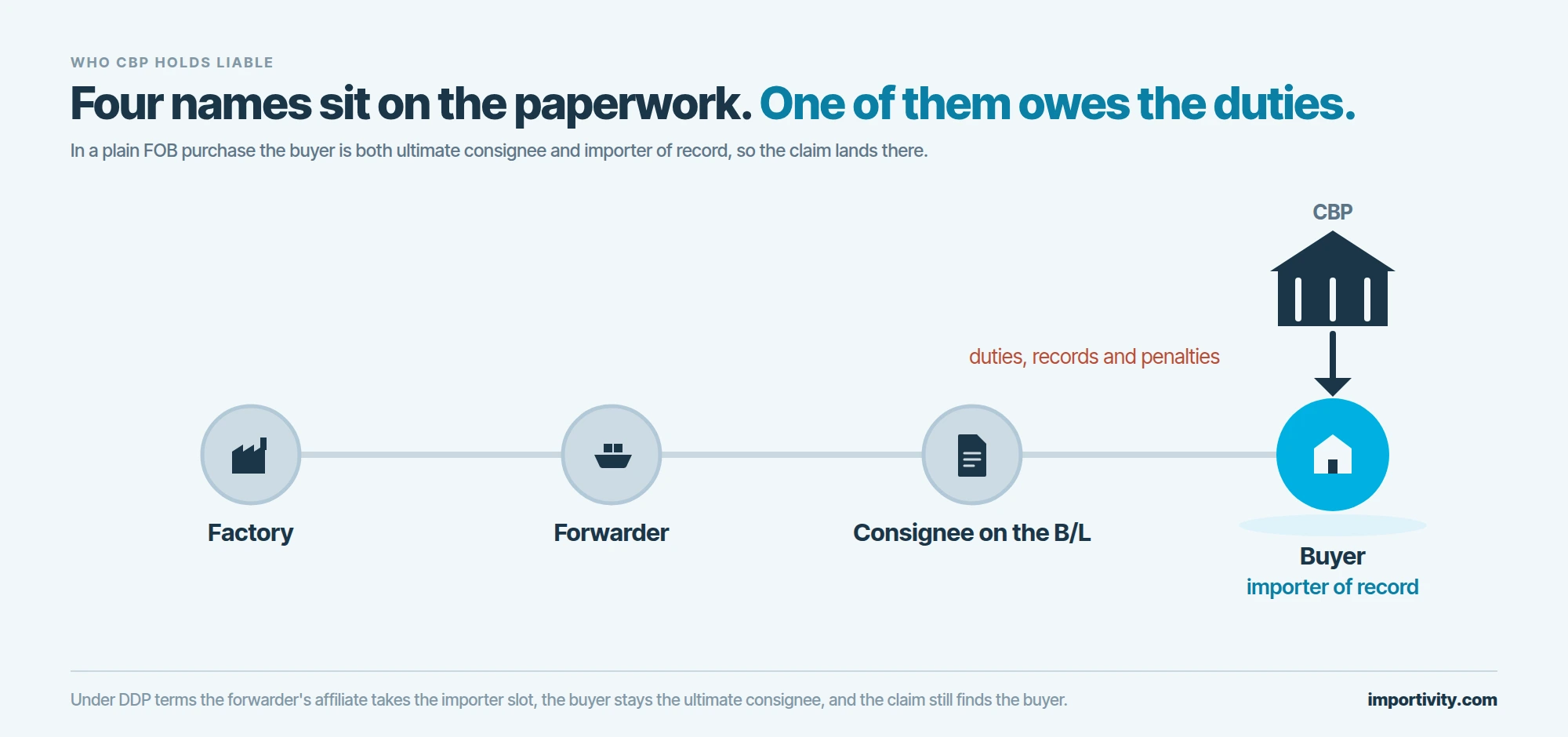
The ultimate consignee is the U.S. party the overseas shipper sold or consigned the goods to at the time of entry, meaning the business that will use, resell or distribute them. A carrier, forwarder or consolidator named on the bill of lading is only a nominal consignee and cannot be listed as the ultimate consignee on a formal entry.
| Party | Where the name appears | What it is on the hook for |
|---|---|---|
| Importer of record | Customs entry, the bond, CBP Form 5106 | Duties and fees, accuracy of classification, value and origin, agency compliance, five years of records, penalties |
| Ultimate consignee | Customs entry and the ISF | Being the real U.S. recipient; usually the buyer, and the party CBP contacts when the importer of record is a shell |
| Consignee on the bill of lading | Carrier's bill of lading | Taking delivery from the carrier; no customs liability by itself |
| Notify party | Carrier's bill of lading | Receiving the arrival notice; no liability |
| Customs broker | Entry filer field, under your power of attorney | Filing correctly on your behalf; the declaration stays the importer's liability |
Everything the importer of record is responsible for
The list is longer than paying duty, and every item attaches to the importer of record personally, whichever contractor did the work.
- Classification. The ten-digit HTS number, and the Section 232, Section 301 and IEEPA duties that stack on the base rate for that number and origin.
- Valuation. The transaction value declared, including assists such as tooling you paid for and any dutiable commissions or royalties.
- Origin. The country of origin claimed, which sets the duty stack and any forced labor or antidumping exposure.
- Duties, taxes and fees. The base duty, the additional tariffs, the merchandise processing fee at 0.3464% of entered value with a $33.58 minimum and a $651.50 maximum per formal entry in fiscal year 2026, and the harbor maintenance fee on ocean cargo.
- The Importer Security Filing. For ocean freight the ISF Importer is usually the owner or purchaser, and the ten data elements are due before the container is loaded overseas.
- Other agency requirements. FDA, FCC, CPSC and Lacey Act filings where the product triggers them.
- Recordkeeping. Every entry record kept for five years from the date of entry and produced on demand.
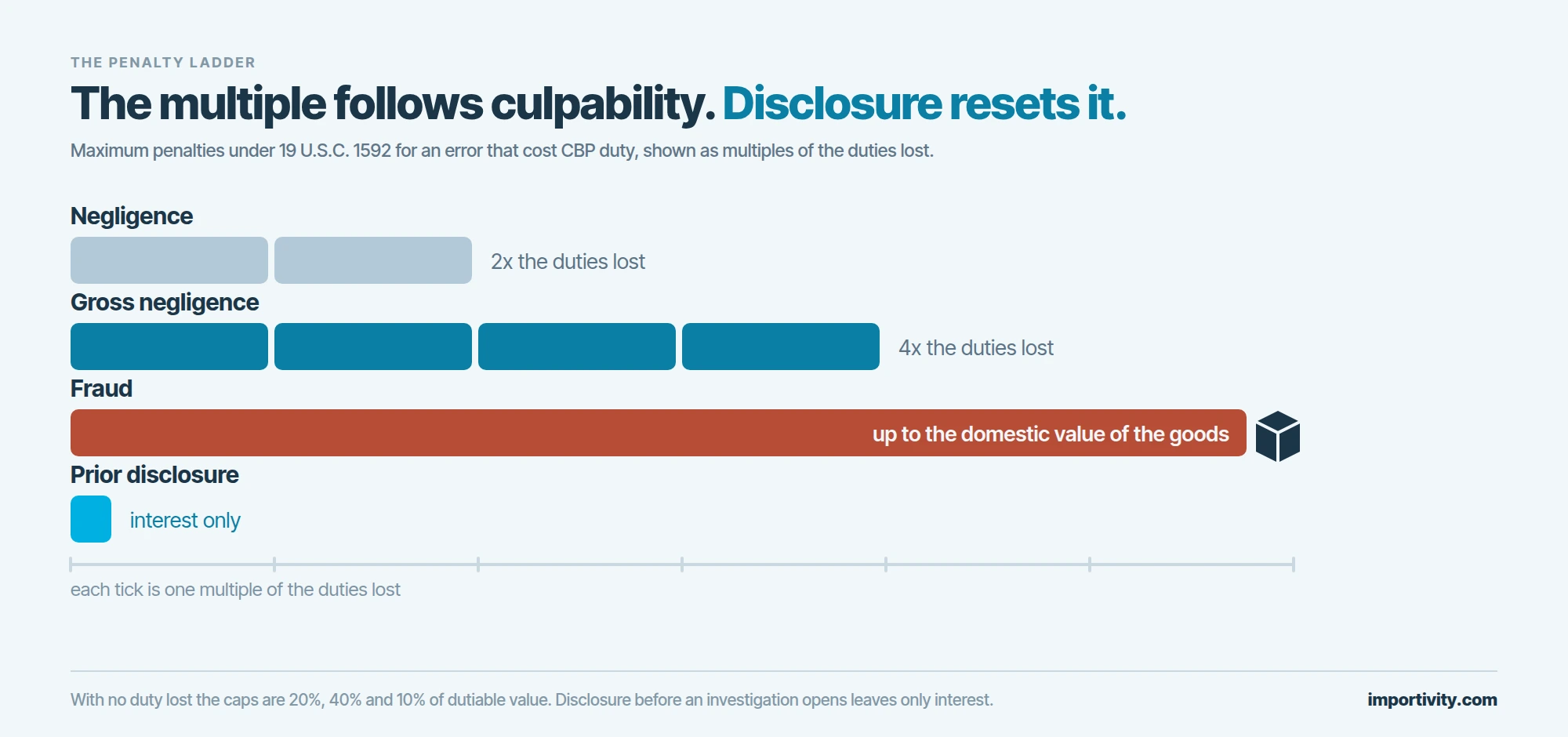
- Penalties. Under 19 U.S.C. 1592 a negligent error costs up to two times the duties lost, gross negligence up to four times, and fraud up to the full domestic value of the goods. Where no duty was lost the caps are 20%, 40% and 10% of dutiable value. A prior disclosure made before CBP opens an investigation reduces the penalty to interest on the unpaid duties.
What keeps an error at the negligence tier is a documented reasonable care process: written classification rationale, a valuation file, origin declarations on hand, and a habit of disclosing errors before CBP finds them.
How you become an importer of record
Becoming the importer of record takes four pieces of paper, and a broker can complete them in a few days if your corporate documents are in order.
- CBP Form 5106. The importer identity form. It records your legal name, address, business structure and officers, and links your entries to an importer number. A U.S. company uses its EIN. A foreign company or an individual without a U.S. tax number requests a CBP-assigned number on the same form. Brokers file it through ACE, and it must be updated when your address changes.
- A customs bond. The surety guarantee that CBP will be paid if you do not pay. A continuous bond is set at 10% of the duties, taxes and fees you paid in the prior twelve months with a $50,000 minimum, and the premium for a $50,000 bond runs about $250 to $600 a year. A single transaction bond covers one entry at the value of the goods plus duties and costs roughly $50 to $200, so a continuous bond wins past about ten entries a year. The detail is in our customs bond guide.
- A customs power of attorney. The document that lets a licensed broker file in your name. Choosing that broker matters more than the form, which is why we wrote a separate piece on what a customs broker costs and how to choose one.
- The first entry. With the 5106 active and the bond on file, the broker files your first entry against your importer number, and your import history begins.
A foreign company can hold the role without forming a U.S. subsidiary. The non-resident importer route uses a CBP-assigned number instead of an EIN, a continuous bond from a U.S. surety, a U.S. agent to accept service of process in the port state, and a power of attorney signed by corporate officers with the incorporation documents attached.
The DDP trap: when the factory's forwarder is the importer
When an overseas factory quotes a delivered duty paid price to your door, someone has to be the importer of record on that entry, and it is not the factory. It is the forwarder the factory uses, or an affiliate set up for the purpose. Your company is not the importer on the entry, so no import history is built in your name and you cannot see what value or HTS number was declared. What you remain is the ultimate consignee, because the goods came to you, and that is the name CBP looks up when an entry goes wrong.
A DDP forwarder that undercharged you for duty made the difference somewhere, usually a lower declared value or a friendlier tariff heading. When CBP audits that forwarder, the entries are traced to the U.S. businesses that received the goods. DDP can be legitimate when the importer on the entry is a party you have identified and the declared value matches your invoice; our explainer on FOB vs DDP covers when each term makes sense. The cleaner answer is usually to buy FOB and hold the importer role yourself. That is how Jordan structures the shipping side of the projects he runs from Austin, Guangzhou and Ho Chi Minh City: the client is always the importer of record on their own goods, and sees the entry before it is filed.
Amazon sellers and the end of de minimis
Amazon will not act as the importer of record for FBA inventory, of any size or value and from any origin. A shipment that arrives with Amazon named as importer is refused and returned at the shipper's expense, and one arriving with collect charges for duty or freight is refused at the dock. The seller sending inventory from overseas is the importer of record and the ultimate consignee, and the entry must be cleared and paid before the truck reaches the dock.
For years many sellers avoided the question by keeping shipments under $800 and using Section 321 de minimis clearance. CBP processed more than 1.36 billion de minimis shipments in fiscal year 2024, up from 139 million in 2015. Executive Order 14324 suspended duty-free de minimis treatment for all countries from August 29, 2025, and on June 24, 2026 CBP published interim final rules that made the suspension indefinite. Entry Type 86 is gone. A commercial shipment valued at $2,500 or less now goes in as an informal entry, anything above that as a formal entry, and both need an importer of record with an importer number. What that does to landed cost is in our piece on the end of the de minimis exemption. A seller who never held a bond completes the 5106 and bond once and treats every inbound shipment as a formal import from then on.
What an importer of record service does and what it costs
An importer of record service is a U.S. company that puts its own name and bond on your entry for a fee. It suits a foreign seller with no U.S. entity, a one-time equipment shipment that does not justify a bond, or a regulated product that needs a licensed importer. The service files the entry, pays the duties and bills them back, holds the records, and carries the compliance risk. Pricing is a flat fee per shipment, a percentage of the CIF value, or a hybrid with a base fee and a smaller capped percentage. Published 2026 ranges put a low-complexity shipment at roughly $300 to $800 in service fees and a regulated or multi-agency import at $800 to $2,500 or more, on top of the pass-through duties and fees. There is no fixed industry rate.
Two cautions. An importer of record service is not a way to move liability for an undervalued invoice. The service will insist on seeing the real commercial invoice, because it is signing the declaration, and a service that does not ask is the forwarder shell described above under another name. And never lend your own importer number to a supplier's or a partner's shipment. Every entry filed under your number is your reasonable care obligation, your bond exposure and your five-year record. Point them instead to a service or to an import agency arrangement where the roles are written down before the first container moves.
Frequently Asked Questions
What is the difference between the importer of record and the consignee?
The importer of record is the legal party that owes CBP the duties and vouches for the accuracy of the entry. The consignee on a bill of lading is a shipping instruction naming who takes delivery from the carrier, and the ultimate consignee on the entry is the U.S. business the goods were sold to. In a simple purchase they are all the buyer. Under DDP terms they split, and only the importer of record carries the liability.
Can a freight forwarder be the importer of record?
Not as a forwarder. The importer of record must be the owner or purchaser of the goods or a licensed customs broker acting under a power of attorney. A forwarder that appears as importer on a DDP shipment does so through a separate company it owns or works with, which is why the buyer never sees the entry. A forwarder also cannot be the ultimate consignee on a formal entry.
How do I become an importer of record in the United States?
File CBP Form 5106 to register your importer identity, using your EIN or a CBP-assigned number if you have no U.S. tax number. Obtain a customs bond, either a continuous bond with a $50,000 minimum or a single transaction bond for one entry. Sign a customs power of attorney with a licensed broker, who then files your first entry under your importer number.
Does Amazon act as the importer of record for FBA shipments?
No. Amazon states that it will not act as importer of record for FBA inventory of any size, value or origin. A shipment that arrives naming Amazon as the importer is refused and returned at the shipper's expense, and any shipment with collect duty or freight charges is refused as well. The seller is the importer of record and must clear and pay the entry before delivery to the fulfillment center.
How much does an importer of record service cost?
Published 2026 ranges put a low-complexity shipment at roughly $300 to $800 in service fees and a regulated or multi-agency import at $800 to $2,500 or more, charged as a flat fee, a percentage of the CIF value, or a hybrid with a cap. Duties, taxes and government fees such as the merchandise processing fee are passed through on top. There is no fixed industry rate, so compare quotes on total landed cost.
About the author
Jordan Lewis
Chief Operating Officer, Importivity
Runs Importivity's sourcing operations across China, Vietnam, Mexico and India, from supplier negotiation through landed delivery.
Press and media inquiries: press@importivity.com