ISF 10+2 Filing Requirements and Deadlines for U.S. Importers

ISF 10+2 is the Importer Security Filing required under 19 CFR Part 149 for ocean cargo moving to the United States. You transmit ten data elements to CBP no later than 24 hours before your container is laden aboard the vessel at the foreign port, and the ocean carrier separately transmits two of its own, the vessel stow plan and container status messages. Eight of your ten are due at that 24 hour mark. The other two, container stuffing location and consolidator, may follow later but must reach CBP no later than 24 hours before the vessel arrives in the United States. Every filing must be secured by a bond. A late, inaccurate or missing filing exposes you to liquidated damages of $5,000 per violation, and CBP can instruct the carrier not to load the container at all.
This guide is for importers, ecommerce sellers and sourcing teams moving goods by ocean who want the filing done correctly rather than done by someone else and hoped for. It covers the ten elements one at a time, where each piece of data actually comes from, how the timing rules work including the two kinds of flexibility CBP allows, who carries the liability, what enforcement looks like in practice, and a process you can run every shipment. If you are still deciding who handles your freight, start with what a freight forwarder actually does, because the ISF sits right on the line between their job and yours.
What the 10 and the 2 in ISF 10+2 Refer To
The name is literal. Ten elements are the importer's, listed at 19 CFR 149.3(a), reported for each good at the six digit HTSUS level and at the lowest bill of lading level on the shipment. If your goods move under a house bill issued by a consolidator, the ISF is filed against that house bill number, not the master.
- Seller. The last known entity that sold the goods, or the owner if there was no sale.
- Buyer. The last known entity that purchased them, or the owner if there was no purchase.
- Importer of record number. Your IRS number, EIN, SSN or CBP assigned number, or the FTZ applicant identification number.
- Consignee number. The identification number of the party in the United States on whose account the goods are shipped.
- Manufacturer or supplier. The entity that actually made or supplied the finished goods, with name and address or a valid manufacturer identification code.
- Ship to party. The first delivery-to party scheduled to receive the goods after release from customs custody.
- Country of origin. Origin under U.S. rules, meaning where the goods were made, not where they were shipped from.
- Commodity HTSUS number. Six digits minimum. Ten digits are accepted and are the better habit.
- Container stuffing location. The physical address where the goods were packed into the container.
- Consolidator. The party who stuffed the container or arranged for it to be stuffed.
The plus two belong to the carrier and you never file them. Under 19 CFR 4.7c the vessel stow plan is due no later than 48 hours after the vessel departs the last foreign port, or before arrival on voyages shorter than 48 hours. Under 19 CFR 4.7d container status messages are transmitted as the carrier's own equipment tracking system records events such as stuffing, loading and discharge. This matters to you for one reason: CBP sees the carrier's version of the container's life alongside your version, and contradictions between the two are what generate questions.
Where Each of These Data Points Actually Comes From
Filings do not fail because the form is hard. They fail because nobody asked the supplier or the forwarder for a specific field until the vessel was already loading. Four of the ten sit in your own records, four come from your supplier, and two come from whoever physically packed the box.
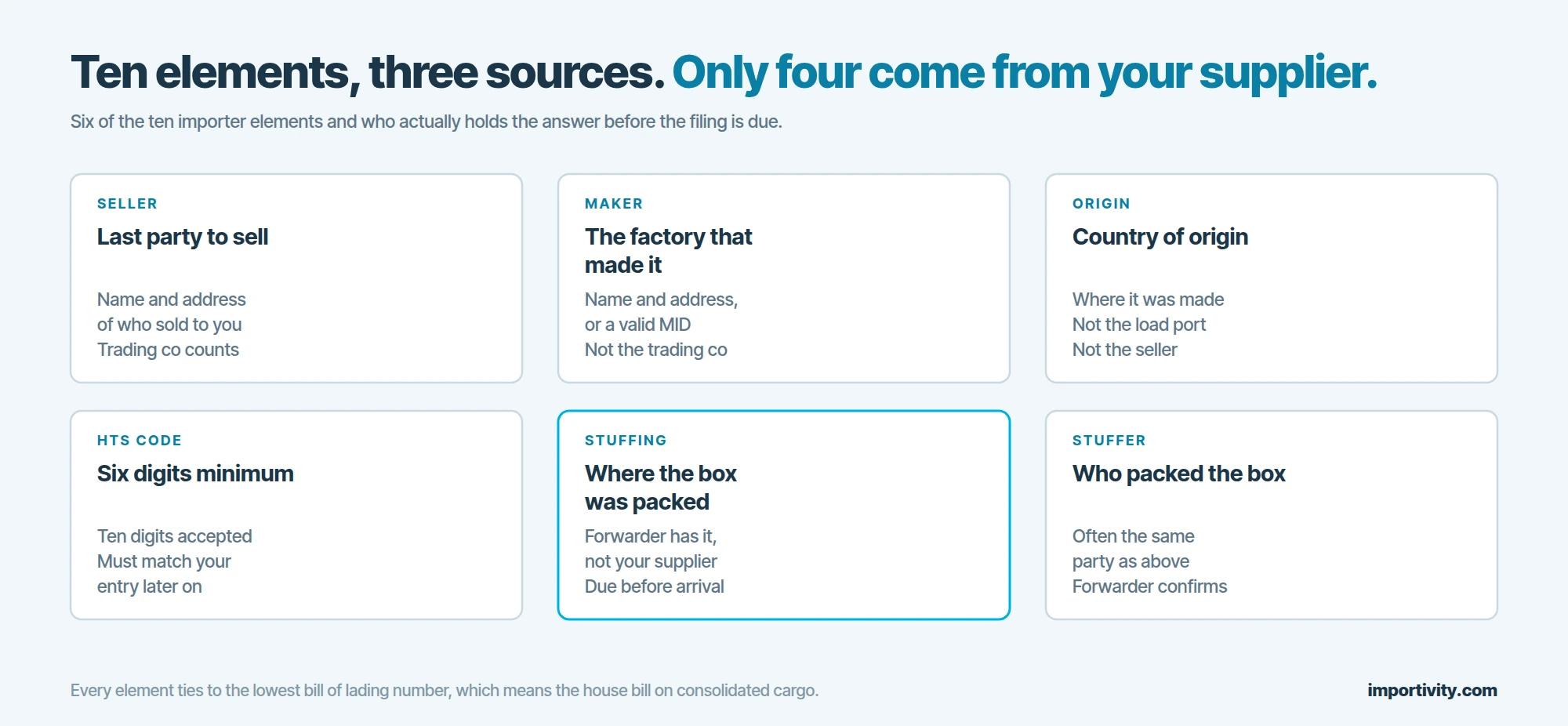
Two of these cause most of the trouble. Seller and manufacturer are different fields and are often different companies. If you buy through a trading company, the trading company is the seller and the factory that made the goods is the manufacturer. Naming the trading company in both fields is one of the most common inaccuracies CBP sees, and it is the kind that also undermines your origin position. Our guidance on customs documentation mistakes covers the wider pattern.
Country of origin and the HTSUS number should be settled before you place the purchase order, not at booking. The six digit number you put on the ISF has to be consistent with the ten digit number on your entry, so classify once and reuse it. If you have not done that work, our HTS classification guide walks through it, and the same code drives the duty line in your landed cost calculator.
The 24 Hour Deadline and the Two Kinds of Flexibility
The headline rule is that the ISF is transmitted no later than 24 hours before the cargo is laden aboard the vessel at the foreign port. Not 24 hours before sailing, and not 24 hours before arrival. Lading is the trigger, which in practice means your data has to be complete before the container reaches the terminal gate cutoff.
CBP built two allowances into the rule, and they are frequently confused with each other.
- Flexible range. For manufacturer, ship to party, country of origin and HTSUS number, you may file the best available data at the time, including a range of acceptable responses. This is not permission to guess and forget. You must update as soon as better information exists, and no later than 24 hours before the vessel arrives at the U.S. port.
- Flexible timing. Container stuffing location and consolidator may be omitted from the initial transmission entirely, then submitted no later than 24 hours before arrival, or upon lading on a voyage shorter than 24 hours.
- The update obligation. If anything changes after you file and before the goods arrive, you amend. Amending a filing costs nothing. Leaving a known error in place is the thing that becomes an inaccuracy claim.
- The withdrawal obligation. If the goods are no longer coming to the United States, you withdraw the filing. Orphaned filings sitting against cancelled bookings are a quiet source of compliance noise.
One practical consequence for LCL shippers: your consolidator often does not confirm the stuffing address until the container is built, which is exactly why that field has flexible timing. Plan on two transmissions per LCL shipment as normal, not as an exception. The trade-offs between consolidated and full container moves are covered in FCL versus LCL shipping.
Who Files It, Who Is Liable and Which Bond Covers It
The ISF Importer is the party causing the goods to enter the United States, generally the owner, purchaser or consignee. Almost every importer delegates the transmission to a licensed customs broker or a forwarder under a power of attorney, and that is fine. Delegation moves the keystrokes, not the liability. If your agent files late or files wrong, CBP comes to you and your bond.
| Shipment type | Who must file | When it is due |
|---|---|---|
| Standard entry or FTZ (ISF-10) | Owner, purchaser or consignee, usually through a broker | Eight elements 24 hours before lading, stuffing location and consolidator 24 hours before arrival |
| Foreign cargo remaining on board (ISF-5) | The carrier | Any time before lading at the foreign port |
| Immediate exportation (ISF-5) | The party filing the IE documentation | Any time before lading |
| Transportation and exportation (ISF-5) | The party filing the T and E documentation | Any time before lading |
| Carrier elements (the plus two) | The ocean carrier | Stow plan within 48 hours of departure, container status messages as events are recorded |
Every ISF must be secured by a bond. If you already hold a continuous customs bond, it covers your filings. If you do not, you need a single transaction ISF bond for each shipment, which your broker can arrange but which adds cost and a step to every booking. For anyone importing more than a handful of containers a year, a continuous bond is the cheaper and calmer answer. Our shipping and logistics team sets this up alongside the freight.
What a Late, Wrong or Missing ISF Costs
CBP enforces the rule through liquidated damages claimed against the bond rather than through fines in the ordinary sense. The standard claim is $5,000 per violation for a filing that is late, inaccurate or incomplete, and a single ISF can draw more than one violation, which is how a single container reaches $10,000. The informal three strikes leniency period ended on June 30, 2016, so first offenses are actionable.
The money is rarely the worst part. CBP can issue a do not load instruction to the carrier, which strands your container at origin and costs you the sailing. Short of that, a filing that does not match the manifest can put the shipment into an exam queue on arrival, and exam time is billed to you in demurrage and per diem while the box sits. A $5,000 claim you can mitigate. A missed vessel in the run up to a retail season you cannot. If your shipments are already running tight, our guidance on managing delays and disruptions is worth reading alongside this.
Mitigation exists. Importers with a clean record and a genuine explanation can petition, and CBP has discretion to reduce a claim, though it will not grant relief where it concludes the violation compromised its targeting work. Treat mitigation as a repair, not as a plan.
A Filing Process That Holds Up Under Audit
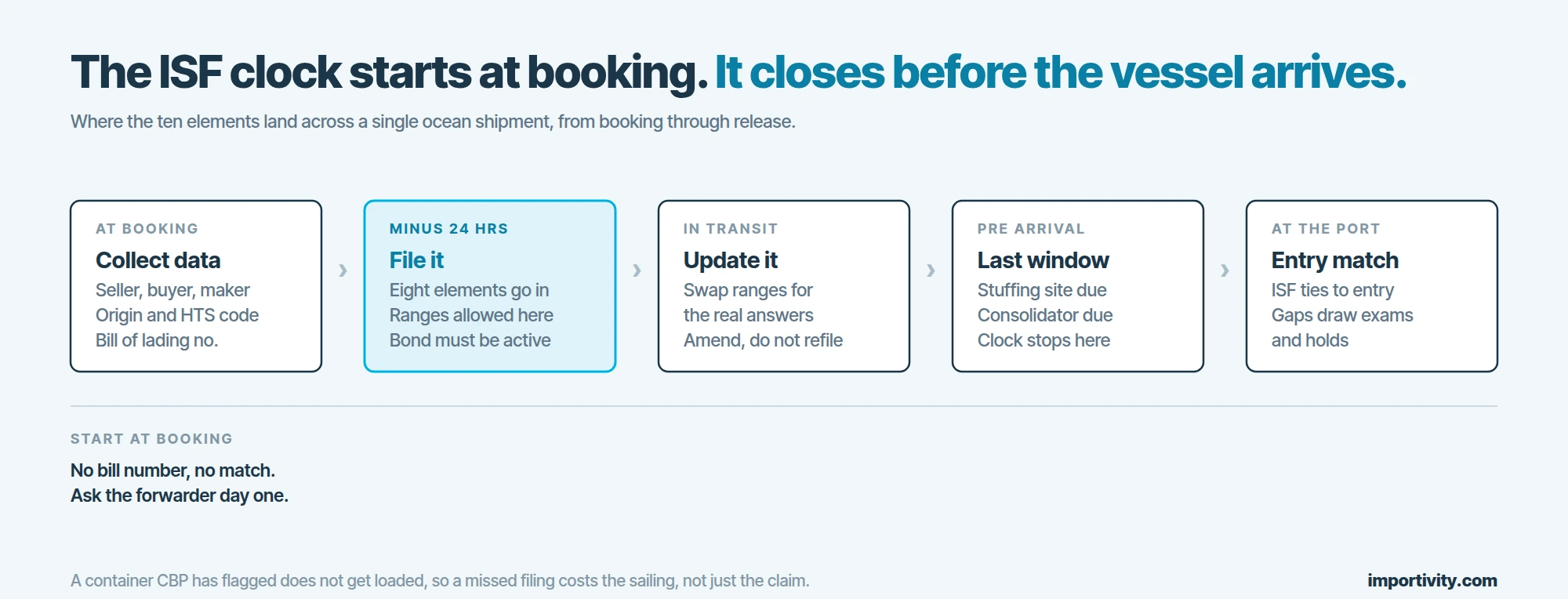
The reliable pattern is to treat the ISF as a data collection problem that starts at the purchase order, not as a task that starts when the forwarder emails you about a booking. Here is the sequence that keeps filings clean without heroics.
Build the collection into supplier onboarding so the same fields arrive with every order. Ask for the manufacturer's legal name and full street address, the country of origin, and the seller entity if it differs from the factory, and store them against the part number rather than against the shipment. Our supplier onboarding checklist is the place to add these fields permanently.
Then fix three things in your own operation. Require the bill of lading number from the forwarder at booking, because without it your filing has nothing to match against. Set your internal cutoff at 72 hours before lading rather than 24, so a supplier who goes quiet still leaves you two working days. And reconcile the ISF against the entry after clearance on the first few shipments from any new supplier, checking that the HTSUS number, origin and manufacturer are identical on both. Where your Incoterm puts the loading decision in the supplier's hands, read Incoterms 2020 explained and make sure your contract obliges them to give you booking data early. If you are sourcing from China, the same discipline is covered in context in our guide to importing from China.
For a worked example of what this costs once the duty actually lands, see our case study on scaling a US gum manufacturer through the 2025 tariff debacle, and Source With Jordan for the sourcing decisions behind it.
Frequently Asked Questions
When exactly is the ISF due?
Eight of the ten importer elements are due no later than 24 hours before the cargo is laden aboard the vessel at the foreign port. Container stuffing location and consolidator may be transmitted later, but no later than 24 hours before the vessel arrives at the U.S. port. The trigger is lading, not sailing and not arrival, so your data must be complete before the terminal cutoff.
Who files the ISF, the importer or the freight forwarder?
The ISF Importer is the owner, purchaser or consignee causing the goods to enter the United States. Most importers authorize a licensed customs broker or forwarder to transmit it under a power of attorney. That delegation moves the work, not the liability. If the filing is late or wrong, CBP claims liquidated damages against the importer's bond, so verify what your agent filed.
What happens if the ISF is filed late?
CBP can claim liquidated damages of $5,000 per violation against your bond, and a single filing can draw more than one violation. It can also issue a do not load instruction so the carrier leaves your container at origin, or route the shipment to an exam on arrival, which adds demurrage and per diem. Mitigation can reduce a claim but is discretionary.
Does ISF apply to air freight or to LCL shipments?
ISF applies to cargo arriving by ocean vessel only. Air, truck and rail shipments are not covered, though they have their own advance data requirements. LCL cargo is fully covered, and the filing is made against the house bill of lading number rather than the master. Expect two transmissions on LCL, because the stuffing address is usually confirmed late.
Can I change an ISF after I have filed it?
Yes, and you are required to. If information changes or becomes more precise after transmission, you must update the filing, and no later than 24 hours before the vessel arrives. Amendments are routine and cost nothing. If the goods are no longer coming to the United States, withdraw the filing rather than leaving it open against a cancelled booking.
About the author
Jordan Lewis
Chief Operating Officer, Importivity
Runs Importivity's sourcing operations across China, Vietnam, Mexico and India, from supplier negotiation through landed delivery.
Press and media inquiries: press@importivity.com