Copper Price Risk in Sourcing and How Importers Can Respond

In mid-2025 the U.S. copper market stopped behaving like one market. A wave of tariff policy split the price of the same metal in two, and importers of anything copper-heavy have been paying for that divergence ever since. If you buy wire, tubing, fittings, connectors, motors, transformers or copper-clad electronics, copper price risk in sourcing is no longer a line item you can ignore between quote and payment.
The trigger is the Section 232 copper tariff and the fight over how far it reaches. Starting August 1, 2025, President Trump imposed 50% tariffs on global imports of semi-finished copper products (e.g., copper pipes, wires, rods, sheets, and tubes) and copper-intensive derivative products (e.g., cables and connectors). Reporting that tariff shifts threaten to split the global copper market is exactly right: the U.S. and the rest of the world are now pricing the same metal differently.
This guide explains how those moves hit your landed cost, supplier quotes, surcharge clauses and PO timing, then gives you a durable playbook for when to hedge, lock pricing, substitute materials or shift supplier geography. If you want the cost mechanics first, start with our landed cost formula and our guide to how tariffs impact product cost, then come back for the copper-specific decisions.
Why Copper Split Into Two Prices
Copper trades on two benchmarks that used to track closely: the LME (London, the global market) and COMEX (New York, the U.S. market). Tariff policy has forced a wedge between them. The LME is pricing the global copper market without US tariff premium. The CME is pricing the US copper market with tariff risk embedded. If you import into the U.S., you are effectively exposed to the COMEX-side price, whether you realize it or not.
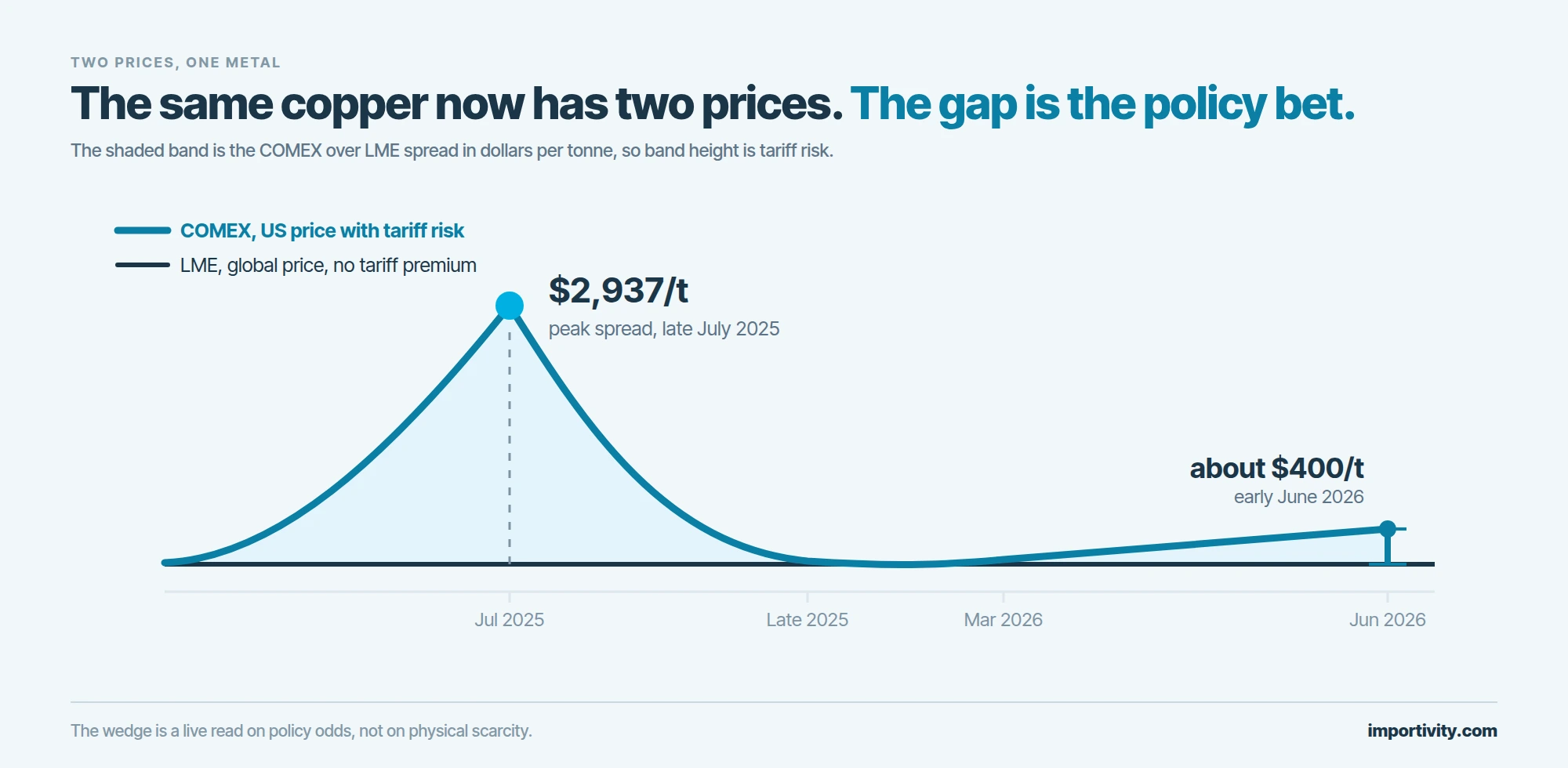
The size of that wedge is a live measure of policy risk. The COMEX-LME spread began re-widening from early 2026 as the 30 June deadline came into focus. It turned positive again in late March and has been climbing since, reaching around $400/t in early June. At current levels, the spread is well below the peak of around $2,937/t seen in late July 2025 when a 50% tariff on all copper was briefly feared. In other words, the market has already priced a range of outcomes, and the spread widens or narrows as the odds shift.
The scope matters as much as the rate. The 2025 tariff hit semi-finished and derivative products but treated raw inputs differently. President Trump did not impose Section 232 tariffs on copper input materials (such as copper ores, concentrates, mattes, cathodes, and anodes) or copper scrap. That split is what pulled refined metal into U.S. warehouses and drove the two benchmarks apart.
The volatility, in real numbers
This is not a theoretical risk. Copper volatility in the futures market was extreme in 2025, with the price reaching new record highs in March and July and a pair of implosive moves to lows in April and late July. U.S. tariffs have only exacerbated the price variance of copper. When policy headlines whipsawed the market, US COMEX copper futures, which had risen enormously in recent months, experienced a significant price correction of almost 22% downwards. A 20%+ move in a copper-heavy bill of materials can wipe out an entire margin.
How Copper Price Risk Actually Hits Your Landed Cost
Copper price risk shows up in three places on your cost sheet, and they compound. First, the metal itself: the copper content of your product is repriced off an exchange, not off your negotiation. Second, the tariff layer on that content when it enters the U.S. Third, the physical premium suppliers charge to deliver metal into a tariff corridor.
The tariff layer is the one importers underestimate, because it stacks. The 50% rate took effect in 2025 and is in force as of May 2026 — it stacks on top of the 10% Section 122 baseline, on top of MFN, and on top of any Section 301 surcharge if Chinese-origin. A single copper-intensive SKU from China can therefore carry several duty layers at once, and getting the HTS classification wrong on any of them is an expensive mistake.
The good news is that the tariff applies to copper content, not always to the whole product, and there are carve-outs. Section 232 tariffs applied only to the copper content of a product, and non-copper content remained subject to other duties. There is also a weight-based exemption worth checking: a tariff exception applies to certain derivative products for which the aggregate weight of the applicable steel, aluminum, and copper inputs is less than 15% of the total weight of the imported product. If your product is only marginally copper-heavy, that de minimis line can change your entire cost picture.
The third cost most quotes hide
Even outside the U.S., tariff diversion has inflated physical premiums. CODELCO quoted Korean customers copper premiums of US$330 per tonne for 2026, up 288% from the prior year benchmark of US$85 per tonne. The premium inflation outside the US reflects the global tightening caused by diversion of supply into the US tariff corridor, not a global supply shortfall. So a supplier in Vietnam or Mexico may quote you a higher metal input even though the tariff never touches their factory floor.
How Copper Moves Distort Supplier Quotes
When copper is volatile, a quote is a snapshot with a short shelf life. Factories quote off the copper price they see on the day, then either build in a fat buffer (you overpay when prices fall) or leave themselves short (they come back for a surcharge, or quietly cut quality). Neither is good for you.
The fix is to separate metal from conversion in the quote. Ask every copper-heavy supplier to break the price into (1) copper content in kg, (2) the reference price and date they used, and (3) their conversion/labor/overhead margin. This is standard practice in metals procurement: the current prices of the alloying elements are multiplied by their proportion in the end product and averaged over defined periods of time. The separate presentation enables transparent pricing and better cost control. Once metal is separated out, you can benchmark the conversion cost across suppliers and stop arguing about a number neither of you controls.
That transparency is the whole point of a disciplined sourcing process, and it is a theme we return to in our piece on transparent budgeting when sourcing globally. A supplier who won't itemize copper content is a supplier who is either padding the number or doesn't understand their own cost base.
Surcharge Clauses and Price Escalation That Protect You
The cleanest way to handle a volatile input is to write it into the contract as an index-linked surcharge rather than fighting over a single fixed price. A raw material surcharge refers to a price surcharge that passes fluctuations in raw material costs on to customers. These price adjustment mechanisms have become indispensable in volatile markets to protect suppliers from incalculable material costs. Done right, the same clause protects you: it caps how the supplier can move price, and on what evidence.
A good copper surcharge clause has four parts. First, a named reference index and averaging window. The company implements a price escalation clause with monthly adjustment based on LME average prices of the last 30 days. Because you import into the U.S., decide deliberately whether to reference LME, COMEX or a U.S.-delivered premium price. Second, a trigger threshold, so tiny moves don't reopen pricing. Third, symmetry: the price must fall when copper falls, not only rise. Fourth, a documentation requirement.
On documentation, borrow the language buyers already use: where any increase in these costs would result in a potential increase of the Supply price for the Product by [x] percent or more, Seller shall provide sufficient documentation to support any Supply price adjustment. And where you can, add a cap. Under this formulation, price increases are limited to seller's increased manufacturing costs, subject to a cap.
Set the adjustment frequency to match the volatility
Don't default to annual pricing on a metal that moves weekly. In sectors like automotive or large-scale manufacturing, quarterly adjustments might align with supplier agreements to provide predictability. In highly volatile markets, such as during periods of geopolitical instability or supply chain disruptions, surcharges can be updated weekly or even daily. For most importers, a monthly LME/COMEX average with a defined threshold and a cap is the sweet spot between fairness and predictability.
| Approach | Best when | Risk you keep | Watch out for |
|---|---|---|---|
| Fixed price, full order | You have a fixed sell price and short lead time | None on metal (supplier holds it) | Fat buffer baked in; supplier may reopen if copper spikes |
| Index-linked surcharge | You can pass cost through to customers | Full metal movement, both directions | Pick the right index (COMEX vs LME); demand symmetry and a cap |
| Partial lock (e.g., 50% of annual volume) | Uncertain demand, some fixed pricing | Half the metal exposure | Forecast accuracy; overcommitting to volume |
| Financial hedge (futures/options) | Large, predictable copper tonnage | Basis risk (COMEX vs your actual buy) | Margin calls; needs treasury capability |
When to Hedge, Lock, Substitute or Move Geography
These are four different tools for four different situations. Sequencing them correctly saves money; using the wrong one wastes it.
Lock pricing when your downstream is fixed
If you sell at a fixed price (a contract, a retail price you can't change mid-season), you need cost certainty more than you need the lowest possible price. Lock a fixed price or a partial volume with the supplier. If the lock premium is smaller than the realistic swing in copper over your buying window, it's cheap insurance.
Hedge when tonnage is large and predictable
Financial hedging with futures or options makes sense once your copper volume is big enough to justify the treasury overhead. The catch is basis risk: if you hedge on LME but pay a U.S.-delivered price, the two won't move identically. As one analysis put it bluntly, buying copper at current CME prices is a policy bet, not a pure supply and demand call. Hedge the metal, but don't assume you've hedged the tariff.
Substitute only as a design decision
Redesigning to use less copper, or aluminum where performance allows, is real leverage but it is engineering, not purchasing. It changes performance, weight, compliance and sometimes tooling. Validate any substitution through the pre-production sample process and full testing before you switch a spec. And confirm the substitute's own tariff exposure first, because aluminum carries its own Section 232 layer.
Shift geography to change the cost mix, not to escape the tariff
This is where importers get it wrong most often. The Section 232 copper tariff is a U.S. import measure keyed to content and HTS code, so moving your factory from China to Vietnam or Mexico does not remove the copper tariff on entry to the U.S. What it changes is the Section 301 China layer, labor cost and lead time. Nearshoring can help on speed and stacking duties without touching the copper 232 rate, a trade-off we cover in nearshoring to Mexico and India vs China manufacturing. Choose geography for the whole cost equation, not on a mistaken belief that it dodges the metal tariff.
Timing Your Purchase Orders Around Policy Dates
Copper's near-term direction is being set by a policy calendar, not just fundamentals. The Commerce Secretary is to provide the President with an update on U.S. copper markets by June 30, 2026, after which the President may determine whether to impose duties on refined copper. Known decision dates are exactly the moments the spread and the price gap the most.
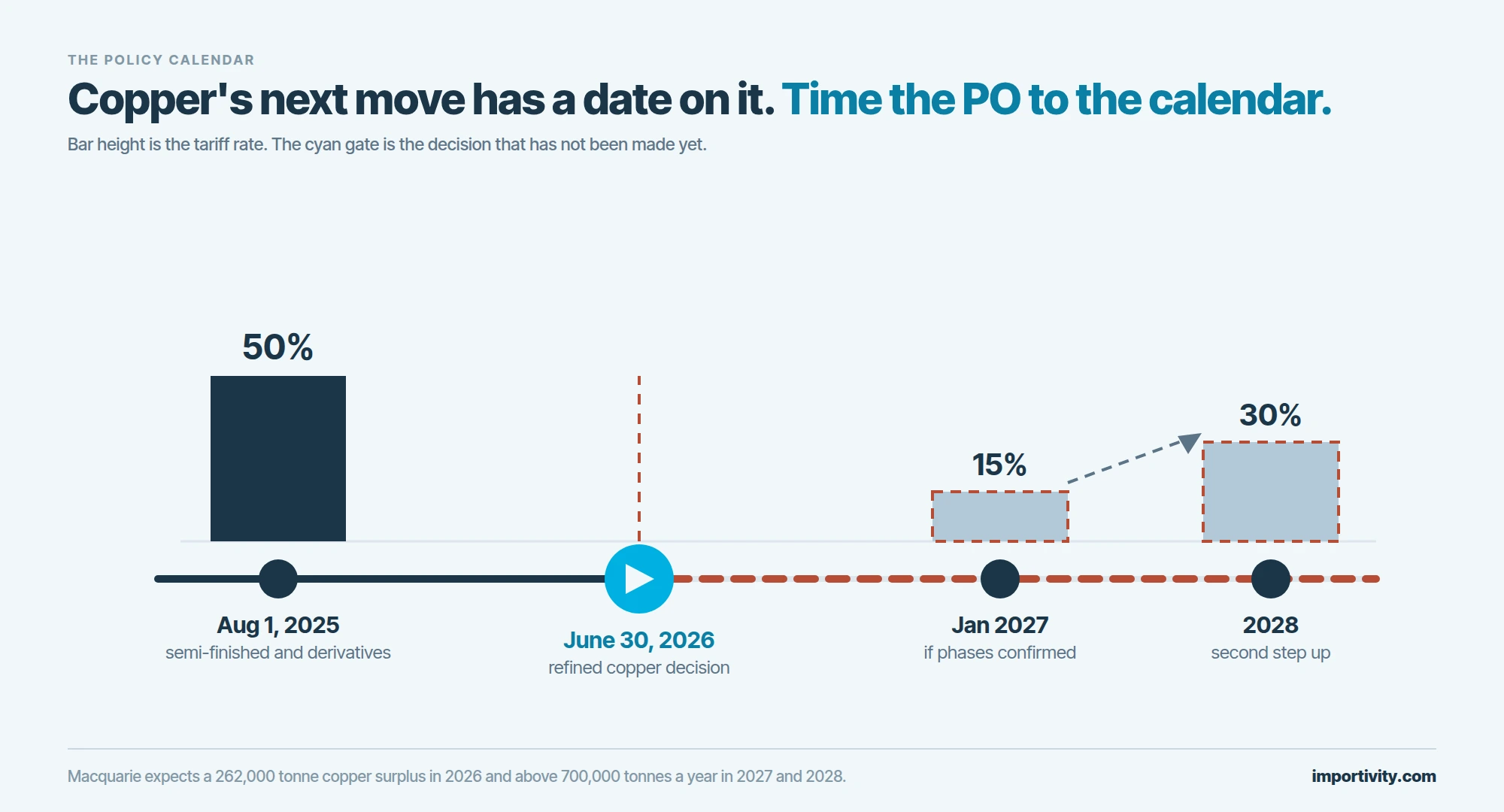
Timing works both ways. A phased tariff structure has been floated, and the details drive the spread. White House confirmation of phased tariffs of 15% in 2027 and 30% in 2028 would likely keep the Comex-LME premium near current levels through the January 2027 start date. Conversely, a delay could unwind tariff-driven positioning, narrowing the premium and reducing the incentive to hold the record 630,000-tonne Comex stockpile. If you can flex PO timing, buying just before a threshold step-up or after a de-escalation can matter more than any negotiation.
Watch the fundamentals too, because they set the floor. Macquarie has noted that the market is not short of copper and expects a 262,000-tonne surplus in 2026, with surpluses above 700,000 tonnes annually in 2027 and 2028. A surplus market means much of the current price strength is policy and positioning, which can reverse quickly. To stay ahead of the calendar, pair a simple copper price alert with a tariff tracking tool so you see policy and metal moves together.
A Practical Copper Risk Checklist for Importers
Run this before your next copper-heavy PO. It turns the market noise above into a repeatable process.
- Get the copper content of each SKU in kg, and the reference price and date the supplier quoted off.
- Confirm the correct HTS code and whether the tariff applies to copper content or full value, then model the stacked duty (232 + 122 + MFN + any 301).
- Check the 15%-by-weight de minimis exception if your product is only lightly copper-based.
- Rebuild the full landed cost at three copper scenarios: current, +20%, and -20%.
- Decide lock vs surcharge vs partial lock based on whether your sell price is fixed.
- If using a surcharge, name the index (COMEX vs LME), set a monthly averaging window, a trigger threshold, symmetry and a cap, with documentation required.
- Map upcoming policy dates against your PO timing.
- Vet the supplier's ability to hold spec under margin pressure via a factory audit and tight quality control.
Copper price risk isn't something you eliminate. It's something you price, document and time. The importers who lose money are the ones who accept a single blended number and hope; the ones who protect margin separate metal from conversion, put a fair surcharge mechanism in writing, and buy around the policy calendar. If you want a partner to model the landed cost, structure the clause and vet the factory, that's exactly the work we do.
If you want to see what this looks like on a live project rather than in a guide, Source With Jordan is where we publish the sourcing itself.
Frequently Asked Questions
What is copper price risk in sourcing?
It is the exposure your product cost carries when copper moves between the day you quote and the day you pay. Because copper is priced on exchanges (LME and COMEX) and increasingly split by U.S. tariffs, a copper-heavy product can see its component cost swing 20% or more inside a single quarter without any change to your factory or specification.
Why are COMEX and LME copper prices different right now?
The COMEX (U.S.) contract embeds the expected premium from the Section 232 copper tariff, while the LME reflects the global market without that U.S. tariff layer. That gap has ranged from a few hundred dollars per tonne to nearly $3,000/t during peak tariff fear in mid-2025. If you source into the U.S., you are effectively paying the COMEX-side price, so watch that benchmark, not just LME.
Does the U.S. copper tariff apply to my finished imported product?
It can. The Section 232 tariff applies to the copper content of semi-finished copper products and copper-intensive derivatives, and it stacks on top of MFN, the Section 122 baseline and any Section 301 duty. Correct HTS classification and a documented copper-content breakdown are what determine whether and how much you pay, so get classification right before you commit volume.
Should I lock my copper price with the supplier or let it float?
Lock when you have firm downstream pricing or a fixed sell price you can't change, and when the lock premium is smaller than the volatility you're exposed to. Let it float via a transparent index-linked surcharge when you can pass cost through to customers and want to avoid paying a fat fixed-price premium. Many importers split the difference by locking a portion of annual volume.
Can I substitute another material to reduce copper price risk?
Sometimes. Aluminum can replace copper in some conductors, heat sinks and busbars, and redesign can cut copper content in fittings and connectors. But substitution changes performance, compliance and sometimes tooling, so it is a design decision, not a purchasing one. Validate with samples and testing before you switch, and confirm the new material's own tariff treatment.
About the author
Jordan Lewis
Chief Operating Officer, Importivity
Runs Importivity's sourcing operations across China, Vietnam, Mexico and India, from supplier negotiation through landed delivery.
Press and media inquiries: press@importivity.com