Canada Import Tariffs to the US and How Buyers Should Respond
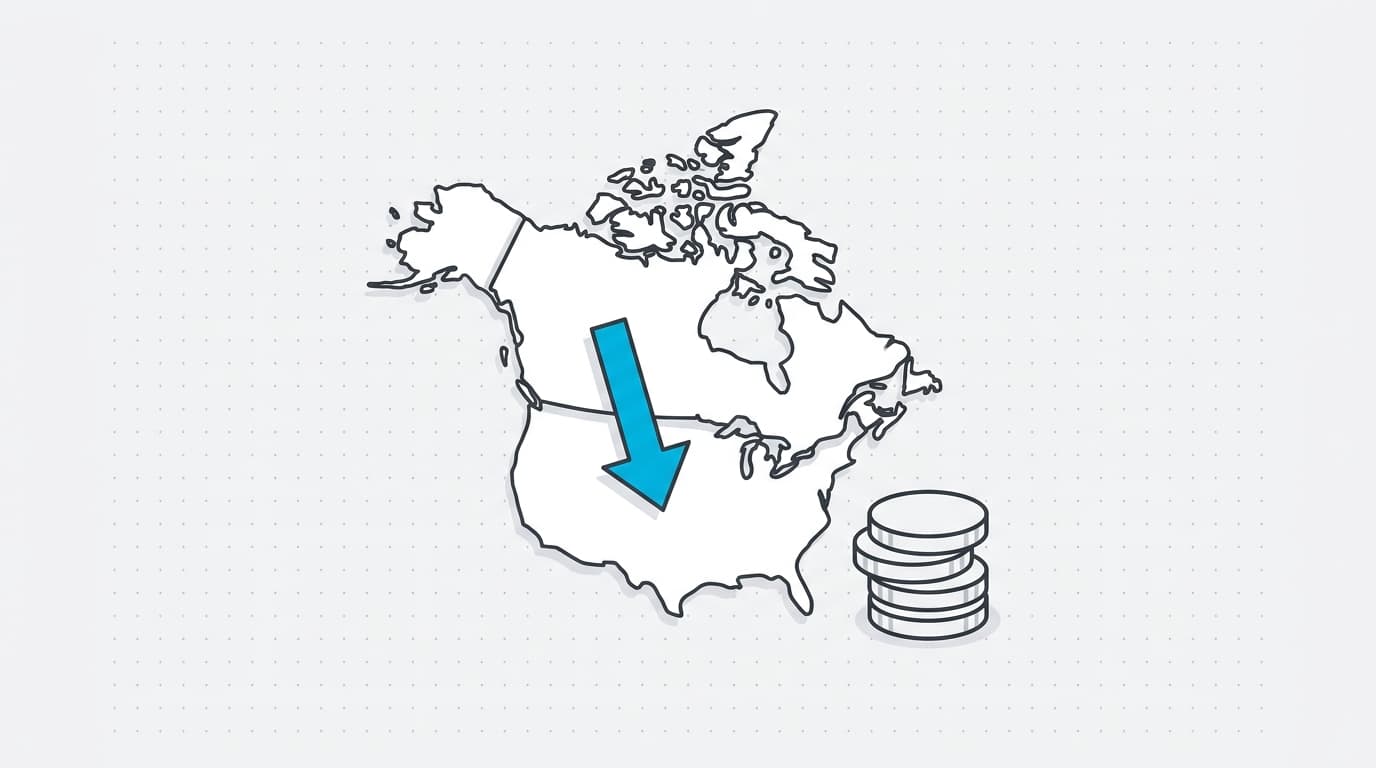
On July 20, 2026, the Trump administration signed three proclamations imposing an additional 50% tariff on a specific list of Canadian goods, invoking a nearly-forgotten trade statute to do it. CNBC and Al Jazeera reported the measures target roughly $20 billion in annual imports across dairy, alcohol and motor vehicles, plus a surprising range of consumer goods. If you buy from Canada, this is a real cost event with a hard deadline, not a headline you can ignore.
The news is the trigger, but the durable question underneath it is the one this page answers: how do Canada import tariffs to the USA actually work, how do you model a new duty into your landed cost, and what are your options if a Canadian supplier suddenly becomes too expensive? Whether you land here the week the tariff hits or six months later, the decision framework is the same.
We help U.S. brands and importers rebuild cost models and evaluate alternatives when trade policy shifts. If you want to understand the mechanics first, our guides on calculating landed cost and HTS classification pair directly with everything below.
What Just Happened With the 50% Canada Tariff
Trade counsel at Wiley confirmed that on July 20, 2026, President Trump invoked Section 338 of the Tariff Act of 1930 to impose 50% additional tariffs on certain goods of Canada, including USMCA-compliant goods, effective August 19, 2026. The measures were split across three separate proclamations, each targeting a different set of imports.
The stated justification is retaliation. In three proclamations, President Trump determined that Canada discriminates against U.S. exports in the dairy, alcoholic beverage, and motor vehicle sectors and imposed the tariffs to offset the resulting burden on U.S. commerce. On the auto side specifically, the White House pointed to a sharp drop in exports, noting that from April 2025 through March 2026, Canadian imports of U.S. motor vehicles decreased by approximately 22%, or $5.6 billion, compared to the same period a year earlier.
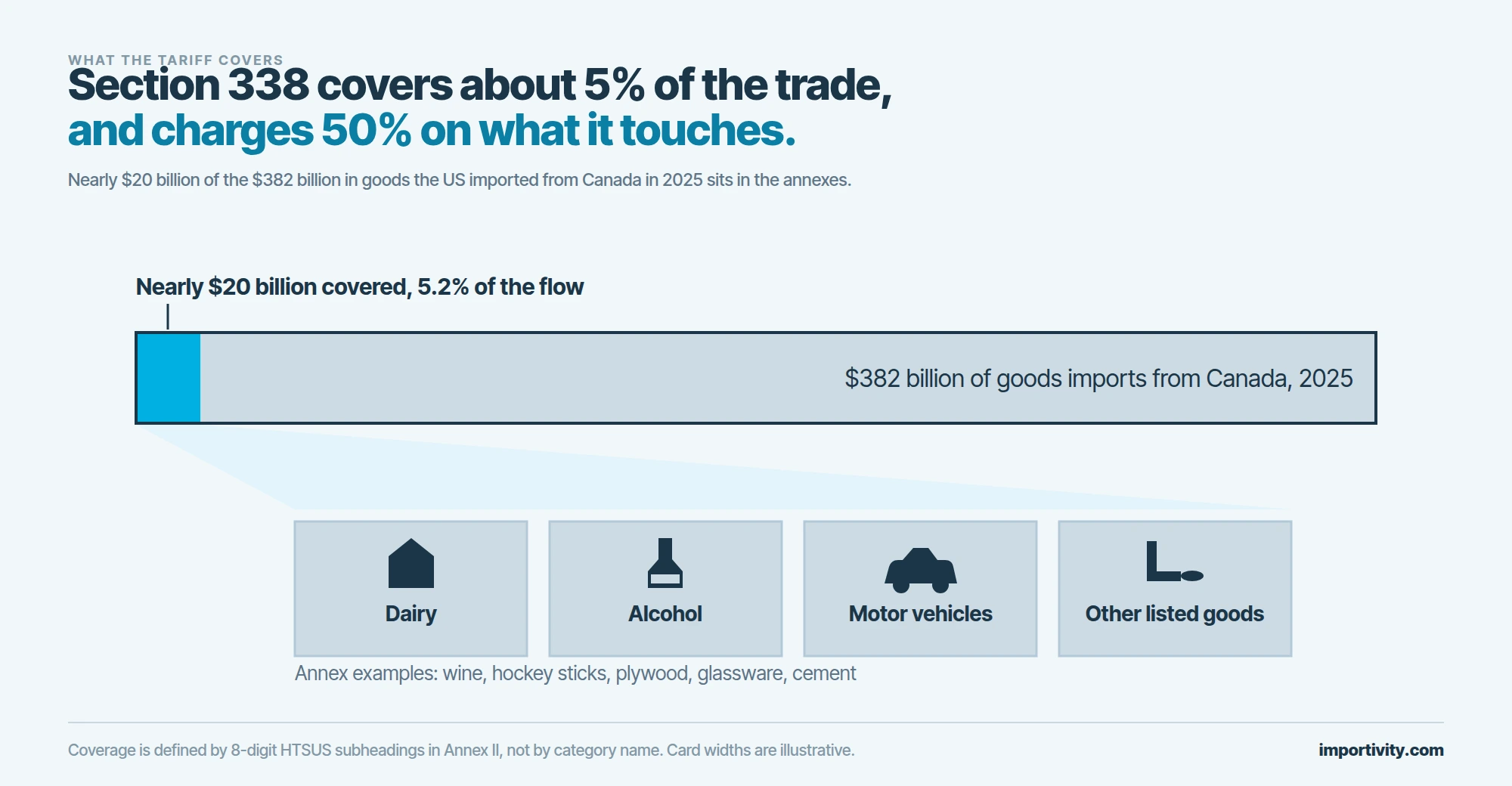
The legal vehicle is notable. Section 338 gives the president the power to impose tariffs of up to 50% on the goods of countries found to be discriminating against the U.S. It is an obscure authority. The tariff-setting power has gone unused for decades, and researchers found no public record relating to Section 338 since 1949. The scale here matters too. The U.S. Trade Representative's office said the tariffs would apply to nearly $20 billion of imports from Canada, about 5.2 percent of the $382 billion worth of goods the US imported from Canada in 2025.
Which Products Are Actually Affected
Do not assume the headline sectors are the whole story. Each Section 338 proclamation imposes a 50% tariff on a different set of Canadian imports, covering products ranging from wine to hockey sticks to cement. Legal advisories tracking the annexes list an even broader spread. The proclamations cover a range of goods in the dairy, automotive, and alcohol beverage sectors, and the affected imports also include other products such as hockey equipment, plywood, glassware, and cement.
Coverage is defined at the code level, not the category level. Annex I sets out exceptions and implementation details, while Annex II identifies the specific HTSUS classifications and Chapter 99 modifications covered. That means the only reliable way to know if you are exposed is to match your goods' 8-digit HTSUS subheadings against the annex lists. If you are unsure of your classifications, start with our guide to HTS codes and customs classification before you do anything else.
The USMCA Surprise
Here is the trap. Section 338 tariffs apply to covered goods regardless of whether they qualify for USMCA preferential treatment. Under the Section 122 and Section 232 regimes, USMCA-qualifying Canadian goods have generally been shielded or treated favorably. Section 338 works differently, and a valid USMCA certificate of origin does not exempt a covered product from it. If your compliance process has always leaned on your Canadian supplier's certificate of origin to secure duty-free entry, that assumption no longer holds for listed goods.
What Is Carved Out
Several major categories are excluded. Energy products, potash, products already subject to Section 232 tariffs (steel, aluminum, copper, automobiles and auto parts), fish and critical minerals are excluded from the Section 338 tariffs. The battery-supply angle is deliberate. The critical minerals exemption is seen as a deliberate carve-out preserving North American battery supply chains. If your Canadian product is already paying a Section 232 duty on steel, aluminum or copper, it is not double-hit by Section 338.
How the Duty Stacks and Why That Matters for Cost
The 50% is additive, not a replacement. The 50% tariff applies in addition to any other duties, taxes and fees already owed on the covered goods rather than replacing them. Advisories confirm it stacks on top of AD/CVD and other duties as well. That is the single most important fact for your cost model: you are adding half the customs value in new duty on top of whatever you already pay.
Context helps here. Canada already faces layered US trade measures. The U.S. imposed Section 232 steel and aluminum tariffs, increased the rate to 50% in June 2025, and imposed 50% tariffs on certain copper products in August 2025, with Canada a key source of U.S. copper imports. The Section 338 action sits alongside those regimes rather than inside them, which is exactly why the carve-out for 232-covered goods exists.
A Simple Landed-Cost Illustration
Say you import a covered Canadian consumer good at a $200,000 customs value, currently entering duty-free under USMCA. Under Section 338, you add $100,000 in duty. That is before ocean or truck freight, insurance, customs brokerage and inland delivery. Your effective per-unit cost can jump 40% to 50% depending on how large freight and overhead were as a share of the old landed cost. Rebuild the number properly with our step-by-step landed-cost formula rather than eyeballing it.
The Timeline and Why It Is Not Necessarily Final
You have a defined window. The effective date is 12:01 a.m. Eastern on August 19, 2026, for goods entered for consumption or withdrawn from warehouse for consumption on or after that date, which is 30 days from signing, the minimum notice required under Section 338.
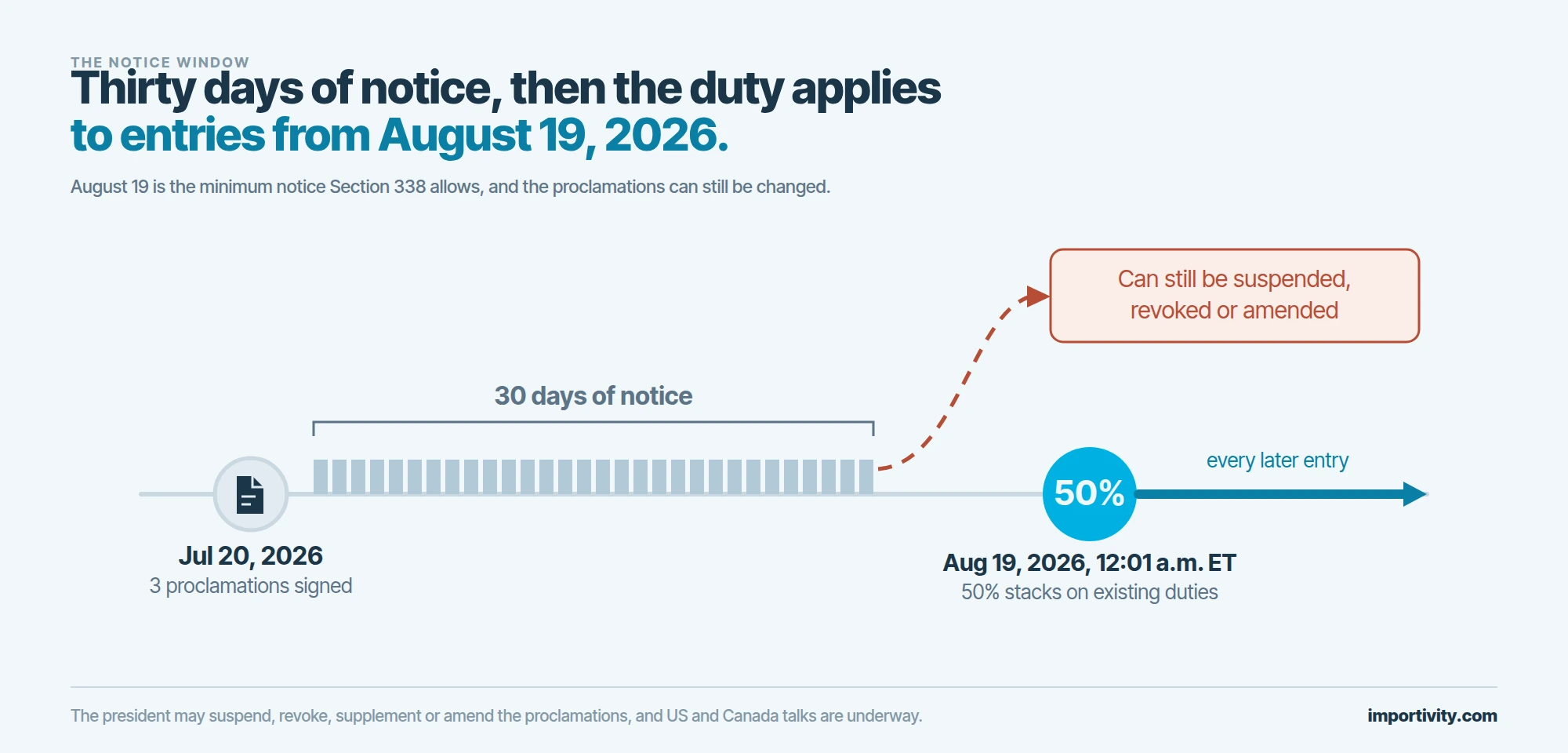
The measures are not locked in permanently. The statute caps tariffs under Section 338 at 50% and allows them to take effect 30 days after they are proclaimed, and the President may subsequently suspend, revoke, supplement, or amend the proclamation. Negotiations are live. With a 30-day implementation window before the August 19, 2026 effective date, the United States and Canada have begun intensified negotiations that could modify or prevent these tariffs from taking effect. Practically, that means you should prepare as if the tariff is real while building flexibility for the chance it is softened or pulled.
Absorb, Renegotiate, or Resource
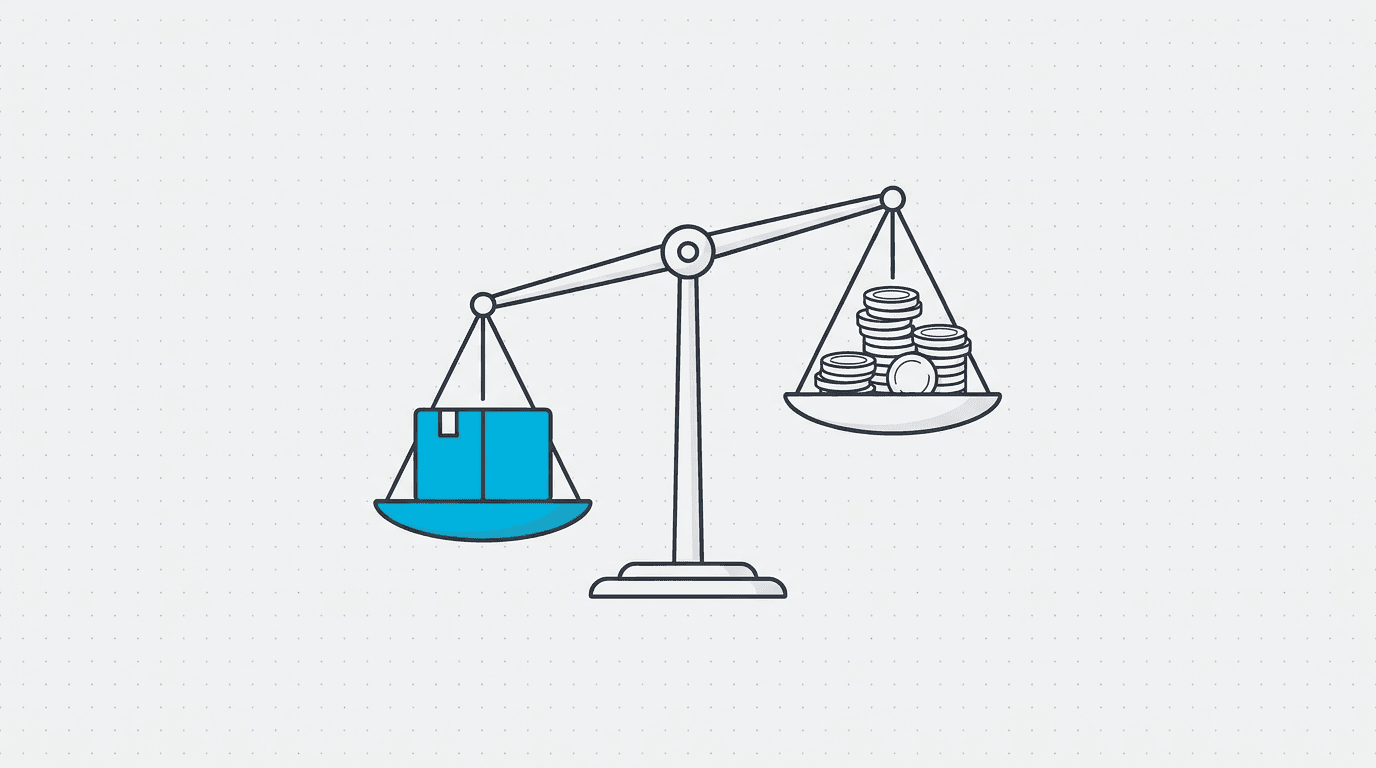
Once you know you are exposed, you have three levers. Most importers end up using some combination, sequenced by how much time and volume they have.
| Response | When it makes sense | Main risk |
|---|---|---|
| Absorb the cost | Short-term, high-margin SKUs, or a bet that negotiations kill the tariff before renewals | Margin erosion if the tariff persists past your buffer |
| Renegotiate / share | Long supplier relationship, Canadian factory has room on price, USMCA content can be restructured | Supplier can only give what its own margin allows |
| Resource / diversify | Commodity or easily-tooled products, high annual spend, tariff likely to stick | Requalification time, tooling transfer, quality risk |
Absorbing the Cost
Absorbing works when the tariff might be temporary and your margin can take it for a quarter or two. Given that the proclamations can be amended or revoked and talks are underway, a short-term absorb is a defensible bet on some SKUs. But model your break-even: how many months of 50% duty can you eat before it wipes the product's profit for the year? If the answer is short, absorbing is a bridge, not a strategy.
Renegotiating With Your Canadian Supplier
Split the pain. A supplier who values your volume may share the increase, adjust payment terms, or help restructure so more of the product falls under a carved-out classification or Section 232 treatment. Any reclassification must be genuine and defensible, not a paper exercise. If you are reopening commercial terms anyway, our guides on transparent budgeting and manufacturing agreements are worth a read before you sit down.
Resourcing to Another Origin
If the product is a commodity, the spend is large, and the tariff looks durable, moving production is the rational play. For many categories, Mexico, Vietnam, India or China can land competitively even after their own duties once you rebuild the full model. Compare origins with our guides to nearshoring to Mexico, sourcing from Vietnam, and India vs China manufacturing. Do not skip supplier vetting when you move fast, and use our factory audit checklist to avoid trading a tariff problem for a quality one.
A Practical 30-Day Action Plan
Use the notice window. The importers who lose the least are the ones who treat the 30 days as a project, not a wait-and-see.
- Pull every Canadian SKU and confirm its 8-digit HTSUS code against the proclamation annexes.
- Flag which SKUs are carved out (energy, potash, fish, critical minerals, or already under Section 232).
- Rebuild landed cost for every affected SKU with the 50% duty stacked on existing duties and fees.
- Rank affected SKUs by annual spend and margin impact so you know where to fight first.
- Consider pulling forward covered shipments so goods are entered for consumption before August 19.
- Open supplier conversations early on price-sharing and any legitimate reclassification.
- Line up at least one alternate-origin quote for your highest-exposure SKUs.
- Check whether past duties on re-exported goods qualify for a refund via duty drawback.
If you want help modeling the exposure or standing up an alternate source quickly, our tariff consulting and supplier sourcing processes are built for exactly this kind of fire drill.
The Bigger Lesson for Import Planning
The specific 50% Canada action will resolve one way or another. What will not change is the underlying reality: tariff policy is now a fast-moving variable that can reprice a supply chain overnight, even with a treaty partner and even on USMCA-qualifying goods. The revival of a 1930 statute to do it is a reminder that the tools available to policymakers are broader than most importers assume.
Build your program so a single-origin dependency never leaves you cornered. Keep classifications clean, keep landed-cost models current, and keep at least one qualified backup supplier warm for any high-spend product. Tools that flag policy changes early are worth the subscription, as we cover in our piece on tariff tracking. The goal is not to predict the next tariff, it is to be able to respond to it in days instead of months.
For a worked example of what this costs once the duty actually lands, see our case study on scaling a US gum manufacturer through the 2025 tariff debacle, and Source With Jordan for the sourcing decisions behind it.
Frequently Asked Questions
Which Canadian imports are hit by the new 50% tariff?
The three July 20, 2026 Section 338 proclamations target specific listed goods across the dairy, alcohol and motor vehicle sectors, plus items such as wine, hockey sticks, plywood, glassware and cement. Coverage is defined by the exact 8-digit HTSUS subheadings in each proclamation's annex, so you must check your codes rather than rely on the headline category names.
Does USMCA protect my Canadian goods from these tariffs?
No. This is the detail that surprises most importers. Section 338 duties apply to covered goods even when they qualify as originating under USMCA, so a valid certificate of origin does not exempt a product named in the proclamations. That is a departure from the Section 232 and IEEPA regimes where USMCA status often mattered.
What products are exempt from the Section 338 tariffs?
Energy products, potash, fish and certain seafood, critical minerals, civil aircraft covered by the WTO agreement, and goods already subject to Section 232 tariffs (steel, aluminum, copper, autos and auto parts, and other 232-covered categories) are excluded. If your product is already paying a Section 232 duty, it is not additionally hit by Section 338.
When do the tariffs take effect and can they change?
They take effect at 12:01 a.m. Eastern on August 19, 2026, applying to goods entered for consumption on or after that date. The 30-day window exists because it is the minimum notice Section 338 requires. The President can suspend, revoke, supplement or amend the proclamations, and intensified US-Canada negotiations mean the measures could be modified or dropped before the date.
How does a 50% tariff change my landed cost?
The 50% duty is ad valorem and stacks on top of any existing duties, taxes and fees rather than replacing them. On a $100,000 shipment of covered goods, that is an added $50,000 in duty before freight, insurance, brokerage and inland costs. Rebuild your landed-cost model line by line and compare the new Canada number against alternate origins before you commit to a purchase order.
About the author
Jordan Lewis
Chief Operating Officer, Importivity
Runs Importivity's sourcing operations across China, Vietnam, Mexico and India, from supplier negotiation through landed delivery.
Press and media inquiries: press@importivity.com