Import Product Compliance Explained (CE, FCC and FDA Certifications Every Importer Needs)

Import product compliance is the single most common reason shipments get detained, seized, or refused entry at U.S. ports, yet it remains the part of sourcing most importers leave entirely to their factory. That's a liability transfer that doesn't actually work. When CBP stops your container, the penalty lands on you as the importer of record, not on your supplier in Shenzhen.
The short version: every product category sold in the U.S. (or the EU and UK) has a defined set of certifications, test reports, and marks it must carry before it enters the market. Some you self-declare. Others require a third-party accredited lab. None are optional, and the factory's word that "we always pass" is not a substitute for records you personally hold.
This guide maps the major certifications by product type, explains who is legally responsible, and shows you exactly how to build compliance requirements into your purchase orders before production starts, so you're not scrambling at the port.
The Certification Map: What Your Product Actually Needs
The table below covers the most common import categories and the marks or approvals that are mandatory or functionally required to sell in the U.S., EU, or UK. It is not exhaustive, FDA device classification alone has hundreds of subcategories, but it covers the situations most importers run into.
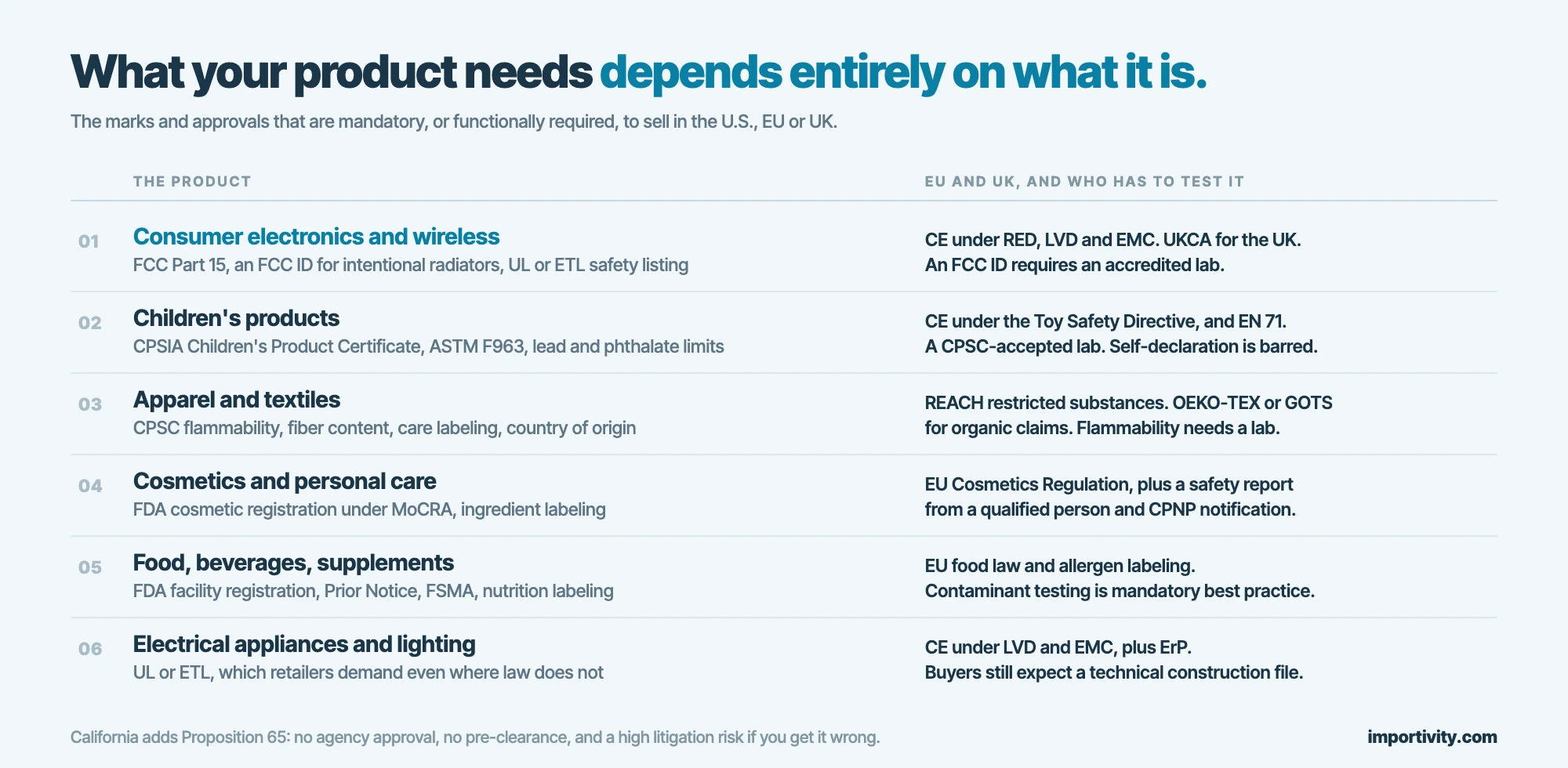
| Product Type | U.S. Requirements | EU / UK Requirements | Self-Declaration or Lab? |
|---|---|---|---|
| Consumer electronics, wireless devices | FCC Part 15 (unintentional radiators), FCC ID (intentional radiators like Bluetooth/WiFi), UL or ETL safety listing | CE marking (Radio Equipment Directive / LVD / EMC), UKCA for UK post-Brexit | FCC ID requires accredited lab; CE can be self-declared for some directives but lab testing is standard practice |
| Food, beverages, dietary supplements | FDA food facility registration, Prior Notice filing, FSMA compliance, nutrition labeling (21 CFR Part 101) | CE not applicable; EU food law (EC 178/2002), allergen labeling | Facility registration is administrative; lab testing for contaminants and labeling accuracy is mandatory best practice |
| Cosmetics and personal care | FDA cosmetic registration (MoCRA 2022 now requires it), ingredient labeling, no prohibited substances | EU Cosmetics Regulation (EC 1223/2009), safety assessment by a qualified person, CPNP notification | No pre-market approval in the U.S., but MoCRA facility registration is now required; EU requires a qualified-person safety report |
| Medical devices | FDA 510(k) clearance or PMA (Class II/III), Class I exempt registration, UDI labeling | CE marking under EU MDR 2017/745, notified body involvement for Class IIa and above | Third-party notified body required for most EU device classes; FDA clearance is never self-declared |
| Children's products (toys, apparel, furniture) | CPSC/CPSIA: Children's Product Certificate (CPC), ASTM F963 toy standard, lead/phthalate limits, third-party testing required | CE marking (Toy Safety Directive 2009/48/EC), EN 71 standard | CPSIA mandates CPSC-accepted third-party lab for children's products, self-declaration is not permitted |
| Apparel and textiles | CPSC flammability (16 CFR Part 1610/1615/1616), fiber content labeling (Textile Act), care labeling (16 CFR Part 423), country of origin | REACH (restricted substances), OEKO-TEX or GOTS if claiming organic/safe | Flammability testing requires a lab; fiber/care labeling is importer-managed paperwork |
| Electrical appliances, lighting | UL listing or ETL mark (retailers require it even if not legally mandated nationally), Energy Star where applicable | CE (LVD + EMC directives), ErP Directive for energy-related products | UL/ETL requires product submission to accredited lab; CE self-declaration possible under LVD but buyers expect a TCF (technical construction file) |
| Products sold in California | Proposition 65 warning requirements if any listed chemical exceeds safe harbor levels (applies to nearly everything containing plastics, metals, or dyes) | N/A | You assess; if a listed substance is present above thresholds, a warning label is required, no agency pre-approval, but litigation risk is high |
| Electronics components, cables (EU/UK) | RoHS (10 restricted substances) applies to EU; not a U.S. federal requirement but many OEM customers demand it | RoHS Directive 2011/65/EU, REACH SVHC disclosure above 0.1% w/w | Supplier declaration of conformity plus lab testing for RoHS; REACH SVHC requires supply chain disclosure |
Key takeaway: Most importers discover they need a certification after production is complete, when it's too late to change the product. Map your certification needs before you place the PO, not after the goods land at the port.
Self-Declaration vs. Third-Party Testing: The Difference That Gets People in Trouble
These two paths are not interchangeable. Understanding which applies to your product before testing starts can save you from paying for the wrong test, or worse, accepting invalid paperwork from a factory.
Self-declaration
Some certifications allow you (or your supplier) to declare conformity based on internal testing or design review. EU CE marking under certain directives, particularly the EMC Directive for lower-risk products, permits a Declaration of Conformity (DoC) without an accredited third-party lab. You are still responsible for maintaining a technical file that supports the declaration if a market surveillance authority asks for it. In practice, even where self-declaration is technically allowed, most large retailers and platforms such as Amazon and Walmart will ask for third-party test reports anyway.
Mandatory third-party testing
For the following, a third-party accredited lab is not optional:
- FCC ID approval for intentional radiators (Bluetooth, WiFi, cellular), must use an FCC-recognized Telecommunications Certification Body (TCB)
- CPSIA children's product testing, must use a CPSC-accepted third-party laboratory
- FDA medical device clearance, never self-declared; FDA reviews the submission
- EU notified body involvement, required for higher-risk CE categories (Class IIa+ medical devices, PPE Category III, pressure equipment)
What testing actually costs
Testing costs vary widely, so budget for them as line items, not surprises. FCC testing for a Bluetooth speaker runs $3,000–$8,000. CPSIA toy testing for a full battery typically runs $1,500–$4,000. EU CE testing for electronics covering EMC and LVD is often $2,000–$6,000. Include these figures in your landed cost calculation before you place the order.
You Are the Importer of Record. Compliance Is Your Problem.
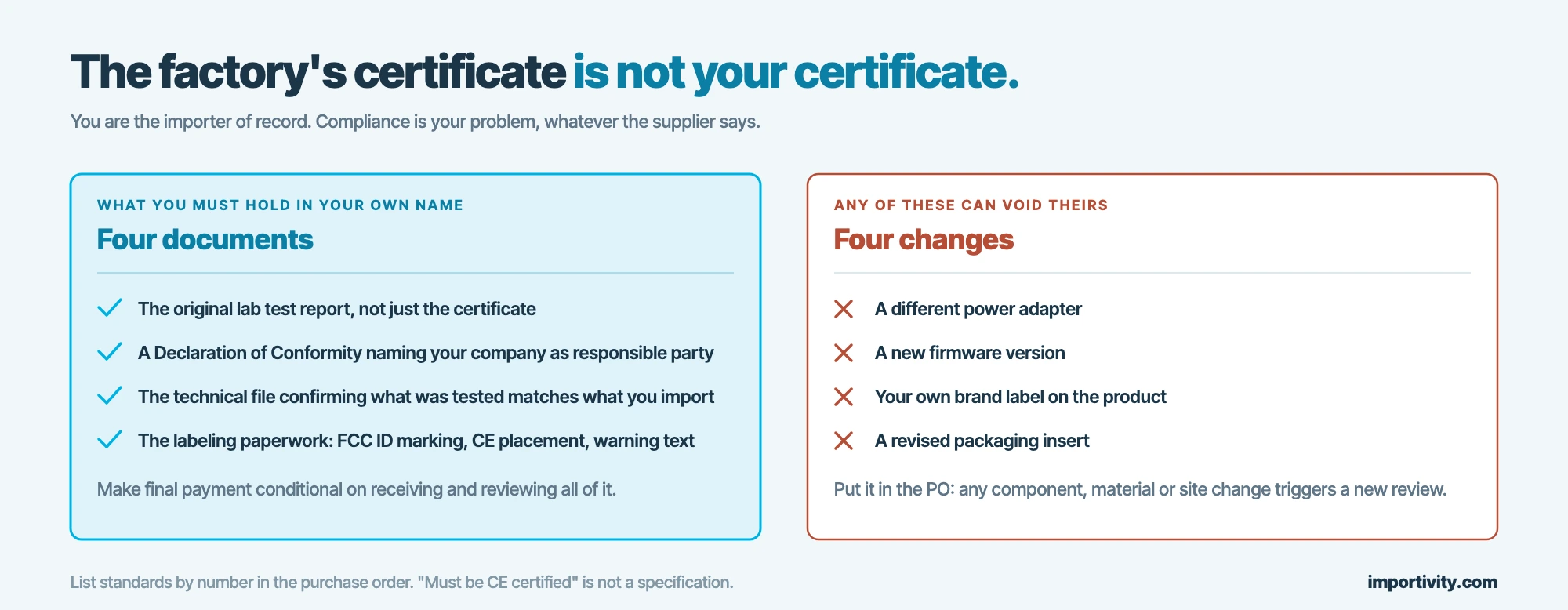
This point deserves direct treatment because a lot of first-time importers get burned by it. When a factory tells you "we're already CE certified" or "we have FCC approval for all our products," that paperwork belongs to them for their specific product configuration. The moment you make any change, a new power adapter, a different firmware version, your own brand label, a revised packaging insert, the existing certification may be void. You are then on the hook for updated conformity.
What records you need to hold yourself
Even if you change nothing, you need to obtain and hold the actual test reports and declarations. "The factory said they have it" is not a defense when CBP or a market surveillance authority asks for records. Specifically, you need to hold:
- The original lab test report (not just the certificate, the full report)
- A Declaration of Conformity listing your company as the responsible party
- The technical file or product spec confirming what was actually tested matches what you're importing
- Any labeling paperwork (FCC ID marking, CE marking placement, warning text)
Why the full test report matters
The deeper point: If your supplier is reluctant to provide the full test report, not just the certificate, that reluctance is itself a red flag. Legitimate test reports name the testing lab, include the date, list the specific product model and sample description, and reference the exact standards tested. A certificate without a report behind it is just a piece of paper.
Building Compliance Into the Purchase Order
The right time to establish compliance requirements is before production, not after. If you wait until goods are finished to ask about certifications, you have almost no leverage, and the factory knows it.
What to include in the PO and supplier agreement
- List the specific standards by number. Don't write "must be CE certified." Instead, write "must conform to Directive 2014/53/EU (RED) and 2014/30/EU (EMC), tested to EN 300 328 and EN 55032, with a full test report from an accredited laboratory."
- Define who pays for testing. For initial certifications on a new product, the cost typically falls on whoever is funding the development run. For ongoing production, you can negotiate that the factory maintains its own test reports as part of their QMS. Be explicit.
- Require document submission before shipment. Make it a condition of payment: final payment is not released until you receive and review all test reports, DoCs, and labeling paperwork.
- Specify what triggers re-testing. Any change in components, materials, firmware, or manufacturing location should trigger a new conformity review. Put this in writing.
- Include a right-to-audit clause. You should be able to verify the factory's claims through your own quality control process or third-party inspection.
If you're sourcing electronics, particularly anything with wireless functionality, budget 60–90 days for FCC/CE testing into your product development timeline. Delays at the lab are common. Re-testing after a failed result can add another 4–6 weeks on top of that.
Red Flags: How to Spot a Fake or Invalid Certificate
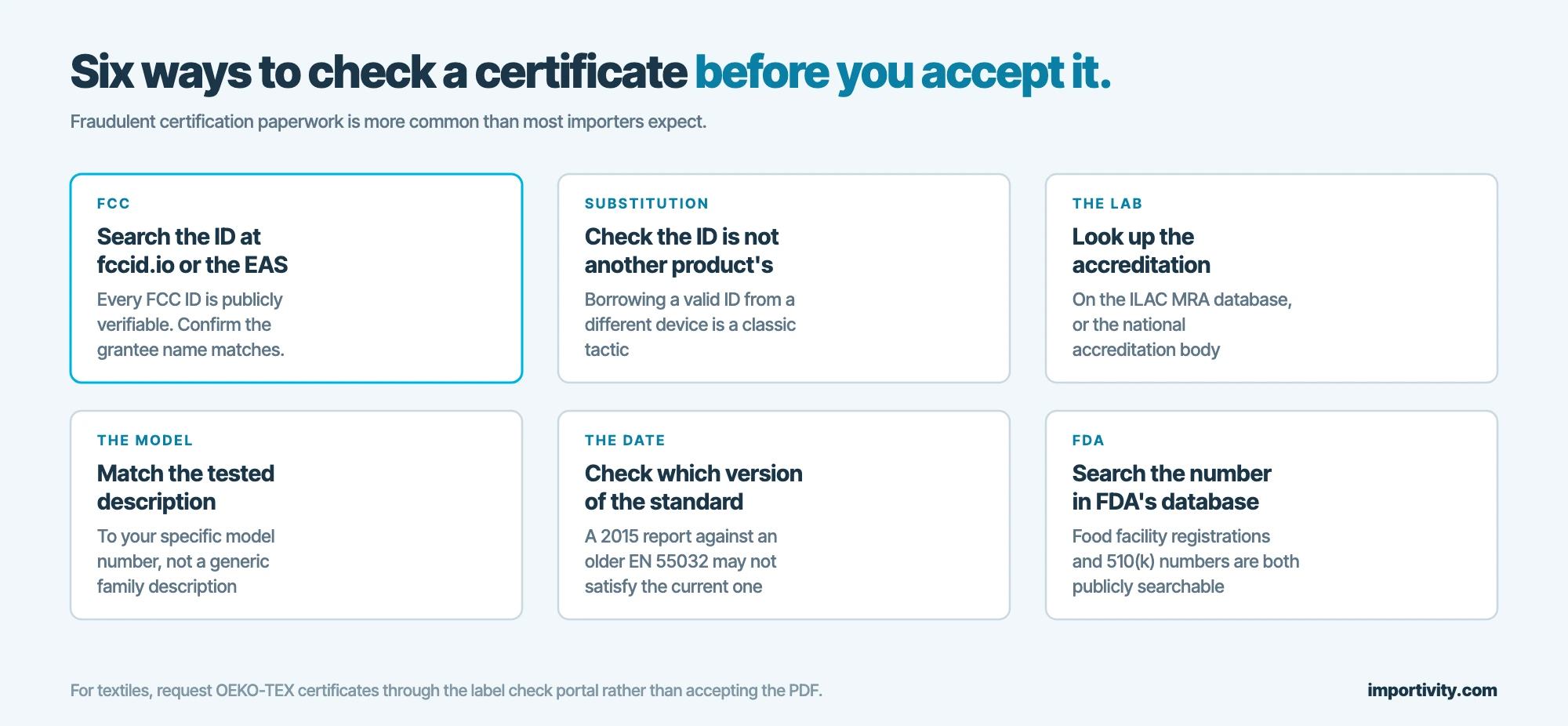
Fraudulent certification papers are more common than most importers expect, particularly in certain product categories. Here are the specific signs to check before you accept paperwork at face value.
For FCC authorizations
- Every FCC ID is publicly verifiable at fccid.io or the FCC's own Equipment Authorization System (EAS). Search the ID and confirm the grantee name, product description, and grant date match what your supplier provided.
- Watch for FCC IDs that belong to a different product entirely, this is a classic substitution tactic.
For CE certificates and test reports
- Your test report should name an accredited lab, look up its accreditation on the ILAC MRA database or the relevant national accreditation body.
- Also verify that the tested product description matches your specific model number, not a generic family description.
- Pay attention to dates, standards are updated regularly. A CE test report from 2015 against an older version of EN 55032 may not satisfy the current directive if the standard has since changed.
For FDA registration numbers
- FDA food facility registration numbers are searchable in the FDA's online database. If a supplier gives you a registration number, check it directly.
- A 510(k) clearance number (formatted as Kxxxxxx) is also publicly searchable in FDA's 510(k) database. Verify that the device description matches what you're importing.
If you're doing substantial volume in textiles sourcing, request OEKO-TEX certificates through the OEKO-TEX label check portal rather than accepting the PDF alone. Certificates have expiration dates that suppliers don't always disclose when they've lapsed, and each one is verifiable by certificate number.
A practical rule: if a supplier sends you a certificate as a standalone PDF with no test report, no lab name, and no verifiable certificate number, treat it as unverified. Cross-reference it against an official database or request the full report. The paperwork that protects you in a CBP inquiry is the test report, not the certificate it generated.
If you want to see what this looks like on a live project rather than in a guide, Source With Jordan is where we publish the sourcing itself.
Frequently Asked Questions
Does my overseas factory's CE certification cover me as the U.S. importer?
Not automatically. CE marking relates to the EU market, not the U.S., so CE doesn't satisfy U.S. requirements like FCC or CPSIA. For EU sales, if the factory holds CE for their product and your version is identical, they can name you as the EU authorized representative on the Declaration of Conformity. However, you still need to hold copies of all records, and any product changes void the original certification regardless of who paid for it.
What happens if CBP detains a shipment for a missing certification?
CBP can issue a Notice of Detention, giving you typically five business days to provide the required records. If you can't produce them, the shipment may be refused entry and you'll bear the cost of re-export or destruction. For FDA-regulated products, a formal refusal is entered into OASIS and can trigger automatic exam on future shipments from the same supplier. Beyond the immediate shipment, CPSC violations can result in civil penalties up to $150,000 per violation and $15.15 million per series of violations.
Can I use a Chinese lab's test report for FCC authorization?
For FCC Supplier's Declaration of Conformity (SDoC), you can use any ISO 17025 accredited lab recognized by the FCC's NVLAP program, which includes many Chinese labs. For FCC ID approval (required for intentional radiators), the application must go through an FCC-recognized Telecommunications Certification Body (TCB), and the TCB will evaluate the test reports. The lab that generated those reports must hold the required accreditation, so confirm accreditation status before commissioning the tests, not after.
Is Prop 65 a federal law? Does it apply if I only sell outside California?
Proposition 65 is a California state law (Safe Drinking Water and Toxic Enforcement Act of 1986). Technically it only applies to products sold in California. In practice, because California is the largest U.S. consumer market and e-commerce makes geographic restriction difficult to enforce, most importers treat Prop 65 compliance as a national requirement. Enforcement is mostly through private citizen lawsuits, plaintiffs' attorneys regularly buy products online, test them, and send 60-day notices. The litigation cost of a Prop 65 action often exceeds $30,000 even when you ultimately prevail.
How often do certifications need to be renewed?
It depends on the certification. FCC grants don't expire, but they become invalid if you make a permissive change to the product without filing an updated approval. OEKO-TEX standard 100 certificates are valid for one year. EU CE certifications tied to a notified body (medical devices, PPE) require periodic surveillance audits, typically annual. FDA food facility registration must be renewed every two years during the October–December renewal period. Build a compliance calendar so renewals don't lapse while goods are in production or transit.
Ready to Verify Your Suppliers’ Compliance Before You Order?
Compliance paperwork is only as good as the supplier behind it. If you're not certain your factory's certifications are genuine, current, and matched to your product configuration, the time to find out is before you wire the deposit, not after the container arrives. Our supplier vetting process includes checking certification claims as part of the factory audit, so you go into production with records you can stand behind.
About the author
Jordan Lewis
Chief Operating Officer, Importivity
Runs Importivity's sourcing operations across China, Vietnam, Mexico and India, from supplier negotiation through landed delivery.
Press and media inquiries: press@importivity.com