

Guide
Tariff Mitigation Strategies
The proven, legal strategies to lower duty exposure and protect margins as trade policy shifts.
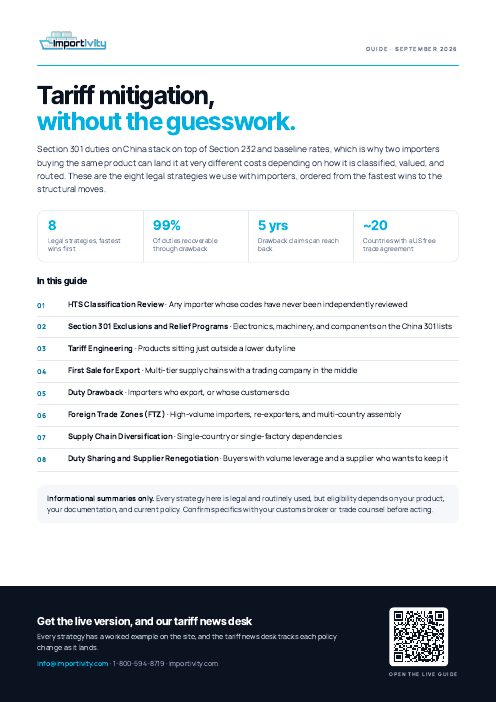
Tariffs are a line item you can manage, not just absorb. Section 301 duties on China stack on top of Section 232 and baseline rates, which is why two importers buying the same product can land it at very different costs depending on how it is classified, valued, and routed. Below are the eight strategies we use with importers, ordered from the fastest wins to the structural moves. Before you pick one, make sure you can measure the result: our guide to calculating landed cost sets out the arithmetic these strategies are trying to move.
In this guide
- 01HTS classification review: confirm you are paying the correct rate
- 02Section 301 exclusions and relief programs: claim what you qualify for
- 03Tariff engineering: change the product so it lands in a lower duty line
- 04First Sale for Export: pay duty on the factory price, not the middleman invoice
- 05Duty drawback: recover duties on goods that leave the country again
- 06Foreign Trade Zones: defer, reduce, or eliminate duty at scale
- 07Supply chain diversification: cap exposure to any single tariff action
- 08Duty sharing: move part of the cost back up the supply chain
- 09Worked example: an $18k backup mold that avoided $480k a year in duty
Talk with a tariff expert, or submit a sourcing request for a tariff-aware plan.
Free download
Get the Tariff Mitigation Strategies
Enter your details and we'll email you the guide. No cost, no obligation.
Where Tariffs Stand in 2026 and Why Mitigation Matters Now
The duty environment changed shape several times in 2026: through the courts, through Section 232, and through new Section 301 tariffs on 60 economies. Each change moves real money, and each changes which mitigation strategy is worth running first. Everything below links to our coverage of the underlying action.
IEEPA tariffs struck down, and refunds ordered
The Supreme Court held that IEEPA cannot be used to impose tariffs, the Court of International Trade ordered refunds to begin, and CBP has since opened a refund portal covering roughly $166B. If you paid IEEPA-based duties, recovering them on entries that are not finally liquidated is now largely an administrative exercise, and it belongs at the top of your list. The phase for finally liquidated entries opens October 6, 2026 and so far covers only importers that sued at the Court of International Trade.
A Section 122 surcharge filled the gap, then expired
A flat 10% surcharge under Section 122 of the Trade Act of 1974 applied to most imports from February 24 to July 24, 2026, when its 150-day statutory term ran out. The announced increase to 15% was never ordered. Whether duties paid in that window are refunded depends on a pending appeal, so keep the entry records.
Steel, aluminum and copper now assessed on full customs value
The 50% Section 232 duty on steel, aluminum, copper and their derivatives now applies to the full customs value rather than only the metal content. For derivative products this is a large, quiet increase, and it makes accurate classification and valuation worth far more than it was a year ago.
Section 301 scope widened well beyond China
Since July 24, 2026, Section 301 forced-labor tariffs apply to all products of 60 economies, 12.5% for most (including China and Vietnam) and 10% for others (including Mexico and India), unless an annex exemption applies, and Brazil carries a separate 25% Section 301 action. Country shifting is still a valid strategy, but 'move it out of China' is no longer sufficient on its own. The destination has to be checked against current actions before you commit tooling.
Tariff policy in 2026 has moved faster than annual planning cycles. Re-check classification, valuation, and country of origin against current actions before you rely on last year's answer. Our tariff news desk tracks each change as it lands.
The Eight Strategies
Ordered from the fastest wins to the structural moves. Most importers should work down the list in this order. Each one opens into a worked example.
- 01
HTS Classification Review
Best for: Any importer whose codes have never been independently reviewed
Misclassification is the most common reason importers overpay, and it is the cheapest thing to fix. A line by line review of your HTS codes against the current tariff schedule regularly turns up products sitting in the wrong heading, sometimes for years, and sometimes at a rate several points higher than the correct one. Start from a documented review of HTS codes and customs classification rather than the codes your freight forwarder inherited.
- Start here. It costs the least and needs no change to the product
- Errors can be corrected going forward and, in some cases, backward
- It also cuts penalty risk when a code is wrong in the other direction
- 02
Section 301 Exclusions and Relief Programs
Best for: Electronics, machinery, and components on the China 301 lists
Some products are covered by an active exclusion or relief program that removes or reduces the additional duty. Exclusion lists change, expire, and get reinstated, so eligibility has to be re-checked against your exact codes rather than assumed from last year's answer. Background on how the lists are built is in our explainer on Section 301 tariffs, and if you have already paid, see what is recoverable through Section 301 tariff refunds.
- Match current USTR exclusion lists against your exact HTS codes
- Watch expiry dates, because coverage is often extended in short windows
- Separate relief tracks exist for specific steel, aluminum, and automotive lines
- 03
Tariff Engineering
Best for: Products sitting just outside a lower duty line
Documented changes to materials, components, or the point of assembly can move a product into a different HTS heading that carries a lower rate. The change has to be real and defensible rather than a paperwork exercise, which is why this gets decided at the design and sourcing stage, not at the border.
- Decided before production, not after the goods ship
- Needs engineering, sourcing, and customs input in the same room
- Back it with a CBP ruling request when the classification is close
- 04
First Sale for Export
Best for: Multi tier supply chains with a trading company in the middle
When goods pass through a trading company, duty is normally assessed on the price you pay. First Sale lets you declare the earlier factory to middleman price instead, so the middleman's markup is never dutiable. On a 25 percent line, that markup converts straight into margin.
- Duty is based on the factory price, not your commercial invoice
- Requires a documented, bona fide sale destined for the United States
- Getting factory pricing transparency is the usual blocker, not the law
- 05
Duty Drawback
Best for: Importers who export, or whose customers do
Drawback refunds up to 99 percent of the duties, taxes, and fees paid on goods that are later exported, destroyed, or used to make something that is exported. Claims can reach back five years, so the first filing is usually the single largest recovery on this list. The mechanics, timelines and record-keeping are covered in our guide to duty drawback and tariff refunds.
- Recovers up to 99 percent of duties, taxes, and fees paid
- Retroactive claims cover the previous five years of entries
- Needs clean import to export tracing, which is the real work
- 06
Foreign Trade Zones (FTZ)
Best for: High volume importers, re-exporters, and multi-country assembly
Goods admitted to an FTZ are not formally entered until they leave the zone, so duty is deferred and cash stays in the business. Anything re-exported or scrapped in the zone may never be dutiable at all, and inverted tariff relief can let you pay the finished good rate instead of the higher component rate.
- Duty deferred until goods actually leave the zone
- No duty on goods that are re-exported or destroyed
- Setup and compliance overhead means it pays off at volume, not at pilot scale
- 07
Supply Chain Diversification
Best for: Single country or single factory dependencies
Moving part of your volume to a second country caps your exposure to any one tariff action and hands you leverage in the next price negotiation. A backup mold or a qualified second factory is routinely cheaper than a single year of the duty it avoids. Moving production only helps if origin holds up under scrutiny. See how to prove Vietnam origin and avoid transshipment risk, and for assemblies, how to verify component origin in electronics supply chains.
- Nearshore to Mexico for shorter lead times and USMCA treatment
- Shift labor intensive lines to Vietnam or India
- Qualify the second source before you need it, not during a spike
- 08
Duty Sharing and Supplier Renegotiation
Best for: Buyers with volume leverage and a supplier who wants to keep it
This is the one commercial lever on the list rather than a customs one, and it is the fastest to pull. Factories facing the loss of a major account will often absorb part of a tariff increase, shift Incoterms, or rework packaging and shipping density so the duty is calculated on a smaller base.
- Ask for a split of the increase before you move the volume
- Revisit Incoterms so assists and freight are handled correctly
- Re-examine what is actually in the dutiable value on every entry
Informational summaries only. Every strategy here is legal and routinely used, but eligibility depends on your product, your documentation, and current policy. Confirm specifics with your customs broker or trade counsel before acting.
How to Choose the Right Tariff Mitigation Strategy for Your Situation
Most importers do not need all eight. They need the two or three that match their product, their volume, and how much of the supply chain they actually control. Work through these in order.
Confirm what you are actually paying
Pull twelve months of entry summaries and total duty by HTS code and by supplier. Importers are routinely surprised here, because duty is buried in the broker's invoice. You cannot prioritize without this.
Check whether you are owed a refund
Given the IEEPA ruling and the CBP refund portal, money you have already paid may be recoverable. Refunds require no change to your product, your supplier, or your process, which makes them the first thing to chase.
Verify classification and valuation
A code review and a look at whether First Sale applies are cheap, need no supplier change, and often move more money than a sourcing shift. This matters more now that Section 232 metals are assessed on full customs value.
Ask whether the product can change
If design, materials, or the point of assembly can move, tariff engineering is on the table. If the product is locked by a customer specification or a certification, it is not, and you skip to routing.
Ask whether the routing can change
Foreign Trade Zones and bonded warehousing help when you hold inventory, re-export, or process before entry. Duty drawback helps when you export what you imported. Both are structural but neither touches the product.
Only then consider moving production
Country shifting carries requalification, tooling, and origin-substantiation costs, and the destination has to be checked against current Section 301 and 232 actions. It is the highest-leverage move and the slowest, so it should be a decision, not a reflex.
A practical rule: exhaust everything that does not require the supplier to change before you ask the supplier to change. Refunds, classification and valuation work run in weeks. Requalifying a factory runs in quarters.
FTA and USMCA Qualification: Eliminate Duty by Origin, Not Just by Classification
Classification changes which rate applies. Origin can remove the rate altogether. Free trade agreements are the one lever that can take the base (MFN) rate to zero, though Section 232 and 301 layers may still apply, and they are consistently the most under-used strategy on this list because qualification is a documentation exercise rather than a sourcing decision.
USMCA (US, Mexico, Canada)
Duty-free treatment where the good meets the relevant rule of origin, which may be a tariff shift, a regional value content threshold, or both. Automotive and textiles carry their own stricter rules.
- Qualification turns on the rule for your specific HTS heading, not on where the factory is
- You need a valid certification of origin and the records behind it, held for five years
- Nearshoring to Mexico without checking the rule of origin is how importers end up paying anyway
Other US free trade agreements
The United States has agreements covering roughly 20 partner countries, including Korea, Australia, Singapore, Chile, and the CAFTA-DR group. Each has its own rules of origin and its own certification format.
- Worth checking whenever you shortlist a country, before tooling is committed
- A partner-country supplier is not automatically an FTA-qualifying supplier
- Some agreements allow accumulation across partners, which can rescue a marginal case
Substantial transformation and what it does not cover
Where no agreement applies, origin still decides which country's rates you pay. Substantial transformation is the test, and it is stricter than most importers assume.
- Final assembly alone frequently fails the test
- Repacking, labeling, and light finishing almost never confer origin
- Documentation matters as much as the physical process, especially for goods routed through third countries
Qualification is worth pricing before you move production. An FTA-qualifying supplier at a slightly higher unit price routinely beats a cheaper non-qualifying one once duty is in the model.
Frequently Asked Questions
The eight strategies in detail
Each route to a lower duty bill, when it applies, and what it takes to qualify.
Not sure which strategy fits your product?
Send us your HTS codes and volumes. We will tell you which of these levers actually applies to you, what it is worth, and what it takes to put in place.