A Complete Guide to Suppliers, Costs and Logistics while Sourcing From Vietnam
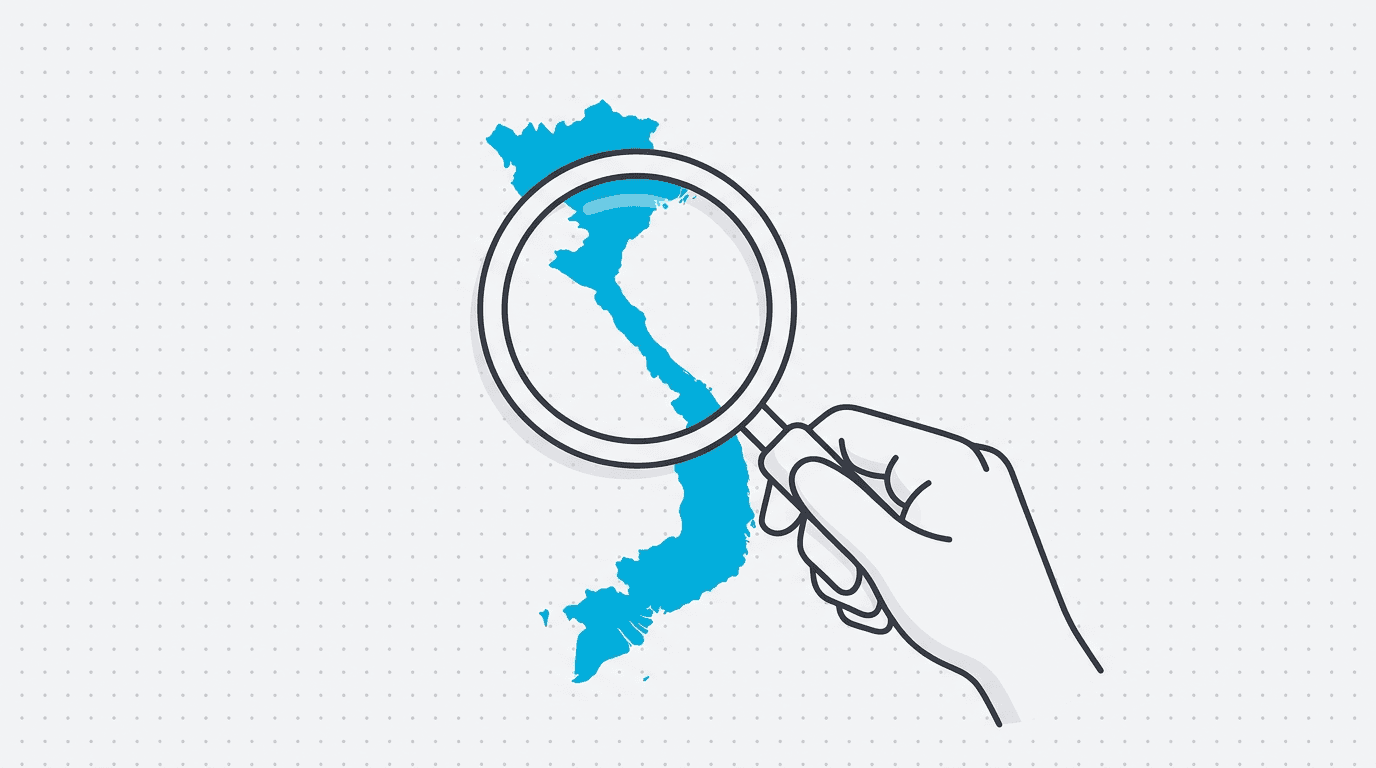
Sourcing from Vietnam has gone from a niche hedge against China risk to a mainstream procurement strategy for U.S. brands. In the five years following the first wave of Section 301 tariffs, Vietnam's exports to the United States roughly doubled, and the growth was not an accident. The country has competitive labor costs, improving port infrastructure, and a manufacturing base that is genuinely strong in several high-demand categories. If you're diversifying out of China, Vietnam belongs on your shortlist.
That said, Vietnam is not a plug-and-play China replacement. Its supplier ecosystem is smaller, raw material supply chains still run through China in many sectors, and factory capacity is under real strain in the most popular product categories. This guide gives you the complete picture: where Vietnam excels, where it falls short, what it actually costs, and how to find factories worth working with.
The short version: Vietnam makes the most sense for furniture, footwear, apparel, wood products, and certain electronics assembly, especially if you're sourcing at small-to-mid scale and want to reduce U.S. import duties. For categories dependent on complex component supply chains or very high volumes, the math is more complicated.
Why Vietnam Became the Leading China+1 Destination
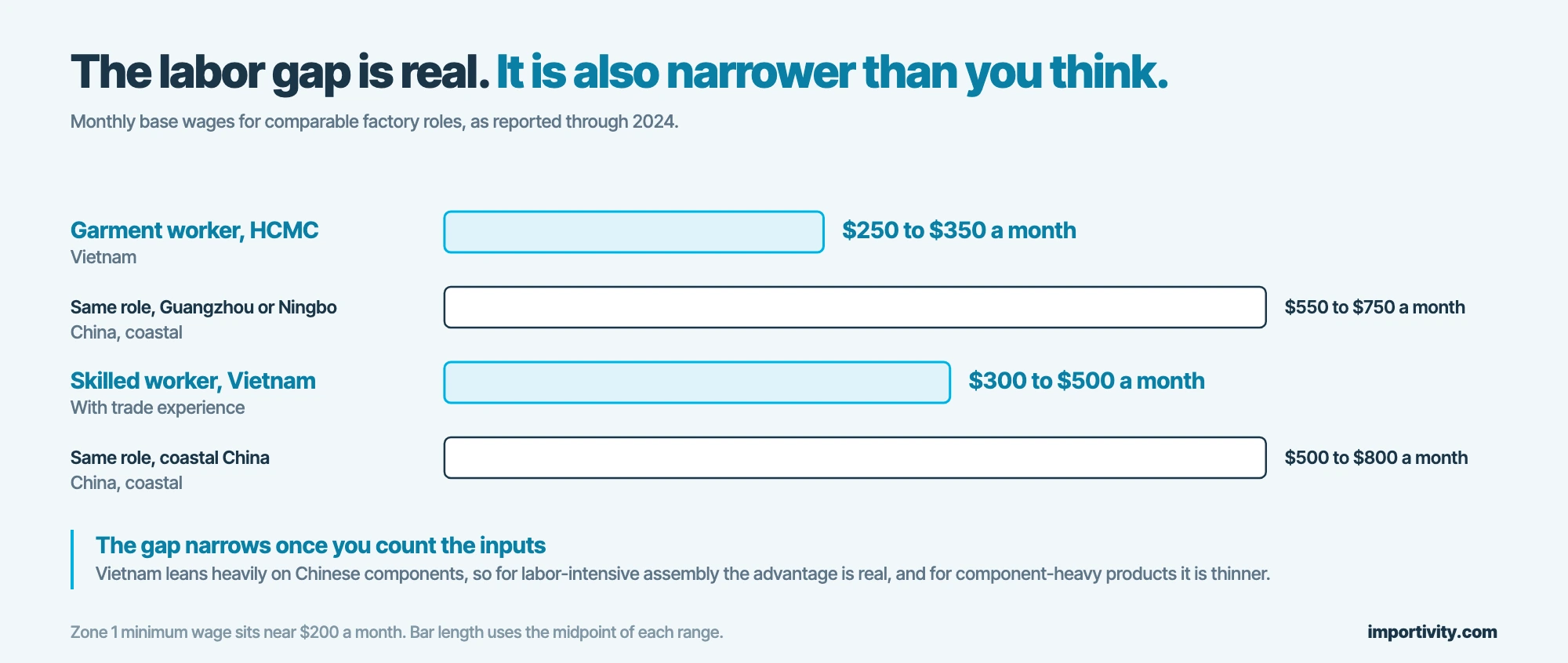
Vietnam's rise as an alternative manufacturing hub has a few structural causes that are unlikely to reverse. First, labor costs remain well below China's coastal provinces. A garment worker in Ho Chi Minh City earns about $250–$350/month in base wages; in Guangzhou or Ningbo, comparable roles cost $550–$750/month. That gap narrows when you account for Vietnam's heavier reliance on Chinese components, but for labor-intensive assembly, it is real.
Second, Vietnam signed a wave of free trade agreements, the CPTPP, the EU-Vietnam FTA, and RCEP, that China's manufacturers cannot access directly. For U.S. brands, the Section 301 tariff exemption is the more immediate driver. Goods assembled in Vietnam with enough local value-added qualify as Vietnamese-origin and ship duty-free or at standard MFN rates, bypassing the 7.5%–25% (and in some categories, 25%+) Section 301 surcharges on Chinese goods.
Third, Vietnam benefits from geography and policy stability. It borders southern China's supply chains, shares a coastline with major east-west shipping lanes, and has actively courted foreign direct investment. Samsung, Intel, LG, and Nike all have major Vietnamese manufacturing operations, which pulls in ancillary suppliers and raises the overall factory quality floor.
Strongest Product Categories
Not every category works in Vietnam. These are the ones where the supplier base is deepest and quality is most reliable for U.S. import:
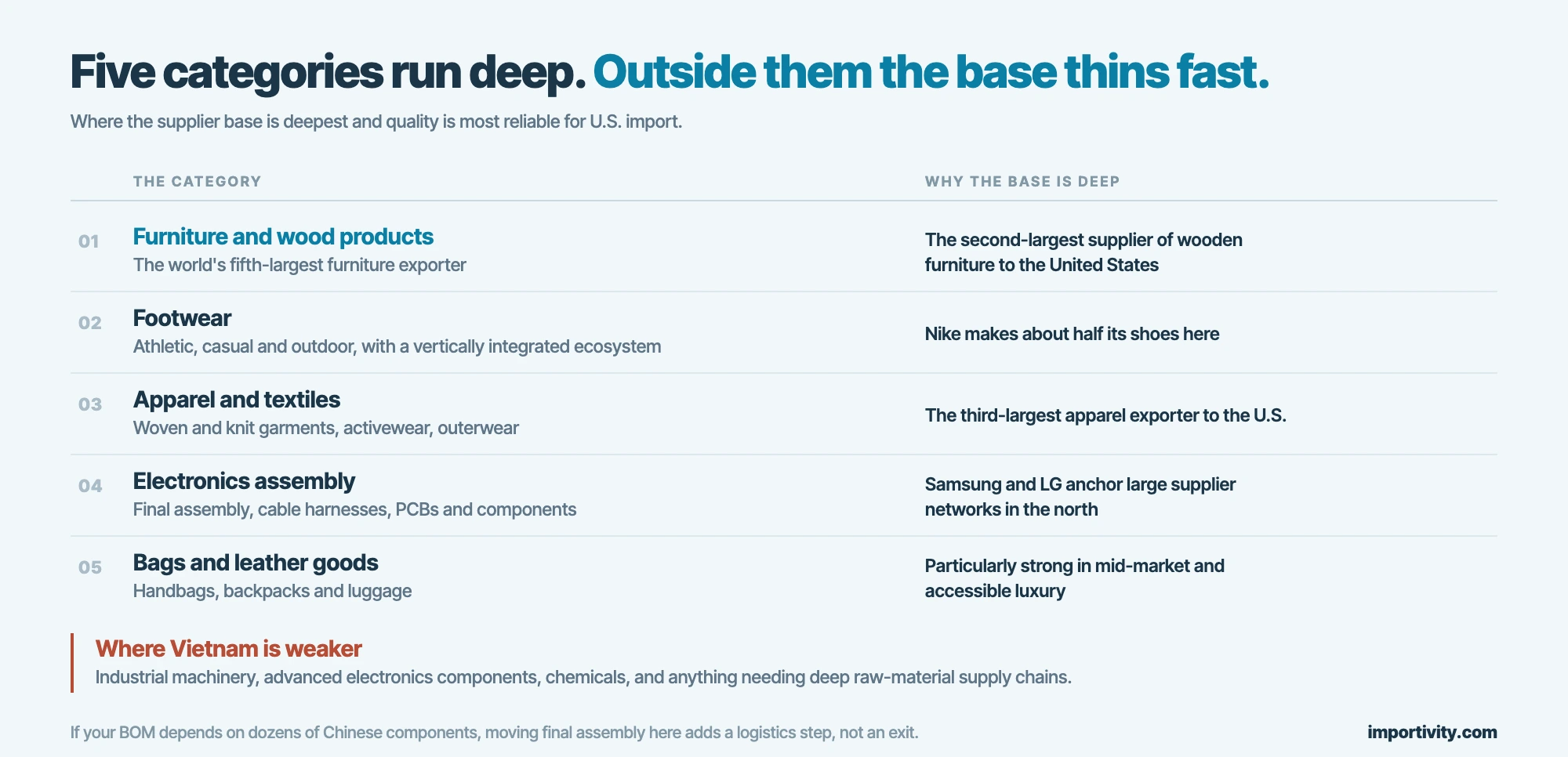
- Furniture and wood products, Vietnam is the world's fifth-largest furniture exporter and the second-largest supplier of wooden furniture to the U.S. after China. The Binh Duong and Dong Nai provinces south of Ho Chi Minh City have hundreds of factories ranging from contract manufacturers to OEM/ODM specialists. Lead times of 45–75 days are typical for production runs.
- Footwear, Nike makes about half its shoes in Vietnam. The supplier ecosystem for athletic, casual, and outdoor footwear is mature and vertically integrated compared to other categories. Minimum order quantities (MOQs) are typically 300–1,000 pairs per style at tier-2 factories.
- Apparel and textiles, Vietnam is the third-largest apparel exporter to the U.S. Woven and knit garments, activewear, and outerwear are all strong. The caveat: most fabric is still imported from China or South Korea, so yarn-forward rules of origin under trade agreements can be a problem for some buyers.
- Electronics assembly, Final assembly of consumer electronics, cable harnesses, PCBs, and components is growing fast. Samsung and LG anchor large industrial parks in the north. Quality is high where FDI factories have trained the local workforce, though complex sub-assemblies often still depend on Chinese component supply.
- Bags and leather goods, Handbags, backpacks, and luggage. Vietnam's leather goods sector is particularly strong for mid-market and accessible luxury brands shifting production out of China.
Where Vietnam is weaker: Industrial machinery, advanced electronics components, chemicals, and products that need deep raw-material supply chains. If your bill of materials depends on dozens of Chinese-sourced components, simply moving final assembly to Vietnam does not eliminate your China exposure, it just adds a logistics step.
Manufacturing Regions: South vs. North
Vietnam's industrial base is split between two clusters with meaningfully different characteristics. Understanding which one fits your category saves time when you start vetting suppliers.
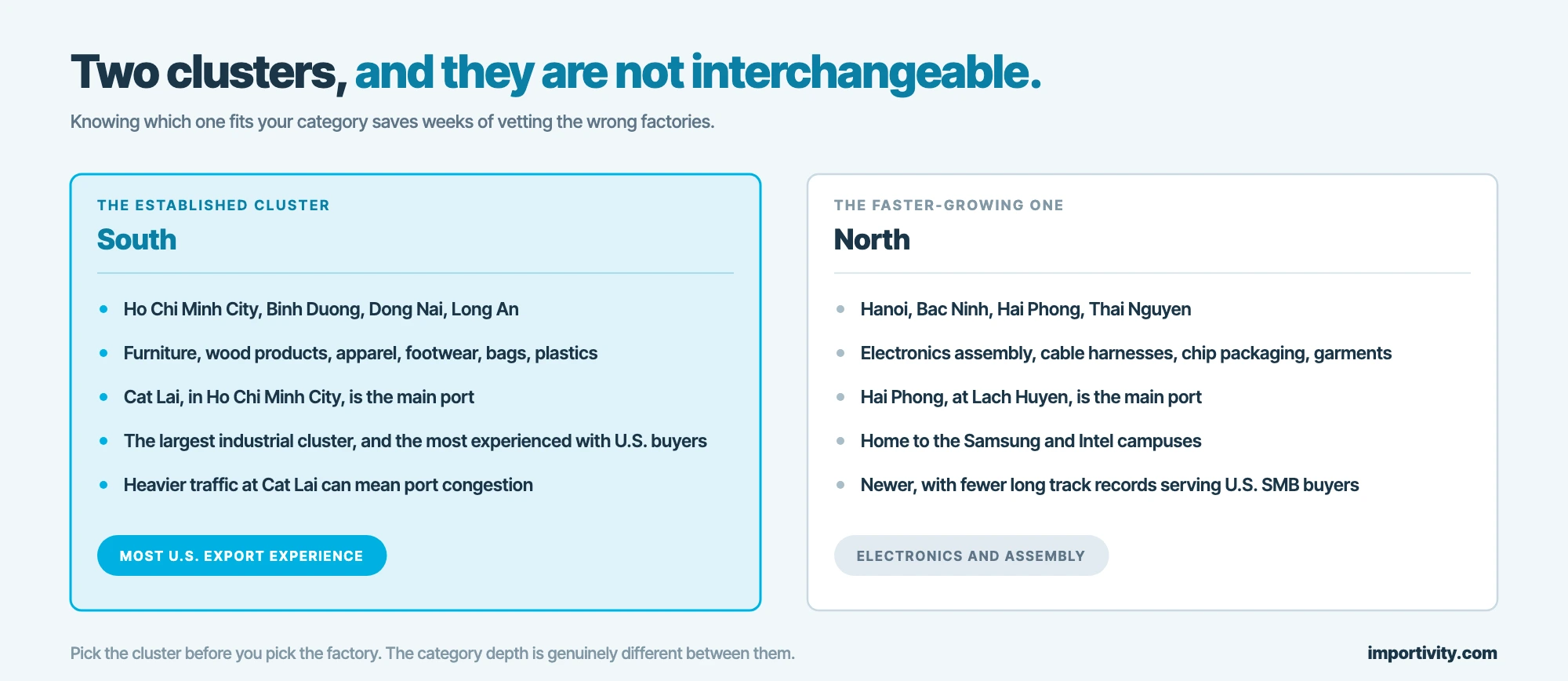
| Region | Key Cities / Provinces | Strongest Categories | Main Port | Notes |
|---|---|---|---|---|
| South | Ho Chi Minh City, Binh Duong, Dong Nai, Long An | Furniture, wood products, apparel, footwear, bags, plastics | Cat Lai (HCMC) | Largest industrial cluster; most experienced with U.S. export buyers; heavier traffic at Cat Lai can mean port congestion |
| North | Hanoi, Bac Ninh, Hai Phong, Thai Nguyen | Electronics assembly, cable harnesses, semiconductor packaging, garments | Hai Phong (Lach Huyen) | Home to Samsung and Intel campuses; faster-growing but newer, fewer factories with long track records serving U.S. SMBs |
For most U.S. importers sourcing furniture, footwear, or apparel, the southern cluster is the starting point. For electronics buyers whose Chinese suppliers are in Guangdong and want geographic continuity with a Vietnam leg, the north makes more logistical sense.
Cost Comparison with China
Vietnam's cost advantage over China is real but narrower than many buyers expect, and it's category-dependent. Here is how to think about the major cost drivers:
Labor
Vietnam's minimum wages vary by zone. Zone 1 (major cities) sets the minimum at about $200/month as of 2024; skilled factory workers with trade experience earn $300–$500. China's coastal provinces run $500–$800 for comparable roles. For labor-intensive products, sewn goods, hand-assembled furniture, footwear, Vietnam's labor advantage is 30%–50% on the wage line.
Components and Materials
This is where the advantage erodes. Vietnam imports a large share of its production inputs, fabric, leather, foam, hardware, electronic components, mostly from China. Your factory's FOB price already embeds the cost of those Chinese materials plus the Vietnam value-add. In many cases, the net ex-works cost difference versus a Chinese factory is 10%–20%, not 40%.
Tariff Impact
For goods currently subject to Section 301 tariffs, the duty savings when shifting origin to Vietnam can be significant, 7.5% to 25% of customs value, depending on the HTS code. That math often makes Vietnam the cheaper landed-cost option even when the FOB price is modestly higher than China. Run the landed-cost comparison, not just the ex-works comparison.
Key takeaway: Vietnam typically beats China on landed cost for apparel, footwear, furniture, and bags once Section 301 tariffs are included, but do the math product by product. The margin is rarely wide enough to absorb a poor factory choice or quality problems.
Tariffs, Transshipment Risk, and Compliance
The tariff story has a dark side worth knowing before you start. U.S. Customs and Border Protection has been actively investigating transshipment, Chinese goods with minimal processing re-exported through Vietnam to claim Vietnamese origin. Penalties include seizure of goods, back-duties, and in fraud cases, criminal referral.
To qualify as Vietnamese origin under CBP's substantial transformation test, goods generally need to undergo a meaningful manufacturing process in Vietnam, not just repackaging, labeling, or minor assembly. For apparel, CPTPP's yarn-forward rule is even stricter. Specific rules apply per HTS chapter.
Steps to Protect Yourself from Transshipment Risk
Taking the right steps upfront protects you from costly enforcement actions later:
- Request a factory audit that specifically documents the production process and confirms raw material sourcing.
- Ask for bills of lading showing Vietnamese-origin inputs where possible.
- Avoid factories that pitch themselves as "transshipment solutions" or claim to re-certify Chinese goods with minimal work.
- Work with a licensed customs broker who knows your specific HTS code and can advise on the substantial transformation threshold before you commit.
Moreover, transshipment enforcement has increased greatly since 2019. This is not a theoretical risk, CBP has issued large penalty assessments against U.S. importers who relied on fraudulent certificates of origin issued by Vietnamese middlemen.
MOQs, Factory Scale, and Supplier Structure
Vietnam's factory landscape skews toward mid-size manufacturers, typically 200–2,000 workers, rather than the giant contract manufacturers you find in China's Pearl River Delta. That has real implications for how you source.
Typical MOQs at Vietnamese Factories
- Apparel: 300–500 pieces per style/colorway for a mid-size factory; 1,000+ at larger operations
- Footwear: 300–1,000 pairs per SKU
- Furniture: often by container (a 40' HQ container of chairs or tables is a common minimum)
- Bags: 200–500 units per style
Scale and Capacity Considerations
Vietnam is workable for smaller brands, you do not need to be placing $500,000 orders. However, if you are buying very small quantities (under 100 units), you will struggle to get serious factories interested. Trading companies that combine orders from multiple buyers exist, but quality control is more complicated through that channel.
Additionally, factory concentration is a real capacity issue. The best Vietnamese furniture and footwear factories are heavily booked, particularly post-2020. Lead times have lengthened in popular categories; do not assume the same turnaround you might get from a hungry factory in a less-saturated market.
Logistics and Ports
Vietnam has two primary export ports for U.S.-bound cargo:
- Cat Lai (Ho Chi Minh City), The largest container port in Vietnam and the main gateway for goods made in the south. It handles the majority of Vietnam's container exports. Congestion during peak season (Q3–Q4) is a recurring issue; plan for an extra 3–7 days of port dwell time versus typical.
- Hai Phong (Lach Huyen deepwater terminal), The main port for northern Vietnam and the primary export point for electronics and goods made in the Hanoi/Bac Ninh corridor. Hai Phong is less congested than Cat Lai and handles larger vessels since the Lach Huyen expansion.
Transit Times and Air Freight
Transit times from Vietnamese ports to the U.S. West Coast run about 18–22 days; to East Coast ports via the Suez Canal, 28–35 days. Air freight from Tan Son Nhat (HCMC) or Noi Bai (Hanoi) to LAX or JFK typically runs 3–5 days at about $4–$7/kg depending on volume and service level.
Component Lead Times
One logistics nuance worth noting: because many Vietnamese factories source components from China, your total supply chain lead time includes the time for Chinese materials to arrive in Vietnam before production starts. Factor in 2–4 weeks of component transit if your factory does not hold safety stock.
Finding and Vetting Suppliers
Where to look
Alibaba and Global Sources list Vietnamese factories, but the quality signal is noisier than for Chinese suppliers, there are fewer verified reviews and the directories are less mature. Vietnam Manufacturers Directory and the Vietnam Chamber of Commerce (VCCI) maintain listings. Industry-specific trade shows, most notably HKTDC's sourcing fairs and Vietnam's own VIFA EXPO (furniture), put you in front of real factory owners.
What a credible vetting process looks like
- Business license check: Verify the factory is registered with Vietnam's Ministry of Planning and Investment. A legitimate manufacturer can provide their Enterprise Registration Certificate.
- Factory audit: Third-party social compliance and quality audits (SMETA, BSCI) are available through SGS, Bureau Veritas, and Intertek. Budget $400–$800 for a one-day audit.
- Sample orders: Never skip sampling, regardless of how professional the factory looks. Request a pre-production sample (PP sample) for approval before bulk production.
- Financial stability check: Ask for references from existing U.S. or European buyers. A factory that has been supplying a recognizable brand for 3+ years is a good signal.
- Origin compliance review: Before you place an order, confirm the production process is enough for substantial transformation under CBP rules for your specific HTS code.
A sourcing agent with on-the-ground presence in Vietnam can compress this process greatly, particularly for factory identification, Mandarin/Vietnamese language negotiation, and pre-shipment inspection. If you are entering Vietnam for the first time and placing meaningful order volumes, the agent fee is usually recovered in the first order through better pricing and avoided quality problems.
Honest Limitations
Vietnam is not the right answer for every category or every buyer. Here is where it genuinely falls short:
- Raw material depth: Vietnam lacks the domestic raw material base that makes China's supply chains self-sufficient. Steel, aluminum, advanced fabrics, electronic components, and specialty chemicals mostly come from outside the country, mainly China. You are not eliminating China dependency; you are often just moving it one step upstream.
- Capacity constraints: The best factories are busy. If you have a hard launch deadline and a large first order, you may not be able to get production slots at qualified factories on your timeline.
- Rising wages: Vietnam's labor cost advantage has narrowed as the economy has grown. Wages have increased about 7%–10% per year in manufacturing zones over the past decade. The gap remains, but it is not static.
- Smaller supplier ecosystem: For categories where China has 500 qualified suppliers, Vietnam may have 30. Your negotiating leverage and fallback options are more limited.
- Quality variance: The gap between Vietnam's best factories and its worst is wide. Tier-1 factories supplying major global brands can be excellent; in contrast, smaller factories without established export buyer relationships may have significant quality and process gaps.
If you are weighing the tradeoffs between countries, it is worth reading our direct comparison of China vs Vietnam for manufacturing, it goes deeper on cost structure, ecosystem differences, and when each country wins. If Mexico is also on your shortlist, the Vietnam vs Mexico comparison covers the distinct tradeoffs there, particularly for nearshoring and tariff exposure under USMCA.
For a broader view of how these three sourcing destinations stack up, see our guide to sourcing from Vietnam, China and Mexico, useful if you are still deciding which market to prioritize first.
We keep people in Guangzhou and Ho Chi Minh City rather than running this from a desk. Our case study on a plan B mold strategy using China for scale and Vietnam for tariff relief shows how the comparison plays out on a real programme, and Source With Jordan is where the work on the ground gets published.
Frequently Asked Questions
Is sourcing from Vietnam cheaper than China?
On labor costs alone, yes, Vietnam's factory wages are about 40%–50% lower than coastal China. However, ex-works prices are often only 10%–20% cheaper because Vietnamese factories import many of their components and materials from China. The full landed-cost calculation changes when you add Section 301 tariffs: for categories carrying a 25% Section 301 surcharge, Vietnamese-origin goods frequently arrive cheaper at the U.S. dock even if the FOB price is modestly higher.
What are typical MOQs at Vietnamese factories?
MOQs vary by category. For apparel, expect 300–500 pieces per style at a mid-size factory. Footwear is typically 300–1,000 pairs per SKU. Furniture is often quoted by container load. Bags and leather goods commonly start at 200–500 units per style. Very small orders (under 100 units) are difficult to place directly with manufacturers, trading companies or sourcing agents who combine orders are a better option at that scale.
How do I avoid transshipment problems when importing from Vietnam?
The key is ensuring your goods genuinely undergo substantial transformation in Vietnam, not just repackaging or minor assembly of Chinese-made products. Request factory audits that document the production process, review bills of lading for Vietnamese-sourced inputs where possible, and avoid any factory or agent that markets their services as a way to re-certify Chinese goods. Work with a licensed customs broker familiar with your specific HTS code before committing to a sourcing arrangement.
Which port should my freight go through, Cat Lai or Hai Phong?
That depends on where your factory is located. Cat Lai in Ho Chi Minh City serves the southern manufacturing cluster (furniture, apparel, footwear). Hai Phong serves the northern cluster (electronics, northern garment factories). If your factory is in Binh Duong or Dong Nai, Cat Lai is the practical choice. Factories in Bac Ninh or near Hanoi will route through Hai Phong. Your freight forwarder will typically handle routing automatically, just confirm with them if Cat Lai congestion is a concern during peak season.
What product categories is Vietnam NOT a good fit for?
Vietnam is a weaker option for products that need deep domestic component supply chains: advanced industrial machinery, complex electronics needing dozens of locally-sourced sub-components, specialty chemicals, and products where the raw material base simply does not exist in Vietnam. It is also less competitive for categories where you need very high volumes quickly, top Vietnamese factories are heavily booked in popular categories like furniture and footwear, and capacity constraints are a real issue.
About the author
Jordan Lewis
Chief Operating Officer, Importivity
Runs Importivity's sourcing operations across China, Vietnam, Mexico and India, from supplier negotiation through landed delivery.
Press and media inquiries: press@importivity.com