How to Source Aluminum Extrusions Overseas (Suppliers, Costs and MOQs)
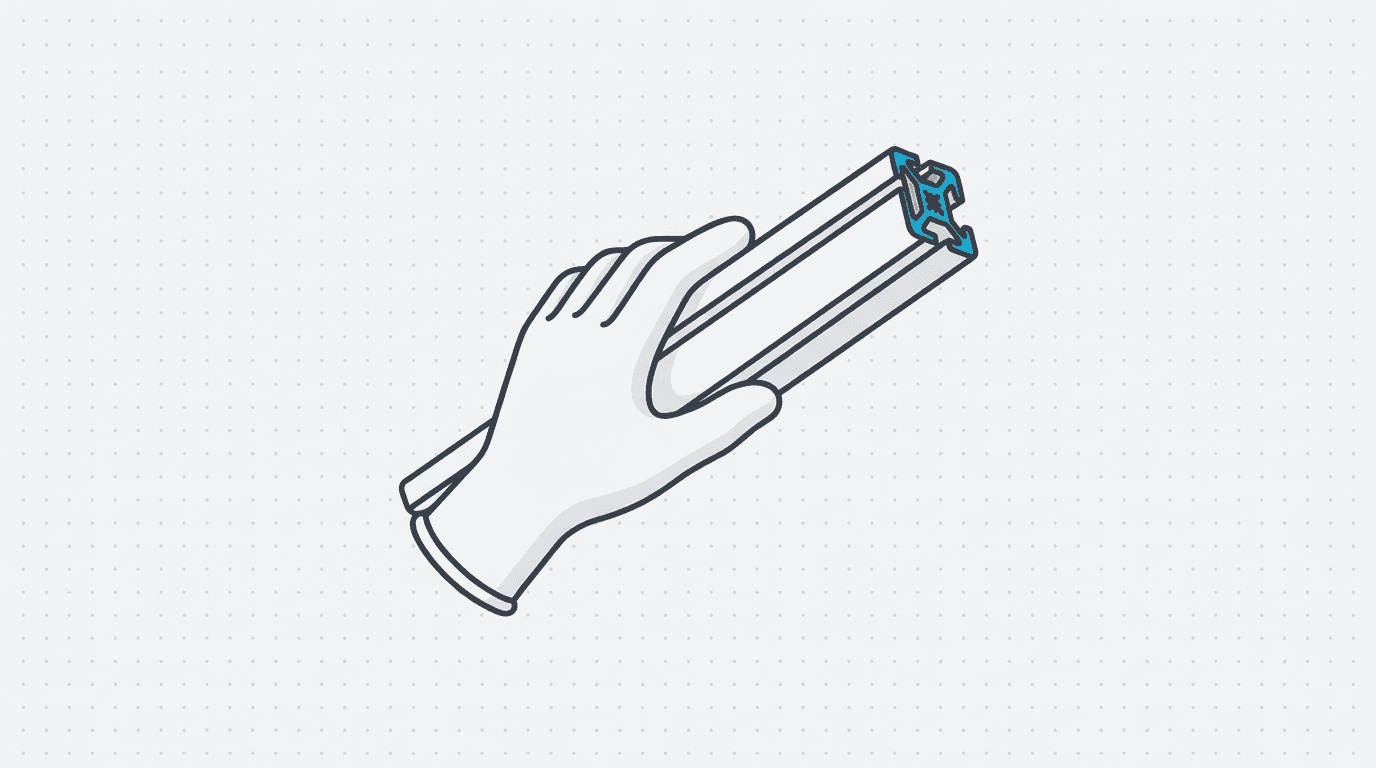
Aluminum extrusion sourcing is one of the more technical purchasing decisions you'll make as an importer. You're not just buying a commodity. You're paying for a specific alloy, a custom die shape, a finishing process, and freight from a factory that may be 7,000 miles away. Get any of those wrong and you're sitting on scrap metal or renegotiating tooling costs six weeks before your launch date.
The short version: Chinese suppliers are typically the lowest-cost option for standard extrusions, but U.S. AD/CVD duties on Chinese aluminum extrusions have been in place since 2011 and have reshaped where most buyers look. As a result, Vietnam, India, Mexico, and South Korea now handle significant volume that used to go to China. Your country choice affects not just price but lead time, duty exposure, and how much quality oversight you need.
This guide walks through how extrusion pricing is built up, which alloys and tempers matter for most applications, and how die costs work. It also covers what finishing options you actually have and how to think about tolerances and incoming inspection. Whether you're sourcing architectural framing, heat sinks, structural channels, or consumer product enclosures, the underlying framework is the same.
What Aluminum Extrusion Is, and Where It’s Used
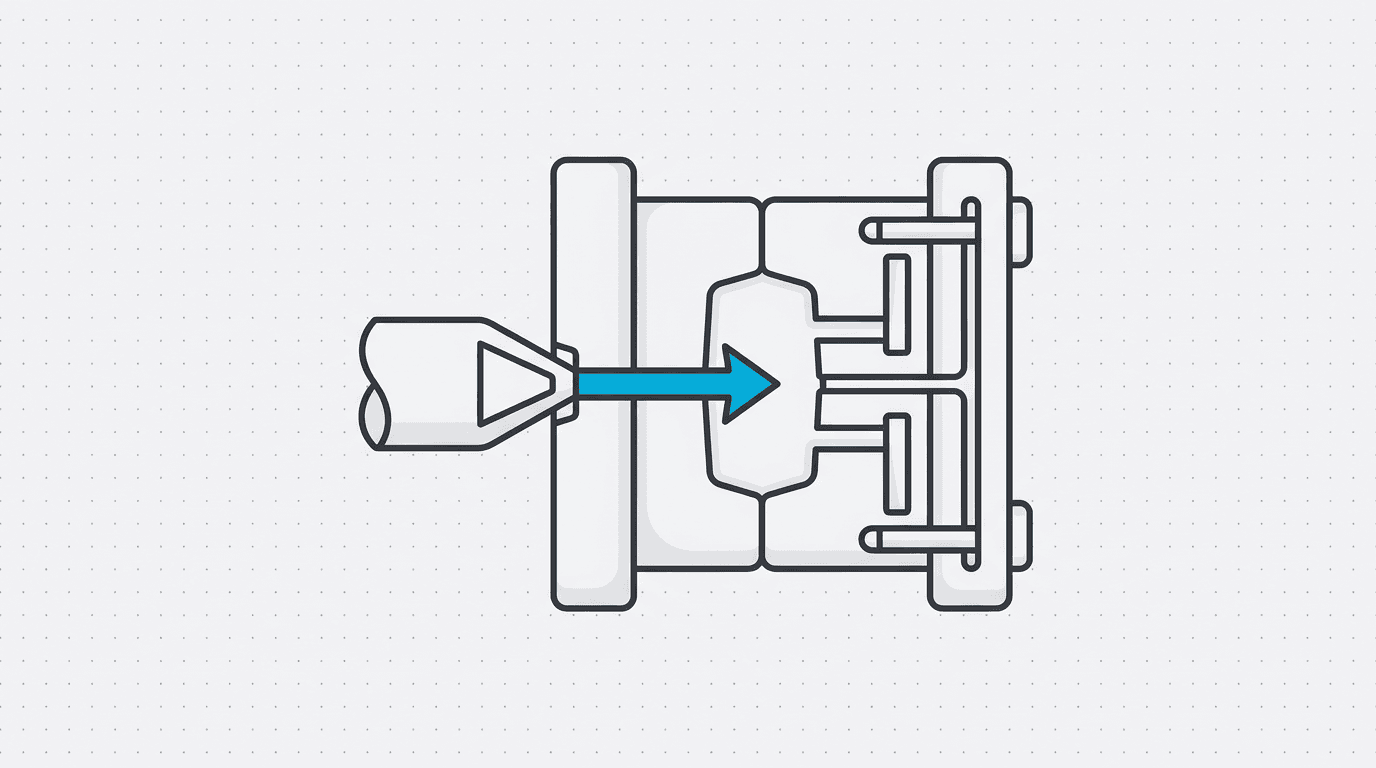
Extrusion is a forming process where a heated aluminum billet is pushed through a hardened steel die to produce a continuous cross-sectional profile. Think of it like a pasta extruder, the die shape determines what comes out. The result is then cut to length, heat-treated, and finished.
The process is well-suited to complex, consistent cross-sections that would be expensive to machine or fabricate from plate. Common applications include:
- Architectural and construction: window and door frames, curtain wall systems, solar panel mounting rails, LED light housings
- Industrial: conveyor framing (T-slot profiles), machine guards, structural channels and angles
- Electronics and thermal: heat sink profiles, enclosures, heatspreader fins
- Consumer products: bike frames, furniture legs, shelving systems, sporting goods
- Transportation: automotive trim, truck flooring, EV battery enclosures
If your design requires the same cross-section along the entire length and you need consistent mechanical properties, extrusion is almost always cheaper than machining from billet or welding from sheet. In fact, the break-even point versus CNC machining is typically somewhere around 50–200 units depending on complexity.
Common Alloys and Tempers
Most commercial extrusions use alloys from the 6000 series, specifically 6061 and 6063. They're both magnesium-silicon alloys, but they serve different purposes.
6063: The Architectural Workhorse
6063 has excellent extrudability, meaning it flows through complex die shapes cleanly and produces a smooth surface finish. It also takes anodizing beautifully. Tensile strength is moderate (about 27,000–35,000 psi in T5 temper). This is the default choice for window frames, door frames, solar rails, LED profiles, and anything where appearance matters more than strength.
6061: Structural Applications
6061 is much stronger (about 40,000–45,000 psi in T6 temper) but harder to extrude into thin, complex shapes. Die costs tend to be higher and surface finish is rougher than 6063. Use it when you need load-bearing capacity, structural brackets, machine components, aerospace-adjacent parts. T6 temper (solution heat-treated and artificially aged) is the standard for structural 6061.
Temper note: The temper suffix matters as much as the alloy. T5 (cooled from extrusion and artificially aged) is common for 6063. T6, however, requires a separate solution heat treatment step and costs more. Confirm the temper in your purchase order, some suppliers default to T4 or T5 when you specified T6.
How Extrusion Pricing Is Built Up
This is where most buyers get surprised. The price you pay per kilogram is not the aluminum price, it's a stack of four or five separate cost components. Understanding each one tells you where you have leverage and where you don't.
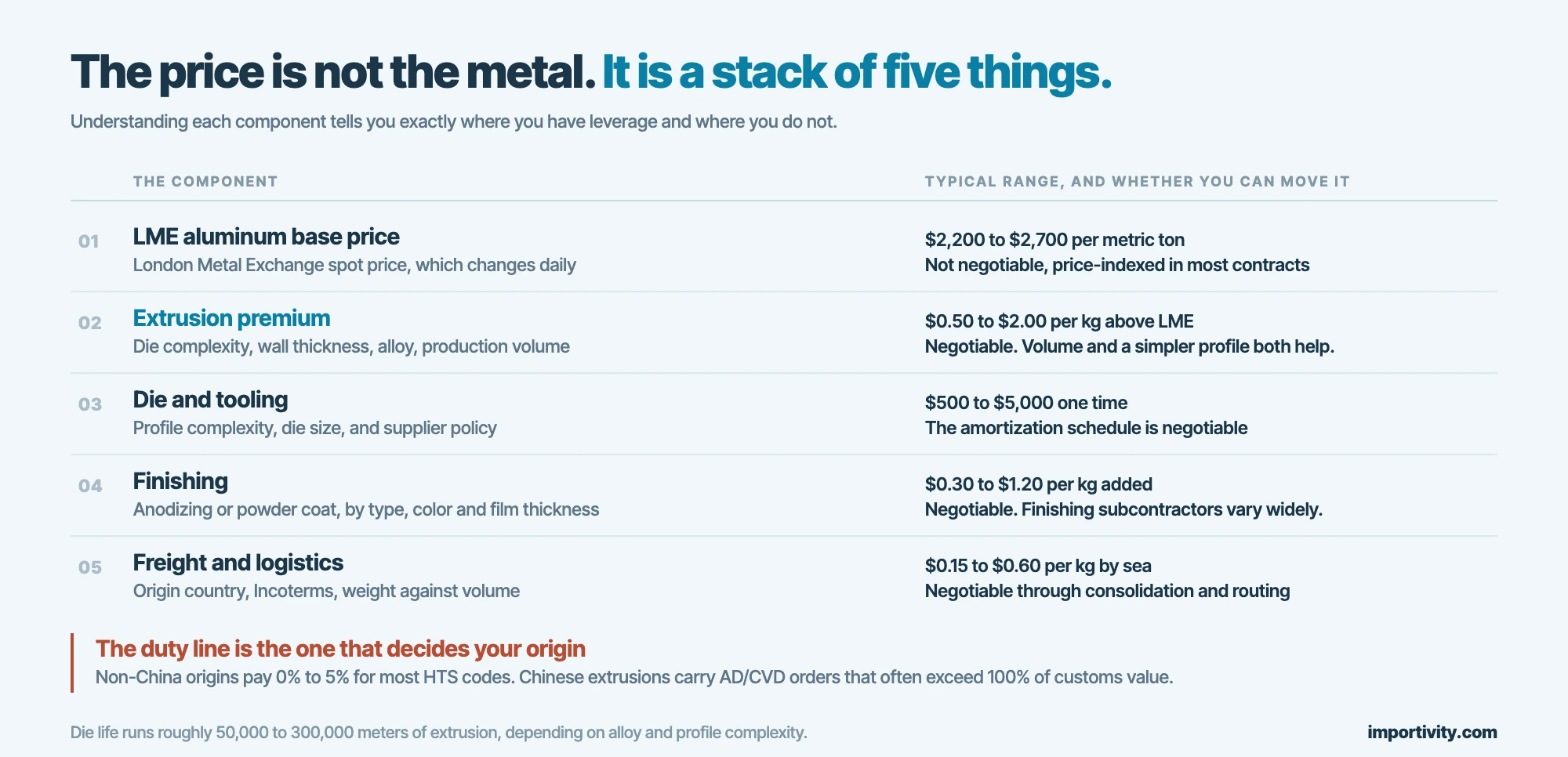
| Cost Component | What Drives It | Typical Range (USD) | Negotiable? |
|---|---|---|---|
| LME aluminum base price | London Metal Exchange spot price; changes daily | $2,200–$2,700/mt | No, price-indexed in most contracts |
| Extrusion / conversion premium | Die complexity, wall thickness, alloy, production volume | $0.50–$2.00/kg above LME | Yes, volume and profile simplicity help |
| Die / tooling cost (amortized) | Profile complexity, die size, supplier policy | $500–$5,000 one-time, often amortized | Partially, amortization schedule is negotiable |
| Finishing (anodizing, powder coat) | Surface treatment type, color, film thickness | $0.30–$1.20/kg added | Yes, finishing subcontractors vary widely |
| Freight and logistics | Origin country, Incoterms, weight vs. volume | $0.15–$0.60/kg (sea freight) | Yes, consolidation and routing matter |
| Import duties (non-China) | HTS code, country of origin | 0–5% for most origins | No, fixed by trade law |
| AD/CVD duties (China only) | Antidumping + countervailing duty orders | Often 50–200%+ of customs value | No |
A realistic landed cost from Vietnam or India for a standard 6063-T5 profile in mill finish, at moderate volume (5,000–10,000 kg), is roughly $2.80–$3.80/kg before freight. Add $0.30–$0.50/kg for anodizing and $0.20–$0.40/kg for sea freight to the U.S. West Coast. You're typically looking at $3.30–$4.70/kg landed for a basic architectural profile, much cheaper than domestic U.S. production but not as cheap as Chinese pricing before AD/CVD.
Die Costs and Tooling Amortization
Every custom profile requires a steel die. A simple, solid die (small profile, no hollow chambers) might cost $500–$1,200. A complex hollow die with multiple chambers, common for heat sinks, multi-void structural profiles, or thin-wall enclosures, can run $2,000–$5,000 or more. The die is yours; the supplier makes it and typically holds it at their factory.
Amortization structures
Most overseas suppliers offer two models:
- Full upfront payment: You pay the tooling cost before production begins. Per-unit cost is pure conversion and material. This is cleanest and cheapest if you're confident about volumes.
- Amortized into the unit price: The supplier recoups die cost across the first batch (say, 2,000 kg). Unit price is higher initially, then drops. This approach hides the real tooling cost and makes switching suppliers harder later, avoid it unless cash flow demands it.
Die life is typically 50,000–300,000 meters of extrusion depending on alloy and profile complexity. For most importers at 5,000–20,000 kg/year, one die will last the product's lifetime. Ask for the die to be stored at the factory, with a written agreement that lets you transfer it to another supplier if you move production.
Key point: If a supplier quotes "no tooling charge," the profile is either standard (no custom die needed) or the cost is buried in the unit price. Ask directly which applies.
MOQs: Why They Exist and How to Work With Them
Minimum order quantities for custom extrusions typically fall in the range of 500–2,000 kg per profile. The reason is straightforward: setting up and running a single die requires a minimum press run to be economical. Billet heating, die installation, the initial scrap length (the "butt end" discard), and post-extrusion processing all have fixed costs that don't scale down.
For standard catalog profiles (T-slot series, common angles, standard channels), MOQs drop considerably, some distributors in Vietnam and India will ship 200–300 kg. For custom hollow profiles or tight-tolerance parts, however, expect to hit 1,000 kg before suppliers will quote competitively.
If you're in prototype or early-stage and can't commit to 500 kg, your practical options are:
- Use a domestic U.S. extruder for development quantities (expensive per-unit, but fast and no duty complexity)
- Source a close-enough catalog profile from a stocking distributor and adjust your design
- Accept a higher per-unit price from an overseas supplier who will run a small batch, some will, at a steep premium
Finishing Options
Mill finish
Mill finish is the as-extruded surface with no additional treatment. It is appropriate for structural or industrial applications where appearance is secondary and it is also the lowest-cost option. Some oxidation and handling marks are normal, this is not a cosmetic finish.
Anodizing
Anodizing is an electrochemical process that thickens the natural oxide layer on the aluminum surface. Type II (conventional anodizing) produces a 0.4–0.7 mil film; Type III (hard anodizing) produces 1.0–2.0 mil and suits wear-resistant applications. Anodizing can be clear or dyed. Additionally, 6063 anodizes much better than 6061, if you need a sharp, consistent color, specify 6063. Anodize film thickness and class should be called out per MIL-A-8625 or equivalent.
Powder coating
Powder coating uses electrostatically applied dry powder, cured in an oven. It offers better color range and UV durability than anodizing for outdoor applications. It also adds 0.002–0.006 inches of thickness to all surfaces, relevant if your profile has tight fit-up tolerances. Specify the powder type (polyester, TGIC, fluoropolymer) for your application environment.
Chromate conversion (Alodine/Chem film)
Chromate conversion is a chemical treatment that improves corrosion resistance and paint adhesion without adding meaningful thickness. It is common in aerospace and electronics applications. Typically, this finish follows MIL-DTL-5541 Type I or Type II.
Tolerances, QC, and What to Inspect
Standard dimensional tolerances for aluminum extrusions follow the Aluminum Association's publication AA-TF-100 (or equivalent ISO 22966). A few things commonly trip up first-time importers:
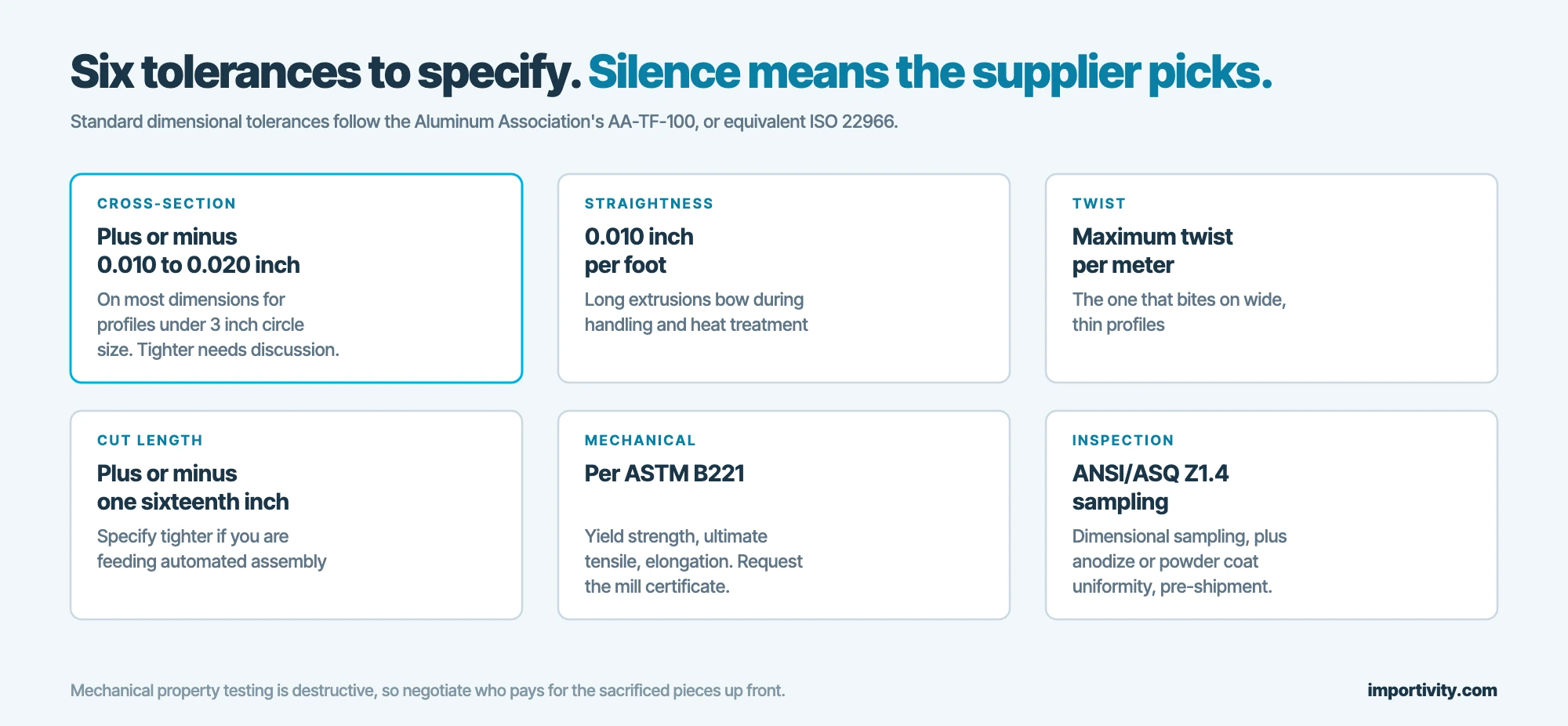
- Cross-section tolerances: Typically ±0.010 to ±0.020 inch on most dimensions for profiles under 3 inches circle size. Tighter tolerances require discussion with the supplier and may cost more.
- Straightness: Standard is 0.010 inch per foot (or 0.8 mm/m). Long extrusions can bow during handling and heat treatment, specify straightness tolerance explicitly if assembly fit matters.
- Twist: For wide, thin profiles, twist can be an issue. Specify maximum twist per meter.
- Cut length: Typically ±1/16 inch on cut-to-length pieces. If you're doing automated assembly, specify tighter.
- Mechanical properties: Specify yield strength, ultimate tensile strength, and elongation per the applicable ASTM standard (B221 for extrusions). Request mill certs with each shipment.
Pre-shipment inspection priorities
For quality control inspection, focus pre-shipment on dimensional sampling per ANSI/ASQ Z1.4, visual inspection of anodize or powder coat uniformity, and hardness testing if temper is critical (Rockwell or Brinell). Mechanical property testing requires destructive sampling, negotiate this into your initial tooling check, not every shipment.
Working with established aluminum extrusion manufacturers who have ISO 9001 certification and in-house testing equipment reduces the inspection burden considerably. Suppliers without their own lab will, however, be slower to catch and document non-conformances.
Antidumping Duties on Chinese Extrusions, and How They Shape Your Sourcing Decision
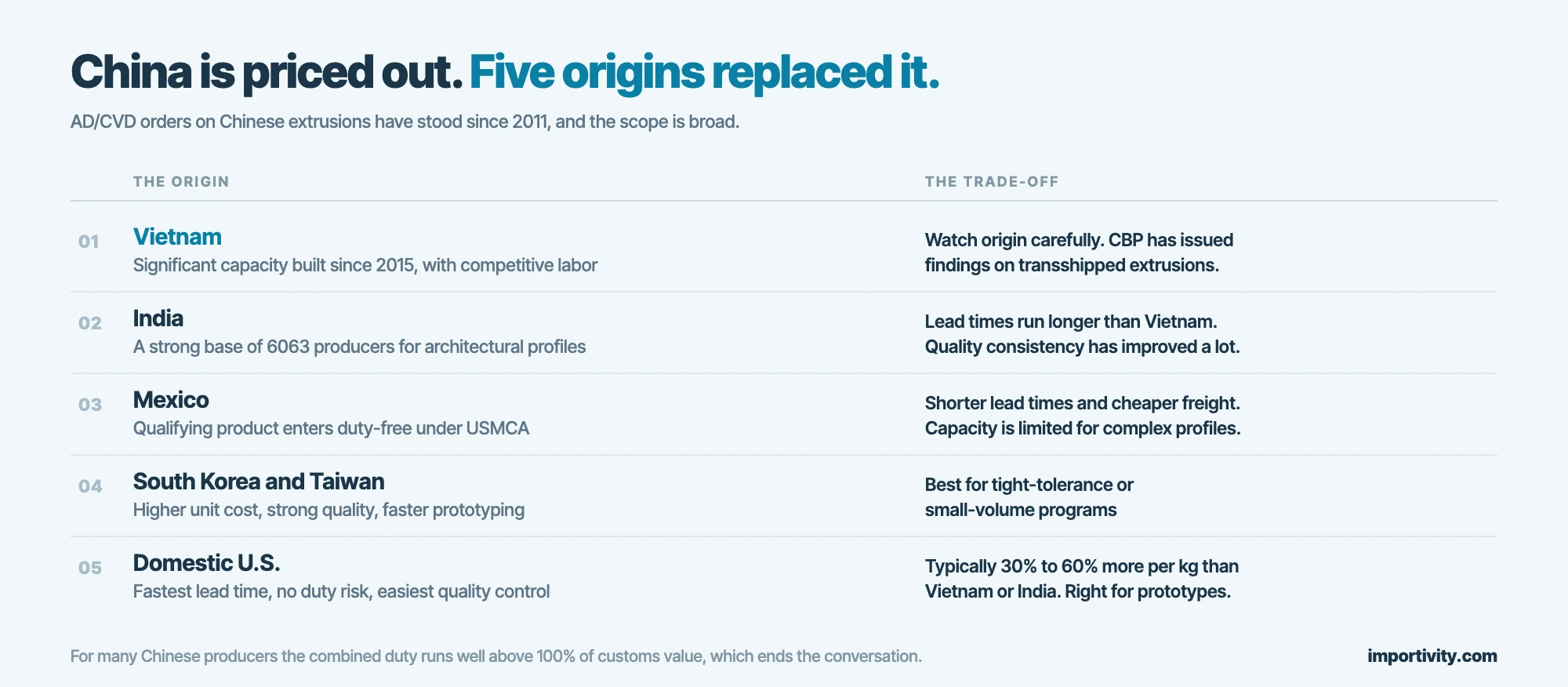
This is the single most important trade policy factor for aluminum extrusion sourcing. The U.S. International Trade Commission (ITC) has maintained AD/CVD orders on aluminum extrusions from China since 2011 (Case A-570-967 / C-570-968). For many Chinese producers, the combined duty rate runs well above 100% of the customs value, effectively making Chinese extrusions uncompetitive for the U.S. market at most volumes.
The scope of the order is broad and covers most custom aluminum extrusions regardless of shape, alloy, or finish. There are exclusions (certain finished goods where extrusion is incidental to the product), but navigating scope rulings is costly and slow. Don't plan your sourcing strategy around a scope exclusion unless you have a customs attorney's written opinion in hand.
Where buyers actually source now
- Vietnam: Significant extrusion capacity has built up since 2015. Labor costs are competitive. Watch for origin check needs, CBP has issued findings of circumvention for Vietnamese operations that were transshipping Chinese-origin product.
- India: Strong base of 6063 producers for architectural profiles. Lead times can be longer than Vietnam. Quality consistency has improved a lot in the past five years.
- Mexico: Under USMCA, qualifying product enters duty-free. Lead times are shorter and freight is cheaper. Capacity is more limited for complex custom profiles.
- South Korea and Taiwan: Higher unit costs, but strong quality and faster prototyping. Better for tight-tolerance or small-volume programs.
- Domestic U.S.: Fastest lead time, no duty risk, easiest QC. Typically 30–60% more expensive per kilogram than Vietnam/India. The right choice for prototypes, regulated applications, or products where supply chain risk outweighs cost.
For most metals sourcing programs that previously relied on China, Vietnam or India is the practical replacement. These options offer lower cost than domestic, manageable lead times at 8–14 weeks, and no AD/CVD exposure when you source from legitimate local producers. Verify the supplier's country of origin records before placing your first order.
If you're moving production from China to another country, run a background check on any supplier with prior Chinese supply chain ties. Request records on their billet sourcing as well. CBP's Anti-Circumvention enforcement has been active, and a single seizure notice can strand a full container for months.
For a worked example running from a drawing to a first article, see our 420seven prototyping case study, and Source With Jordan for the sourcing behind it.
Frequently Asked Questions
How long does tooling take before I can get first samples?
Die fabrication typically takes 3–6 weeks from approved drawings. Add 1–2 weeks for initial sample extrusion, measurement, and shipping samples to you. Budget 6–10 weeks from final drawing approval to having first-article samples in hand. If your profile has tight tolerances or complex geometry, a second die iteration is not unusual, budget 4 additional weeks and 50–75% of the original die cost for a die correction.
What drawings or specifications does a supplier need to quote?
At minimum: a dimensioned cross-section drawing (2D DXF or PDF) with all critical dimensions toleranced, alloy and temper spec, cut length and tolerance, finish spec (mill, anodize type, powder coat color/type), and any mechanical property needs. If you have a 3D model, include it, but the 2D cross-section with callouts is what the die maker actually works from. Ambiguous drawings lead to assumptions; assumptions lead to wrong parts.
Can I get a price without committing to a die?
Yes. Request a budgetary quote based on your drawing, most suppliers will provide an estimated unit price, die cost, and MOQ without any commitment. This is a normal part of the process. Once you accept a formal quotation and pay the tooling deposit, you're committed to that profile at that factory. Don't pay a tooling deposit until you've confirmed the supplier can hit your dimensional and mechanical requirements.
What's the risk of sourcing from Vietnam given circumvention concerns?
The risk is real but manageable with the right supplier. Ask for records on their domestic billet sourcing (Vietnamese or other non-Chinese origin), their extrusion press ownership and capacity, and their history of CBP audits. Legitimate Vietnamese producers have this paperwork. If a supplier is vague about where their billet comes from or pushes back on origin records requests, that's a red flag. A customs attorney can also perform an origin analysis on the supply chain before you commit to large volumes.
When does it NOT make sense to source extrusions overseas?
Several scenarios favor domestic or near-shore sourcing: you need quantities under 500 kg and can't afford minimum charges; your lead time need is under 6 weeks; you're in a regulated industry (aerospace, medical, defense) where supply chain paperwork makes overseas sourcing cumbersome; your design is still changing and you expect multiple die corrections; or the extrusion is a minor component in a larger product where the duty and logistics overhead isn't worth the per-unit savings. None of these are permanent, many brands develop the product domestically and shift to overseas production once the design is locked.
About the author
Jordan Lewis
Chief Operating Officer, Importivity
Runs Importivity's sourcing operations across China, Vietnam, Mexico and India, from supplier negotiation through landed delivery.
Press and media inquiries: press@importivity.com