How Ocean Freight Spikes Change Sourcing Costs and Supplier Decisions
In late July 2026, a USDA report put a hard number on a problem every importer feels but few quantify: ocean freight is eating margin. Ocean freight costs for moving U.S. grain to Japan surged during the second quarter, with Gulf rates averaging $69.27 per metric ton, equal to 149 percent of last year. Grain is not what most brands ship, but the mechanics are identical. When the vessel market tightens, the cost of moving anything across an ocean climbs, and it climbs unevenly by route.
The container side tells the same story. Container freight rates hit a 22-month high in July 2026, with the Drewry World Container Index reaching USD 4,639 per FEU, the highest point since September 2024, mainly due to increasing charges on Asia-Europe lanes. On the transpacific, the pressure is worse: stronger demand pushed rates from the Far East to the U.S. West Coast up 7% in a single late-June week and 91% higher than a year earlier. If you import from Asia, that surcharge is already in your next quote.
This guide explains how ocean freight actually flows through your sourcing decisions, from the unit price a factory quotes to the Incoterm you sign to the timing of your purchase order. The news is the hook. The durable point is this: freight is a variable input you can manage, and the importers who treat it like one protect their margins while everyone else absorbs the hit. If you want the full cost picture, start with our guide to how to calculate landed cost.
Why Ocean Freight Is a Sourcing Decision, Not Just a Shipping Line Item
Most brands file freight under logistics and forget about it until the invoice lands. That is a mistake. Ocean freight is one of the largest and most volatile inputs in your landed cost, and it interacts directly with which supplier you choose, which country you source from, and when you place your order.
The 2026 market makes the point. The global shipping market is experiencing significant volatility, with businesses shipping from China facing higher transportation costs, limited container availability, longer transit times, and unpredictable surcharges across major trade lanes. None of that is a factory's fault, but all of it changes whether a given factory is the right choice for your program this quarter.
The reason freight belongs in sourcing decisions is leverage. Once you sign a DDP contract or commit to a single origin, you have baked a freight assumption into your unit economics for the life of that agreement. Model it wrong and you carry the error on every carton.
The value-density rule that decides how much you should care
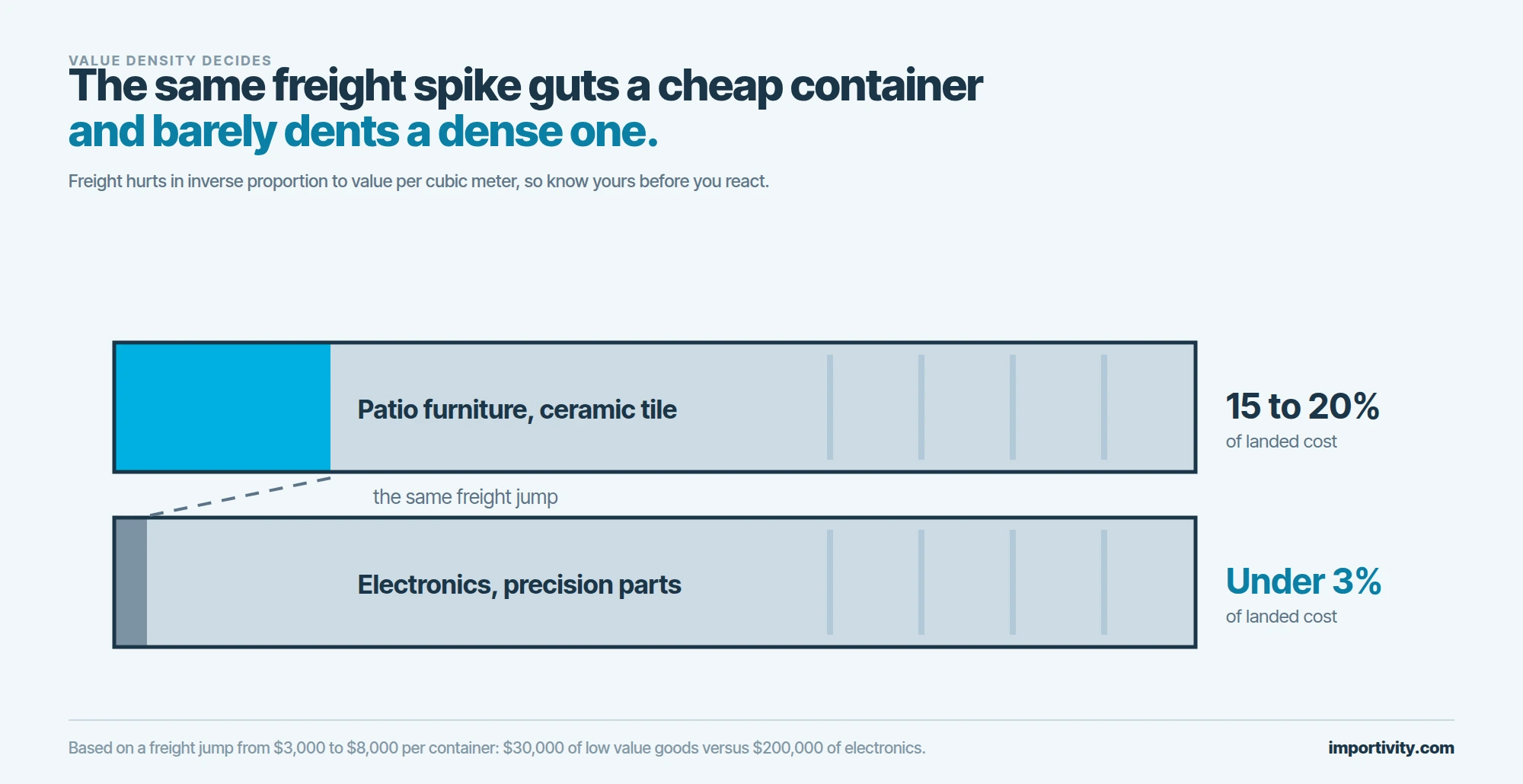
Freight hurts in inverse proportion to how much your product is worth per cubic meter. A container of patio furniture or ceramic tile is nearly all volume and little value, so a freight spike can swing landed cost 15 to 20 percent. A container of sourced electronics or precision components is high value per cube, so the same spike barely moves the needle. Know your value density before you panic or overreact.
How a Rate Spike Flows Through Your Supplier Quote
The first place freight volatility shows up is the quote, and it shows up differently depending on your Incoterm. Understanding that path is the difference between negotiating from data and negotiating from a feeling.
Under an ex-works or FOB arrangement, the factory price stays roughly stable and the freight moves separately on your forwarder's invoice, where you can see every base rate and surcharge. Under CIF or DDP, the supplier folds their freight assumption plus a risk markup into your unit price, and you lose visibility. During a spike, that markup balloons, because the supplier is protecting themselves against a rate they cannot predict.
The surcharges that appear when the market tightens
A quoted ocean rate is rarely the whole cost. When lanes tighten, carriers layer on charges that can rival the base rate:
- Peak Season Surcharge (PSS) — applied during high-demand windows, often July through October for holiday inventory.
- Bunker Adjustment Factor (BAF) — a fuel pass-through that climbs with oil prices; bunker fuel prices remained sharply above winter levels through mid-2026.
- General Rate Increase (GRI) — carrier-announced hikes that can add over $1,000 per container with little notice.
- Congestion and detour surcharges — tied to port backups or rerouting around chokepoints.
When you see a quote jump, ask your forwarder to break out base rate versus surcharges. Surcharges are temporary and negotiable; a rising base rate signals a structural shift you need to plan around.
Freight, Lead Times and the Reroute Problem
Ocean freight does not just change cost. It changes time, and time changes everything downstream, from cash flow to your selling window. The two move together during a disruption.
The 2026 driver is routing. Voyages around the Cape of Good Hope can extend transit times by one to two weeks on impacted services and consume an estimated 2.5 million TEU of capacity. That capacity absorption is why rates stay elevated even when the physical fleet is growing. Longer routes mean fewer effective sailings, which means less space, which means higher prices and later arrivals at the same time.
The outlook for the back half of 2026 is not comforting. The USDA report warns that the shipping industry could face challenges in the second half of 2026 that may elevate ocean freight rates, including longer voyage distances, weather disruptions, and pressure on major chokepoints. If you are planning Q4 arrivals, build the reroute risk into your timeline now.
What a two-week transit change does to your program
Add two weeks of transit and you have added two weeks of inventory-in-transit cash, pushed your reorder trigger earlier, and narrowed the buffer before a stockout. For seasonal goods this is existential. If your business depends on seasonal inventory, waiting for freight prices to decline can create another risk: missing your selling window. The freight bill is visible; the lost sale is not, and it is usually bigger.
How Incoterms Decide Who Eats the Volatility
Incoterms are the contract language that assigns freight cost and risk between you and your supplier. In a stable market the choice is a preference. In a volatile market it decides who absorbs the spike.
The practical hierarchy for controlling freight exposure is straightforward. FOB gives you the most control: the supplier delivers to the origin port and you own the ocean leg, so you book through your own forwarder and see real rates. DDP hands the whole chain to the supplier, which is convenient but opaque, and during a spike you pay their worst-case assumption plus margin. CIF sits in between and still hides the freight math inside their price.
| Incoterm | Who books ocean freight | Rate visibility | Best when |
|---|---|---|---|
| EXW / FOB | You (via your forwarder) | Full — you see base rate and every surcharge | Freight is volatile; you want control and negotiating leverage |
| CIF / CFR | Supplier | Low — freight is baked into unit price | Small volume; you lack a forwarder relationship |
| DDP | Supplier (door to door) | None — one all-in number with a risk markup | Stable market; you want zero logistics involvement |
The rule during a spike: do not lock into a long DDP or CIF contract. You are handing the supplier a blank check on the fastest-moving cost in your model. Shift to FOB, control the freight leg yourself, and revisit the Incoterm when the market calms. Our full breakdown is in Incoterms 2020 explained.
When to Renegotiate, Reroute, Shift Ports or Rebalance Suppliers
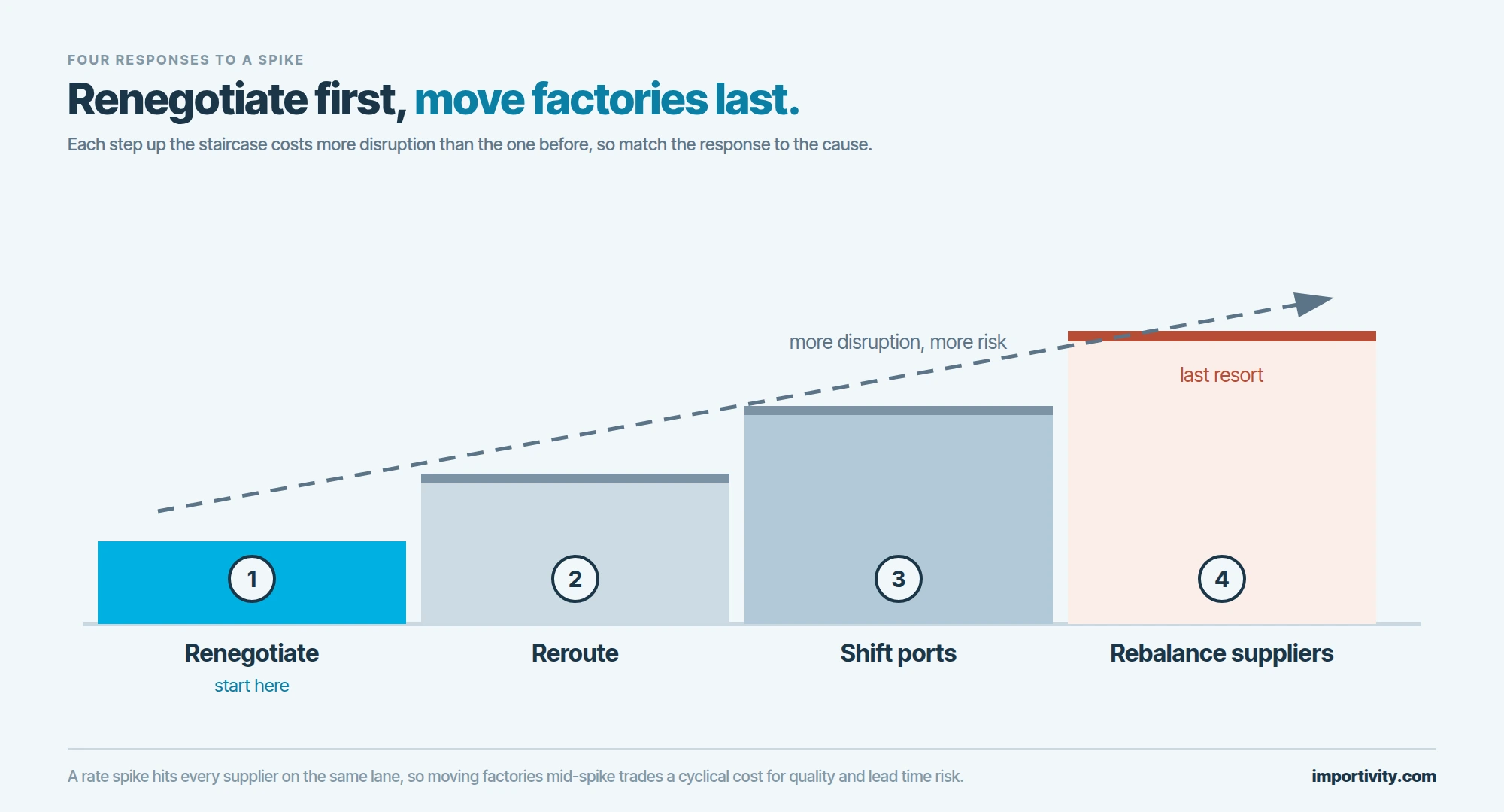
A freight spike triggers four possible responses, in rough order of how drastic they are. Match the response to the cause, and never jump to the most drastic first.
1. Renegotiate — the first and cheapest move
Before anything else, work the contract you have. Ask your forwarder for a fixed contract rate instead of riding the spot market. Unlike the pandemic years when spot rates changed daily, 2026 contract rates hold steady, and shippers with steady volume can lock in good terms. Consolidate orders to fill containers, since a well-loaded box lowers cost per unit. Push suppliers on FOB terms so you own the freight leg.
2. Reroute — same origin, different path
If your lane is hit by a specific chokepoint, ask whether an alternative routing avoids it. For Asia-Europe cargo especially, confirm whether the routing is via Suez, Cape of Good Hope, or another adjusted service. A reroute changes transit time and cost without touching your supplier relationship, which makes it low-risk.
3. Shift ports — same country, different gateway
Rates diverge sharply by port pair. In the grain data, Pacific Northwest rates averaged $36.25 per metric ton while the Gulf-to-Japan spread widened to $33.02, equal to 171 percent of last year, increasing the advantage for western ports. The lesson for container importers is identical: if your East Coast lane is congested and expensive, a West Coast entry plus inland transport may pencil out better. Compare total landed cost, not the ocean rate alone.
4. Rebalance supplier geography — the last resort
Only when a lane shows a durable structural disadvantage should you move production. If the transpacific is permanently disadvantaged relative to a nearshore option, that is a real signal. This is where nearshoring to Mexico or evaluating Vietnam, China and Mexico earns its place. But moving factories mid-spike trades a known, cyclical cost problem for unknown quality and lead-time risk. Do it deliberately, with a factory audit and a pre-production sample run, not in a panic.
Timing Your Purchase Order Around the Freight Cycle
The most common freight mistake is waiting for rates to fall. It usually costs more than acting. Peak-season rates tend to keep rising before they soften, and the money you save on freight by waiting is often dwarfed by the cost of arriving late.
The 2026 market rewards early booking. As of July 2026, shipping costs increased compared with June as the market entered early peak season, with demand rising as Amazon sellers, retailers, distributors, and brand owners began shipping inventory for Black Friday, Cyber Monday, and the year-end holiday season. Space tightens before rates peak, so the importer who books in June for a Q4 arrival wins twice, on rate and on availability.
Frontloading is also being driven by trade policy, not just freight. Some importers are moving shipments earlier than planned ahead of possible tariff increases later this year. When freight and tariff risk both point toward acting early, the case for waiting evaporates. Pair your freight timing with a view on duties using our guide to how tariffs impact product cost.
The air-freight hedge
During severe ocean spikes, the price gap to air narrows enough that a split shipment makes sense: core inventory by sea, urgent or high-margin units by air. We walk through the tradeoff in sea vs air freight. The decision hinges on value density and how firm your deadline is.
Building Freight Volatility Into Your Sourcing Model
The durable takeaway is process, not prediction. You cannot forecast the next chokepoint or fuel spike, but you can build a sourcing model that absorbs shocks instead of breaking under them.
Treat freight as a scenario, not a single number. When you calculate landed cost, model a base, an elevated, and a spike freight rate, and check that your margin survives all three. If a program only works at the lowest freight rate, it is not a program, it is a bet on calm seas.
- Quote and buy on FOB so you control the ocean leg and see real rates.
- Lock contract rates with your forwarder for steady-volume SKUs.
- Model landed cost at three freight scenarios and stress-test margin.
- Track your key lanes weekly; a rising base rate is a planning signal, not noise.
- Keep a qualified backup supplier in a second geography, vetted before you need it.
- Book peak-season space early rather than betting on a spot-rate decline.
If you want a partner to run this analysis and manage the freight leg alongside your suppliers, that is what factory-to-door logistics management is for. The goal is simple: make freight a managed input, not a quarterly surprise.
If you would rather somebody held these decisions open on every shipment instead of after a problem, that is the work we publish at Source With Jordan.
Frequently Asked Questions
How much can ocean freight change my landed cost?
It depends on value density. On a $30,000 container of low-value goods, a jump from $3,000 to $8,000 in freight can add roughly 15 to 20 percent to landed cost. On a $200,000 container of electronics, the same jump adds under 3 percent. Always model freight as a line item in landed cost, not a rounding error.
Should I switch suppliers when freight rates spike?
Rarely as a first move. A rate spike is usually cyclical and hits every supplier on the same lane, so switching factories mid-spike trades a known cost problem for unknown quality and lead-time risk. Rebalance supplier geography only when a lane shows a durable structural disadvantage, such as a reroute that permanently adds two weeks of transit.
What Incoterm protects me best when freight is volatile?
FOB gives you the most control because you or your forwarder book and pay ocean freight directly and see every surcharge. Avoid locking into long DDP or CIF quotes during a spike, since the supplier bakes their freight assumption plus a markup into your unit price and you lose visibility into what you are actually paying to ship.
Is it cheaper to wait for freight rates to drop before ordering?
Usually no. Waiting risks missing your selling window, and peak-season rates often keep climbing before they soften. If you have a firm delivery deadline, the cost of a stockout almost always exceeds the freight premium. Book space early and lock a contract rate rather than betting on a spot-market decline.
When does air freight make sense during an ocean spike?
When the ocean-to-air price gap narrows and your product is high-value or time-critical. During severe spikes, air can cost only three to five times ocean instead of the usual ten, which makes it viable for launches, replenishment gaps, or high-margin SKUs. Split shipments, moving core inventory by sea and urgent units by air, are often the smartest hedge.
About the author
Jordan Lewis
Chief Operating Officer, Importivity
Runs Importivity's sourcing operations across China, Vietnam, Mexico and India, from supplier negotiation through landed delivery.
Press and media inquiries: press@importivity.com