What a Customs Bond Is, What It Costs and How Much Bond You Need
A customs bond is a financial guarantee, filed with U.S. Customs and Border Protection on CBP Form 301, that the duties, taxes, fees and any penalties on your imports will be paid even if you do not pay them. A licensed surety company issues it, you pay the surety an annual premium, and CBP is the party the promise runs to. You need one for every formal entry, which in practice means any commercial shipment worth more than $2,500 and any shipment of any value that another agency regulates or that carries quota or antidumping duties. Most importers buy a continuous bond, sized at 10 percent of a year's duties, taxes and fees with a $50,000 floor, and pay roughly $400 to $700 a year for that minimum bond.
This guide is for US importers who have been told they need a bond and want to know what they are buying, how big it has to be, and why so many bonds went insufficient in 2025 and 2026. It covers the three parties, when CBP requires a bond, single transaction versus continuous, the sizing formula with a worked example, the cost, and what happens when CBP claims. If you are still deciding who will file your entries, start with what a customs broker does and costs, because the broker is usually the one who arranges the bond.
What a customs bond is and who is on it
A bond is a three-party contract. You are the principal. The surety, an insurance company approved by the Treasury to write federal bonds, is the guarantor. CBP is the obligee, the party the guarantee protects. If you fail to pay what an entry owes, or fail to do something CBP can demand under the entry, such as redelivering goods that were released and later refused, the surety pays CBP up to the limit of liability. That limit is the number people mean when they say "a $50,000 bond."
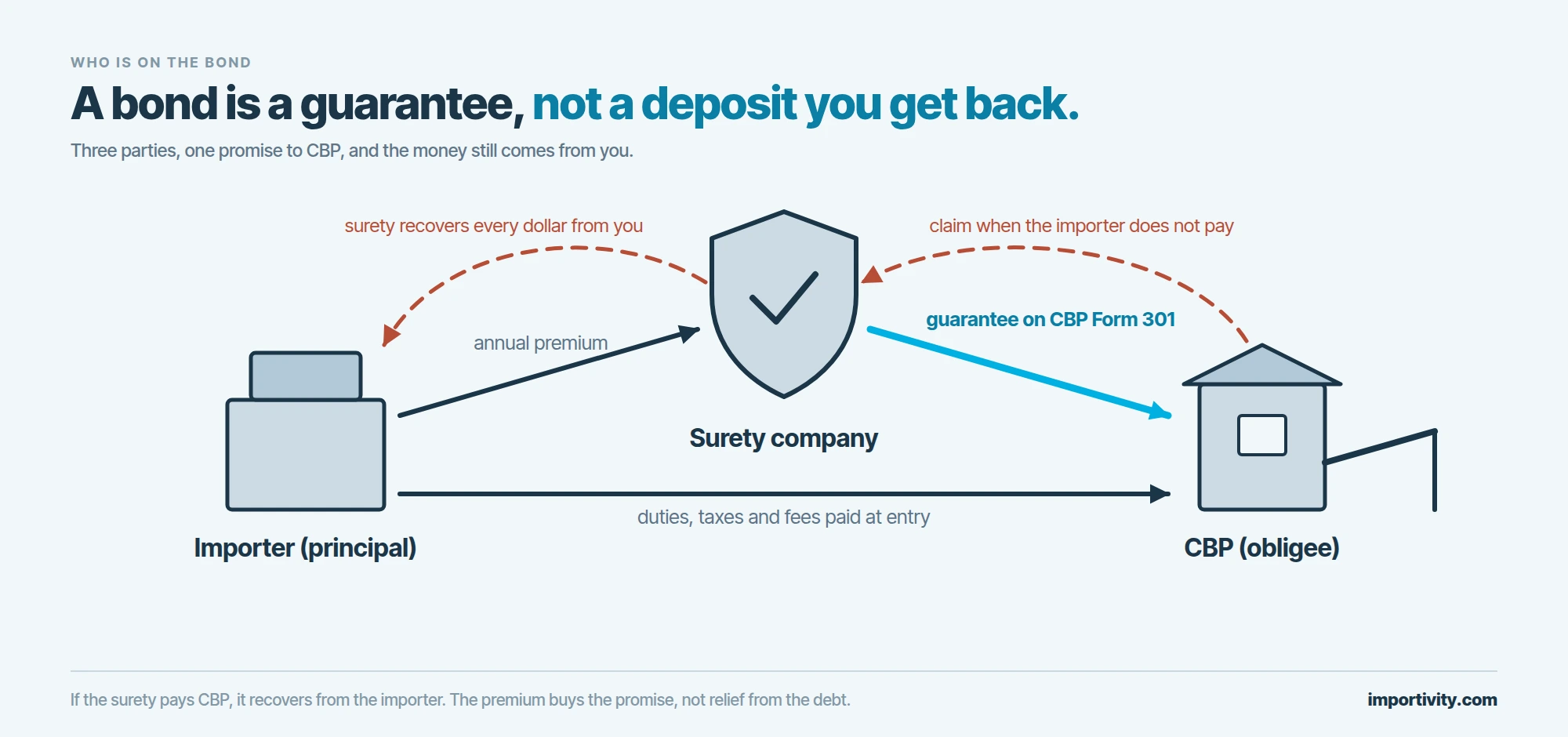
Two things catch first-time importers out. The premium is not a deposit: you pay a few hundred dollars a year for the promise, you never get it back, and the bond amount is never money you hand over. And the bond does not relieve you of the debt. If CBP collects from the surety, the surety collects from you under the indemnity agreement you signed.
The bond covers ordinary duties and fees, the Section 232 and Section 301 layers, antidumping deposits, liquidated damages for a missed Importer Security Filing, and penalties for failing to redeliver rejected goods.
When CBP requires a bond
The trigger is the entry type, not the size of your company. Any formal consumption entry needs a bond, and a shipment becomes a formal entry once its value passes the $2,500 informal entry limit. Below that, an unregulated shipment clears informally without one, which is why a sample order arrives without anyone mentioning bonds and the first production order does not.
- Regulated goods at any value. Anything needing FDA, EPA, FCC or another partner agency review needs a bond even under $2,500, because the bond secures CBP's right to demand redelivery if the agency refuses the goods.
- Quota, antidumping and countervailing goods. Always bonded, and often bonded higher, because the final antidumping duty can be set years after release.
- The Importer Security Filing. The ISF must be secured by a bond before the vessel loads. A continuous bond covers it; without one you buy a single ISF bond, typically $10,000, on top of the entry bond. Our guide to ISF 10+2 filing requirements covers the deadline and the $5,000 liquidated damages the bond answers for.
- Bonded operations and temporary imports. Warehouse and foreign trade zone operators carry their own bond types with a $50,000 minimum, and a temporary importation under bond is generally secured at double the duty.
If you are the importer of record, the bond is in your name. A foreign seller shipping delivered duty paid either holds a bond as a non-resident importer or hires an importer of record service whose bond covers the entry. Somebody's bond is behind every formal entry that clears.
Single transaction bond vs continuous bond
A single transaction bond, also called a single entry bond, covers one entry. A continuous bond covers every entry you file for a year, renews automatically, and covers the ISF as well. A single transaction bond is priced on the shipment's value, so it is cheap for a $4,000 order and expensive for a $150,000 one, and sureties commonly stop writing them after about five a year. Anyone who ships more than a few times a year, or ships anything high value, comes out ahead on a continuous bond within the first quarter.
| Option | How it is sized and priced | When it fits, and who carries the liability |
|---|---|---|
| Single transaction bond | At least entered value plus all duties, taxes and fees; premium roughly 0.4 to 0.5 percent of that figure with a minimum charge per entry | One or two low-value entries a year; you remain liable and pay again on every shipment |
| Single transaction bond on regulated or quota goods | Three times the entered value for FDA, EPA, FCC, TSCA, marketing-order, alcohol and quota merchandise; AD/CVD entries at value times the duty rate | Rare one-off regulated shipments; sureties often decline or demand collateral at these sizes |
| Continuous bond | 10 percent of 12 months of duties, taxes and fees, $50,000 floor, $10,000 steps to $100,000 then $100,000 steps; $400 to $700 a year at the floor | Anyone filing more than a handful of entries or any ISF; you are the principal and it covers every port |
| ISF-only bond | A single bond, typically $10,000, covering one security filing | A one-off ocean shipment with no continuous bond in place; the entry still needs its own bond |
| An importer of record service's bond | Priced into the service fee; sized on the service's own 12-month duty total | Foreign sellers and one-time buyers; the service is the principal and liable, and it charges for that risk |
How much bond you need and what it costs
For a continuous importer bond, CBP takes 10 percent of the total duties, taxes and fees over a 12-month period, either what you paid in the previous 12 months or what you estimate for the next 12 if you are new, and sets the limit in $10,000 steps up to $100,000 and $100,000 steps above that. It never goes below $50,000. You need more than $500,000 a year in duties, taxes and fees before 10 percent of it clears the $50,000 floor. The worked example below shows the same $2,000,000 of annual purchases at three effective duty rates, and the bond each one forces.
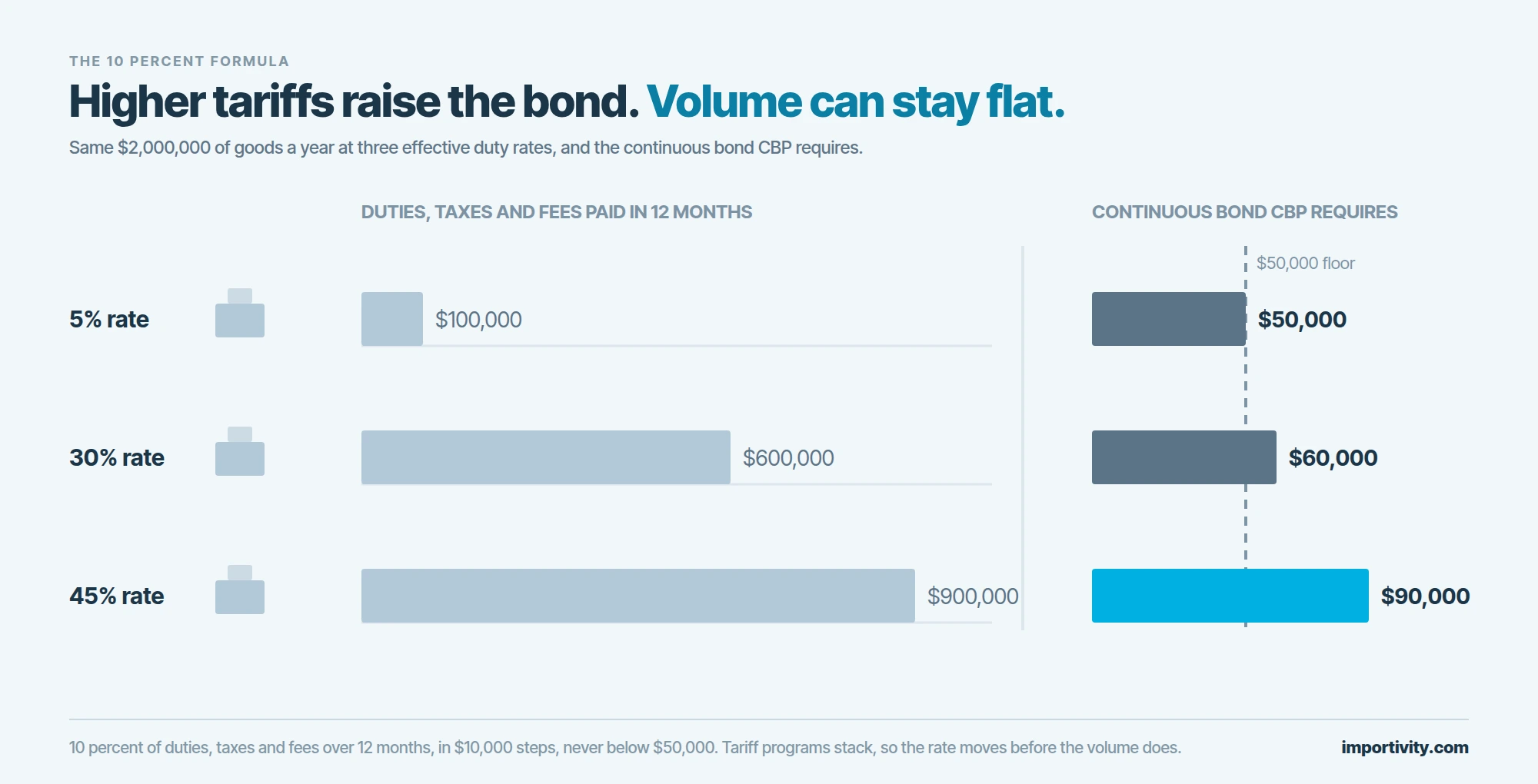
At a 5 percent effective rate the importer pays $100,000 in duties, taxes and fees, 10 percent is $10,000, and the bond sits at the $50,000 floor. At 30 percent, roughly what a Section 301 list product from China carried before anything else was added, duties reach $600,000 and the bond steps to $60,000. At 45 percent, duties reach $900,000 and the bond is $90,000. The goods, the supplier and the volume never changed. Only the rate did. Our explainer on Section 232 tariffs walks through how those layers stack on the base rate.
The cost side is simpler. The $50,000 minimum continuous bond usually runs $400 to $700 a year, and a clean import history with no antidumping exposure lands at the low end. Larger bonds cost more in dollars but less per thousand of coverage. Continuous bonds up to about $200,000 are generally written without financial statements; above that, expect a request for audited financials and, if they do not support the limit, an irrevocable letter of credit for up to the full bond amount. A single transaction bond is priced on the shipment, roughly 0.4 to 0.5 percent of value plus duties with a minimum charge.
Why bonds went insufficient in 2025 and 2026
CBP reviews every active continuous bond against the formula on a rolling basis, and when the duties, taxes and fees paid over the trailing 12 months exceed what the bond supports, it issues a bond insufficiency notice. You get 30 days to put a larger bond in place, and the surety terminates the old one on 15 days notice. Notices have quadrupled since 2017, and about half of the bonds flagged are under $100,000. Nothing about those importers' businesses grew. Their duty rates did.
The sequence repeats, so it is worth understanding. Section 301 duties on Chinese goods already sat on the base rate. Section 232 duties on steel, aluminum, copper and their derivatives were raised and widened through 2025. The tariffs imposed under the International Emergency Economic Powers Act stacked on top of both until the Supreme Court struck them down on February 20, 2026, and CBP began refunding them in phases. A bond set in early 2025 on a trailing year of low duties was undersized by summer, and a bond set in early 2026 still carries the IEEPA duties paid before the ruling inside its lookback until those months roll off. Section 232 and 301 remain in force.
Three habits keep you ahead of the notice. Size the bond on the next 12 months, not the last 12, including every tariff program you can see coming. Over-cover by a step: a $60,000 bond instead of a $50,000 one costs a little more and buys headroom, whereas a lapse stops your freight at the port. And avoid carrying two bonds at once, because stacking a second bond over an overflow is expensive and often triggers a collateral request. If you are reworking where you buy from to bring the rate down, the options in our tariff mitigation strategies resource shrink the bond requirement as a side effect, because the bond follows the duty.
Antidumping and countervailing exposure deserves its own line. Sureties treat AD/CVD entries as their largest source of losses, because the final duty is set in a review that can come years after entry and applies retroactively. Disclose AD/CVD goods on the application; start importing them later and the surety will ask for financials, may demand collateral, and may terminate the bond. CBP can also demand a separate single transaction bond on an AD/CVD entry, sized at value times the duty rate.
How to buy one and what happens when CBP claims on it
You buy a bond through your customs broker or directly from a surety agency. A minimum continuous bond is usually approved within a day or two and filed electronically, and it must be on file before the first entry or ISF is transmitted. A change of EIN needs a new bond. Working with an import agency that handles the bond, the broker and the entry together closes the gap where nobody notices the bond is short until the freight is on the water.
A claim starts when a bill goes unpaid past its due date, or when CBP assesses liquidated damages for a missed ISF or a failure to redeliver. CBP demands payment from the surety, the surety pays, then pursues you under the indemnity agreement. An importer who leaves the surety unpaid lands on CBP's national sanctions list and will not get another bond without full collateral. The surety's exposure is capped at the limit of liability. Yours is not. The bond changes who CBP collects from first, not who owes the money.
The test before your next order is one number: your duties, taxes and fees over the next 12 months, every tariff layer included. If 10 percent of it is anywhere near your current bond, act before the notice does. Jordan and the team run this check inside the landed-cost work on every sourcing engagement, because a factory that looks cheaper on the unit price and lands in a 45 percent duty bracket has just raised your bond as well as your duty.
Frequently Asked Questions
Do I need a customs bond for every import?
You need one for every formal entry, which in practice means any commercial shipment valued over $2,500, and for any shipment of any value that another agency regulates, that is subject to quota, or that carries antidumping or countervailing duties. An Importer Security Filing also has to be secured by a bond. Small, unregulated shipments under $2,500 clear as informal entries without one.
How much does a continuous customs bond cost per year?
The premium for the $50,000 minimum continuous bond usually runs $400 to $700 a year, paid once to the surety, and the bond renews automatically. Larger bonds cost more in dollars but less per thousand of coverage. The premium is not a deposit and is never refunded, and it is separate from the duties, which you still pay on every entry.
How does CBP decide how much bond I need?
For a continuous importer bond, CBP takes 10 percent of the duties, taxes and fees paid or expected over a 12-month period, sets it in $10,000 steps up to $100,000 and $100,000 steps above that, and never lets it fall below $50,000. A single transaction bond is at least the entered value plus duties, taxes and fees, and three times the entered value for regulated or quota goods.
What happens if CBP says my bond is insufficient?
You get a written notice and about 30 days to file a new bond at a higher amount while the surety terminates the old one on 15 days notice. Miss the window and CBP can hold or refuse entries and terminate the bond, which stops your freight until a replacement is in place. Sureties may ask for financial statements or a letter of credit before writing the larger bond.
Can I use my customs broker's bond instead of buying my own?
Only if the broker is the importer of record on the entry, which changes who is legally responsible for the duties and the declaration. Most brokers file under your own continuous bond and will not put their bond behind your goods. An importer of record service does lend its bond, but it becomes the principal and prices that liability into its fee.
About the author
Jordan Lewis
Chief Operating Officer, Importivity
Runs Importivity's sourcing operations across China, Vietnam, Mexico and India, from supplier negotiation through landed delivery.
Press and media inquiries: press@importivity.com