How to Find Manufacturers Near You (and When Overseas Costs Less)
To find manufacturers near you, search an industrial directory such as Thomasnet by the process your product needs and your state, and ask your state's Manufacturing Extension Partnership (MEP) center for its free supplier scouting service. Then compare each local quote, delivered, with the overseas landed cost: a $10.00 backpack made in China lands at a California warehouse for $17.35, so a US shop that quotes less than that costs you less.
This guide is for US founders and product companies that want a factory within driving distance, for a first run, a reorder program or a Made in USA line. It covers where to look and what each source is good for, how to qualify a shop, what local factories do well, and a worked cost comparison with overseas production. If you have not yet decided what kind of manufacturer you need, start with how to find a manufacturer to make your product.
Search by process, not by product
Local manufacturers describe themselves by what their machines do. A shop that could mold your phone stand lists itself as an injection molder, and a shop that could sew your tote bag lists itself as a cut and sew contractor. A search for "phone stand manufacturer" mostly finds companies that sell phone stands. A search for "plastic injection molding" plus your state finds the plants.
So before you search, write down the process behind each part: injection molding, CNC machining, sheet metal fabrication, casting, cut and sew, printing or packaging. Then look up the industry code on the Census Bureau's NAICS search. Directories, government data and trade groups sort plants by these 6-digit codes. Some examples:
- 332710, Machine Shops. CNC milled and turned parts made to your drawing.
- 326199, All Other Plastics Product Manufacturing. Many molded plastic consumer goods.
- 315210, Cut and Sew Apparel Contractors. Shops that sew garments for other companies from materials those companies supply.
- 315250, Cut and Sew Apparel Manufacturing (except Contractors). Firms that buy the fabric and make finished garments.
The code also tells you whether a local search is worth the time. The Census Bureau's County Business Patterns counts establishments by NAICS code in every county and ZIP code. It gives counts, not company names, so use it to pick the two or three nearby counties with the most plants of your type, then run your directory and map searches there.
Where to find manufacturers near you
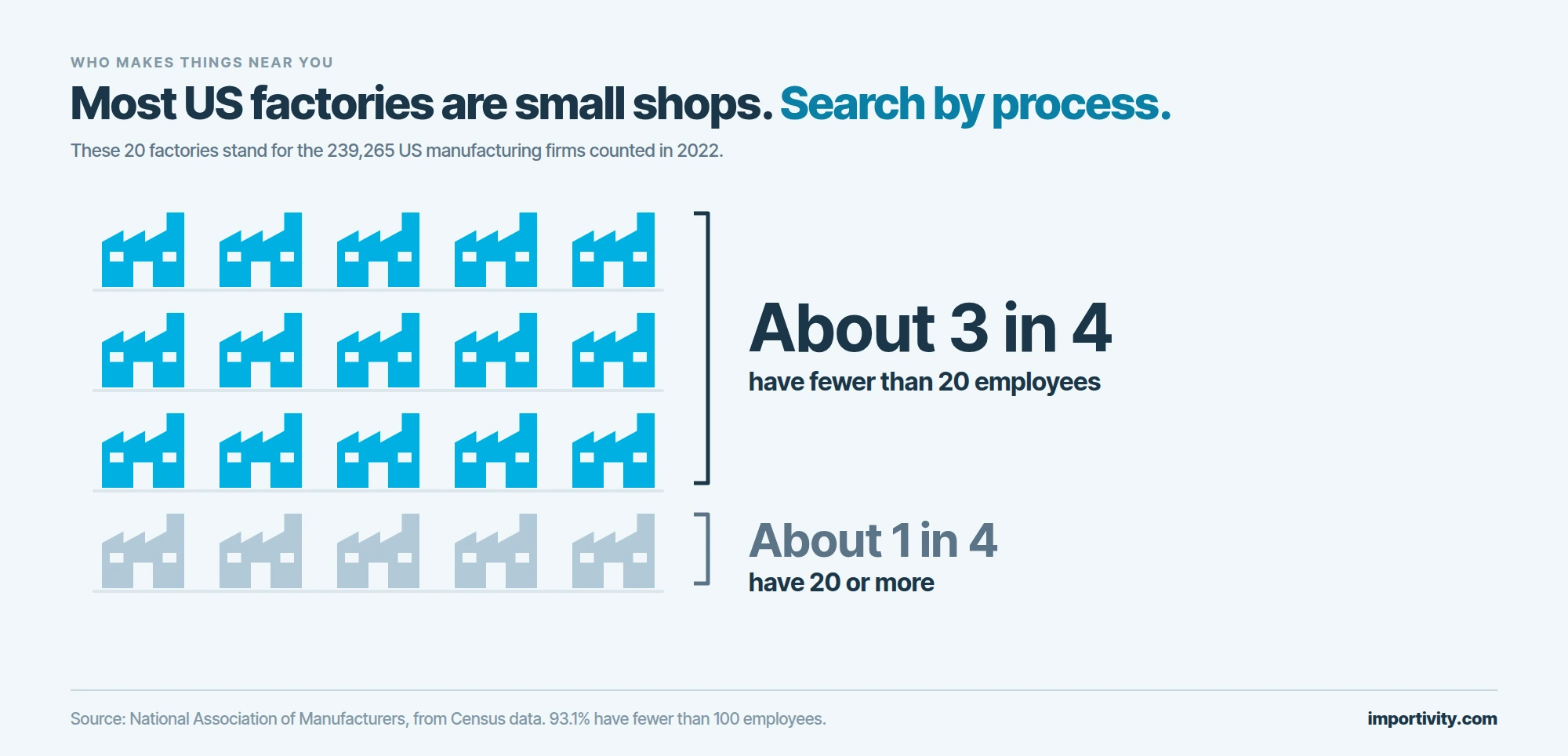
Most of the plants near you are small. The National Association of Manufacturers, using Census data, counts 239,265 manufacturing firms in the US in 2022. About three in four have fewer than 20 employees, so only about one in four has 20 or more, and 93.1% have fewer than 100. Small shops often have no sales team and a basic website, which is why the sources below find more of them than a general web search does.
Each source finds different shops, so use two or three together.
| Where to look | What it is good for | What to know |
|---|---|---|
| Thomasnet | Searching North American suppliers by process, material, certification and state | Free to search. Companies write their own listings, so a listing is not a check. |
| Your state's MEP center | Free supplier scouting and introductions to shops in your state | Results usually take 30 to 45 days. Some centers also search CONNEX, a database of more than 140,000 US manufacturers. |
| State and county economic development offices | Names of local plants, industrial parks and recent expansions | Ask for a list of manufacturers by NAICS code and for the industrial parks nearest you. |
| Census County Business Patterns | Counting plants of your type in each county and ZIP code | Counts only, no company names. Use it to decide where to search. |
| Map search | Process plus town, such as "CNC machining Dayton Ohio" | Finds shops that barely advertise. Check that the address is a plant, not a sales office. |
| Trade shows | Meeting many suppliers of one process in a day | MD&M West runs February 9 to 11, 2027 in Anaheim for medical device makers, and FABTECH covers metal fabrication. Check the exhibitor list for companies in your state. |
| Manufacturing Day open houses | Seeing local factory floors before you need them | Held around the first Friday of October. More than 3,000 events took place in 2025. |
NIST funds MEP centers in nearly every state and in Puerto Rico, and federal funds pay about half of their cost. Their supplier scouting service is free to the company asking. You describe the part with drawings, tolerances, certifications and volume. The centers look for US manufacturers with the equipment and the interest, and NIST says results usually take 30 to 45 days, delivered as a report listing each company with its contact details and product lines. Contact the center that covers your state to start.
Sewn products have their own directories and trade shows. Our guide to clothing manufacturers in the USA covers them.
How to qualify a local manufacturer
Being close is the advantage, so use it: visit before you send a purchase order. Bring the same drawings or specification you would send overseas, and check these points.
- The process is in house. Ask for the equipment list, with machine types, sizes or press tonnage, and the number of shifts. Some shops take orders and send the work out to other shops.
- The floor matches the claims. Look for parts like yours in progress, and ask who would run your job.
- The paperwork checks out. Look the company up in your state's business entity search and ask for a certificate of insurance. Check any ISO 9001 claim on IAF CertSearch, which shows whether a certificate is active, suspended, withdrawn or expired. Medical parts usually call for ISO 13485, and aerospace parts for AS9100.
- The quote is complete. Get it in writing at two quantities, with the unit price, the setup charge, the tooling cost and who owns the tooling, the lead time, the payment terms and the packaging.
- You know where the materials come from. Many US shops buy imported resin, fabric or parts, and the duty on those inputs shows up in their prices. For a Made in USA claim, the FTC requires that all or virtually all of the product be made in the US.
- The first parts pass. Approve a first article or a small pilot lot, measured against your drawing, before the full order.
- Customers vouch for it. Call two current customers and ask about on-time delivery and how the shop handled a problem.
What local factories do well, and what they rarely do
Local shops win where distance, speed or small batches matter more than labor cost.
- Short runs and prototypes. Job shops are set up for many small jobs, so 50 or 500 pieces is normal work for them.
- Fast changes. You can drive over, look at a bad part with the operator and agree on a fix the same day.
- Heavy or bulky goods. When freight is a large share of what you pay, a short truck trip costs less than an ocean crossing.
- Metal goods. Under the 2026 Section 232 rules, covered steel, aluminum and copper products pay 50% or 25% of their full customs value when imported from almost any country, which closes much of the price gap.
- Faster delivery. An ocean order from China takes 30 to 40 days door to door after production, on Freightos's rule of thumb. A local shop can deliver in smaller batches as you sell.
What local factories rarely do is labor-heavy work at overseas prices. Sewing, hand assembly and high-volume electronics assembly cost more in the US because wages are higher. Many US shops also run one process, so a product that needs molding, sewing, printing and retail packaging can mean four suppliers, with you coordinating them. An overseas factory or a full-service contract manufacturer often does all of it under one roof. That is why a factory in China is still the default for many consumer products, and our guide to manufacturers in China shows which regions make what.
Local vs overseas costs: what a local quote has to beat
Compare a local quote, delivered to your door, with the overseas landed cost, not with the factory price. Our guide to shipping from China to the US prices one order with dated figures: 5,000 backpacks of man-made fiber at $10.00 each FOB Shanghai, in one 40 ft container to a warehouse in Ontario, California, at October 22, 2026 rates. Each backpack lands at $17.35.
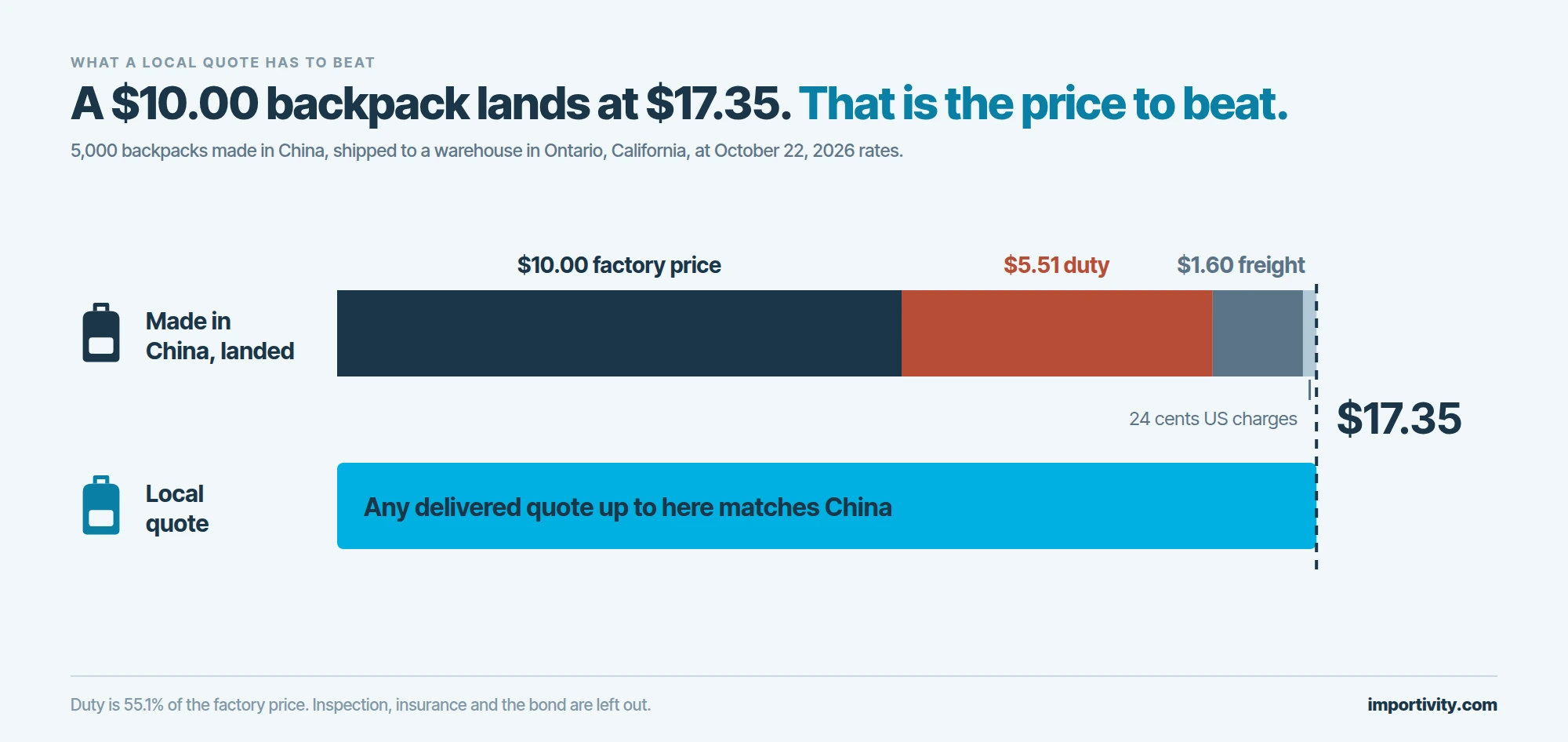
Here is where the extra $7.35 a backpack comes from:
- Duty, $5.51. The 17.6% MFN rate, 25% under Section 301 List 3 and 12.5% under the 2026 forced-labor action, 55.1% in all.
- Ocean freight, $1.60. Drewry's $8,007 rate for a 40 ft container from Shanghai to Los Angeles, spread over 5,000 backpacks.
- US charges, 24 cents. The merchandise processing fee, harbor maintenance fee, broker and ISF filing, port fees and trucking to the warehouse, $1,211.91 in total.
So a US sewing shop that quotes $17.35 or less per delivered backpack matches China. That is 73.5% above the Chinese factory price. Costs the example leaves out give the local shop a little more room: cargo insurance, the customs bond, the cash you pay out weeks before the goods arrive, and an inspection day before shipment, which the inspection firm V-Trust publishes at $268 per man-day.
The break-even price changes with the country, the order size and the product:
- Made in Vietnam. The List 3 duty falls away and the backpack pays 30.1%. At the same factory price and freight, that takes $2.50 off, so the local quote has to come in under about $14.85.
- Made in Mexico under USMCA. A product that qualifies enters free of the MFN rate and the forced-labor duty, so the local shop competes with the factory price plus trucking.
- A smaller order. Some import costs hardly change with order size: the broker's entry and ISF filing ($224.95 at the broker Clearit's published prices), one inspection day ($268) and the merchandise processing fee, which has a $34.58 minimum. On 500 backpacks they add $1.06 each. On 5,000, where the fee is $173.20, they add 13 cents. Small orders usually ship LCL, which costs more per cubic meter than a full container, and factories charge more per piece below their price breaks.
- A metal product. The Section 232 duty of 50% or 25% on full value raises the overseas landed cost, so a local metal shop can win with a quote much further above the overseas factory price.
For the full method with inventory carrying cost and a three-way example, read whether local sourcing is cheaper. If you are comparing US locations, our manufacturing cost comparison by state covers wages, energy and rent.
How brands split production between local and overseas
Few brands have to pick one side permanently. These four setups use each side for what it does best.
- Local prototypes and pilot runs, overseas volume. Make the first few hundred units near you while the design still changes, then send the frozen design to an overseas factory. Our step-by-step guide to finding overseas manufacturers covers that search.
- Overseas base, local reorders. Keep steady volume overseas and a local shop qualified for rush reorders and new products. The local shop will usually want some regular volume to keep your job on its schedule, so include that in the price you compare.
- Imported parts, local assembly and packing. This shortens the reorder cycle for the finished product. It does not make the product American for customs or for a Made in USA claim unless the US work changes the product enough to meet those rules.
- Mexico as a nearer option. Goods that qualify under USMCA skip the MFN rate and the forced-labor duty, and they reach US warehouses by truck.
Whichever split you choose, send every supplier the same specification and quantities so you can compare the quotes line by line. If you want US and overseas factories found and checked against one spec, send us your product details. Importivity helps US brands find and vet factories here and overseas. It also runs quality control and handles the shipping and the tariffs. Our US manufacturing page explains how that works with domestic suppliers.
Frequently Asked Questions
How do I find manufacturers near me?
Search an industrial directory such as Thomasnet by the process your product needs, such as CNC machining or cut and sew, and filter by your state. Ask your state's MEP center for its free supplier scouting service, which NIST says usually takes 30 to 45 days. Add your county economic development office and a map search by process and town, then visit each shop and approve a pilot lot before a full order.
Is it cheaper to manufacture locally or overseas?
It depends on duty, freight and order size. In one dated example, a $10.00 backpack made in China lands at a California warehouse for $17.35 after a 55.1% duty stack, ocean freight and US charges, so a US quote under $17.35 delivered would cost less. From Vietnam the break-even price drops to about $14.85. Labor-heavy goods at volume usually stay cheaper overseas, while small runs and metal goods often favor local shops.
Do local manufacturers take small orders?
Many do. About three in four US manufacturing firms have fewer than 20 employees, and job shops are set up for many small jobs. Expect setup or tooling charges that keep the unit price high at 50 to 500 pieces, so ask for quotes at two quantities to see the price break. A local order also avoids per-shipment import costs, which add about $1.06 a unit to a 500-piece order of $10.00 backpacks.
What is an MEP center and does it cost anything?
A Manufacturing Extension Partnership center helps small and medium-sized US manufacturers improve and grow. NIST funds centers in nearly every state and in Puerto Rico. Federal funds pay about half of their cost, and states, partners and client fees pay the rest. Their supplier scouting service, which looks for US manufacturers that can make a part you need, is free to the company asking.
How can I check if a local manufacturer is legitimate?
Look the company up in your state's business entity search and ask for a certificate of insurance. Check any ISO 9001 claim on IAF CertSearch, which shows whether a certificate is active, suspended, withdrawn or expired. Then visit the plant, confirm the machines for your process are in house, call two current customers, and approve a first article or pilot lot before you place the full order.
About the author
Jordan Lewis
Chief Operating Officer, Importivity
Runs Importivity's sourcing operations across China, Vietnam, Mexico and India, from supplier negotiation through landed delivery.
Press and media inquiries: press@importivity.com