Manufacturers in China (Who Makes What, Where, and How to Check One)
Manufacturers in China sit mostly in six coastal provinces, and most products have a home city: Shenzhen and Dongguan for electronics, Foshan for furniture and appliances, Yiwu and Yongkang in Zhejiang for small goods and hardware, Jinjiang in Fujian for athletic shoes, and Baigou in Hebei for bags. China makes close to 30% of the world's manufacturing value added, so for most products the real work is picking the right city and checking the factory.
This guide is for US brands looking for a factory in China, either for a first product or to replace a supplier that is not working. It covers which city makes what, the nearest port for each, wages and US duties as of November 3, 2026, and how to find and check a factory. If you already buy from China and want a second country as a backup, read our China plus one guide.
What China manufactures and how much
China's manufacturing value added was 33.6 trillion yuan in 2024, according to its Ministry of Industry and Information Technology. In September 2025 the ministry said China's share of world manufacturing value added was close to 30%, and that China had been the largest manufacturing economy for 15 years in a row.
The US still buys a large part of that output. US goods imports from China were $308.7 billion in 2025, down 29.9% from 2024, according to USTR. News reports of those figures put China's share of US goods imports at about 9%, the lowest since China joined the WTO in 2001.
For a buyer, the useful way to read Chinese manufacturing is by product group. Electronics, appliances, furniture, lighting, toys, fabric and apparel, footwear, bags and hardware each have their own towns, where factories, parts suppliers, mold shops and test labs work close together. A factory inside the right cluster buys its parts nearby. A factory outside it often buys from the cluster anyway, which adds days to the schedule and a margin to your price.
Where manufacturers in China are located
The clusters in this guide sit in six coastal provinces: Guangdong, Fujian, Zhejiang, Jiangsu, Shandong and Hebei. Each is a short truck ride from a main container port. Shanghai handled 55.06 million TEU in 2025 and has been the world's busiest container port for 16 years in a row, and Ningbo-Zhoushan, which serves most of Zhejiang, ranked third in the world at 43.87 million TEU.
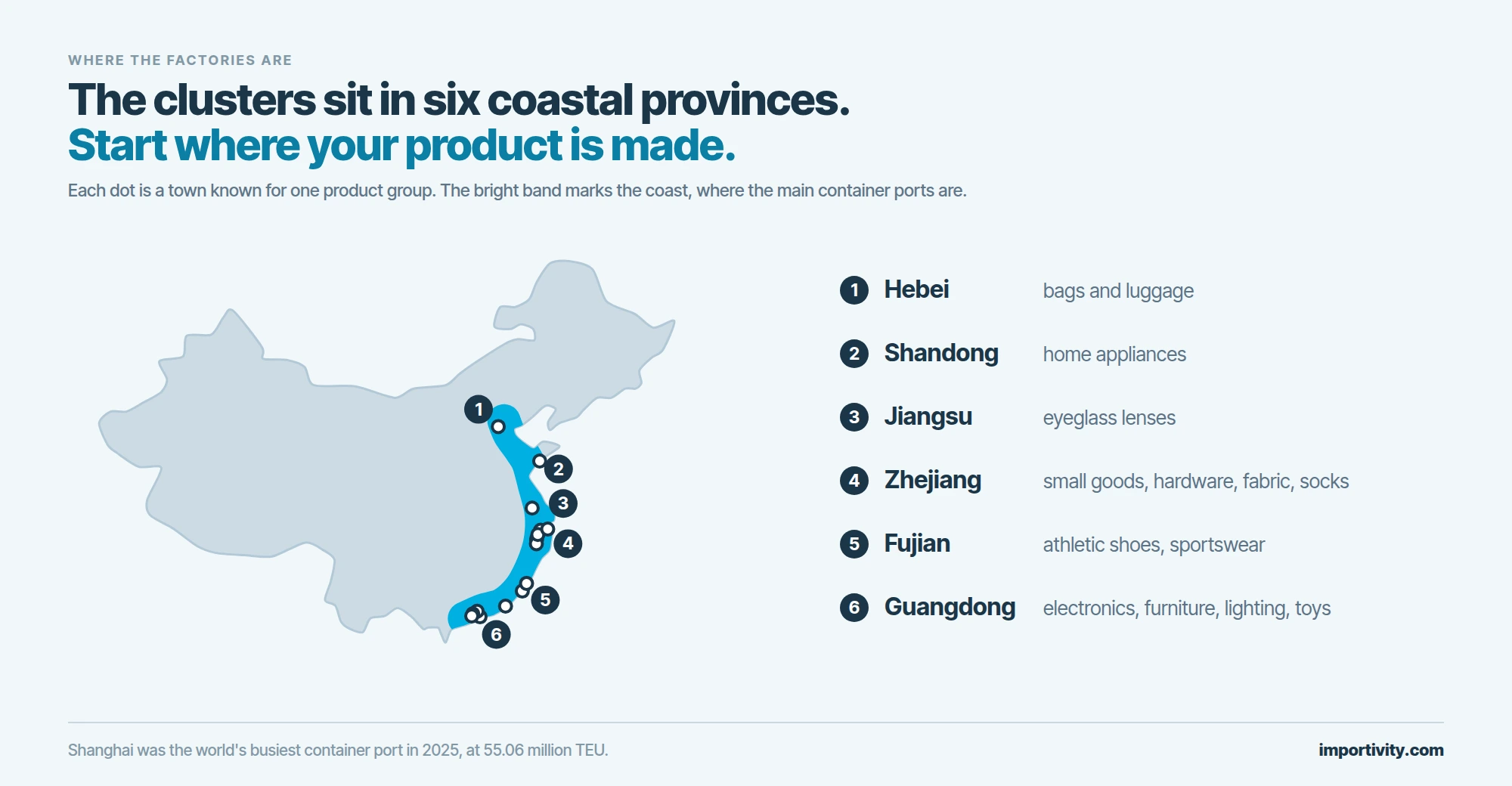
- Guangdong. Shenzhen and Dongguan make electronics and electronic parts. Foshan makes furniture, with most factories in Longjiang and the showrooms in Lecong, both in Shunde district. Shunde is also one of China's three main home appliance bases. Guzhen in Zhongshan was named China's lighting capital by the national light industry and lighting associations in 2002. Chenghai in Shantou makes plastic toys, which our guide to toy manufacturers in China covers in detail.
- Zhejiang. Yiwu is China's small-commodity wholesale center. Yongkang makes hardware and insulated cups, and Global Times reported in 2024 that it makes and exports over 70% of China's thermal cups. Chinese state media reported that China Textile City in Keqiao, Shaoxing, had 38,000 fabric vendors and about 401 billion yuan of trade in 2024. Datang in Zhuji makes about 25 billion pairs of socks a year, which Xinhua put at more than 70% of China's output in 2024. Cixi in Ningbo is another of the three appliance bases, focused on small appliances.
- Fujian. Jinjiang and Putian make athletic shoes and sportswear. Jinjiang is home to several of China's largest sportswear brands, among them Anta and Xtep.
- Jiangsu. Danyang makes eyeglasses. China Daily reported in 2025 that it makes over 400 million pairs of lenses a year, about half of world production.
- Shandong. Qingdao, home to the appliance makers Haier and Hisense, is the third appliance base.
- Hebei. Baigou is a bag and luggage town that Xinhua said in 2024 holds about 28% of China's domestic bag market.
The table pairs common products with the city that makes them and the nearest main container port.
| Product | Where it is made | Nearest main export port |
|---|---|---|
| Electronics and electronic parts | Shenzhen and Dongguan, Guangdong | Shenzhen |
| Furniture | Foshan (Shunde district), Guangdong | Guangzhou (Nansha) or Shenzhen |
| Lighting | Guzhen, Zhongshan, Guangdong | Guangzhou (Nansha) or Shenzhen |
| Home appliances | Shunde, Guangdong; Cixi, Zhejiang; Qingdao, Shandong | Guangzhou or Shenzhen; Ningbo-Zhoushan; Qingdao |
| Small commodities and gifts | Yiwu, Zhejiang | Ningbo-Zhoushan |
| Hardware and insulated cups | Yongkang, Zhejiang | Ningbo-Zhoushan |
| Athletic shoes and sportswear | Jinjiang and Putian, Fujian | Xiamen |
| Bags and luggage | Baigou, Hebei | Tianjin |
Treat the cluster as the place to start, not proof of quality. Each town holds many small workshops next to a few large plants, and their quality varies widely. The table leaves out fabric, socks and eyeglasses, but the same advice holds: buy in Keqiao, Datang or Danyang, or from a supplier that can show you its goods come from there.
What manufacturing in China costs in 2026
Labor. China sets minimum wages by province, in up to four tiers by city. As of January 1, 2026, the highest monthly minimum, which applies in each province's largest cities, was 2,740 yuan in Shanghai, 2,660 yuan in Jiangsu and Zhejiang, 2,500 yuan in Guangdong, 2,330 yuan in Sichuan and 2,320 yuan in Anhui, according to the national table from the Ministry of Human Resources and Social Security. Shenzhen sets its own rate of 2,520 yuan.
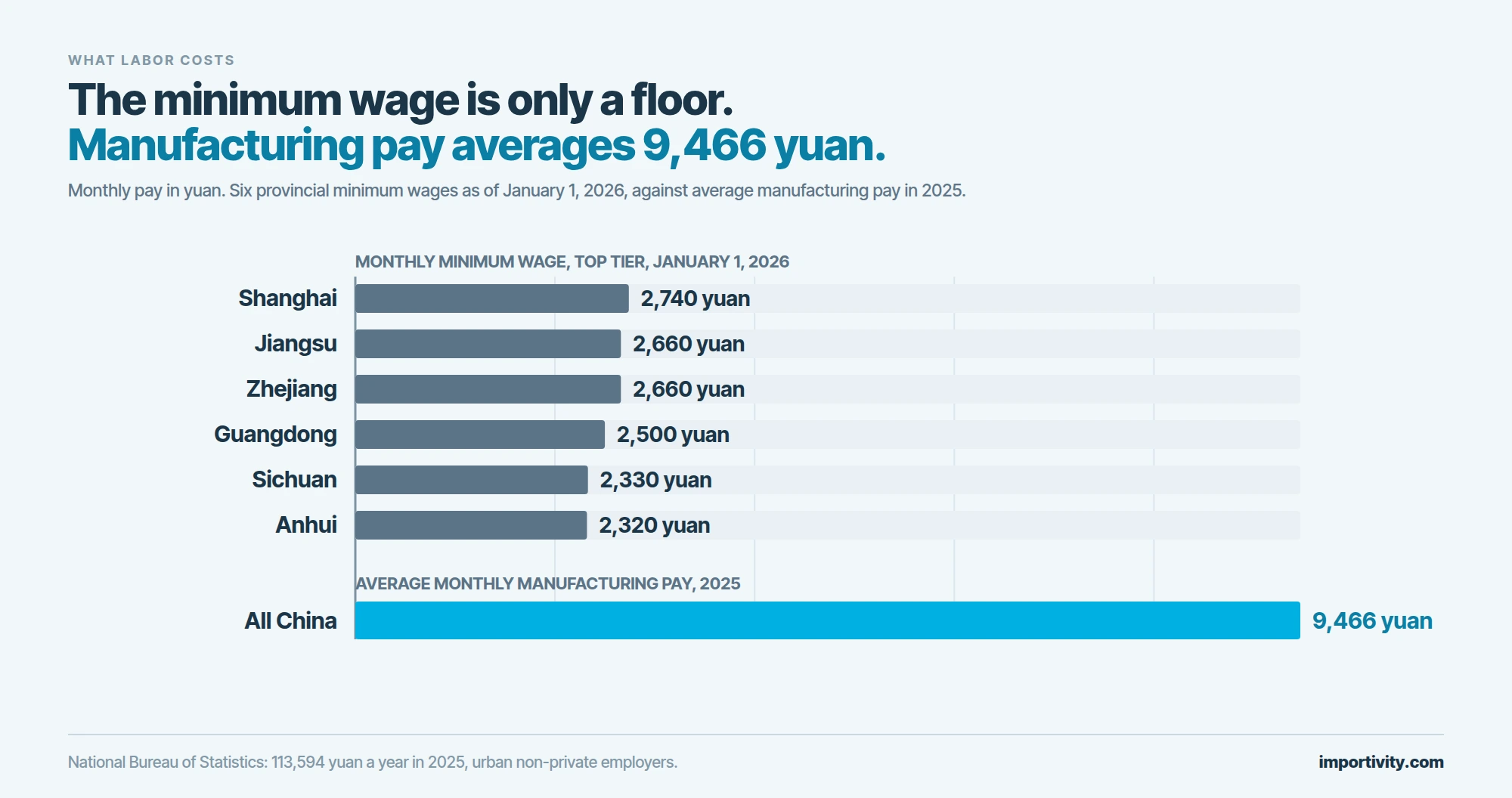
Average manufacturing pay runs far above those minimums. The National Bureau of Statistics puts average manufacturing pay at 113,594 yuan in 2025 for urban non-private employers, up 5.2% from 2024. That is about 9,466 yuan a month, more than three times the Shanghai minimum. At about 6.65 yuan to the dollar, the rate Trading Economics showed at the start of November 2026, it comes to about $1,420 a month. Inland provinces such as Sichuan and Anhui have lower minimums, but a factory there pays more to truck goods to the coast and has fewer parts suppliers nearby.
Currency. A price quoted in yuan changes in dollars every time the exchange rate moves. Ask suppliers to quote in US dollars, or fix the exchange rate in the purchase order, so a move in the yuan does not reopen the price.
US duty. As of November 3, 2026, a product made in China pays its normal duty rate, plus a Section 301 list duty of 7.5% or 25% if it is on one of the China lists (50% or 100% on some lines after the 2024 review), plus a 12.5% Section 301 forced-labor duty that started on July 24, 2026. Goods that pay a Section 232 duty, such as steel, aluminum and copper goods or certain upholstered wood furniture, are exempt from the 12.5% layer and pay the 232 rate instead. The IEEPA tariffs ended after the Supreme Court ruling in February 2026. On a $10.00 backpack with a 17.6% base rate, the layers add up to 55.1% from China against 30.1% from Vietnam, as our guide to tariff stacking shows. Our guide to import tax from China to the US explains each layer and how to look up your own code.
How to find a manufacturer in China
Use more than one channel, because each one turns up a different kind of supplier.
- Search 1688 to find the town. 1688 is Alibaba's domestic wholesale site for Chinese buyers. Its listings show which cities make a product and what factories charge each other, even if you never order there. Our guide on how to buy from 1688 explains the agent model a US company needs.
- Use the export marketplaces as a first list. Alibaba.com, Made-in-China.com and Global Sources list Chinese suppliers in English. Many listings are trading companies, so filter by business type and check each supplier yourself.
- Go to a trade fair. The Canton Fair in Guangzhou runs twice a year in three product phases, and the autumn 2026 session closes on November 4. Industry fairs go deeper: the China International Furniture Fair for furniture, the Guzhen lighting fair for lighting, and the Hong Kong Electronics Fair for electronics.
- Visit the cluster. Yiwu, Lecong and Guzhen have permanent markets and showrooms, so one day there shows you dozens of suppliers of one product. Ask each showroom where its factory is, then visit the factory.
- Work with a sourcing partner. A sourcing partner can read the registry, visit plants and compare quotes in Chinese. Our China sourcing agent service and supplier vetting service do this for US brands.
How to check a Chinese factory before you pay
Before a deposit, confirm three things: the company is real, it is the factory, and it can make your product to your standard.
- Look up the business license. Every Chinese company has an 18-character Unified Social Credit Code on its license. Search it on the National Enterprise Credit Information Publicity System (GSXT), run by the State Administration for Market Regulation, and check that the name, status, registered capital and legal representative match the documents you were sent. The site is in Chinese, so use a browser translation or a partner.
- Read the business scope. A factory's scope includes production of the goods. A scope that lists only sales, wholesale and trade belongs to a trading company. Our guide to buying from a manufacturer or a trading company lists the other checks and explains when a trader is the better choice for a small order.
- See the line on video. Ask for a live video call that walks from the gate to the machines making a product like yours. The address should be in an industrial area and match the license.
- Send one RFQ to three to five factories in the same cluster. Send each one the same drawings and the same order quantity. Quotes that are far apart often mean different materials or a middleman.
- Audit before a large order. An on-site audit checks whether the quality system and the capacity on paper exist on the factory floor. Our factory audit checklist lists the documents to request.
- Pay for a sample, then inspect the order. Approve a sample before tooling or bulk production, and book a pre-shipment inspection before you pay the balance.
When China is still the right choice
A product on a China list carries a duty that the same product from Vietnam, Mexico or India does not. China has to save you at least that much somewhere else, and in three cases it often does.
- The product has many parts. Electronics, appliances and other assemblies need dozens of components. In Shenzhen, Shunde or Cixi most of them are made nearby, while factories in newer sourcing countries often import the same parts from China.
- It needs tooling. The main clusters have many mold and die makers, so injection molds, die-cast tools and stamping dies are easier to source and change there.
- No China list covers your code. If your HTS code carries no Section 301 list duty, a Chinese product pays the same 12.5% forced-labor duty as a product from Vietnam, and most of the duty case for moving goes away.
The case for moving is strongest for sewn and labor-heavy products with a list duty, such as bags, apparel, footwear and furniture. On the backpack above, a move to Vietnam saves 25 points of duty, but only if the Vietnamese price matches and the origin is real. Our guide to manufacturers in Vietnam shows what Vietnamese factories make and where they are. Many brands keep most of the volume in China and qualify a second country for a share, which our China plus one guide covers step by step.
To find out what your product would cost from a vetted Chinese factory, send us your product and order details. Our team finds and vets factories that make your product type.
Frequently Asked Questions
Where are most factories in China located?
Most export factories are in coastal provinces near the main container ports. Guangdong makes electronics, furniture, lighting and toys. Zhejiang makes small goods, hardware, fabric and socks. Fujian makes athletic shoes and sportswear, Jiangsu makes eyeglass lenses, Shandong makes home appliances, and Hebei makes bags. Inland provinces such as Sichuan and Anhui have lower minimum wages but fewer parts suppliers nearby.
What products are manufactured in China?
Almost every manufactured product is made in China, which accounts for close to 30% of world manufacturing value added by its own government's estimate. For US buyers the main groups are electronics, home appliances, furniture, lighting, toys, fabric and apparel, footwear, bags, hardware and tools. Each group has its own cluster of factories and parts suppliers in a few cities.
How do I find a reliable manufacturer in China?
Start with the city that makes your product, then build a list from 1688, Alibaba.com, Made-in-China.com, trade fairs such as the Canton Fair, and visits to the cluster. Check each company's business license on China's GSXT registry, confirm it is the factory on a live video call, send the same RFQ to three to five factories, and order a sample before you commit.
How can I tell if a Chinese supplier is a real factory?
Look up its 18-character Unified Social Credit Code on the GSXT registry and read the business scope. A factory's scope includes production of the goods, while a trading company lists only sales and trade. Then ask for a live video walk from the gate to the production line, and check that the factory address is in an industrial area and matches the license.
Is it still worth manufacturing in China with tariffs?
Often it is, for products with many parts, products that need molds, and products whose HTS code is on no China Section 301 list. As of November 2026, a Chinese product pays its normal duty, any China list duty, and a 12.5% forced-labor duty. A product that pays a Section 232 duty is exempt from the 12.5% layer. Labor-heavy goods with a 25% list duty, such as bags and furniture, are the strongest case for a second country.
About the author
Jordan Lewis
Chief Operating Officer, Importivity
Runs Importivity's sourcing operations across China, Vietnam, Mexico and India, from supplier negotiation through landed delivery.
Press and media inquiries: press@importivity.com