How to Run a China Plus One Strategy Without Doubling Your Overhead
A China plus one strategy keeps China as your primary source and qualifies a second country to make a share of the same product, usually 20 to 30 percent of volume, so that a tariff change, a factory failure or a port problem in one place never stops your whole supply. It is not a move out of China. Importers who do it well keep the Chinese line at full quality, build a second tool or sewing line elsewhere, and hold both to one specification and one golden sample. The cost is a second set of tooling, audits and inspections. The payoff is that the next tariff notice becomes a volume decision instead of an emergency.
This guide is for US importers buying between a few hundred thousand and a few million dollars a year who want to know what the term means at their size. It covers why the pressure rose in 2025 and 2026, how to pick the plus-one country by product family, how to qualify a second line, what it costs, the origin trap, and a 90 day rollout. For the country-by-country comparisons, start with China vs Vietnam and the supply chain diversification resource.
What China plus one actually means
The phrase describes a split, not an exit. You keep the factory that already makes your product and holds your tooling, and you add one more factory in one more country for a defined slice of the volume. The slice is small at first, because the second line has to earn its share by matching the first on quality and delivery.
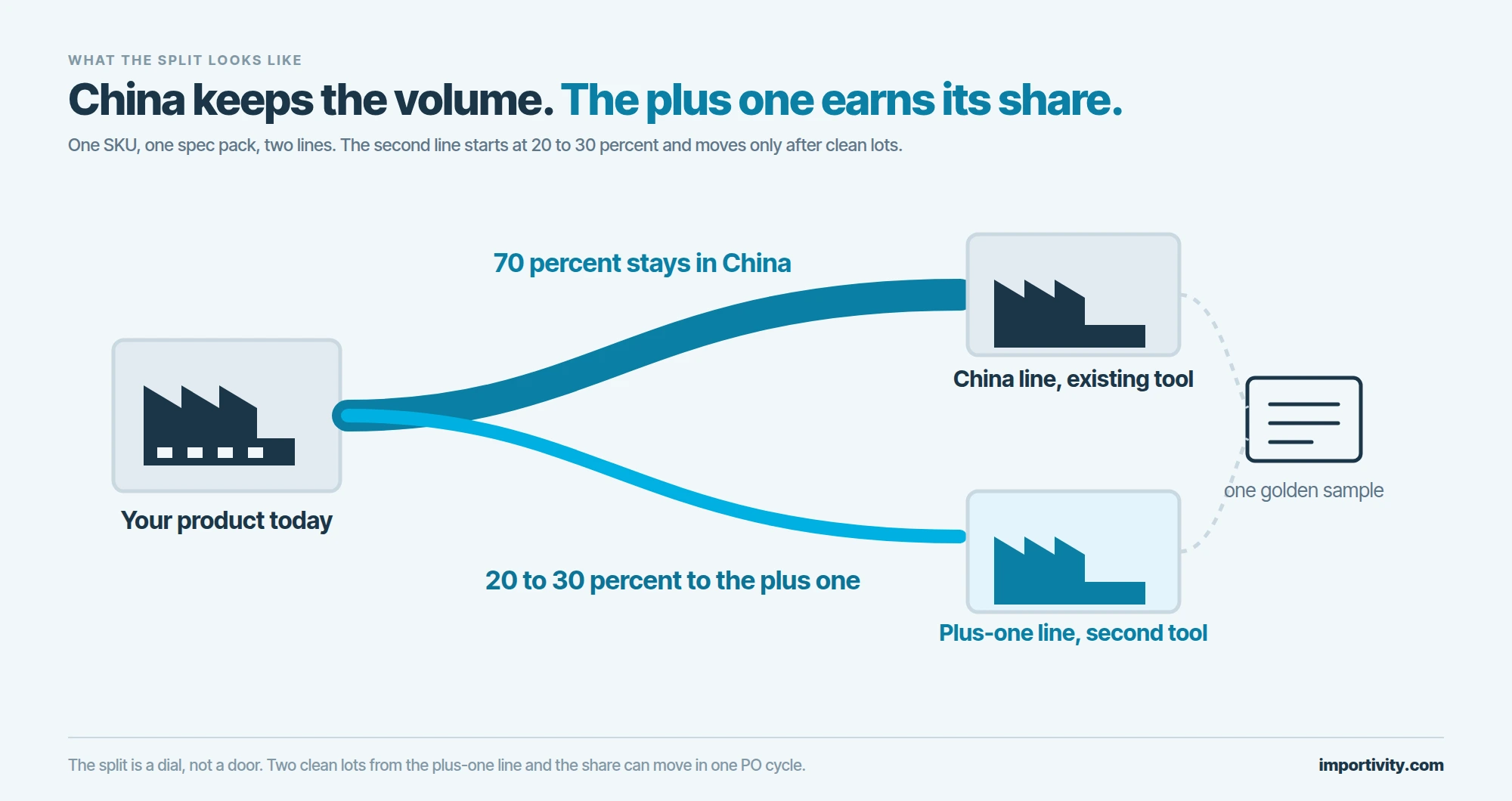
Three things make this different from switching suppliers. Both lines run at once, so one SKU has two purchase orders, two inspection calendars and two freight lanes. The second line is qualified against the first, so the Chinese golden sample is the reference it must hit. And the split is a dial: after two or three clean lots you can move it to 50 percent, or back to 20, in one purchase order cycle.
Four trade-offs come with it. The component ecosystem stays in China: zippers, motors, PCBs and packaging are a day from a Guangdong factory and often a month from a Vietnamese one, so the plus-one line usually imports its inputs and must do real work to them. Tooling lives where it was cut, so the second line needs its own tool. Quality starts lower and climbs, because the Chinese line has years of your feedback in it. And everything doubles except the volume. These are reasons to do it deliberately for the products that carry the risk, not across the whole catalog.
Why the pressure rose in 2025 and 2026
China-only sourcing became expensive to defend in three steps. The first was the tariff stack. Goods from China now carry a 12.5 percent Section 301 forced labor duty, in force since July 24, 2026, on top of the original Section 301 List 1 to 4A rates of 7.5 to 25 percent that most goods already paid. For a product on List 3 that is 37.5 percent before the MFN rate, with Section 232 metal duties on top for covered articles.
The second is a date. The remaining 178 Section 301 product exclusions, extended by USTR in December 2025, expire at 11:59 p.m. Eastern on November 9, 2026, and entries filed from November 10 pay the full list rate again. If one covers your product, the plus-one line is the only thing that changes your landed cost after that date. Our Section 301 exclusions page tracks the list.
The third is enforcement. Since the Supreme Court struck down the IEEPA tariffs on February 20, 2026, the duty picture has been rewritten twice, by the Section 122 surcharge that ran from February 24 to July 24 and then by the forced labor action that replaced it. The constant has been CBP's attention to origin: inspections of China-linked factories in Vietnam were reported in July 2026, and the substantial transformation test has not moved. The market has voted. Between 2022 and 2025 China's share of US imports fell by roughly 16 percentage points while Vietnam's and Mexico's grew by a third and a half. Your competitors are not leaving China. They are splitting.
Pick the plus-one by product family, not by headline
The right second country depends on what the product is made of and how it ships, not on which country was in the news. As of September 2026 the three usual candidates carry different duty positions and suit different goods.
| Plus-one country | Best fit and duty position | Watch out for |
|---|---|---|
| Vietnam | Sewn goods, footwear, furniture, small appliances, wood and rattan. 10 percent forced labor tier, no List 1 to 4A duties. 18 to 30 days ocean transit to the West Coast. | Heavy reliance on Chinese inputs; origin must be earned by real transformation. Capacity is tight in the best factories. |
| Mexico | Heavy, bulky or time-sensitive goods: metal fabrication, appliances, furniture, auto parts. USMCA-qualifying goods are exempt from the forced labor duty. 2 to 7 days by truck. | USMCA content thresholds; a plant assembling Chinese parts may not qualify. Higher labor cost than Vietnam. |
| India | Textiles and home goods, machined and cast metal parts, leather. Deep raw material base for cotton and steel. | 12.5 percent forced labor tier, the same as China. 4 to 6 weeks to the East Coast. Wider factory-to-factory variance. |
| Stay China-only | Low-value, low-volume or highly engineered products whose tooling and component chain cannot be duplicated economically. | Full exposure to the 12.5 percent tier plus list rates and the November 9 exclusion expiry. |
Two rules of thumb. If the product is mostly labor, Vietnam usually wins. If it is mostly weight, Mexico usually wins, and our comparison on moving manufacturing from China to Mexico works through the USMCA math. India is the answer when the raw material itself is Indian, which is why cotton textiles and forged parts go there and molded plastics mostly do not.
The mechanics of qualifying a second line
The plus-one line is qualified like any new factory, with one difference: the reference is your existing production, not a drawing alone. Run these steps in order.
- Freeze one spec pack. Drawing, bill of materials, material specs, finish, packaging and the test method for every characteristic. If the Chinese factory has been working from tribal knowledge, write it down now.
- Send the golden sample, not a description of it. Two signed samples from the Chinese line: one stays on the plus-one factory's floor, one comes back with their first parts for comparison.
- Duplicate the tool. For molded, cast or stamped parts, have a second tool cut from the same CAD and DFM notes, quoted separately from the parts so you can see the price and who owns it.
- Run a first article inspection on the new tool. Every dimension on the drawing, measured on parts off the production tool and process, not a hand-finished sample. Our guide to first article inspection shows what the report must contain.
- Inspect the pilot lot at a tighter level than you use in China. Level II at AQL 2.5 for majors is the normal setting. For the first two plus-one lots use level III, which raises a 200 piece sample to 315 on a 5,000 unit lot.
- Hold the split at 20 to 30 percent for two clean lots. A line that has shipped two lots on time and in tolerance has earned a bigger share.
Keep the Chinese factory informed. A supplier told that 70 percent stays with them while quality holds usually sharpens up; one who hears from a forwarder that a copy of their mold exists in Vietnam starts quoting you like a customer on the way out.
What it costs and when the math does not work
Build the cost model before you send an inquiry, because the answer decides which products qualify. The extra cost has five parts: a second tool, roughly the price of the first; a second audit at one inspector day of $250 to $300 plus travel; two inspection calendars, with level III sampling on the plus-one line until it is proven; split freight, since two smaller shipments cost more per unit than one full container; and your own time across two supplier relationships.
Against that sits the saving. Take a product on Section 301 List 3 with an annual China purchase value of $400,000. Moving 30 percent of it to Vietnam removes the 25 percent list rate on $120,000 and swaps the 12.5 percent tier for the 10 percent tier, worth about $33,000 a year before the plus-one factory's own price is considered. If the second tool costs $15,000 and the extra inspection and freight run $8,000, the program pays back inside the first year. On a $60,000 a year product with the same tool the payback is more than three years, and the honest answer is to leave it in China. So qualify a plus-one line for the products that carry the most duty dollars, not the most units, and only where the tool is cheap relative to the spend. Three products done properly beat twenty done badly.
The origin trap
A plus-one factory only helps your duty position if the product it ships is legally its own origin. The US test is substantial transformation: the goods must emerge from the second country with a new name, character or use. Cutting and sewing garments qualifies. Molding and assembling a housing qualifies. Packing a finished Chinese product into a Vietnamese-labeled box does not, and neither does screwing four Chinese subassemblies together.
The stakes went up in 2025, when the Vietnam trade deal introduced a 40 percent penalty rate for goods found to be transshipped rather than transformed. The legal basis for that penalty fell with the IEEPA ruling, but the origin test is unchanged and CBP's inspections of China-linked factories in Vietnam show where its attention is. If your plus-one line uses Chinese inputs, and most do, the factory has to do enough real work to change what they are, and you need the records that prove it: a bill of materials showing which parts are Chinese, process sheets showing what happens to them, and the labor that went in. Our guide to country of origin rules covers the documents.
For Mexico the test appears twice: substantial transformation decides origin, and the separate USMCA rules of origin with their content thresholds decide whether the goods enter free of the forced labor tier. A Mexican plant that assembles Chinese kits can fail both.
A 90 day rollout
Ninety days is enough to take one product from decision to first plus-one shipment if the tool is simple and the spec pack exists. Three phases, three gates.
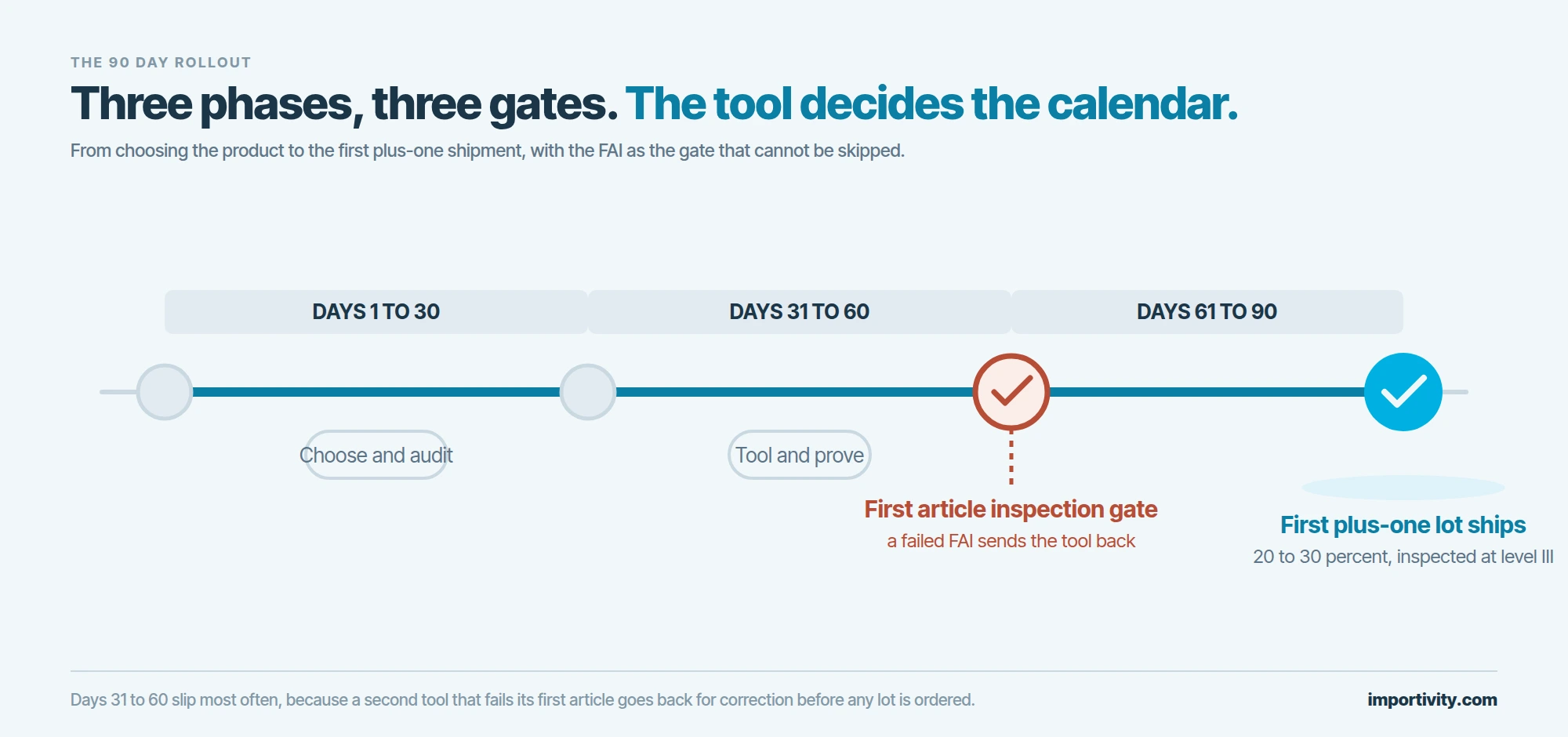
- Days 1 to 30, choose and audit. Pick one product by duty dollars, shortlist three factories, send the spec pack and RFQ, audit the two that quote sensibly, and confirm in writing who owns the second tool.
- Days 31 to 60, tool and prove. Cut the tool, run T1 samples, then the first article inspection off the production process. Gate: the FAI passes on every characteristic, or the tool goes back before any lot is ordered.
- Days 61 to 90, pilot and ship. Place a 20 to 30 percent lot, inspect it at level III, and file the entry with the origin file already assembled. Gate: the lot passes and the origin file would survive a CBP request.
Then repeat for the next product while the first one runs. Importers who try the whole catalog in one quarter end up with five half-qualified factories and no working second line. Jordan runs this exact pairing from Guangzhou and Ho Chi Minh City; if you want the shortlist and audit done by someone already in both cities, start with a fit check with Jordan and bring the product's duty spend for the last twelve months.
Frequently Asked Questions
What is a China plus one strategy?
It is a sourcing plan that keeps China as the primary factory for a product while a second factory in another country, usually Vietnam, Mexico or India, makes a defined share of the same product, often 20 to 30 percent to start. Both lines run to one specification and one golden sample, so volume can shift between them when tariffs or capacity change. It is a split, not an exit.
Which country is the best plus one for a US importer?
It depends on the product. Labor-heavy goods such as garments, footwear and furniture usually go to Vietnam. Heavy, bulky or time-sensitive goods go to Mexico, where USMCA-qualifying products also avoid the forced labor duty tier. Textiles, leather and forged or machined metal parts often fit India, which sits in the same 12.5 percent tier as China but has its own raw material base.
How much does a China plus one strategy cost?
The extra cost is a second tool, a second factory audit, a second inspection calendar, split freight and your own management time. On a product with a large annual duty bill and a cheap tool the program usually pays back within the first year. On a low-value product with an expensive mold the payback can run past three years, and leaving it in China is the better decision.
Does assembling Chinese parts in Vietnam change the country of origin?
Only if the work in Vietnam substantially transforms the parts into a product with a new name, character or use. Cutting and sewing, molding and real assembly qualify. Packing a finished Chinese product into a Vietnamese box or screwing finished subassemblies together does not. CBP tests this on the records, so the factory needs process sheets and a bill of materials that show what it did.
When do the remaining Section 301 China exclusions expire?
The 178 remaining product exclusions were extended by USTR in December 2025 and expire at 11:59 p.m. Eastern on November 9, 2026. Entries filed on or after November 10, 2026 pay the underlying List 1 to 4A rate of 7.5 to 25 percent again. If your product relies on one of them, a plus-one line is the only change that lowers landed cost after that date.
About the author
Jordan Lewis
Chief Operating Officer, Importivity
Runs Importivity's sourcing operations across China, Vietnam, Mexico and India, from supplier negotiation through landed delivery.
Press and media inquiries: press@importivity.com