Why an NDA Fails in China and What an NNN Agreement Does
An NNN agreement is a China specific contract covering three things a standard non disclosure agreement does not: non use, non disclosure and non circumvention. The prong that matters most is non use, because a conventional NDA only stops a factory telling somebody else about your design. It does nothing to stop the factory building that design itself and selling it, since making your product is not disclosing anything to a third party. Add a US governing law clause and US jurisdiction and the document becomes close to unenforceable against a Chinese manufacturer, because winning in a US court is not the same as collecting from Chinese assets.
This guide is for US brands and hardware startups about to send drawings, a tech pack or a sample to a Chinese factory. It covers what each prong does, why the jurisdiction clause decides everything, the five drafting requirements, how liquidated damages give the contract teeth, and what to file before the files leave your office. It is general information rather than legal advice, and an NNN is one of the few documents genuinely worth paying a China qualified lawyer to draft. Our guide to protecting intellectual property in China covers the wider picture.
What the Three Ns Actually Do
Each prong closes a different route your design can take out of the factory, and a document missing one leaves that route open.
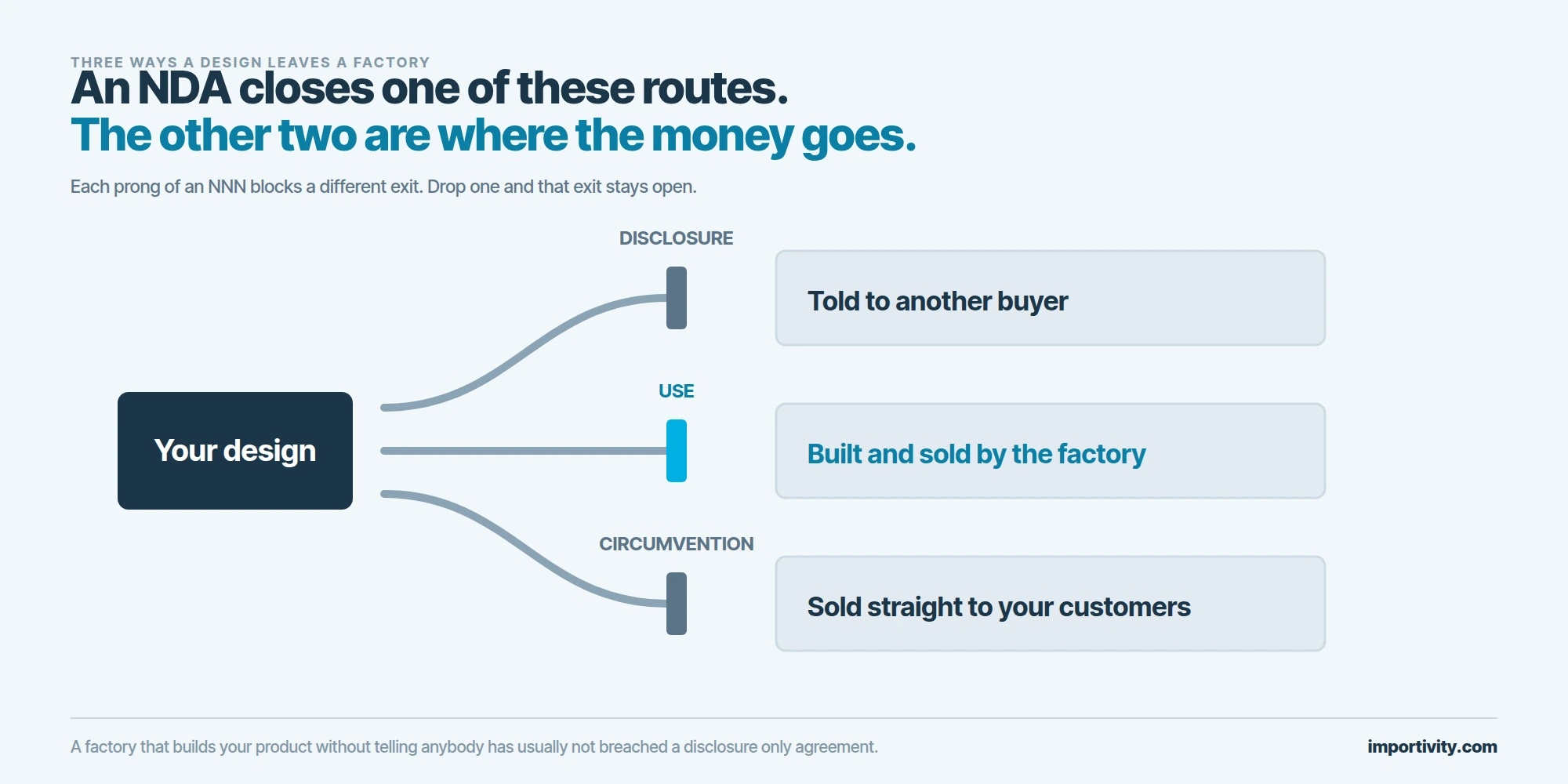
Non disclosure is the familiar one. It bars the factory from passing your information outward, and a well drafted version extends that to its own affiliates, subcontractors and supply network, which is where information actually leaks. Non use bars the factory from using your designs, concepts or know how for its own benefit, whether or not the information fits neatly into a recognised category of intellectual property. Non circumvention bars it from going around you, selling directly to your customers or distributors using the relationship and the opportunity you created.
The China practice firm Harris Sliwoski, which has written about this for years, frames the real risk plainly in its piece on why NDAs do not work for China: the threat is not that the factory tells somebody, it is that the factory makes your product, modifies your design, and sells something similar to somebody else. A disclosure only agreement is silent on all three.
| What the factory does next | Under a US style NDA | Under a China enforceable NNN |
|---|---|---|
| Emails your drawings to another buyer | Breach, but you have to enforce it in China | Breach, enforceable in a Chinese court against local assets |
| Builds your product and sells it under its own brand | Usually no breach at all, since nothing was disclosed | Breach of the non use prong |
| Approaches your retail customers directly | Usually no breach | Breach of the non circumvention prong |
| Passes the design to a subcontractor it owns | Arguable, and often excluded by a narrow definition | Breach where the clause names affiliates and subcontractors |
| Registers your brand name in China first | Not covered by either document | Not covered either. File the trademark separately |
Why a US NDA Is Close to Worthless Here
The jurisdiction clause is the whole ballgame. There is no bilateral treaty between the United States and China on the recognition and enforcement of judgments, so a US judgment only becomes collectable in China if a Chinese court recognises it, historically on the basis of reciprocity.
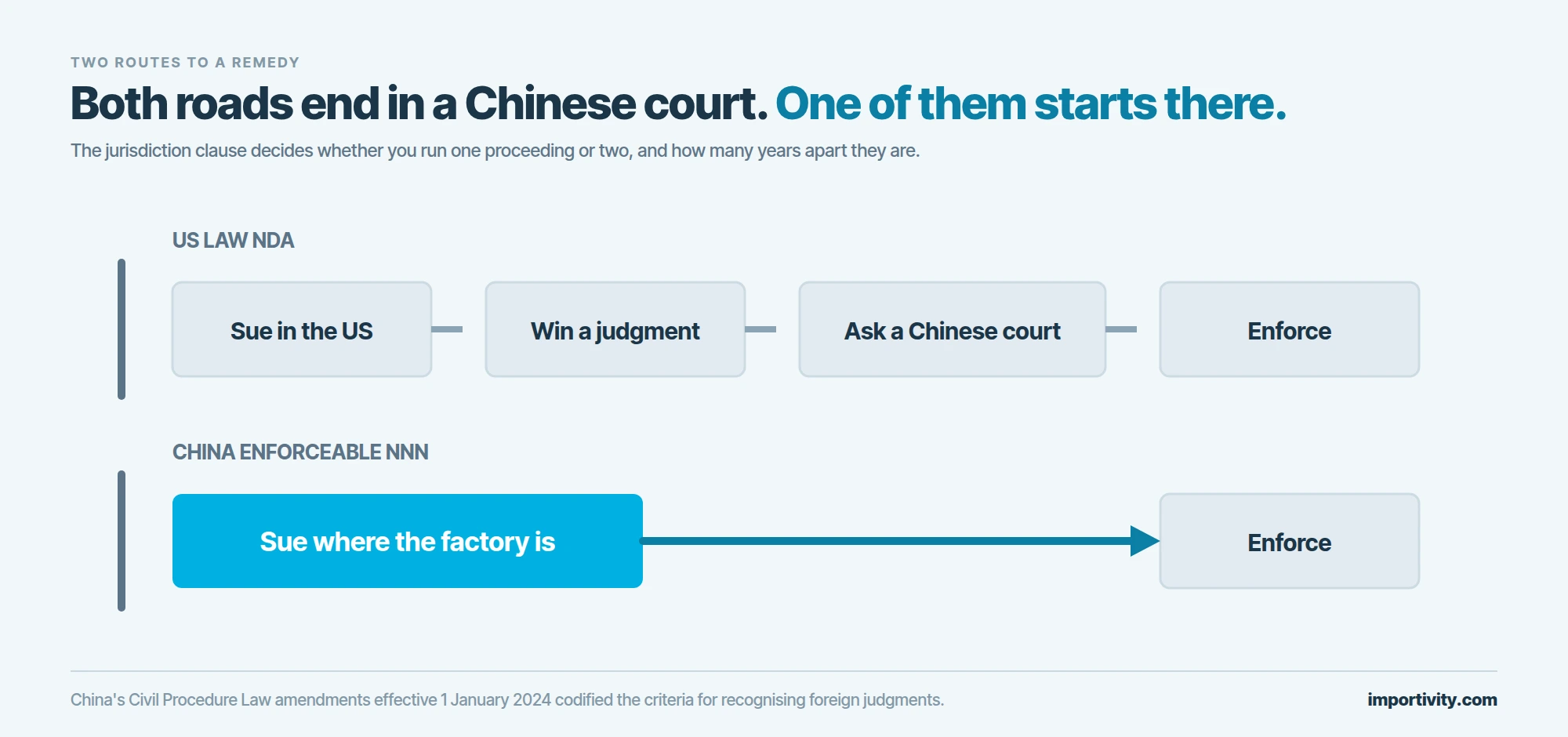
That has improved. The first Chinese recognition of a US commercial judgment came from the Wuhan Intermediate People's Court on 30 June 2017, recognising a Los Angeles Superior Court judgment on the basis of de facto reciprocity established by an earlier US case that had enforced a Chinese judgment, as documented by Herbert Smith Freehills. Amendments to China's Civil Procedure Law effective 1 January 2024 then codified the criteria, making foreign judgments generally enforceable unless narrow exclusions apply, such as lack of jurisdiction, improper service, fraud, a conflicting Chinese ruling or a public policy violation, as summarised by DLA Piper. A Wuxi court has since enforced a 73 million dollar Californian judgment.
None of that makes a US law NDA a sensible instrument. Even on the improved path you must litigate and win in a US court first, then bring a separate recognition proceeding in China, and the outcome remains case by case. Compare that with an NNN drafted so a Chinese court has original jurisdiction over the manufacturer: one proceeding, in the country where the assets and the factory are, in the language the court works in. That is a structural advantage, not a preference.
The Five Drafting Requirements
An NNN that fails on any of these is decoration. Each one is cheap to get right at drafting and impossible to fix afterwards.
- Chinese as the governing language. A Chinese court works from the Chinese text. If the English version governs, you are relying on a translation you did not control and cannot predict.
- PRC governing law. A Chinese court applying foreign law is slow, expensive and uncertain. Choose the law the court already knows.
- Jurisdiction in a Chinese court with authority over the manufacturer. Usually a court where the factory is located, so an order can reach its assets and its bank accounts.
- Execution with the company chop. Under Chinese practice the official company seal is the primary evidence that a company assented to a contract, and it functionally outweighs a signature. Each company has one official seal. Take a specimen and check the chop on your document against it. A signature from the legal representative alongside the chop is good practice, since that person carries apparent authority to bind the company.
- The counterparty's correct legal Chinese name. Not the trading name on the website, not the English name on the quotation. The registered name from the business license. A mismatch can leave you holding an agreement against an entity that has nothing.
None of that requires you to become an expert. It requires you to refuse the free template. A generic NNN downloaded from a sourcing blog will almost always carry a foreign governing law clause, which is precisely the defect that makes it useless.
Liquidated Damages, the Clause That Gives It Teeth
A Chinese court will enforce a contract, but proving your actual loss from a design theft that has not yet reached the market is close to impossible. That is why NNN agreements specify a predetermined damages figure per breach. It gives the court a concrete number to award and gives you a basis for asking for an asset freeze before trial rather than after it.
Article 585 of the PRC Civil Code allows parties to agree liquidated damages, and gives a court or arbitral body the power to increase the amount where it is lower than actual losses, or reduce it where it is excessively higher than actual losses, on a party's request. There used to be a widely cited judicial interpretation treating damages above roughly 130 percent of actual loss as presumptively excessive. That interpretation was abolished on 31 December 2020, and we could not verify any current numeric replacement, so treat any article quoting a fixed percentage as out of date. The rule today is judicial discretion without a published threshold.
Practically, set the figure at a number a court would see as a genuine pre estimate of loss rather than a punishment. Something anchored to the value of the tooling, the development spend and a realistic period of lost margin is defensible. A number chosen to be frightening invites reduction and undermines the rest of the document.
Verify the Counterparty Before You Sign
An agreement with the wrong entity is worse than no agreement, because it buys false confidence. China publishes the information you need for free.
Every Chinese company carries an 18 character unified social credit code and appears on the National Enterprise Credit Information Publicity System at gsxt.gov.cn, operated by the market regulator. Look up the code from the business license and confirm the registered name, the legal representative, the registered capital and the business scope. Three checks matter most: that the entity on your contract is the entity you have been dealing with, that the person signing is the registered legal representative or has written authority, and that the registered scope of business actually includes manufacturing rather than trading.
Do this before the tech pack goes out, not before the purchase order. The information leaves your control at the quotation stage. Our factory audit checklist and supplier vetting service cover the rest of the diligence, and our guide to how sourcing agent fee models work is relevant if somebody else is holding that relationship for you.
What to File Before You Send a Tech Pack
An NNN is a contract remedy. It works after something has gone wrong. Registered rights work before, and two of them are time critical.
China is a first to file trademark jurisdiction. CNIPA grants rights to whoever files first, regardless of prior use elsewhere, so showing a brand to a prospective factory or distributor without having filed creates a real squatting risk. Amendments to China's Trademark Law were moving through the legislature during 2026, expected to tighten proof of use requirements, expand the power to refuse bad faith filings including from former partners, and compress opposition windows. We could not confirm whether they had been enacted, so treat the current first to file position as the one that governs and file early regardless.
Design and utility model patents are the other lever, and they are faster and cheaper in China than invention patents because of how they are examined. They are worth considering for product shape and mechanical detail before drawings leave your office. Once a right is registered in China you can also record it with China Customs, which lets customs interdict suspected infringing goods on both import and export, meaning counterfeits can be stopped as they leave rather than after they arrive in your market.
What Changed in 2025 and 2026
Two developments are worth knowing, and neither removes the need for an NNN.
China's amended Anti-Unfair Competition Law passed on 27 June 2025 and took effect on 15 October 2025. It broadens trade secret misappropriation to cover theft, bribery, fraud, coercion, electronic intrusion and breach of confidentiality, adds extraterritorial reach over conduct outside China that harms Chinese market operators, and raises fines to as much as 5 million yuan with potential personal liability. A new PRC Regulation on the Protection of Trade Secrets then takes effect on 1 June 2026.
Harris Sliwoski's own reading, published in April 2026, is that the new trade secret rules do not replace an NNN, and the reasoning is sound. Trade secret law reaches misappropriation of confidential information. It does not reach a factory that legitimately received your design under a supply relationship and then used it, or one that leaked it through an affiliate, or one that circumvented you commercially. And a competent Chinese manufacturer can duplicate most products without touching anything a court would recognise as a trade secret. The contract still has to do that work.
Get the NNN signed before the drawings go out, sequence the trademark filing ahead of the factory conversation, and treat both as a cost of the project rather than a legal expense. Our guides to exclusive manufacturing agreements and writing a manufacturing RFQ cover the documents that come next. For the tooling and second source side of protecting a design, our case study on a plan B mold strategy across China and Vietnam shows how it plays out in practice, and Source With Jordan is where we publish that work.
Frequently Asked Questions
What does NNN stand for?
Non use, non disclosure and non circumvention. Non disclosure stops the factory passing your information outward, including to its affiliates and subcontractors. Non use stops the factory using your design for its own benefit, which is the prong an ordinary NDA lacks. Non circumvention stops it going around you to sell directly to your customers or distributors using the relationship you created.
Why does a normal NDA not work with a Chinese factory?
Two reasons. First, an NDA covers disclosure, so a factory that never tells anyone but simply builds and sells your product has usually not breached it. Second, a US governing law and US jurisdiction clause means you must win in a US court and then bring a separate recognition proceeding in China to collect. That path has improved since 2024 but remains slow and case by case compared with suing in a Chinese court directly.
What makes an NNN agreement actually enforceable in China?
Five things. Chinese as the governing language, PRC governing law, jurisdiction in a Chinese court with authority over the manufacturer, execution with the company chop rather than a signature alone, and the counterparty's correct registered Chinese legal name taken from its business license. A template with a foreign governing law clause fails on the single most important point.
How much should the liquidated damages figure be?
Enough to be a genuine pre estimate of loss and no more. Article 585 of the PRC Civil Code lets a court increase the figure if it is below actual losses or reduce it if it is excessively higher, on a party's request. An old judicial interpretation treating damages above roughly 130 percent of actual loss as excessive was abolished on 31 December 2020, and no published numeric replacement could be verified, so a deliberately frightening number simply invites reduction.
Do I still need an NNN now that China has new trade secret rules?
Yes. The amended Anti-Unfair Competition Law took effect on 15 October 2025 and a new trade secrets regulation follows on 1 June 2026, but both address misappropriation of confidential information. Neither reaches a factory that received your design legitimately under a supply relationship and then used it, or that circumvented you commercially. A competent manufacturer can also copy most products without touching anything a court would call a trade secret.
About the author
Jordan Lewis
Chief Operating Officer, Importivity
Runs Importivity's sourcing operations across China, Vietnam, Mexico and India, from supplier negotiation through landed delivery.
Press and media inquiries: press@importivity.com