When Does Die Casting Make Sense for Your Product?
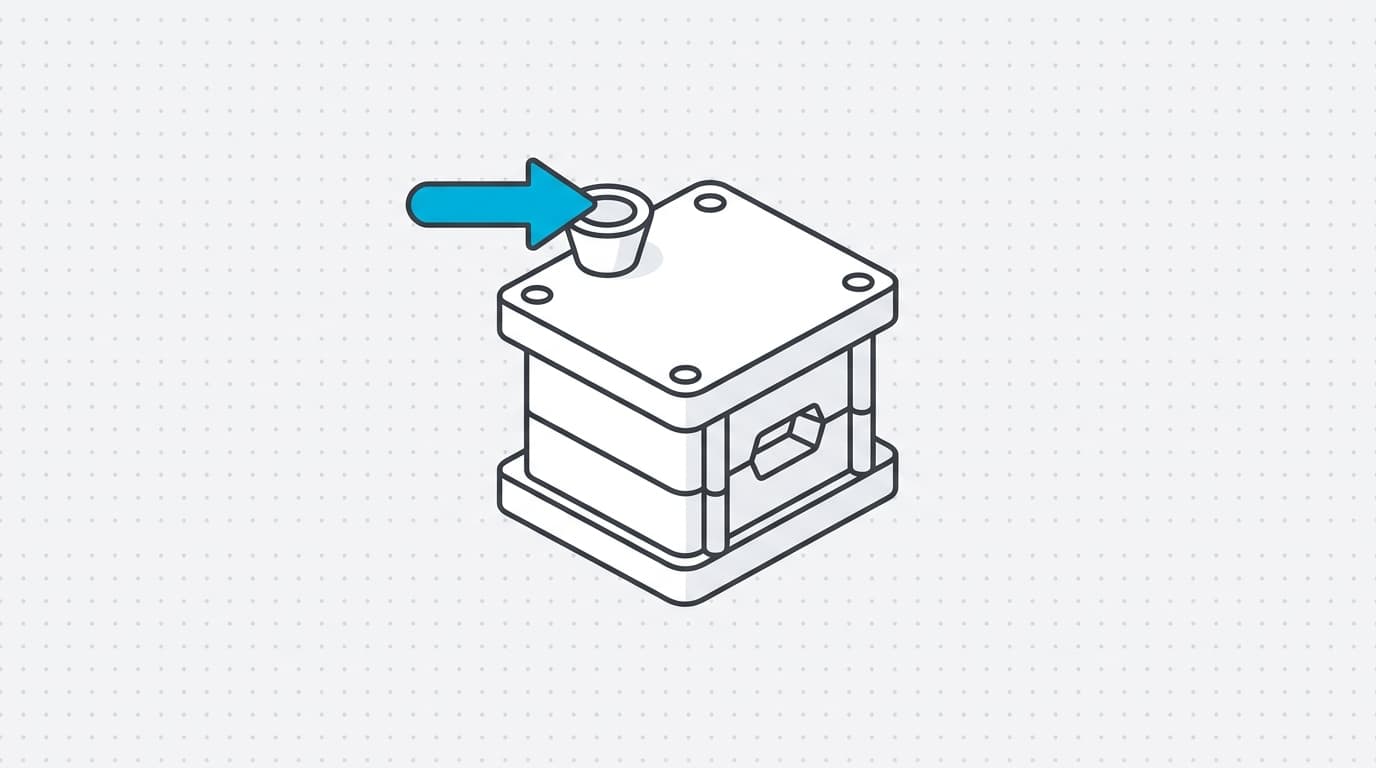
Die casting is a manufacturing process that forces molten metal under high pressure into a reusable steel mold called a die, producing dimensionally accurate metal parts at high volume. It is the go to method for making complex metal components in the thousands to millions, from housings and brackets to connectors and gearbox parts. If you have shipped a plastic product before, think of die casting as the metal equivalent of plastic injection molding.
The catch is tooling. A steel die is expensive to cut, so die casting only makes financial sense once you spread that cost across a large run. This guide explains how the process works, which alloys to consider, how it compares to injection molding and CNC machining, and what the numbers actually look like when you calculate landed cost per part.
It is written for founders, engineers, and product teams deciding whether die casting is the right process for a metal part, and how to source it without overpaying.
Process picker
Is die casting right for your part?
Match your part to the right process:
What Is Die Casting?
Die casting is a metal forming process in which molten metal is injected under high pressure into a hardened steel mold, held until it solidifies, then ejected as a finished or near finished part. The steel mold is the die, and because it is reusable it can produce the same part over and over with tight, repeatable tolerances.
There are two main variants. Hot chamber die casting keeps the metal reservoir inside the machine and suits low melting alloys like zinc and magnesium, which allows very fast cycle times. Cold chamber die casting ladles metal in from a separate furnace for each shot and suits higher melting alloys like aluminum, which would otherwise damage the pump in a hot chamber setup. The alloy you choose largely decides which machine your supplier will run.
The defining strengths of die casting are speed, repeatability, and detail. Once the die exists, each part comes out in seconds with clean surfaces, thin walls, and features that would be slow and expensive to machine one at a time. That is why die casting dominates high volume metal parts across automotive, electronics, lighting, tools, and hardware.
How the Die Casting Process Works
A production die casting run moves through a predictable sequence. Timelines vary with part size and complexity, but the steps rarely change.
- 1. Die design and build. Engineers design a two part steel die with cavities, cooling channels, and ejector pins. Cutting this tooling is the largest upfront cost and can take several weeks.
- 2. Clamp and inject. The two die halves close under heavy clamping force. Molten metal is then injected into the cavity under high pressure, often several thousand pounds per square inch.
- 3. Cooling and solidification. The metal fills every detail and solidifies inside the die within seconds, taking the exact shape of the cavity.
- 4. Ejection. The die opens and ejector pins push the solid part out. The cycle then repeats, which is what makes die casting so fast at volume.
- 5. Trimming. Excess metal from the runners, gates, and flash is trimmed away, usually in a separate trim press.
- 6. Finishing and inspection. Parts are deburred and may be machined, drilled, tapped, powder coated, anodized, or plated, then inspected against your drawing before shipment.
Most of the value engineering happens in step one. A well designed die with uniform wall thickness, generous draft, and smart gate placement runs faster, lasts longer, and produces fewer scrap parts. Time spent on the die pays for itself across the whole program.
Die Casting Alloys Compared: Aluminum, Zinc, Magnesium
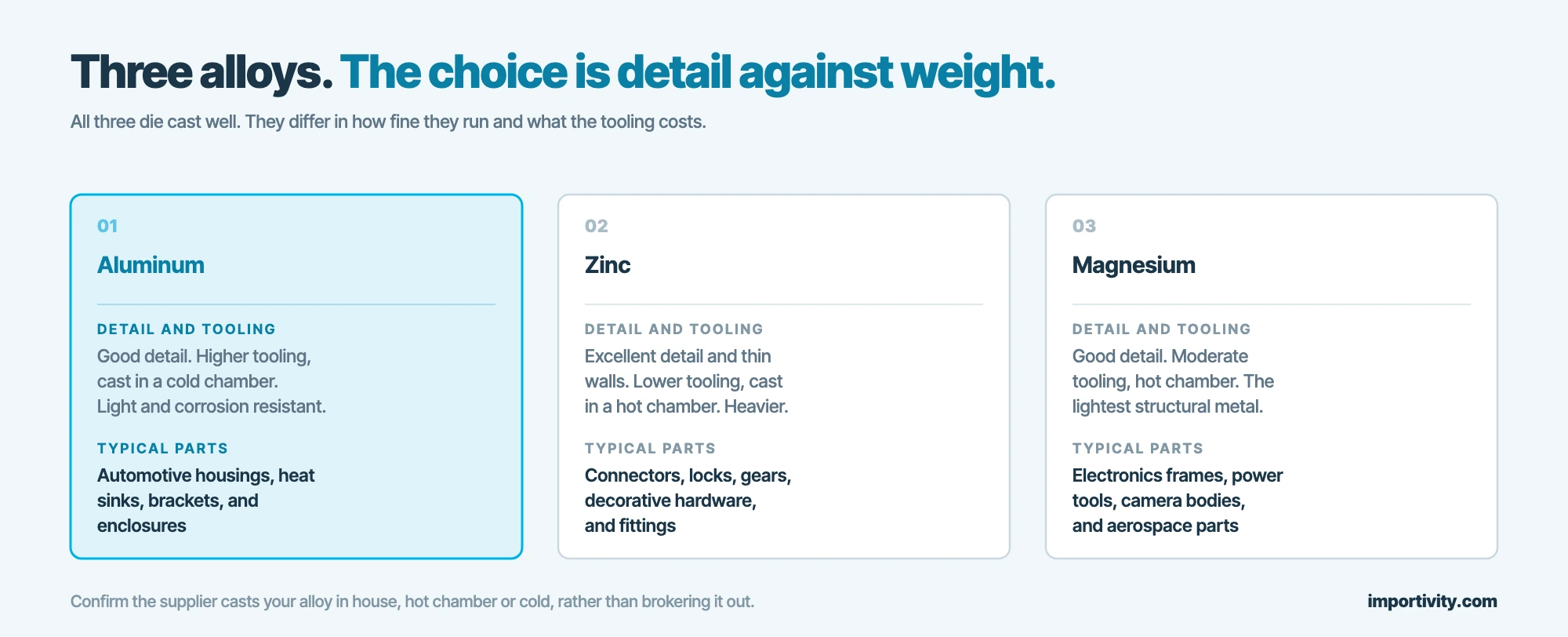
Three families of alloy cover the vast majority of die cast parts. Aluminum is the workhorse, zinc is the detail and low tooling choice, and magnesium is the lightweight option. The table below sums up how they differ so you can match the metal to the job.
| Alloy | Key strength | Detail and thin walls | Relative tooling cost | Weight | Typical uses |
|---|---|---|---|---|---|
| Aluminum | Light, strong, and corrosion resistant, the most common die cast alloy | Good | Higher, cast in cold chamber | Light | Automotive housings, heat sinks, brackets, enclosures |
| Zinc | Casts easily with fine detail and thin walls, low tooling cost | Excellent | Lower, cast in hot chamber | Heavier | Connectors, locks, gears, decorative hardware, fittings |
| Magnesium | The lightest structural metal, strong for its weight | Good | Moderate, cast in hot chamber | Lightest | Electronics frames, power tools, camera bodies, aerospace |
Aluminum wins when you need a strong, corrosion resistant part at moderate weight, which is why it is the default for most structural and thermal applications. Zinc wins when you need very fine detail, thin walls, or a lower tooling budget, at the cost of extra weight. Magnesium wins when shaving grams matters more than anything else, such as portable electronics and handheld tools.
Die Casting vs Injection Molding vs CNC
Die casting is one of three processes teams commonly weigh for a functional part. The right pick depends on material, volume, and how much you can spend on tooling before the first unit ships.
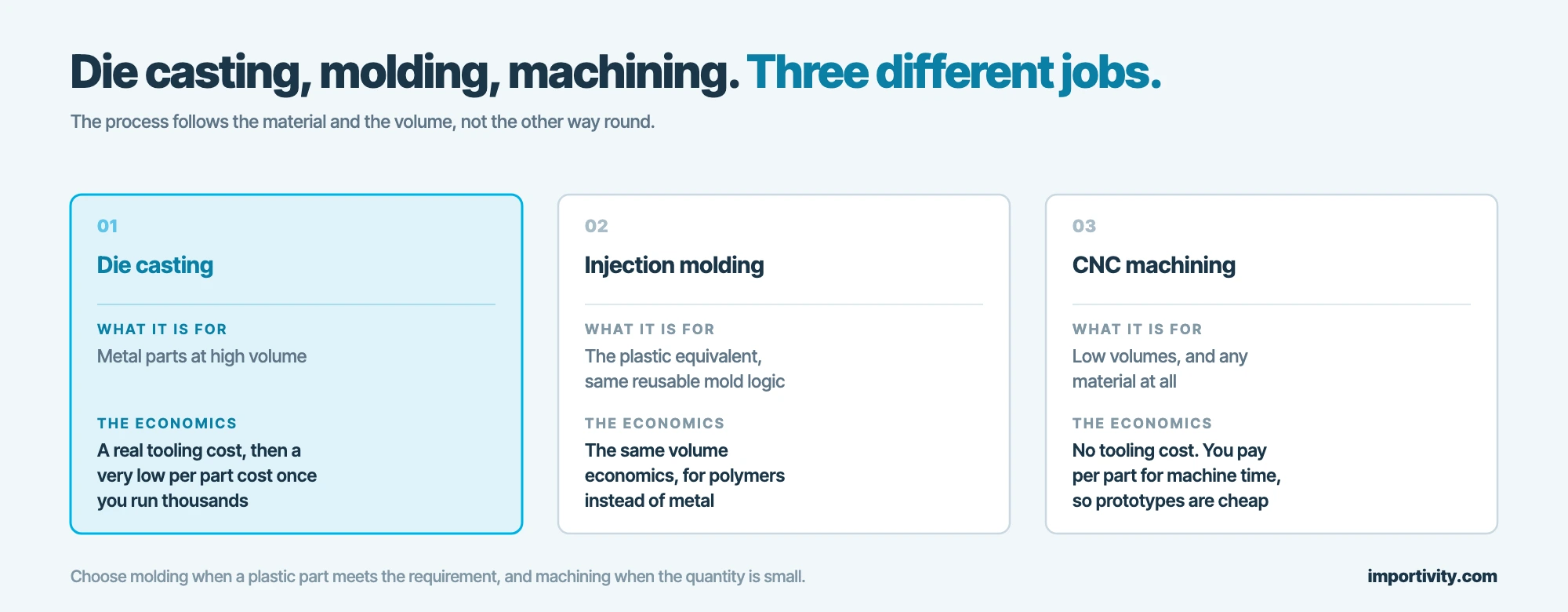
- Die casting is for metal parts at high volume. It carries a real tooling cost but drives per part cost very low once you run thousands of units, so it wins on price at scale.
- Injection molding is the plastic equivalent of die casting. Same high pressure, reusable mold logic, same volume economics, but for polymers instead of metal. Choose it when a plastic part meets your strength and heat requirements. Our guide to plastic injection molding sourcing covers it in depth.
- CNC machining suits low volumes and any material with no tooling cost at all. You pay per part for machine time, so it is ideal for prototypes, low quantities, and metals that are hard to cast. See CNC machining metal parts sourcing for the full picture.
A simple rule of thumb: prototype and validate with CNC, then move to die casting once your metal design is locked and your volume justifies the tooling. If the part can be plastic, injection molding usually beats both on cost. For long constant cross section profiles like rails and frames, aluminum extrusion can be cheaper still, and for flat or bent parts, look at sheet metal fabrication before you commit to a cast tool.
What Die Casting Costs
Die casting has two cost layers: a one time tooling cost and a per part cost. Steel dies are expensive, commonly $5,000 to $50,000 or more depending on size and complexity, but the per part cost is very low once the die exists. That is the whole economic story of the process. Tooling is a fixed cost you spread, or amortize, across every unit you produce, so the more parts you make, the smaller the tooling slice inside each one.
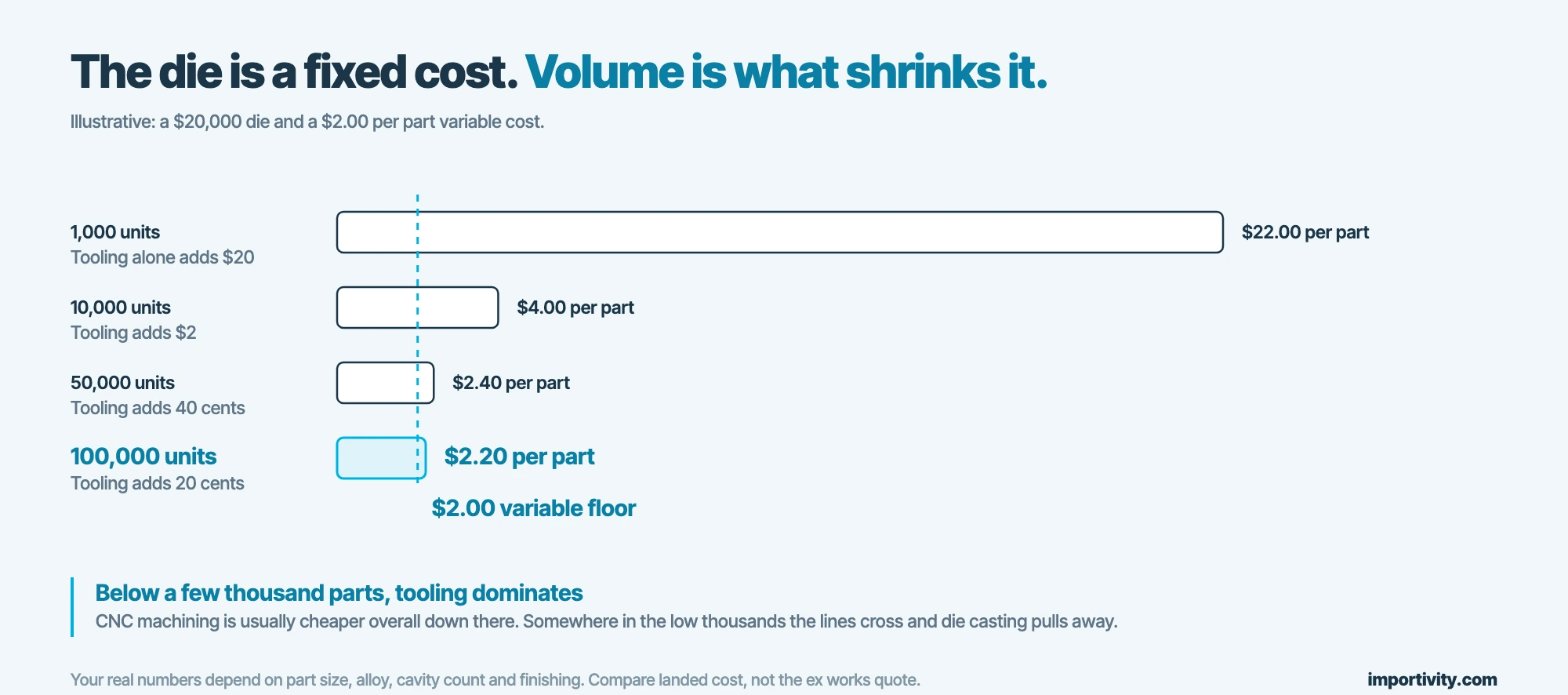
The chart below shows the idea. Using an illustrative $20,000 die and a variable cost of about $2.00 per part, the effective cost per part falls sharply as order volume climbs. At 1,000 units the tooling alone adds $20 to each part. At 100,000 units it adds just 20 cents.
Illustrative only, based on a $20,000 die and a $2.00 per part variable cost. Your real numbers depend on part size, alloy, cavity count, and finishing. This is why die casting needs volume to be economical, and why it is best for high volume metal parts in the thousands to millions.
The takeaway is straightforward. Below a few thousand parts, tooling dominates and CNC machining is usually cheaper overall. Somewhere in the low thousands the lines cross, and from there die casting pulls away. Always compare the true landed cost per part, not just the factory quote, because freight, duty, and finishing all sit on top of the casting price.
How to Source Die Cast Parts
Finding a die caster is easy. Finding one that hits your tolerances, protects your tooling, and holds price across reorders is the real work. Run through this checklist before you release a deposit.
- Confirm the supplier actually die casts your alloy in house, whether that is hot chamber for zinc and magnesium or cold chamber for aluminum, rather than brokering it out.
- Share a full 2D drawing and 3D model with tolerances, draft angles, wall thickness, and critical dimensions clearly marked.
- Ask for design for manufacturing feedback before the die is cut, since fixing geometry on screen is far cheaper than fixing steel.
- Get a written breakdown that separates tooling cost from per part price, and confirm who owns the die once you have paid for it.
- Clarify cavity count, expected cycle time, and quoted capacity so your reorders are not stuck behind larger jobs.
- Order a paid first article sample and measure it against your drawing before approving full production.
- Agree an acceptable quality limit for defects and require pre shipment inspection on every batch.
- Specify all secondary operations up front, including machining, tapping, deburring, powder coat, anodize, or plating.
- Compare true landed cost per part across suppliers, adding freight and duty, not just the ex works casting price.
- Use staged payment terms tied to milestones, and start with a modest first order before scaling volume.
If you would rather not manage this alone, our product sourcing service handles supplier vetting, sampling, and quality control for die cast and machined parts end to end.
For a worked example running from a drawing to a first article, see our 420seven prototyping case study, and Source With Jordan for the sourcing behind it.
Frequently Asked Questions
What is die casting in simple terms?
Die casting is a process that forces molten metal under high pressure into a reusable steel mold called a die. The metal solidifies in seconds and is ejected as an accurate metal part. Because the die is reusable, the process can make the same part over and over at high volume, which makes it the metal equivalent of plastic injection molding.
Which metals can be die cast?
The three most common die cast alloys are aluminum, zinc, and magnesium. Aluminum is light, strong, and corrosion resistant and is the most widely used. Zinc casts easily with fine detail and thin walls and has lower tooling cost but is heavier. Magnesium is the lightest structural metal, which suits portable electronics and handheld tools.
How much does a die casting mold cost?
Steel dies are expensive, commonly $5,000 to $50,000 or more depending on part size, complexity, and cavity count. This is a one time tooling cost. Per part cost is very low once the die exists, so the total cost per part drops sharply as your order volume rises.
When should I use die casting instead of CNC machining?
Use CNC machining for prototypes and low volumes, since it has no tooling cost and works with any material. Switch to die casting once your metal design is finalized and your volume reaches the thousands, where the low per part cost easily offsets the tooling investment. The crossover point usually falls in the low thousands of units.
Is die casting cost effective for small orders?
Usually not. Because the steel die costs thousands of dollars, small orders carry a very high effective cost per part. Die casting is best for high volume metal parts in the thousands to millions, where the tooling is spread thin. For small runs, CNC machining is typically cheaper overall.
About the author
Jordan Lewis
Chief Operating Officer, Importivity
Runs Importivity's sourcing operations across China, Vietnam, Mexico and India, from supplier negotiation through landed delivery.
Press and media inquiries: press@importivity.com