Does Alibaba Have Scams (The Common Frauds and How Importers Avoid Them)
Yes, Alibaba has scams. The platform itself is legitimate and most suppliers on it are real factories, but Alibaba is a directory of millions of independent sellers, and a minority of them will take your deposit and vanish, swap your samples for garbage, or quietly route your payment to a personal account. The good news is that fraud on Alibaba is not random. It follows a short list of repeatable patterns, and almost every loss traces back to two or three avoidable mistakes.
This guide walks through the scams that actually cost U.S. importers money, the red flags that precede each one, and the concrete steps that neutralize them. If you want the broader safety framework rather than the fraud catalog, start with our companion piece on whether Alibaba is safe for U.S. importers, and if you have decided the platform is not for you, see our rundown of Alibaba alternatives and what each one is for.
The through-line is simple. The platform gives you real tools, Trade Assurance, verified listings, and dispute resolution, but those tools only work if you stay inside them and document what you are buying. Scammers exist to get you to step outside.
Is Alibaba a Scam or Does It Just Host Them
Drawing the distinction matters because the answer changes what you do. Alibaba is a marketplace, and it does run real fraud controls. Industry safety guides note that Alibaba actively combats fraud through supplier verification systems, Trade Assurance, and dispute resolution services. That does not make every seller honest. It makes the platform a place where honest and dishonest sellers both advertise, and your job is to tell them apart before you send money.
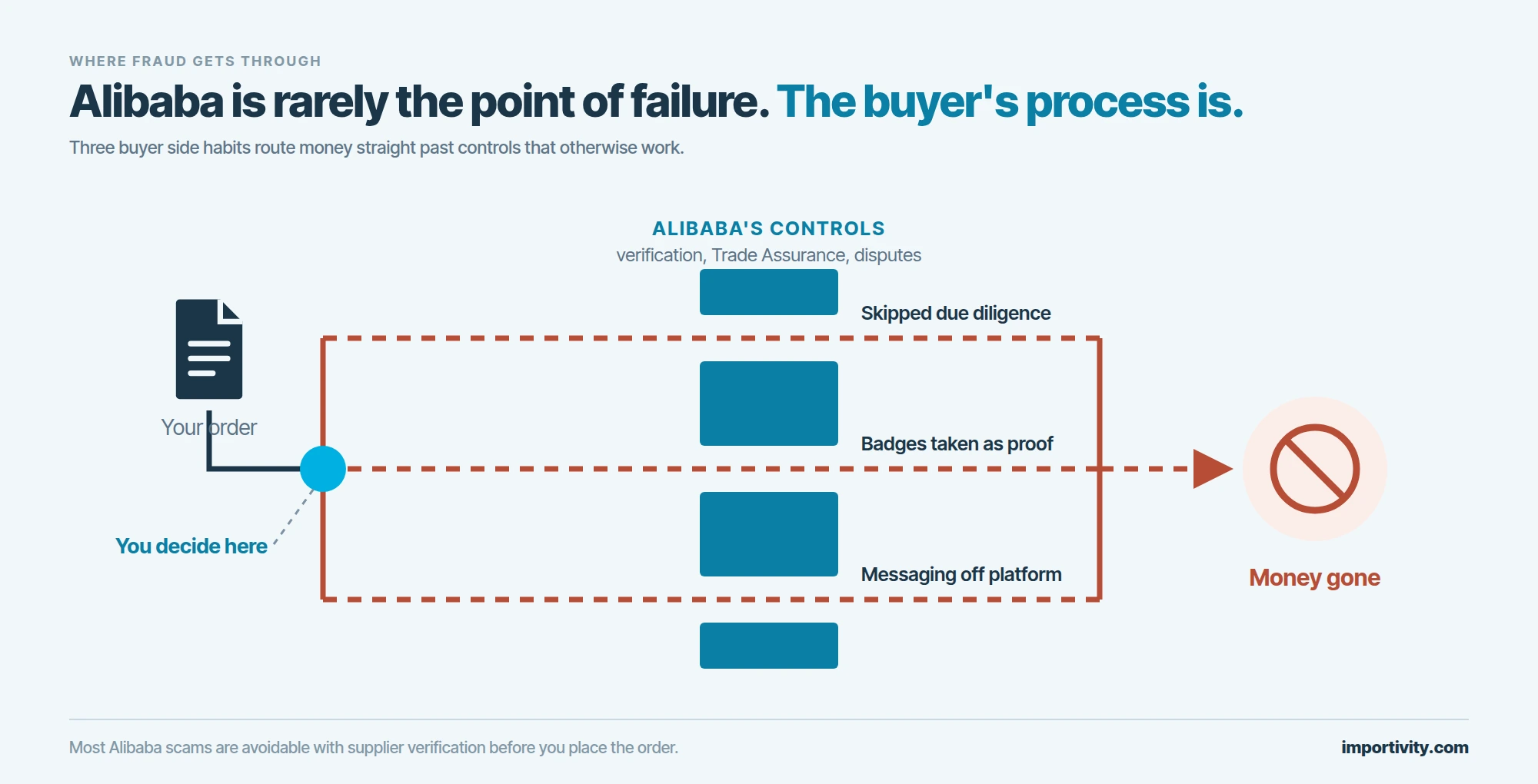
The data backs this up. Most Alibaba scams can be avoided with proper supplier verification before you place an order, and the majority of fraud succeeds because buyers skip due diligence, rely on platform badges alone, or communicate outside Alibaba's official channels. In other words, the platform is rarely the point of failure. The buyer's process is.
So the right framing is not "is Alibaba trustworthy." It is "have I done the work to trust this specific supplier." That reframe moves the whole problem into your control, which is exactly where you want it.
The Scams That Actually Cost Importers Money
Six patterns account for the overwhelming majority of real losses. Learn to recognize them and you have covered most of the threat surface.
Off-Platform Payment Diversion
This is the big one. A supplier pushes you to pay by wire, Western Union, or crypto to a personal or unrelated account, usually with a plausible reason. A common pitch is that if you take Trade Assurance they will be charged extra fees, so they ask you to pay offline instead. Once the money lands off-platform, it is gone. The moment you send money outside Alibaba's Trade Assurance system you lose all platform protections, and if something goes wrong Alibaba will tell you they cannot help because the transaction happened off-platform.
The Last-Minute Bank Account Switch
A variant that catches even experienced buyers. You have negotiated in good faith, then an email arrives updating the supplier's bank details right before you pay. The account is often a personal one with no legal tie to the company. Confirm every payment detail through Alibaba's secure messaging, never act on an email-only change, and verify the account name matches the registered business name.
Bait-and-Switch on Quality
The sample is perfect. The bulk order is cheaper, thinner, or a different product entirely. Samples may look perfect, but the bulk order can be cheaper, different, or poorly made. The defense is a pre-shipment inspection tied to a documented quality standard, which we cover below.
Fake Certificates and Test Reports
Suppliers forge CE, FCC, FDA, RoHS, or SGS documents to clear your compliance checklist. This scam is common because many buyers are too busy to verify documents before ordering, and the supplier might promise to send certificates later but never follow through. Products with fake or missing certificates frequently get stuck at the border. If you import regulated goods, read our guide on verifying component origin in electronics supply chains before you trust a PDF.
Non-Delivery and Phantom Orders
You pay, the supplier produces fake shipping proof, and the goods never exist. One documented case involved a U.S. small business that paid $9,500 for electronics from a supplier with fake shipping proofs where the tracking numbers never worked and the funds were unrecoverable. Trade Assurance and a small verified trial order are the antidote.
Fake Factories and Trading Companies Posing as Mills
Some sellers claim to be manufacturers but are brokers with no production capacity. Some sellers claim to be manufacturers but are actually small brokers with no real production capacity. That is not always fraud, but it changes your pricing and your control, so know who you are dealing with. Our breakdown of buying direct from a manufacturer versus a wholesaler or trading company explains the trade-offs.
The Red Flags That Precede Every Scam
Scams announce themselves before they strike. The following signals, especially in combination, should stop a deal cold.
- Any push off-platform. Watch for pressure to move conversations to WhatsApp, email, or WeChat before escrow is in place.
- Unusual or personal payment requests. If a supplier asks you to pay via an unusual method or to a different account than usual, it is a red flag.
- Prices far below the market. A quote that is too good is bait for a bait-and-switch.
- Vague or stalling answers on specs, lead time, or inspection. Honest factories answer technical questions directly.
- Badges used as the only credential. A Gold Supplier badge only means a fee was paid, not that every deal is safe.
None of these is proof of fraud on its own. Two or three together is a pattern, and a pattern is your cue to slow down and verify harder, not to rationalize why this seller is the exception.
Payment Methods Ranked by Protection
Where your money sits determines whether you can get it back. This is the single most important decision in the whole transaction, so treat payment choice as a risk control, not a convenience.
Trade Assurance is the backbone. Trade Assurance protects your payment, ensures delivery deadlines, and allows you to open a dispute if products differ from the agreed specifications. But it only covers what the order documents, so vague specs leave you exposed even inside the system.
| Method | Protection Level | Recourse If Scammed | Use When |
|---|---|---|---|
| Alibaba Trade Assurance | Strongest | On-platform dispute and mediated refund | Default for nearly every order |
| Credit card via Trade Assurance | Strong | Dispute plus card chargeback | Smaller orders, extra backstop |
| PayPal | Moderate | Buyer protection claim, limited on B2B | Samples and small orders |
| Bank wire to company account | Weak | Hard recall, rarely successful | Only with a vetted, long-term supplier |
| Western Union or crypto | None | Effectively zero | Never |
The rule writes itself. Most Alibaba scams happen when buyers agree to pay outside the platform, especially via wire transfer or crypto, so staying within Trade Assurance is your strongest safety net. If a supplier fights you on this, that fight is the answer.
How to Vet a Supplier Before You Send a Dollar
Verification is tedious and it is also the part that actually works. Budget an afternoon per serious candidate and run this checklist.
Confirm the Real Company, Not the Listing
Badges are a starting filter, not proof. Cross-reference the supplier's Chinese company name against official government business registries and check the registration date, registered capital, and legal representative. A company claiming a decade of experience with a two-year-old registration is lying about something.
Verify Compliance Claims Independently
Do not accept a certificate PDF at face value. Verifying supplier credentials through official government databases such as the FDA, FCC, and CPSC takes minutes and prevents costly compliance failures. For regulated categories this step also keeps your shipment from being seized at the port, which no refund covers.
Pin Down Specs in Writing Before Payment
Ambiguity is the scammer's friend and the honest supplier's enemy. Get everything in writing, including product specifications, prices, delivery times, and refund policies, and make sure nothing is left unclear. Attach bilingual specs to the Trade Assurance order so a dispute has something concrete to reference. For a repeatable framework, use our supplier scorecard and our supplier onboarding checklist.
Protect Your Design and Your Price
If you are sharing designs or tooling, a standard Western NDA will not hold up in China. Use an NNN agreement instead, which addresses non-use, non-disclosure, and non-circumvention under Chinese law.
Inspection Is the Control Scammers Hate Most
Payment protection gets your money back after a bad order. Inspection stops the bad order from shipping in the first place, which is the better outcome. A China lawyer's guidance on this is blunt. Three critical steps are to verify the supplier's business license, use secure traceable payments tied to specific contracts, and never waive your right to independent pre-shipment inspections.
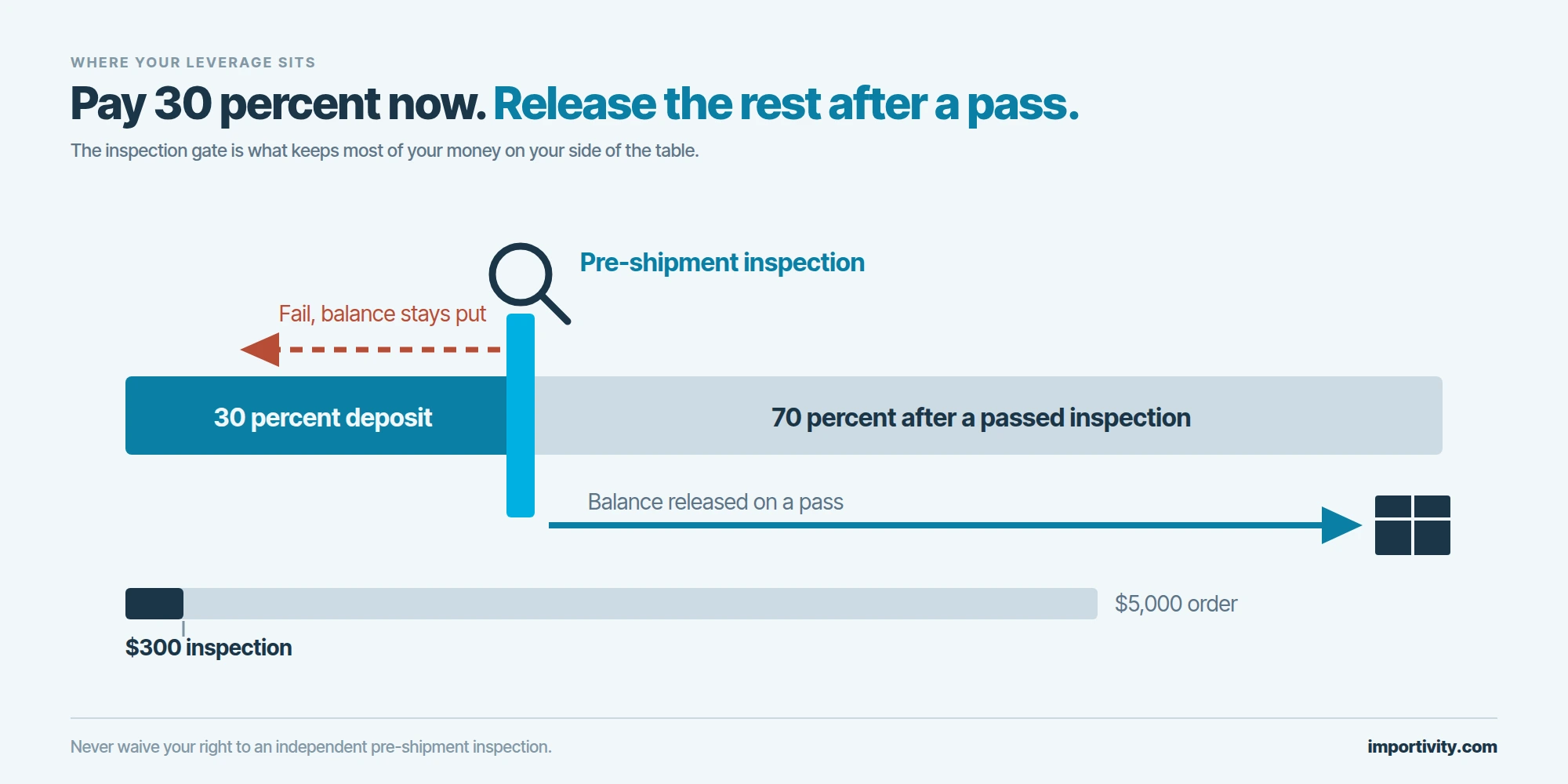
Third-party inspection is cheap relative to what it protects. Third-party inspection services such as SGS and QIMA cost around $300 per shipment, which delivers strong ROI on orders above $5,000. Tie the inspection to a defined acceptance standard so the pass or fail is objective, not a judgment call. Our explainer on AQL sampling and what AQL 2.5 Level II means covers how to set that standard, and a first article inspection catches problems before mass production even starts.
Structure payment around the inspection, not around trust. A common safe split is a 30 percent deposit and 70 percent after a passed pre-shipment inspection, so your leverage survives until the goods are verified. That single structural choice defuses the bait-and-switch, the phantom order, and the quality fraud at once.
What to Do If You Have Already Been Scammed
Speed matters. If you paid through Trade Assurance, open a dispute inside the platform immediately and upload your contract, specs, messages, and any evidence. The system is built for exactly this, and it allows you to open a dispute if products differ from the agreed specifications.
If you paid off-platform, your odds drop sharply but you still act fast. Contact your bank to request a wire recall before the funds clear, file a report with local law enforcement and the FBI's IC3 if you are in the U.S., and gather every record of the transaction. Wires and crypto move quickly, so hours count. The hard truth is that unusual payment requests to a different account are a red flag, and sticking to secure methods like Trade Assurance is the only reliable protection against this exact outcome.
Either way, document the fraud and report the supplier to Alibaba so the listing can be flagged. It will not recover your money, but it limits the next buyer's exposure.
Frequently Asked Questions
Does Alibaba have scams, or is the platform itself a scam?
Alibaba is a legitimate marketplace, not a scam, but it hosts millions of independent sellers and some of them do defraud buyers. The platform runs verification, Trade Assurance, and dispute resolution, yet most fraud succeeds because buyers skip due diligence or pay off-platform. Treat Alibaba as a directory of strangers, not a seal of trust.
What is the single most common Alibaba scam?
Off-platform payment diversion. A supplier convinces you to pay by wire transfer, Western Union, or crypto to a personal account, usually claiming lower fees or faster processing. The moment money leaves Trade Assurance you lose every platform protection, and Alibaba cannot help with a transaction that never happened on its system.
Does Trade Assurance actually protect my money?
It does, but only for what the order documents. Trade Assurance holds your payment and lets you open a dispute if goods differ from the agreed specs, so it only covers what the contract lists. Vague specs, off-platform payments, or waived inspection rights all blow a hole in that protection. Put your exact product, quantity, and quality standard in the order.
Do Gold Supplier and Verified badges mean a seller is safe?
No. A Gold Supplier badge mostly means the company paid an annual membership fee, not that every deal is honest. Verified status adds a basic check but is not a guarantee. Use badges as a first filter, then confirm the real Chinese business registration, trading history, and references before you wire anything.
How do I recover money if I already got scammed on Alibaba?
If you paid through Trade Assurance, open a dispute inside the platform immediately with your contract, specs, and evidence, and Alibaba can mediate or refund. If you paid off-platform to a personal account by wire or crypto, recovery is unlikely and you are into bank recall requests and local police reports. Act within hours, not days, because wires clear fast.
About the author
Jordan Lewis
Chief Operating Officer, Importivity
Runs Importivity's sourcing operations across China, Vietnam, Mexico and India, from supplier negotiation through landed delivery.
Press and media inquiries: press@importivity.com