Prop 65 for Importers and How the Warning Rules Apply to You

Under California's Proposition 65, an importer is one of the businesses that must warn a California buyer before a product exposes them to a listed chemical, and because the overseas factory is out of the state's reach, the claim usually lands on the US company that brought the goods in. You meet the duty with a compliant warning on the product or a written warning notice to your retailer, or by showing the exposure stays under the state's safe harbor level, and a business with nine or fewer employees is exempt.
This guide is for US brands that make products in China, Vietnam, India or Mexico and sell them where California shoppers can buy them, including your own website and Amazon. It covers who has to warn, the label change on January 1, 2028, the chemicals that show up in imported goods, testing, what a 60-day notice costs, and the factory contract. Prop 65 is one layer of the wider stack covered in our guide to import product compliance.
When the importer is the one who has to warn
Prop 65 bars a business from knowingly and intentionally exposing a person to a listed chemical without first giving a clear and reasonable warning. OEHHA's warning regulation, section 25600.2 of Title 27, puts that duty on the manufacturer, producer, packager, importer, supplier or distributor. A retailer is responsible only in five situations, and one of them is that no business further up the chain has an agent for service of process or a place of business in California.
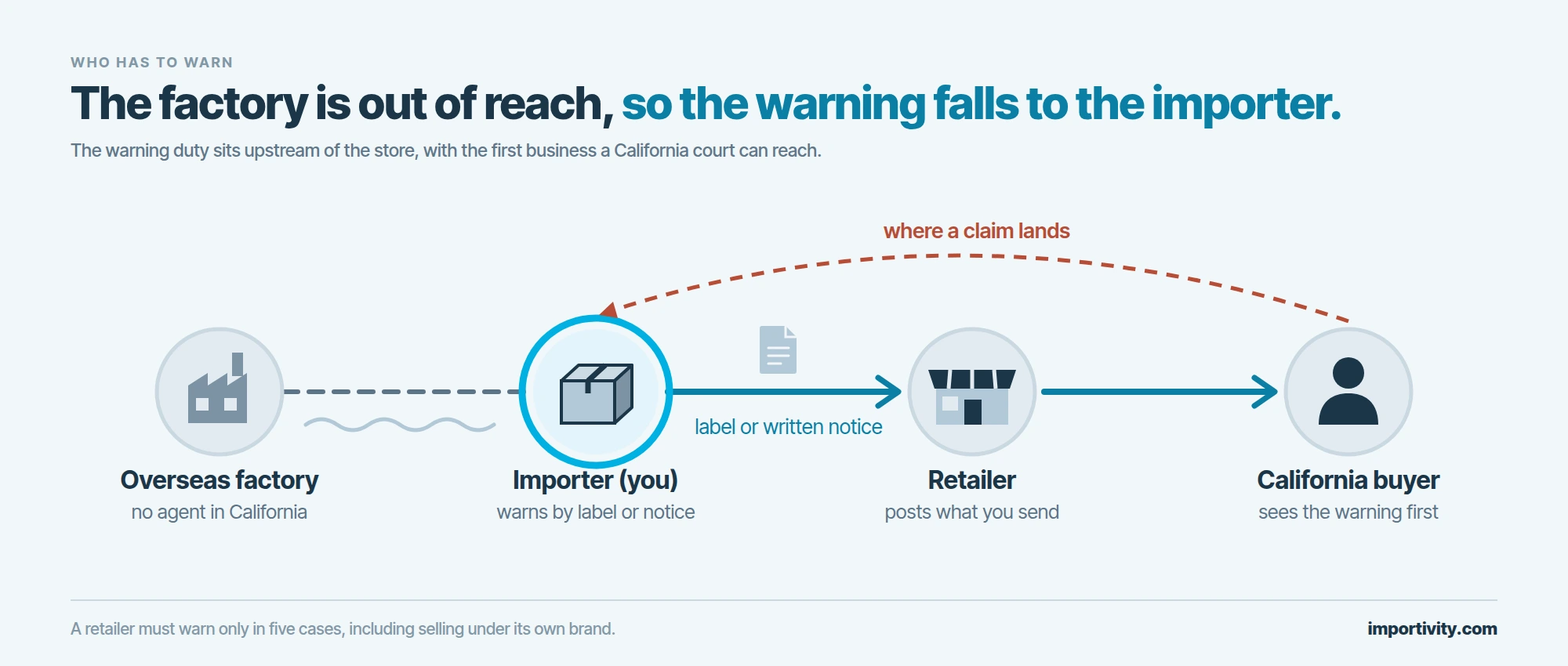
A factory in Guangdong or Binh Duong has neither, so in practice the chain stops at the first US company that handled the goods. Notices in the Attorney General's public database routinely name the US brand or importer next to the store that sold the product, and a store's vendor agreement can send the defense bill back to the vendor. It is the same logic that makes the importer of record answer for the entry at the border. If you sell under your own brand on your own site, you are importer and retailer at once, and selling under a brand you own is one of the five cases where a retailer must warn.
- Nine or fewer employees. The warning duty does not apply to a business with nine or fewer employees in total, and OEHHA counts staff outside California too. Large retail buyers may still require Prop 65 compliance in the vendor agreement.
- A 12-month grace period. Warnings are not required until 12 months after a chemical is listed. OEHHA republishes the list at least once a year, and the edition dated July 31, 2026 is the current one.
Two ways to meet the duty
An upstream business can warn on the product itself, through its label or labeling, or it can send a written notice with warning materials to the retailer's authorized agent and let the store post them. The label is easier to control. If you use the notice route, section 25600.2 says what the notice must contain:
- The exposure statement. That the product may result in an exposure to one or more listed chemicals.
- The product identity. The exact name or description, or an identifier such as the UPC.
- The warning materials. Labels, shelf signs or tags, and the warning text for internet sales.
- Renewal. Every year the product is sold in California, plus a new notice within 90 days if you add a chemical name or a new endpoint.
- Proof of receipt. Electronic or written confirmation from the agent who received it.
Online, the warning has to sit on the product display page, behind a clearly marked hyperlink using the word WARNING, CA WARNING or CALIFORNIA WARNING, or somewhere the buyer sees it before completing the purchase. A warning the buyer has to search for does not count. One more rule catches imported goods: if the label carries consumer information in another language, as bilingual packaging made for Canada or Mexico does, the warning must appear in that language as well as in English.
What the warning says, and the 2028 short-form change
The safe harbor warning, the wording OEHHA treats as clear and reasonable, starts with a black exclamation point in a yellow triangle with a bold black outline, placed left of the text and at least as tall as the word WARNING. Black and white is allowed on a label not printed in yellow. Next comes WARNING:, CA WARNING: or CALIFORNIA WARNING: in bold capitals, then a sentence naming at least one chemical. The full-length version reads "This product can expose you to chemicals including [chemical], which is known to the State of California to cause cancer. For more information go to www.P65Warnings.ca.gov."
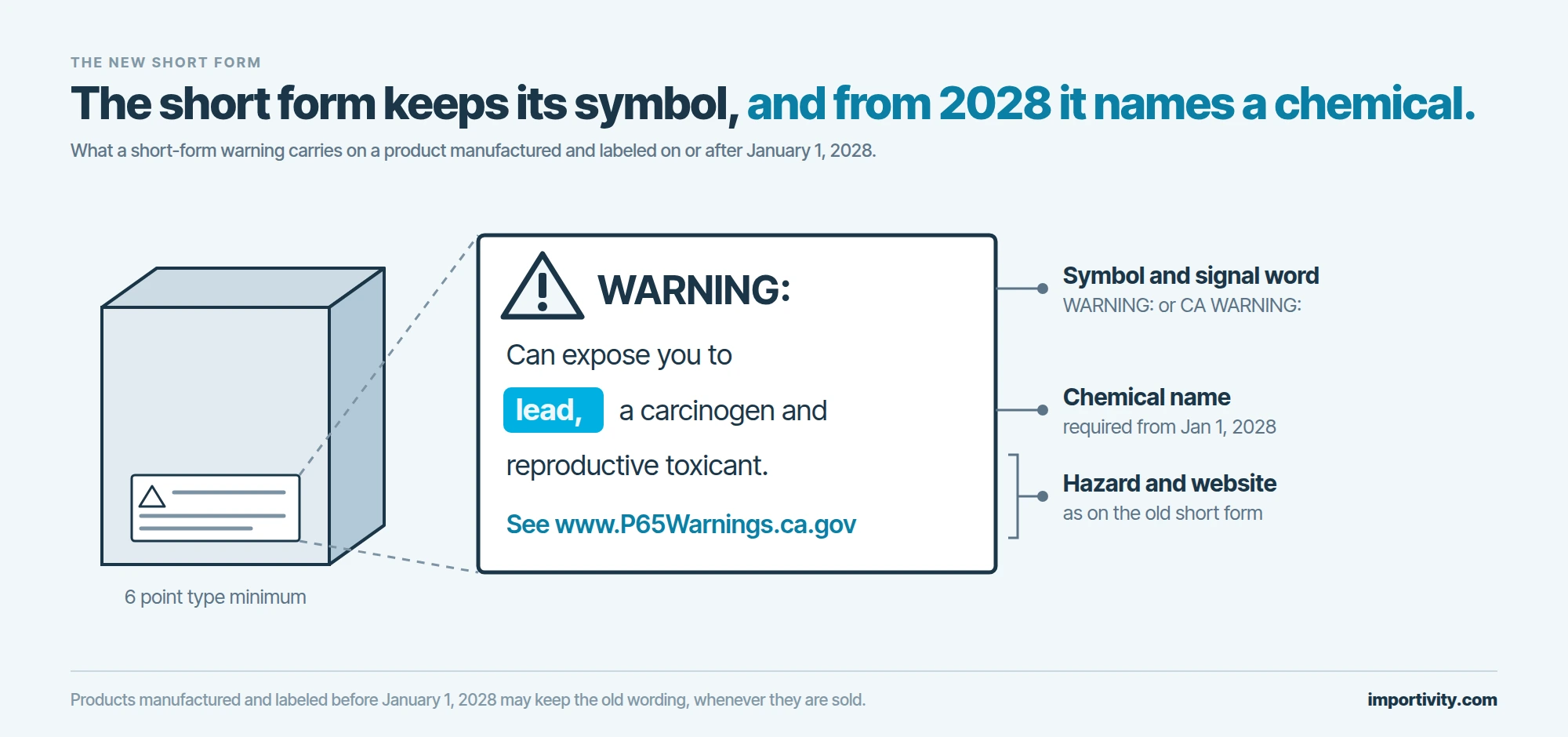
The short form is what most imported products use, because it fits a small box. It may appear only on the product label, in type no smaller than 6 point, and OEHHA dropped a proposed cap on label size. Amendments approved on November 26, 2024 and in force from January 1, 2025 changed its content. The old short form named only the hazard and the website. The new one must name at least one chemical, for example "WARNING: Can expose you to lead, a carcinogen and reproductive toxicant. See www.P65Warnings.ca.gov." The approved phrasings are in section 25603 of the regulation.
The deadline follows the production date, not the sale date. A product manufactured and labeled before January 1, 2028 may keep the old wording and be sold at any time after. One manufactured and labeled on or after that date needs the new content. Until that date, a retailer also has 60 days after receiving your update to change the text on its website. Because the test is when the product is labeled, old box stock printed in 2027 and filled in 2028 would not qualify on a plain reading, so put the artwork change into your next packaging reorder. OEHHA's final statement of reasons explains the transition.
The next round is only a draft. Text for a July 30, 2026 OEHHA workshop, a package it calls Omnibus 2026, would add QR codes as a warning method and clarify internet warnings. None of it is law yet.
The chemicals that turn up in imported goods
Metals top the case counts. In Prop 65 settlements and judgments from the second quarter of 2026, Bureau Veritas counted metals in 60 percent, with lead in 217 cases and cadmium in 41, and phthalates in 16 percent, with DEHP in 56. Food and supplements were 53 percent of the product categories, so consumer goods are the smaller share, but the same few chemicals keep coming up in them.
Each listed chemical can carry a safe harbor number. For a carcinogen it is the No Significant Risk Level, set at no more than one extra cancer case in 100,000 people over a 70-year lifetime. For a reproductive toxicant it is the Maximum Allowable Dose Level, one thousandth of the level with no observable effect. Both are micrograms per day of exposure, not parts per million in the product.
| Chemical | Where it turns up in imported goods | Safe harbor level (micrograms per day) |
|---|---|---|
| Lead | Brass fittings, PVC and vinyl, ceramic glazes, painted surfaces | 0.5 for reproductive harm, 15 by mouth for cancer |
| DEHP | Soft PVC in cords, grips, bags and vinyl upholstery | 310 for cancer, 410 by mouth for adults for reproductive harm |
| DINP | Soft PVC where the factory swapped DEHP out | 146 for cancer |
| Bisphenol A (BPA) | Polycarbonate plastics and epoxy coatings | 3 for skin contact with solid materials, for reproductive harm |
| Cadmium | Pigments, plating, solder, some jewelry alloys | 4.1 by mouth for reproductive harm, 0.05 inhaled for cancer |
| Formaldehyde (gas) | Composite wood, glues, some finished textiles | 40 for cancer |
The list keeps moving. Bisphenol S, the chemical in the recent receipt paper settlements, was listed for female reproductive harm on December 29, 2023, for male reproductive harm on January 3, 2025 and for developmental harm on December 8, 2025, and each listing starts its own 12-month clock. PFOA, used in water-repellent and nonstick finishes, has been listed for cancer since February 25, 2022, and 2025 notices cite it in jackets.
Testing, and what a lab report does not prove
Prop 65 does not require testing. It requires a warning unless you can show the exposure is under the safe harbor level, and testing is the only way to know. The catch is that a lab measures content in parts per million, while the safe harbor is exposure in micrograms per day. A charging cord with DEHP in its jacket and a sealed internal part with the same content give very different exposures, so pair content results with an estimate of how much reaches the user's hands or mouth in normal use.
- Test materials, not product names. Get a material list per component and send the parts most likely to carry a listed chemical, such as soft PVC, coatings, brass, ceramic glazes, coated fabric and composite wood.
- Use an accredited lab and keep the full report. A certificate alone does not say which sample was tested or how.
- Pull the samples yourself. Have your inspector take them from the production lot during the pre-shipment inspection, not from a box the factory set aside.
- Retest on change. A new resin supplier, plating line or pigment batch can move the result.
When a result comes back high, you can warn, which costs a label change and may cost a retail buyer who will not stock warned products, or reformulate, which costs a higher unit price and a new round of samples. Settlements force the same choice: injunctive terms in the Attorney General's records often read "reformulate or provide warning."
60-day notices and what a settlement costs
The Attorney General, district attorneys and city attorneys of cities over 750,000 people can sue, and so can private enforcers acting in the public interest. A private enforcer must first send a 60-day notice to the business, the Attorney General and local prosecutors, with a certificate of merit saying an expert has reviewed the exposure data and the case has merit. It may sue only if no public prosecutor takes the case within those 60 days. Civil penalties run up to $2,500 per day for each violation.
The Attorney General's public log of 2025 notices runs past number 5,200, with filings as late as December 26. Most of the money goes to the plaintiff's lawyers. The latest annual summary on the Attorney General's settlement reports page, for 2019, counted 898 private settlements worth $29.8 million, of which 76 percent was attorney fees and costs and 18 percent civil penalties. Recent cases look the same. A June 2025 settlement over an imported shave foam paid a $2,000 penalty and $22,000 in fees and costs, plus a commitment to reformulate or warn.
If a notice arrives, do not ignore it and do not answer the enforcer before you have advice. Check whether the product is sold into California, your total head count, when the chemical was listed and what your test data shows. Then send it to Prop 65 counsel and to any retailer named with you, and read the indemnity clause in your vendor agreement. This guide is general information, not legal advice.
What to put in the supplier agreement
The factory will not be the defendant in California, so the agreement has two jobs: keep listed chemicals out of the product, and leave you a paper trail if one gets in. Put these terms into the manufacturing purchase order or the supply agreement it references:
- A restricted substances list naming each chemical, its content limit and the test method you will use.
- Material declarations for every component, covering resin, plasticizer, pigment, plating and alloy by grade and source.
- No substitutions of a material or sub-supplier without written approval, with a retest at the factory's cost.
- Test reports before final payment, from an accredited lab, on samples your inspector pulled.
- Warning artwork control. The factory prints your approved label file exactly, at 6 point or larger, in every language on the pack.
- Cost of failure. Who pays for rework, relabeling or replacement when a lot fails.
- Indemnity. Worth having, but hard to collect from a company with no US assets, so the payment holdback is your real protection.
Category rules sit on top of Prop 65. A children's product also needs CPSIA testing, covered in our guide to toy manufacturers in China, and a cosmetic carries the MoCRA duties in private label cosmetics manufacturing. Importivity's quality control team can pull lot samples, arrange lab tests and check warning artwork before cartons are sealed. To vet factories against your restricted substances list, send us your product details.
Frequently Asked Questions
Does Prop 65 apply to my company if we are not based in California?
Yes, if your products reach consumers in California. The warning regulation names importers and distributors among the businesses responsible, wherever they are based. The only size exemption is for a business with nine or fewer employees in total, counting staff outside California.
Do I need a Prop 65 warning on products I sell online?
If the product needs a warning and a California buyer can order it, the listing needs one as well. It can sit on the product display page, behind a clearly marked WARNING hyperlink, or appear before checkout, and a warning the buyer has to search for does not count. If your label uses the short form, the listing may use the same text.
Is Prop 65 testing required by law?
No. The law requires a warning unless you can show the exposure is below the safe harbor level, and testing is how you find out whether you can skip the warning. Lab results give content in parts per million while safe harbor levels are exposure in micrograms per day, so a report has to be read together with an exposure estimate.
Can I keep using the old short-form Prop 65 warning?
Yes, on products manufactured and labeled before January 1, 2028, and those products can be sold at any time after that date. Products manufactured and labeled on or after January 1, 2028 need the new short form, which names at least one chemical. The new wording has been allowed since January 1, 2025, so you can switch at your next packaging reorder.
What should I do if I receive a Prop 65 60-day notice?
Do not ignore it, and do not answer the enforcer before you have advice. Confirm whether the product is sold into California, your total employee count and what your test data shows, then send the notice to Prop 65 counsel and to any retailer named with you. The private enforcer can file suit once the 60 days pass if no public prosecutor has taken the case.
About the author
Jordan Lewis
Chief Operating Officer, Importivity
Runs Importivity's sourcing operations across China, Vietnam, Mexico and India, from supplier negotiation through landed delivery.
Press and media inquiries: press@importivity.com