How to Choose a Private Label Cosmetics Manufacturer
Choosing a private label cosmetics manufacturer is mostly a regulatory decision wearing a commercial disguise. Under the Modernization of Cosmetics Regulation Act, the legal duties attach to the responsible person, defined as the manufacturer, packer or distributor whose name appears on the product label. For a private label brand that is almost always you, not the factory filling your jars. So the question is not who can make a nice serum cheaply. It is which manufacturer will give you the records, certifications and cooperation you need to discharge obligations that are yours by law.
This guide is for US brands launching or scaling a beauty line with a contract manufacturer. It covers who carries the liability, what MoCRA enforces right now, the two rules FDA has still not issued, the MOQ and tooling reality, and where production actually sits. If you are still deciding on the model itself, read our comparison of private label and white label first.
Who Is Legally Responsible for the Product
The responsible person is whoever is named on the label. FDA's own registration and listing guidance defines it as the manufacturer, packer or distributor whose name appears there, following the labelling provisions of the Federal Food, Drug, and Cosmetic Act. In a private label arrangement your brand name is on the jar, so your company is the responsible person even though a contract manufacturer owns the equipment, wrote the formula and ran the batch.
That designation carries the substance of MoCRA: product listing, labelling compliance, safety substantiation, adverse event reporting and recall handling. None of it transfers to the manufacturer by default. What you can do is allocate the work contractually. A quality agreement should state who prepares the safety substantiation dossier, who holds the batch records and for how long, who submits the Cosmetics Direct filings, who owns the formula, and what happens to your indemnity if the manufacturer's records turn out to be incomplete.
Treat that agreement as the real deliverable of your selection process. A manufacturer that will not commit in writing to producing safety data and batch records on demand is a manufacturer that has quietly made those your problem. Our guide to contract manufacturing covers the wider version of this relationship.
What MoCRA Enforces Right Now
Three duties are live and being enforced, and they are the ones a new brand tends to miss because the industry conversation is about the rules that have not arrived yet.
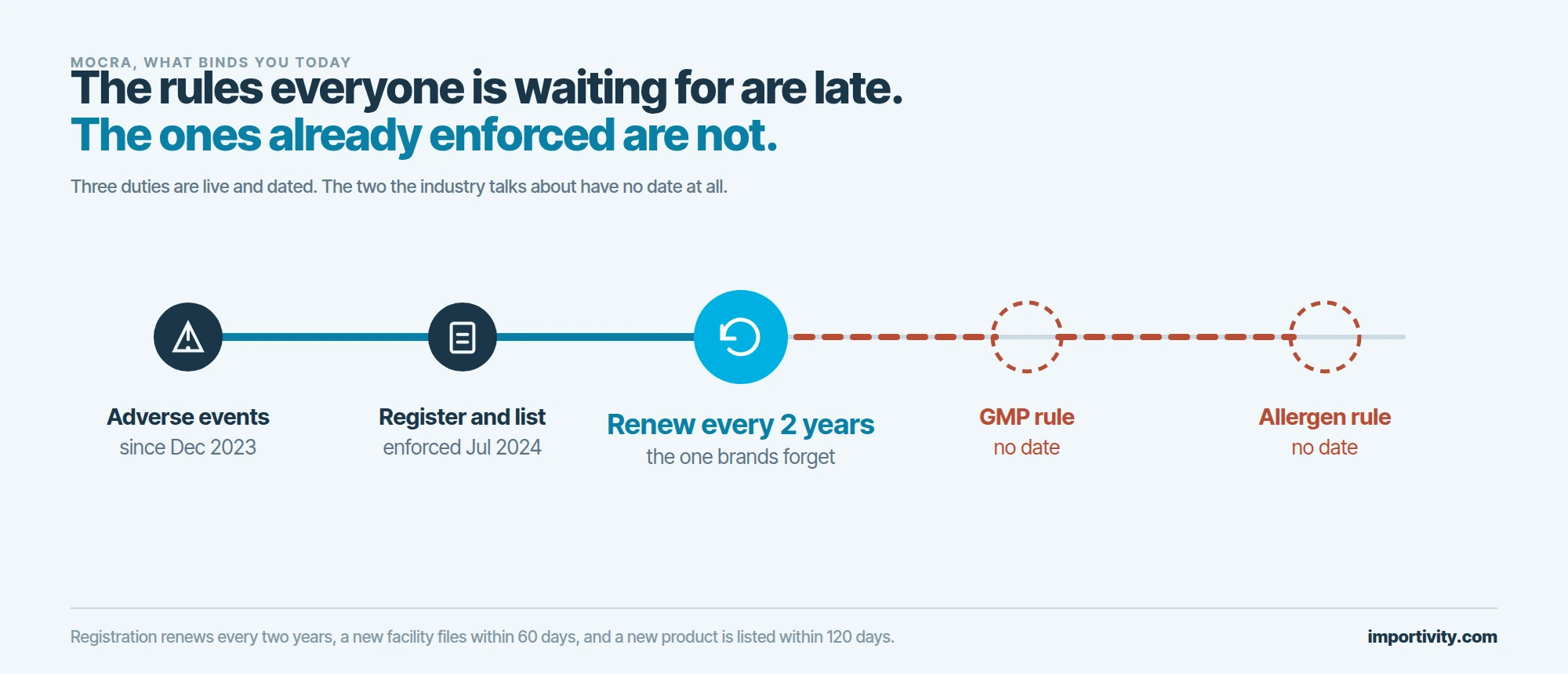
Serious adverse event reporting has been in force since 29 December 2023. A serious adverse event must be reported to FDA within 15 business days of the responsible person receiving it, with records kept for six years, or three years for small businesses. Facility registration and product listing became enforceable from 1 July 2024, after FDA's initial period of compliance policy discretion ended. Registration is renewed every two years, a new facility must register within 60 days of starting operations, and a new product must be listed within 120 days of going to market. Filings go through FDA's Cosmetics Direct portal.
The renewal is the item that catches brands out. A company that registered once in 2024 and considered the job done is now out of date. Put the biennial renewal and the 120 day listing window for each new SKU on a compliance calendar rather than in somebody's memory. Safety substantiation runs alongside all of this: the responsible person must ensure there is adequate substantiation of safety and keep the records supporting it. FDA does not prescribe a test list, which means the burden of deciding what is adequate sits with you and your manufacturer's toxicologist.
MoCRA also exempts smaller businesses, those whose average gross annual US cosmetics sales over the previous three years fall below one million dollars, from good manufacturing practice requirements and from facility registration and product listing. The exemption never covers safety substantiation, labelling or adverse event handling, and it never applies to products that come into contact with the eye's mucous membrane, are injected, or are intended for internal use.
The Two Rules FDA Has Not Issued Yet
Both of the rules the industry has been bracing for are late, and one of them has effectively been shelved. This matters for supplier selection because it decides what standard you can actually hold a manufacturer to today.
MoCRA required FDA to issue a proposed good manufacturing practice rule by 29 December 2024 and a final rule by 29 December 2025. Both deadlines passed. On the government's own rulemaking tracker, RIN 0910-AJ00, the rule moved from a targeted 2025 proposal date into the long term actions list with the notice of proposed rulemaking marked to be determined. There is no imminent federal cosmetic GMP standard.
The fragrance allergen labelling rule is in a similar position. FDA missed its statutory deadline of 29 December 2025 for the proposed rule, and as of early 2026 had not published its list or count of the allergens that will require disclosure. Any article quoting a specific number of allergens is either guessing or importing the figure from the separate European regime. Plan for the requirement, do not design a label around a number nobody has published.
The practical consequence is that ISO 22716, the international good manufacturing practice standard for cosmetics, is the benchmark to use. MoCRA requires the eventual FDA rule to reasonably align with national and international standards, which points squarely at it, and European manufacturers already work to it. Require current ISO 22716 certification, or a documented and audited equivalent, and ask to see the certificate rather than the claim.
What It Costs and Where the MOQ Cliffs Are
Numbers in this category come almost entirely from manufacturers' own published guides rather than independent research, so treat what follows as the ranges the market quotes rather than audited data, and get everything in a written quotation.
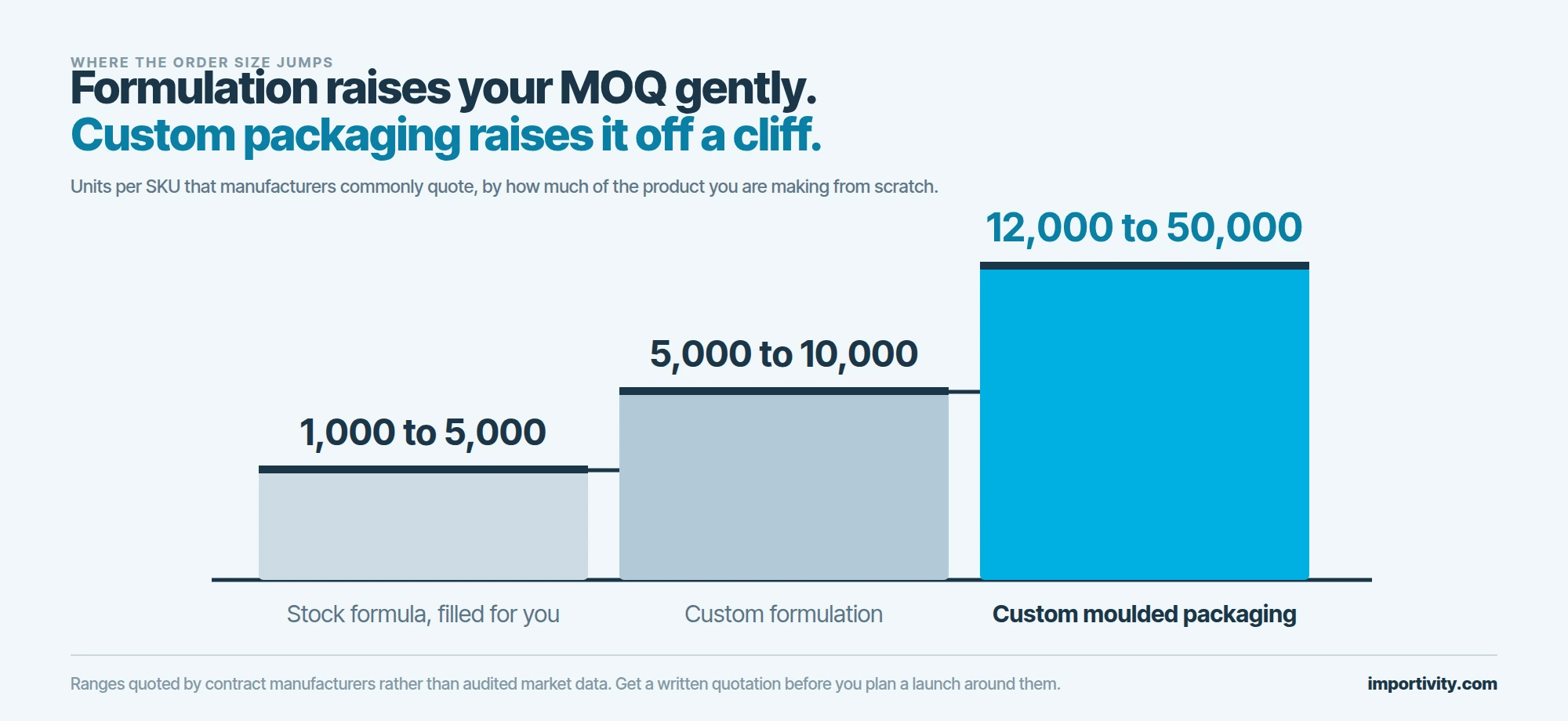
Filling an existing stock formula typically starts somewhere between 1,000 and 5,000 units per SKU, with some programmes going as low as 100 to 250 units for brands testing a concept. A fully custom formulation developed for you usually starts at 5,000 to 10,000 units, because the manufacturer is amortising bench work and stability testing across the run. The real cliff is packaging. A private mold generally needs 12,000 to 50,000 units to make economic sense, and tooling for standard components is quoted from about 5,000 to 20,000 dollars, rising into the tens of thousands and beyond for multi part closures such as airless pumps and compacts.
Time behaves the same way. Mold development alone commonly runs 25 to 45 days, and the full path from tooling kickoff to first packaging delivery is often quoted at 16 to 26 weeks. Stability testing adds its own clock: an accelerated protocol is typically run at 40 to 45 degrees Celsius and 75 percent relative humidity for somewhere between four and twelve weeks to project a two year shelf life. Sequence those in parallel rather than in series, or a straightforward launch turns into a nine month one. Our guide to the pre production sample process covers how to keep sample rounds from adding another month.
Stock packaging is the lever most new brands underuse. Choosing a manufacturer's existing bottle and building the brand in the decoration keeps you off the tooling cliff entirely, which is the difference between a 3,000 unit first run and a 20,000 unit one. Our packaging service is usually where that conversation starts.
Where Private Label Cosmetics Are Actually Made
Four regions dominate and they are genuinely different buys, not price variations of the same thing. Grand View Research puts the global private label cosmetics market at 10.64 billion dollars in 2024 and 11.15 billion in 2025, forecast to reach 14.39 billion by 2030 at a 5.2 percent compound rate, with Asia Pacific holding the largest regional share and skincare the largest product segment.
| Region | What it is genuinely good at | The trade off |
|---|---|---|
| China, concentrated in Guangdong | Lowest MOQs, full service OEM and ODM, packaging and filling in one place | Longest distance from your compliance obligations, and origin scrutiny on imports |
| South Korea | Fast formulation cycles and access to new actives and textures first | Innovation pricing, and MOQs that assume you are scaling |
| Italy | Color cosmetics and prestige packaging execution | Highest unit cost, and development timelines built for large brands |
| United States | Already inside MoCRA jurisdiction, short lead times, no import duty | Higher unit cost and fewer options at very low volume |
The regulatory argument for domestic manufacturing is stronger than it used to be, because your obligations as responsible person do not shrink with distance. A US facility is already registered, already inspectable, and already producing the kind of batch documentation FDA expects. That is worth a real premium per unit if your product carries claims you may one day have to defend. If you go overseas, our guide to import product compliance sets out what has to travel with the goods.
What to Require Before You Sign
Ask for these in writing during selection, not after the first purchase order.
- Current ISO 22716 certification. Ask for the certificate and the issuing body, and check the expiry date rather than the logo on the website.
- A quality agreement. It should name who does safety substantiation, who keeps batch records and for how long, and who files with Cosmetics Direct.
- Formula ownership in writing. Decide before development whether you own the formula or license it, because the answer determines whether you can ever move manufacturer.
- Stability and challenge test protocols. Get the conditions, the duration and who pays, before the first batch.
- Full ingredient disclosure with INCI names and supplier documentation. You cannot substantiate safety on a formula you only partly know.
- A written recall procedure. Traceability by batch is the thing you will need in the hour you least want to be asking for it.
Vet the company as carefully as the formula. Our supplier vetting service and the factory audit checklist both apply here, and the supplier onboarding checklist is the version to work through once you have chosen. We film the beauty and personal care floors we qualify, and those walkthroughs go out through Source With Jordan.
Frequently Asked Questions
Who is the responsible person under MoCRA if I use a contract manufacturer?
You are, in almost every private label arrangement. FDA defines the responsible person as the manufacturer, packer or distributor whose name appears on the product label, which for a private label brand is the brand rather than the factory. Product listing, labelling, safety substantiation, adverse event reporting and recalls all sit with you, and can only be reallocated as work, not as legal duty, through a quality agreement.
What MoCRA requirements are actually being enforced in 2026?
Serious adverse event reporting has applied since 29 December 2023, with a 15 business day reporting window and six year record retention. Facility registration and product listing have been enforced since 1 July 2024. Registration renews every two years, new facilities must register within 60 days, and new products must be listed within 120 days of entering the market. Safety substantiation applies throughout.
Has FDA issued cosmetic GMP regulations yet?
No. MoCRA required a proposed rule by 29 December 2024 and a final rule by 29 December 2025, and both deadlines passed. On the federal rulemaking tracker the rule has moved to the long term actions list with the proposal date marked to be determined. Until it arrives, ISO 22716 is the standard to hold a manufacturer to, and MoCRA requires the eventual FDA rule to align with international standards.
What is a typical MOQ for private label cosmetics?
Manufacturers commonly quote 1,000 to 5,000 units per SKU for filling an existing stock formula, and 5,000 to 10,000 units for a fully custom formulation. Some low volume programmes start at 100 to 250 units. Custom packaging is the real threshold, since a private mold usually needs 12,000 to 50,000 units to be economic. These are quoted market ranges rather than audited figures, so get a written quotation.
How many fragrance allergens will FDA require me to disclose?
No number has been published. FDA missed its 29 December 2025 statutory deadline for the proposed fragrance allergen rule and has not released its list or count. Any figure circulating online is either an estimate or a European allergen count imported into a US discussion. Plan for the requirement arriving, but do not design labelling or reformulate around a number that does not officially exist.
About the author
Jordan Lewis
Chief Operating Officer, Importivity
Runs Importivity's sourcing operations across China, Vietnam, Mexico and India, from supplier negotiation through landed delivery.
Press and media inquiries: press@importivity.com