How to Find a Private-Label Clothing Manufacturer for Your Apparel Brand
In short, private label apparel is more accessible than it was a decade ago, but it rewards preparation. Brands that show up with a proper tech pack, realistic MOQ expectations, and a clear compliance checklist get better pricing, faster samples, and fewer disasters at the port. Brands that skip those steps pay for it later, sometimes in unsalable inventory, sometimes in a US Customs hold.
Below, we cover every stage: production models, sourcing countries, MOQ realities, tech packs, sampling, compliance, and a real cost breakdown. If you already know some of this, skip to the section that matters.
Production Models: Private Label, White Label, Cut-and-Sew, and Full-Package
These four terms are used loosely in the industry, which creates real confusion when you are talking to factories. Here is what each actually means, and when each one is the right call.
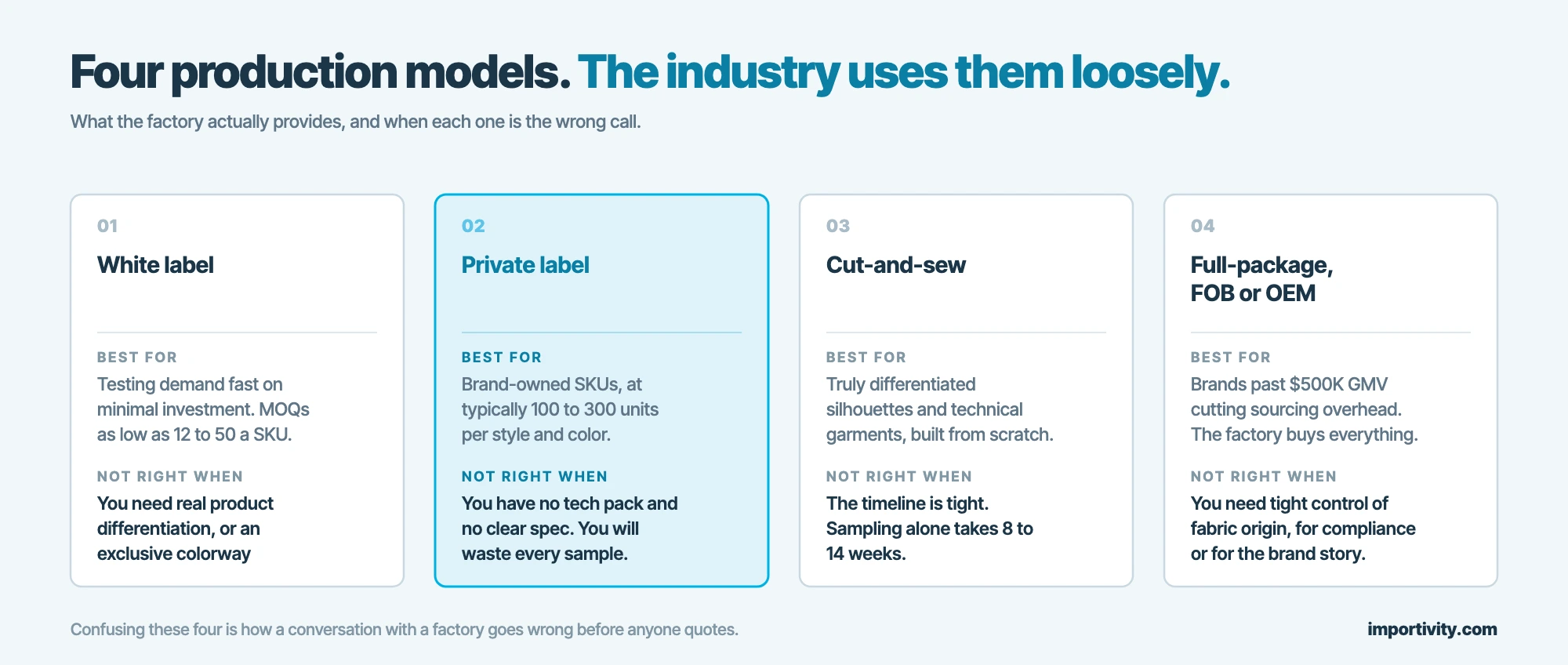
| Model | What the factory provides | Your involvement | Best for | Not right when |
|---|---|---|---|---|
| White label | Pre-made stock garments; you add your label and packaging | Branding only, no design input | Testing demand fast with minimal investment; MOQs as low as 12–50 units per SKU | You need unique product differentiation or exclusive colorways |
| Private label | Garments made to your spec, sold exclusively to you | Design direction, fabric approval, branding | Brand-owned SKUs; typically 100–300 units per style/color | You have no tech pack and no clear spec, you will waste every sample |
| Cut-and-sew | Full custom construction from scratch: pattern, cut, sew | Full design ownership, you provide or develop patterns and tech packs | Truly differentiated silhouettes, technical garments, or anything not derivable from an existing base | You are on a tight timeline; sampling takes 8–14 weeks minimum |
| Full-package (FOB/OEM) | Factory sources fabric, trims, packaging, and ships complete product FOB | Spec + approval at each stage; factory handles supply chain | Brands scaling past $500K GMV who want to reduce sourcing overhead | You need tight control over fabric origin for compliance or brand story reasons |
The deeper point: White label gets you to market fastest, but it gives factories zero reason to protect your design, the same base garment is likely selling to three other brands. If you are building a real brand asset, private label or cut-and-sew is worth the higher upfront effort.
Where to Source Apparel: Country Tradeoffs
Every country has a sweet spot. The right one for you depends on your category, quality tier, MOQ, and lead time tolerance, not just on unit price.
China
China remains the default for most apparel categories. The depth of the supply chain, fabric mills, trims, embroidery, print houses, is unmatched. FOB prices for a basic cut-and-sew tee run $3.50–$7 depending on fabric weight and finish. Factories are experienced working with foreign brands, and MOQs are generally negotiable. However, the risk is real: Section 301 tariffs (25% on most apparel HTS codes) plus potential geopolitical exposure mean brands with China-heavy sourcing are actively diversifying.
Bangladesh
Bangladesh is the world's second-largest apparel exporter after China. Its main advantage is low labor cost on high-volume, simple construction, basics, fleece, denim. FOB on a heavyweight hoodie can come in at $8–$12 vs. $14–$18 from a comparable China factory. That said, there is less depth on technical garments, embroidery quality varies, and lead times stretch to 90–120 days. Compliance infrastructure has improved greatly since Rana Plaza, but audit needs (BSCI, WRAP, SA8000) are non-negotiable with most U.S. retailers.
Vietnam
Vietnam is the primary beneficiary of China sourcing diversification. It is strong on performance and activewear, cut-and-sew complexity, and consistent quality. There is no Section 301 exposure, and EVFTA gives European market access as a bonus. The tradeoff: factories are harder to vet remotely, and the best ones are often fully booked. MOQs at quality factories tend to be higher, 300–500 units per style is a realistic floor.
India
India is the right call for natural fibers, cotton, linen, modal, and sustainable blends. It has deep cotton supply chains and strong hand-embroidery and block-print craft capabilities. India is, however, less competitive on synthetic performance wear. Lead times are comparable to Bangladesh (90–110 days), and the artisan/craft positioning can support premium retail pricing for the right brand.
Turkey
Turkey offers the fastest turnaround of any major apparel source country. At 45–60 days from order to FOB, it is achievable for standard constructions. It is strong on knitwear, denim, and performance basics. FOB prices run 20–35% higher than Asia, but the speed and proximity to Europe make Turkey attractive for brands doing frequent drops or replenishment-heavy models. For U.S. brands, the calculus is tighter given the transatlantic freight cost.
Portugal
Portugal offers premium positioning, "Made in Europe" branding, and strong technical quality, particularly on jerseyware, swimwear, and athleisure. MOQs at the better factories run 200–500 units, and FOB pricing is the highest of any region here. It is worth it if your retail price point is $80+ and European sourcing is part of the brand story.
MOQs: Where Small Brands Get Squeezed
MOQ is not one number, it operates at three levels, and confusing them is how you end up with 600 units of a colorway you cannot sell.
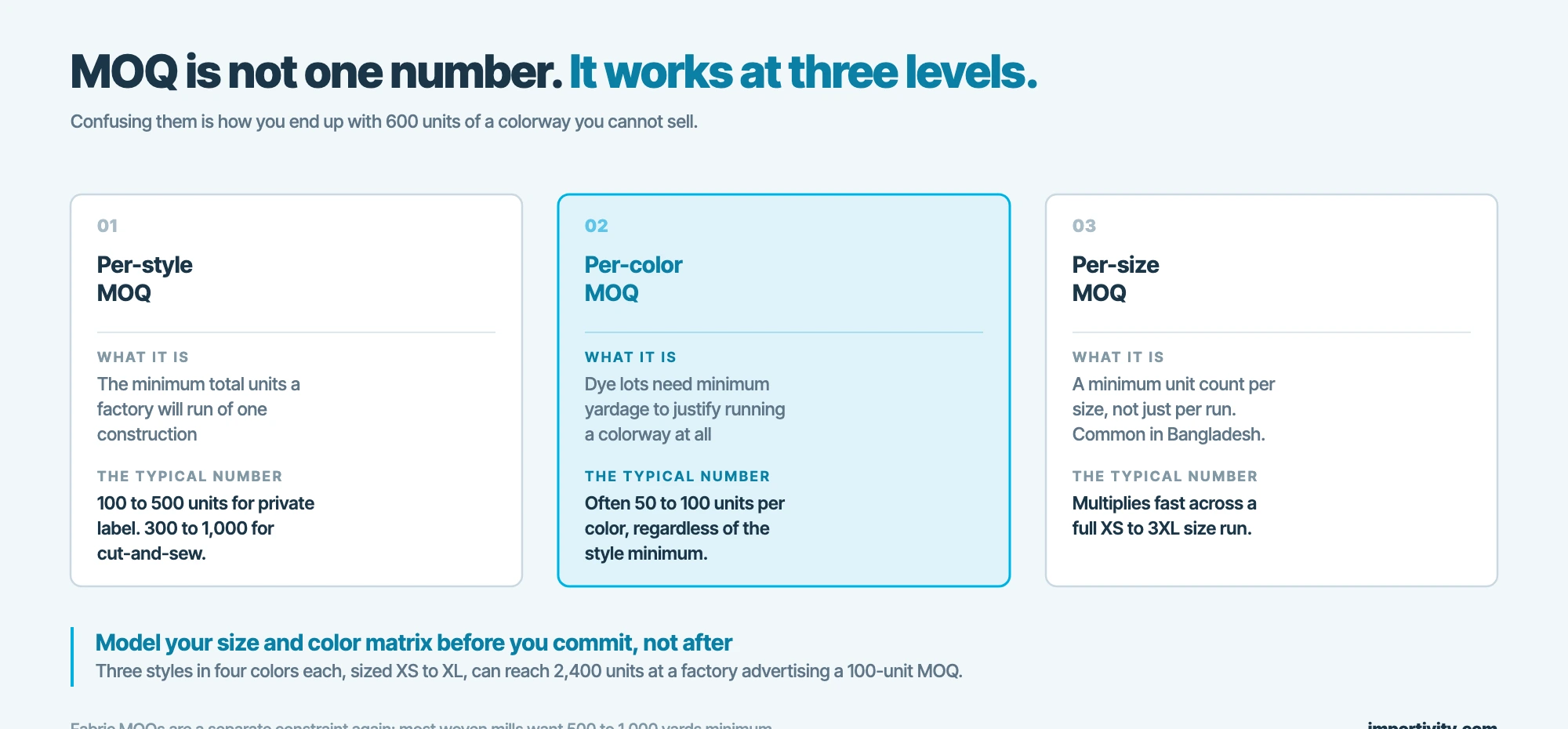
- Per-style MOQ: The minimum total units the factory will run of a single construction. Typically 100–500 units for private label, 300–1,000 for cut-and-sew.
- Per-color MOQ: Factories running dye lots need minimum yardage to justify a colorway, often 50–100 units per color minimum, regardless of the style MOQ.
- Per-size MOQ: Some factories, especially in Bangladesh, require a minimum unit count per size, not just per run. If you are doing XS–3XL and the per-size minimum is 20 units, your order is 140 units before you have run a single color.
The practical implication is clear: a brand launching three styles in four colors each, with XS–XL sizing, can easily hit 2,400 units at a "100-unit MOQ" factory before it realizes what happened. Model your size/color matrix before you commit to a factory, not after.
Fabric MOQs also add a separate constraint in full-package production. Most woven mills require a 500–1,000 yard minimum per colorway. If your style needs 1.5 yards per unit, that is a 333-unit floor from the fabric alone, before the factory adds its own cut-and-sew MOQ on top.
Tech Packs: Why They Make or Break Your Sample
A tech pack is the single document a factory uses to build your garment. If it is incomplete, the factory fills in the blanks, and their guess will not match your vision. A proper tech pack contains:
- Flat sketches (front, back, detail views) with callouts for every construction detail
- A graded measurement spec table (all points of measure across all sizes, with tolerances, typically ±0.5 cm to ±1 cm depending on the measurement)
- Fabric spec: composition, weight (GSM), weave or knit construction, finish, and acceptable mills or alternatives
- Trim spec: zipper brand and pull style, button specs, elastic spec with stretch ratio, label placement and attachment method
- Colorway callouts: Pantone TPX or TCX numbers (not RGB; factories use physical color standards)
- Stitch type and SPI (stitches per inch) needs for seam-critical areas
- Packaging and labeling instructions including care content, country of origin labeling, and size label placement
Why Incomplete Specs Cost You Sample Rounds
Brands that send a reference garment and a mood board, without a proper tech pack, typically go through three or four sample rounds before getting close. Each round costs $150–$600 in sample fees plus 3–5 weeks of elapsed time. A good tech pack, however, usually reduces that to two rounds. This is also where working with an experienced manufacturer sourcing partner earns its keep, they catch spec gaps before the first sample ships.
Key takeaway: Spend $500–$1,500 on a freelance technical designer to build your tech pack before you contact a factory. It is the highest-ROI investment you will make in the product development stage.
Fabric Sourcing, Lead Times, and Sampling Rounds
Fabric sourcing
In full-package (FOB) production, the factory sources fabric on your behalf, which is convenient, but it means you have limited visibility into the mill, the fiber content accuracy, or the dye lot consistency. For brands where fabric integrity matters (performance wear, sustainable positioning), CMT (cut-make-trim) production lets you buy and nominate your own fabric. The tradeoff is that you take on fabric sourcing, quality, and delivery risk.
Fabric lead times are often the longest link in the chain. A specialty woven fabric with a custom colorway from a Chinese mill takes 45–75 days to produce before it reaches your garment factory. Build that into your critical path. Stocking a base fabric in advance, especially if you use the same shell across multiple styles, compresses your replenishment lead time greatly.
Realistic production timelines
- White label / in-stock: 2–4 weeks from order to FOB
- Private label (existing base, new colorway and label): 45–75 days
- Cut-and-sew, new construction: 90–150 days including sampling rounds
- First-time factory, full-package: Add 2–4 weeks for factory onboarding and pre-production approval
Sampling rounds
Plan for at least two rounds for any private label style, a proto sample to check construction and fit, then a salesman sample (SMS) or pre-production sample (PP sample) to confirm fabric, color, and trims against your approved spec. Rush fees for accelerated sampling run $100–$300 per sample on top of normal charges. Factories in Turkey and Portugal can sometimes turn a proto in 10–14 days. Asia, by contrast, is typically 3–5 weeks per round.
Ethical Compliance and Audit Requirements
For most textiles manufacturing categories, ethical compliance is no longer optional if you want retail distribution or want to avoid brand liability. The main frameworks you will encounter:
- BSCI (Business Social Compliance Initiative): Required by most European retailers and increasingly by U.S. mid-market chains. Audits cover labor hours, wages, fire safety, and child labor. Audit results are valid for 12–24 months.
- WRAP (Worldwide Responsible Accredited Production): A U.S.-centric standard; required by several major American retailers and popular with factories serving the U.S. market.
- SA8000: The most rigorous of the mainstream standards, it covers union rights and binding management systems. Required by some premium and mission-driven brands.
- OEKO-TEX Standard 100: Fabric/product certification, tests for harmful substances in the finished garment. Increasingly required for children's apparel and any brand making "clean" or "non-toxic" claims.
- Higg Index / FEM: An environmental audit framework; it is becoming relevant for brands selling to sustainability-focused retail channels.
UFLPA: The Cotton Origin Rule You Cannot Ignore
Beyond formal audits, the Uyghur Forced Labor Prevention Act (UFLPA) creates a burden of proof for any cotton, yarn, or fabric with Xinjiang supply chain exposure. If you source from China and cannot document cotton origin to the gin level, U.S. Customs can detain your shipment. This is a real enforcement risk, CBP issued over 4,200 UFLPA detentions in the first two years of enforcement. Know your cotton supply chain.
Cost Breakdown: What a Garment Actually Costs
Here is a cost build for a mid-weight private label fleece hoodie, sourced from a Tier 1 factory in Vietnam, on a 500-unit run:
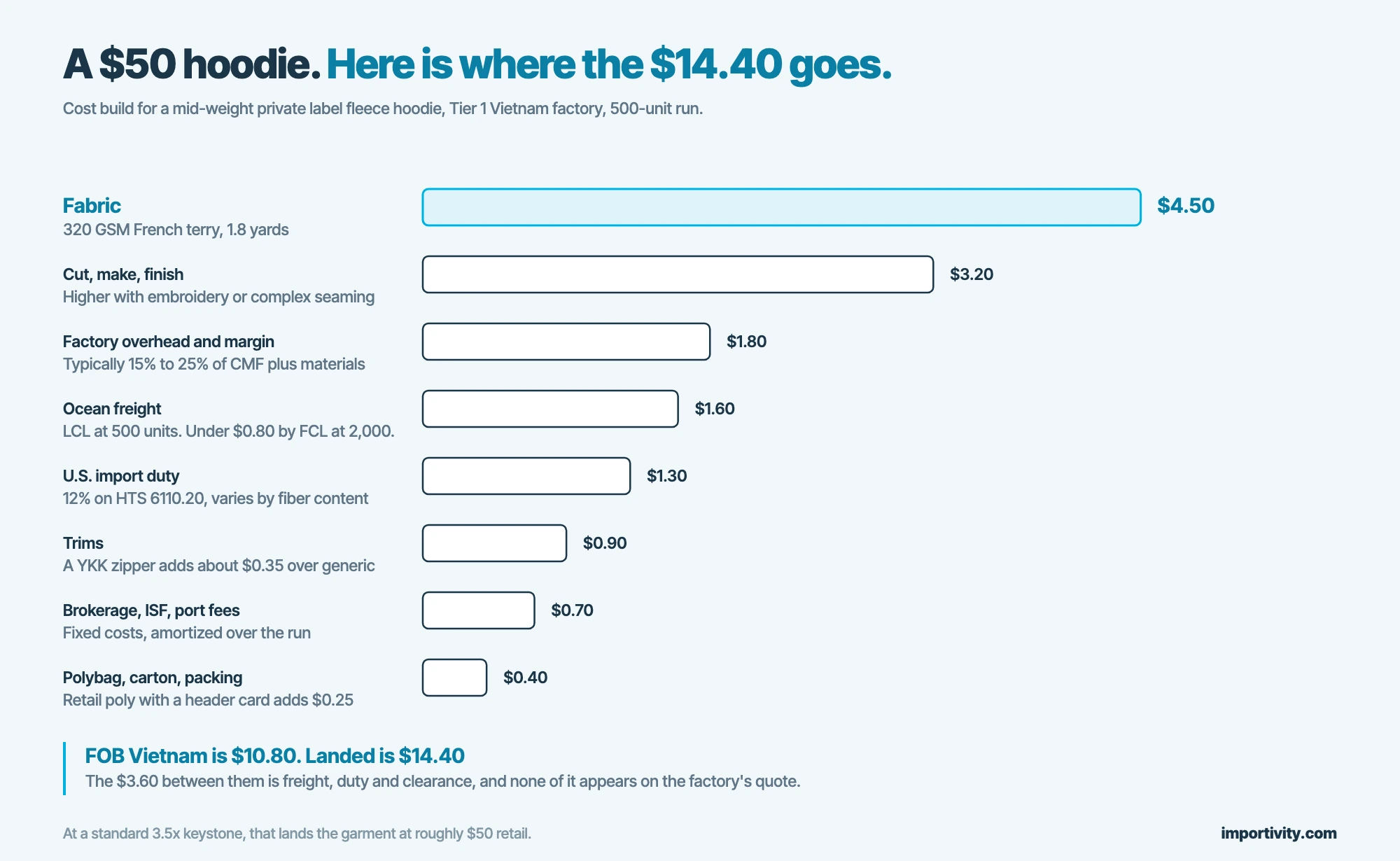
| Cost Component | Per-Unit Cost (USD) | Notes |
|---|---|---|
| Fabric (320 GSM French terry, 1.8 yards) | $4.50 | Mill-sourced; price improves at 1,000+ unit runs |
| Trims (zipper, drawcord, labels, hang tag) | $0.90 | YKK zipper adds ~$0.35 vs. generic |
| Cut, make, and finish (CMF labor) | $3.20 | Higher for embroidery or complex seaming |
| Factory overhead and profit margin | $1.80 | Typically 15–25% of CMF + materials |
| Polybag, carton, packing | $0.40 | Retail poly with header card adds ~$0.25 |
| FOB Vietnam unit cost | $10.80 | Before freight, duty, and landed cost |
| Ocean freight (LCL, 500 units) | $1.60 | FCL drops this below $0.80 at 2,000+ units |
| U.S. import duty (12% on HTS 6110.20) | $1.30 | Rate varies by fiber content and HTS code |
| Customs brokerage + ISF + port fees | $0.70 | Fixed costs amortized over units |
| Landed cost per unit | $14.40 | At standard 3.5x keystone, retail ~$50 |
First-Run Costs and Unit Economics
The numbers above assume you have a completed tech pack, approved fabric, and an existing factory relationship. First-run costs are higher: sample fees ($300–$600 per round), tech pack development ($500–$1,500), quality inspection ($250–$400 per shipment), and agent or sourcing fees (typically 5–8% of FOB) all sit on top. Model those into your unit economics on the first order. Do not spread them across a projected future volume you have not yet reached. For a full overview of selecting the right partner for your brand, the ultimate guide to private label manufacturers covers the vetting framework in depth.
We qualify the plants that build this kind of product and film the visits, which go out through Source With Jordan.
Frequently Asked Questions
What is a realistic minimum order for private label apparel?
For private label (your spec, your label, not a stock item), 100–300 units per style is the practical floor at most Asia-based factories. Some smaller factories in Turkey or Portugal will run 50 units, but expect to pay a premium on per-unit price to offset their setup cost. Below 50 units, white label is usually the better path, you will get product faster and at lower total risk, even if the differentiation is limited.
How do I find a legitimate apparel factory overseas?
Trade shows (Magic in Las Vegas, Texworld in New York, the Canton Fair in China) are the most efficient in-person channel. Online, Alibaba and Global Sources are starting points but require careful vetting, check business licenses, audit reports, and production photos independently. A sourcing agent or agency with category-specific textile relationships can shortcut the vetting process greatly, particularly if you need audit paperwork or compliance support.
How many sampling rounds should I budget for?
Two rounds minimum for an existing silhouette with modifications; three rounds for an original cut-and-sew construction. Budget $150–$600 per sample (some factories charge per piece, some per style) plus international courier both ways ($60–$120 per round). Factor 3–5 weeks per round from Asia, 1–2 weeks from Turkey or Portugal. If you are on round four and still not close, the problem is usually an incomplete tech pack or a misaligned factory, not a sampling process problem.
What import duty rate applies to apparel?
U.S. apparel duties are assessed by HTS code and vary by fiber content. Cotton knit outerwear (HTS 6110.20) is 12%. Woven synthetic outerwear can run 16–28%. Tariff engineering, adjusting fiber content or construction to shift HTS classification, is legitimate but requires a binding customs ruling to do safely. On top of base duty, China-origin apparel carries a 25% Section 301 surcharge, making effective duty rates on some China-sourced categories exceed 35%. Vietnam, Bangladesh, India, and Turkey do not carry Section 301 exposure.
Do I need a sourcing agent for apparel manufacturing?
Not necessarily, but the case for one gets stronger as your order complexity increases. A sourcing agent adds value on factory vetting, sample management, pre-shipment inspection, and compliance paperwork. They earn their 5–8% FOB fee most clearly when you are dealing with a new country, a new factory, or a product category where quality defects are expensive to discover after clearance. For repeat orders from vetted factories in a category you understand, direct-to-factory management is workable.
About the author
Jordan Lewis
Chief Operating Officer, Importivity
Runs Importivity's sourcing operations across China, Vietnam, Mexico and India, from supplier negotiation through landed delivery.
Press and media inquiries: press@importivity.com