How to Choose the Right Contract Manufacturing Partner
Contract manufacturing is an arrangement where you hire an outside factory to make a finished product to your specification, then sell it under your own brand. You own the design, the intellectual property, and the customer relationship. The factory owns the machines, the labor, and the day to day production. For most brands, it is the fastest way to get a real product made without buying a plant of your own, and it sits at the center of how we run product sourcing and manufacturer sourcing for our clients.
This guide covers what contract manufacturing actually includes, how the process works step by step, what it costs, and how to find and vet a partner without getting burned. It is written for founders and product teams choosing between building in house, using a contract manufacturer, or going the OEM or private label route.
At a glance
Which manufacturing model fits your product?
Match your situation to the right model:
What Is Contract Manufacturing?
A contract manufacturer, sometimes shortened to CM, produces goods for another company under contract. You supply the product design, a bill of materials, drawings or samples, and quality requirements. The manufacturer sources the inputs, runs production, inspects the output, and ships it to you or your warehouse. You pay per unit, plus one time costs like tooling.
The key distinction is ownership. In contract manufacturing the buyer owns the design and the brand. This separates it from buying a stock product off a catalog, and it is why contract manufacturing is the standard model for everything from cosmetics and supplements to electronics, apparel, and industrial parts.
How Contract Manufacturing Works
A typical engagement moves through six stages. Timelines vary by product complexity, but the sequence rarely changes.
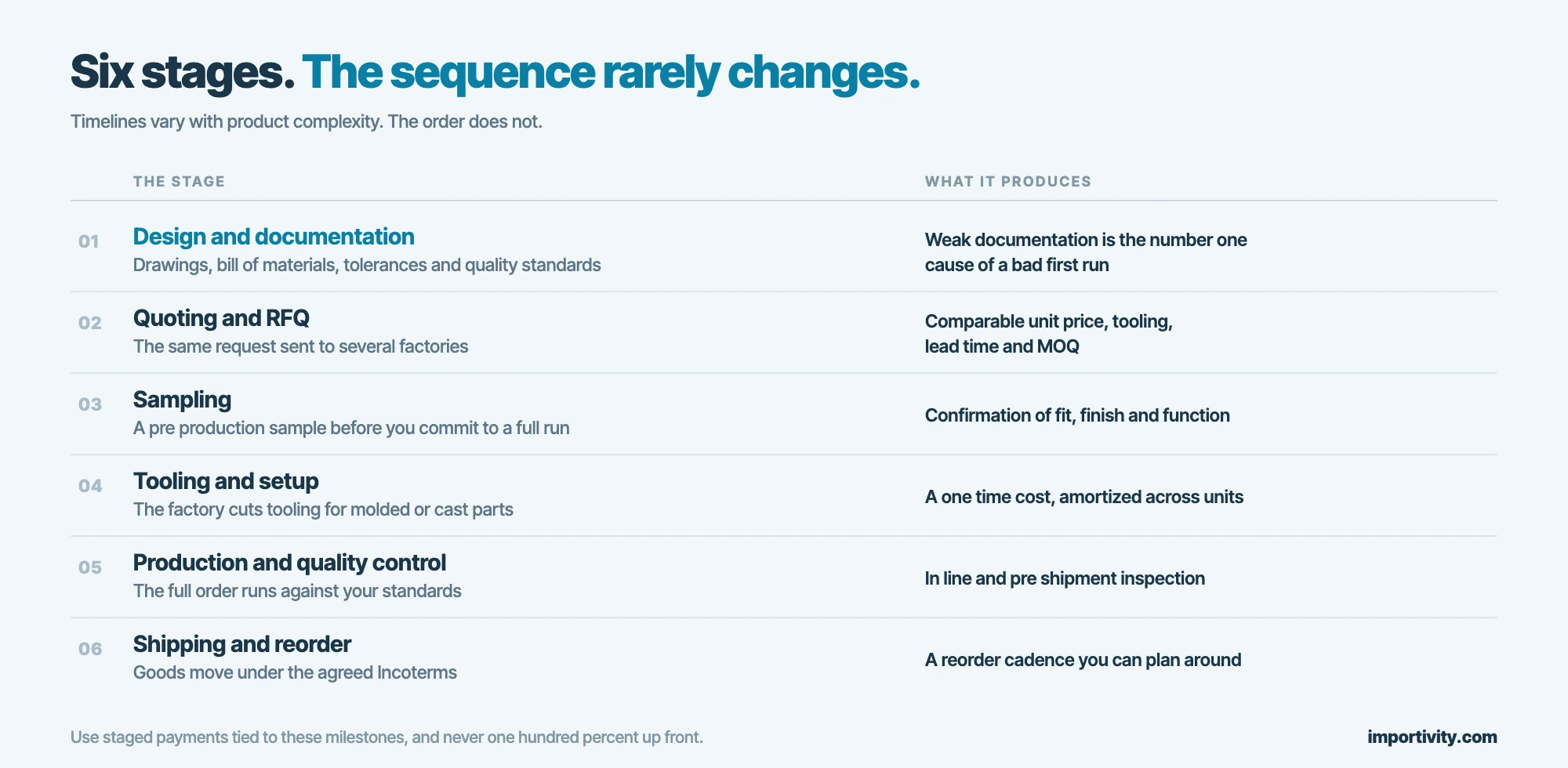
- Design and documentation. You finalize drawings, a bill of materials, tolerances, and quality standards. Weak documentation is the number one cause of bad first samples.
- Quoting and RFQ. You send a request for quote to several factories and compare unit price, tooling, lead time, and minimum order quantity.
- Sampling. The factory builds a pre production sample so you can confirm fit, finish, and function before committing to a full run.
- Tooling and setup. For molded or cast parts, the factory cuts tooling. This is a one time cost that gets amortized across your units.
- Production and quality control. The full order runs, with in line and pre shipment inspection against your standards.
- Shipping and reorder. Goods ship under agreed Incoterms, and you set up a reorder cadence.
What Sits Inside a Contract Manufacturing Quote
The per unit price is only part of your true cost. A realistic quote breaks down roughly like the chart below for a mid complexity product. Materials and labor dominate, but tooling, quality control, and freight with duty move your landed cost well above the factory gate price.
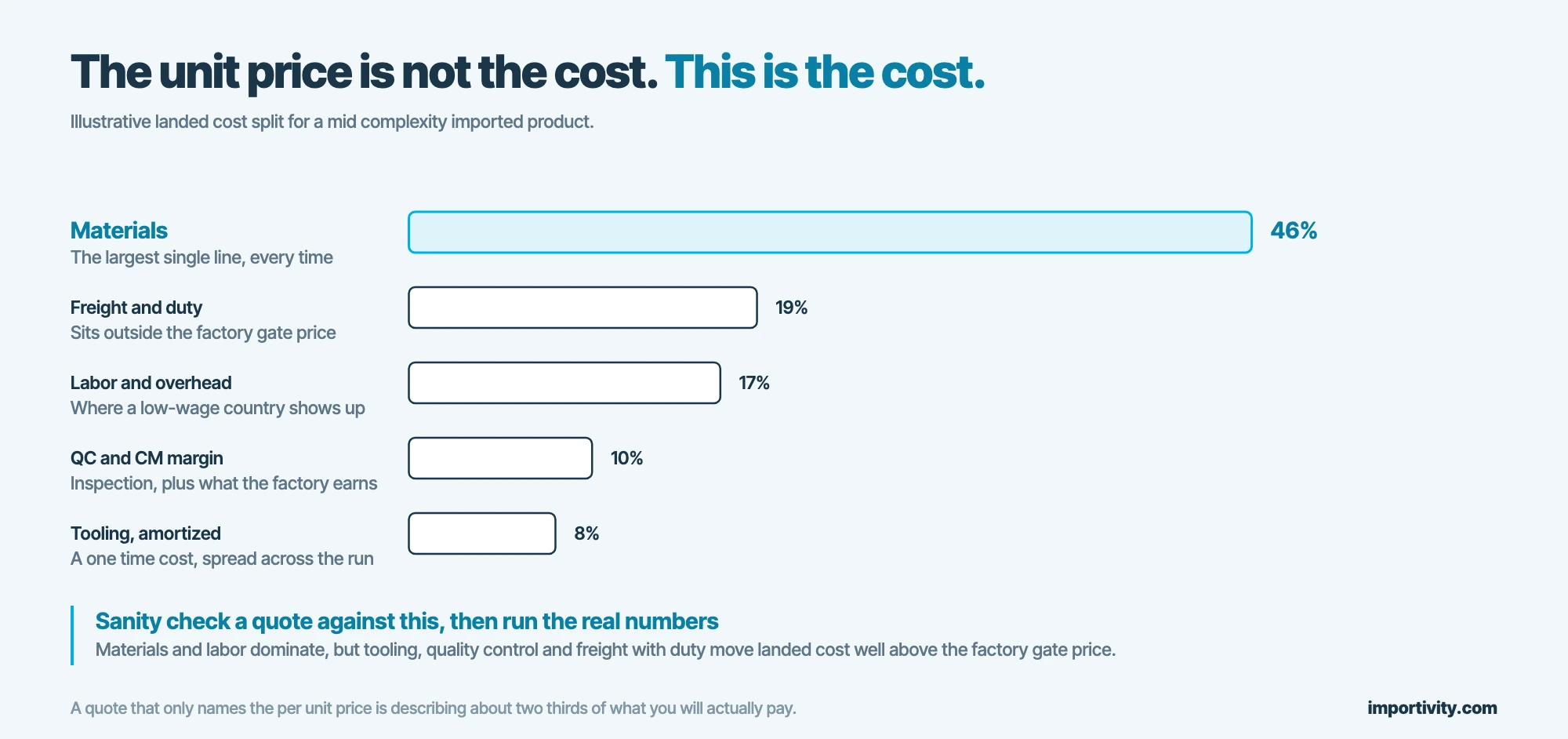
100%
- Materials 46%
- Labor & overhead 17%
- Tooling (amortized) 8%
- Freight & duty 19%
- QC & CM margin 10%
Illustrative split for a mid complexity imported product. Use it to sanity check quotes, then confirm your real numbers with a full landed cost calculation.
Contract Manufacturing vs OEM, ODM, and Private Label
These terms overlap and get used loosely, which causes real confusion during sourcing. The difference comes down to who designs the product and how much you can customize it.
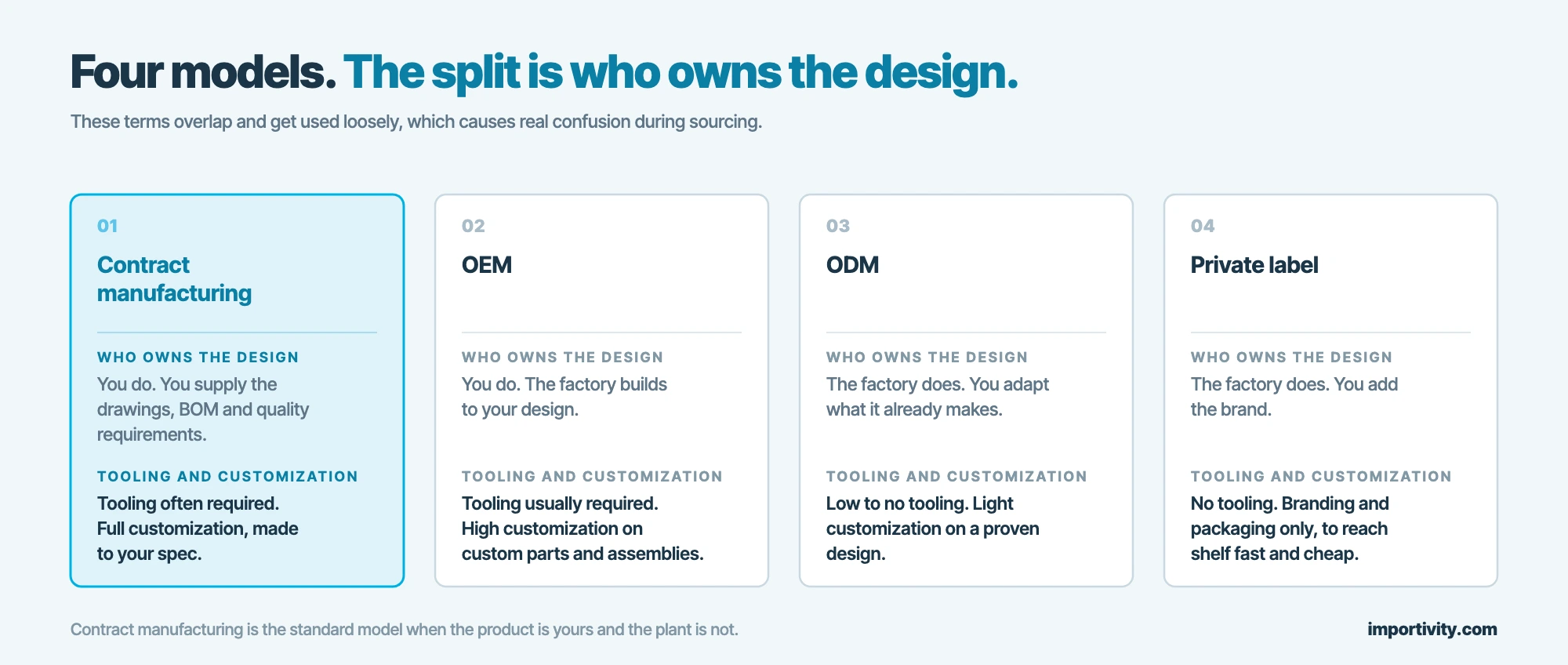
| Model | Who owns the design | Customization | Tooling cost | Best for |
|---|---|---|---|---|
| Contract manufacturing | You | Full, made to your spec | Often required | Unique products you designed |
| OEM | You (factory builds to your design) | High | Usually required | Custom parts and assemblies |
| ODM | The factory | Light, on an existing design | Low to none | Speed to market on a proven design |
| Private label | The factory | Branding and packaging only | None | Getting to shelf fast and cheap |
If you want to go deeper on two of these, read our breakdown of OEM vs ODM manufacturing and our guide to private label vs white label.
What Does It Cost to Launch With Each Model?
Upfront investment is the fastest way to separate these models in practice. Contract manufacturing and OEM carry tooling and sampling costs, while private and white label push almost everything into per unit price. The bars below show the rough size of the upfront commitment before you own any inventory.
Tooling for a molded product commonly runs from a few thousand dollars to well over twenty thousand for complex, multi cavity molds. Sampling rounds add a few hundred to a few thousand. The trade is simple: pay more upfront for a product that is truly yours, or pay less upfront and accept a product many others can also sell.
How to Find and Vet a Contract Manufacturer
Finding factories is easy. Finding one that will hit your quality bar, protect your design, and still be there for your third reorder is the hard part. Work through this checklist before you place a deposit.
- Confirm the factory actually makes your product type, not a broker reselling someone else's line.
- Request a business license and match it to the bank account you will pay.
- Run a factory audit on site or through a third party inspector.
- Complete real supplier vetting, including references from current customers.
- Order a paid pre production sample and test it against your spec, not a photo.
- Agree quality standards in writing, including the acceptable quality limit for defects.
- Put intellectual property, tooling ownership, and confidentiality in a signed agreement.
- Use staged payment terms tied to milestones, never one hundred percent up front.
- Check capacity so your order is not the smallest job on their floor.
- Start with a modest first order, then scale as they earn it.
New to sourcing entirely? Start with our step by step guide on how to find a manufacturer to make your product, then come back here to structure the relationship.
When Contract Manufacturing Is the Right Call
Contract manufacturing fits when you have a defined product, expect steady volume, and want to control quality and branding without the capital cost of a plant. It is less attractive if your volumes are tiny, your design is still changing every week, or your margins cannot absorb tooling. In those cases a private label or ODM product can get you to market faster while you validate demand, and you can graduate to full contract manufacturing once the product proves out.
If you want to see what this looks like on a live project rather than in a guide, Source With Jordan is where we publish the sourcing itself.
Frequently Asked Questions
What is the difference between contract manufacturing and OEM?
They overlap heavily. In both, an outside factory builds a product to your design. OEM usually refers to making custom parts or components to a buyer's specification, while contract manufacturing more often describes producing a complete finished product. In practice many suppliers offer both under one roof.
How much does contract manufacturing cost?
You pay a per unit price plus one time costs. Tooling for molded or cast products can run from a few thousand dollars to over twenty thousand for complex molds, and sampling adds a few hundred to a few thousand. Your true cost is the landed cost per unit, which includes freight and duty, not just the factory quote.
What is a minimum order quantity for contract manufacturing?
MOQ depends on the process and material. Simple assembled goods may start in the hundreds, while injection molded or custom electronic products often require thousands of units to justify setup. You can sometimes negotiate a lower first order by paying a slightly higher unit price.
How do I protect my design and intellectual property?
Sign a confidentiality and IP agreement before sharing detailed drawings, register trademarks in your manufacturing country, and keep ownership of any tooling you pay for written into the contract. Splitting production across processes or suppliers can also reduce the risk of a full copy.
Should a small brand use contract manufacturing or private label?
If your design is unique and volumes are steady, contract manufacturing gives you a product no competitor can buy off the same shelf. If you are still testing demand or need to launch cheaply, private label gets you to market faster. Many brands start private label and move to contract manufacturing once a product proves out.
About the author
Jordan Lewis
Chief Operating Officer, Importivity
Runs Importivity's sourcing operations across China, Vietnam, Mexico and India, from supplier negotiation through landed delivery.
Press and media inquiries: press@importivity.com