CBP Form 5106 Explained and How to Get Your Importer Number Right
CBP Form 5106, the Create/Update Importer Identity Form, is the document that creates your importer record with U.S. Customs and Border Protection. Every bond, entry, bill and refund is keyed to that record, so nothing can be filed in your name until it exists. You file it once, before your first formal entry, with your legal name, an identification number (an EIN, an SSN, or a CBP-assigned number if you have neither), your mailing and physical addresses, a phone number and an email address. A broker can submit it through ACE in minutes, and CBP typically activates a new record in about two business days.
This guide is for first-time US importers and for foreign companies that have been told they need an importer number. It walks the current form block by block, explains which number belongs in block 1B, shows how to file it and how long it takes, and covers the rule in force from September 18, 2026, under which CBP voids importer numbers whose 5106 data is wrong. What the importer of record is liable for once the record exists is a separate question, covered in what an importer of record is liable for.
What Form 5106 actually does
The form is authorized by 19 CFR 24.5 and does one job: it tells CBP who you are and how to reach you, so that an identification number can be tied to a legal entity. CBP's guidance says any party that appears on an ACE transaction, including the importer of record, the ultimate consignee and a "sold to" party, needs a record. The only common exception is a Section 321 shipment for personal use.
Two things follow. The ultimate consignee on a formal entry needs a record even when someone else is the importer of record, which surprises companies that buy DDP. And a record created years ago for a one-off shipment is still your record, stale address included.
Which number goes in block 1B
Block 1B asks for one identification number and its type. Most of the confusion around the form lives here.
| Number type | Who uses it | What to know |
|---|---|---|
| IRS Employer Identification Number | Any US business with an EIN | The EIN automatically becomes your importer number. CBP adds a two-digit suffix, 00 by default. |
| EIN with a division suffix | A company importing under several divisions | One form per division, "DIV" checked in block 1C and the parent's name in 1D. Each suffix is its own record. |
| Social Security Number | A sole proprietor or individual with no EIN | The SSN must belong to the owner and then appears on entry documents, which is why many people choose the next row. |
| CBP-assigned number in place of an SSN | An individual who does not want the SSN on paperwork | Check the first reason in block 1E. Block 3J then becomes mandatory and must carry your name, title and SSN. |
| CBP-assigned number, non-resident | A foreign company or person with no EIN and no SSN | Check "I am not a U.S. Resident" in 1E. The number is for CBP use only, not a tax ID. Keep using it even if you later get an EIN. |
One rule catches people who set up a US entity late: if you hold an EIN when you submit the form, that EIN becomes your number and no CBP-assigned number is issued, whatever you checked in 1E.
The form block by block
The current form is revision 06/26, five pages including instructions, with an estimated completion time of 45 minutes. Every required field carries a red asterisk. There are four sections, and they are not equally important.
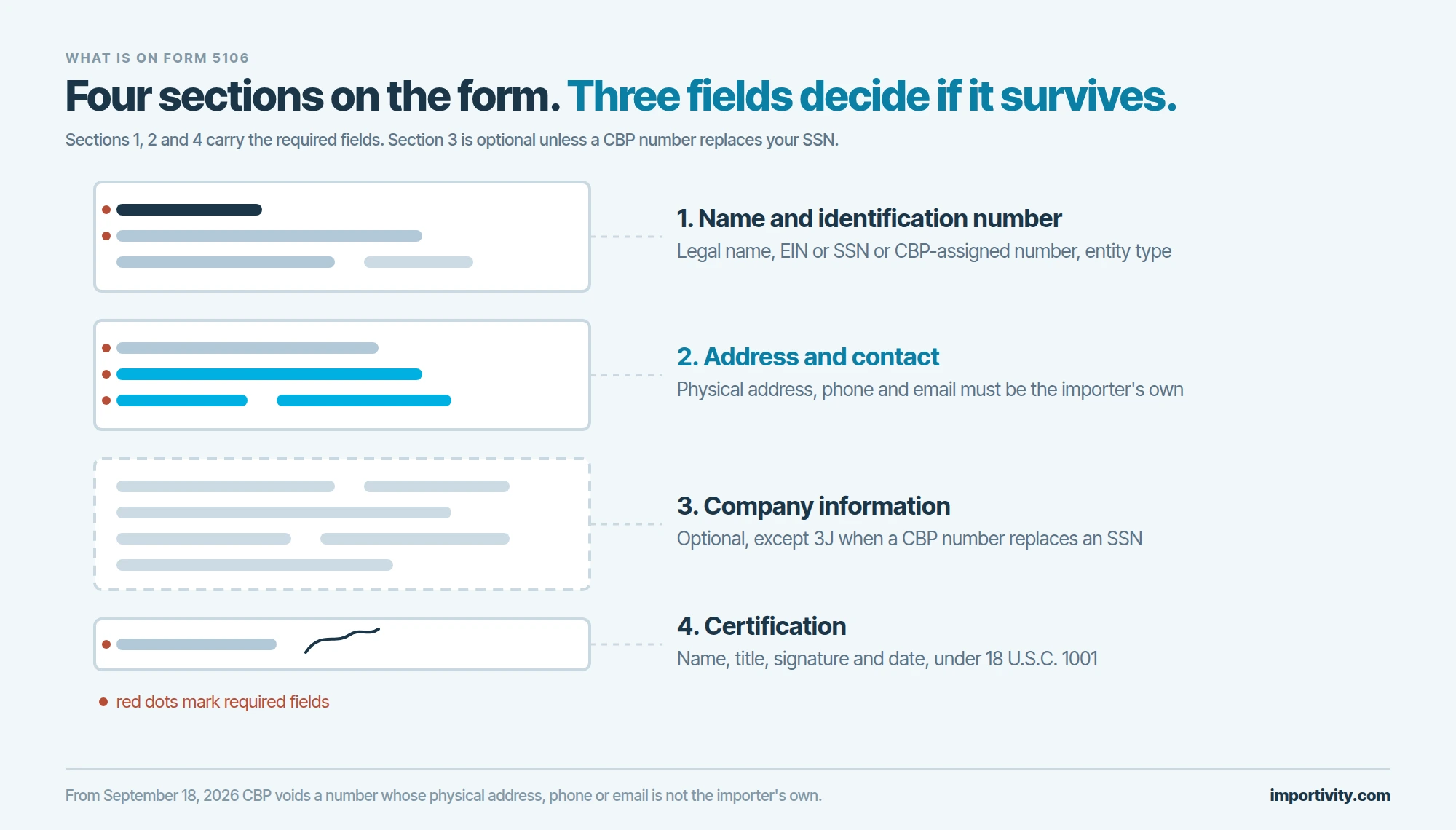
- Section 1, name and identification number. Block 1A is the full legal name, not the trade name. 1B is the number and its type. 1C and 1D handle divisions, AKA and DBA names. 1E is where you request a CBP-assigned number and give the reason. 1G is the entity type, 1H the entries you expect in a year, 1I how the number will be used, and 1J to 1M take partnership program codes such as CTPAT.
- Section 2, address information. 2A is the mailing address with a required address type. Each street line is limited to 32 characters. If 2A is a PO box, 2B, the physical location, becomes mandatory, and 2B may never be a PO box or a business service center. It can be the owner's home. 2C phone and 2E email are required. A foreign address needs the country ISO code, and where no two-character state code exists you enter "FN".
- Section 3, company information. Business description, NAICS code, D-U-N-S number, filer code, year established, related businesses, primary bank, articles of incorporation, and up to four officers or beneficial owners. All optional, with one exception: if you chose a CBP-assigned number instead of your SSN, block 3J must carry your title, name and SSN. CBP says an empty section 3 affects how it reads risk, so on a first record it is worth filling.
- Section 4, certification. Printed name, title, signature and date, under 18 U.S.C. 1001. Electronic signatures are accepted. If a broker signs as attorney-in-fact, the power of attorney has to travel with the form or the submission is rejected.
Address type, phone and email became mandatory in the March 2019 revision. Older records were grandfathered, but the moment one is updated for any reason every current mandatory field must be supplied, which is how an address change on an old record turns into a full refile.
How to file it and how long it takes
There are three routes, and the first is almost always the right one.
- Through a licensed customs broker in ACE. A broker with ABI access creates or updates the record electronically from a signed form and a power of attorney, with the fewest format rejections. If you do not have a broker yet, what a customs broker does and costs covers how to pick one.
- By email to your assigned Center of Excellence and Expertise. The subject line must read "New 5106 Add" or "5106 Update" plus your team assignment so it routes correctly. CBP's Revenue Division procedures add the format rules that cause most rejections: one form per email, PDF or TIF under 18 MB, the current form version only, and the power of attorney attached whenever someone other than an officer signed.
- On paper at a port of entry. Ports still accept a mailed, faxed or scanned copy. It is the slowest route.
CBP's published timing is about two business days for a new record and about five business days for an update such as a name or address change. Plan around the rejections rather than the processing time: an expired form version, a legal name that does not match the IRS record for the EIN, or a missing power of attorney each send the submission back to the start.
What changed on September 18, 2026
Executive Order 14411, "Strengthening Customs Enforcement," was signed on June 3, 2026. CBP's first step under it was a Federal Register notice on August 19, 2026, "Accuracy of Importer of Record Data Submitted to CBP." From September 18, 2026, CBP voids an importer number when the information on the Form 5106 for that record is inaccurate or incomplete. Earlier in the year CBP had already deactivated a reported 4.8 million records that had filed no entry in the preceding twelve months, so the agency is working through the registry systematically rather than case by case.
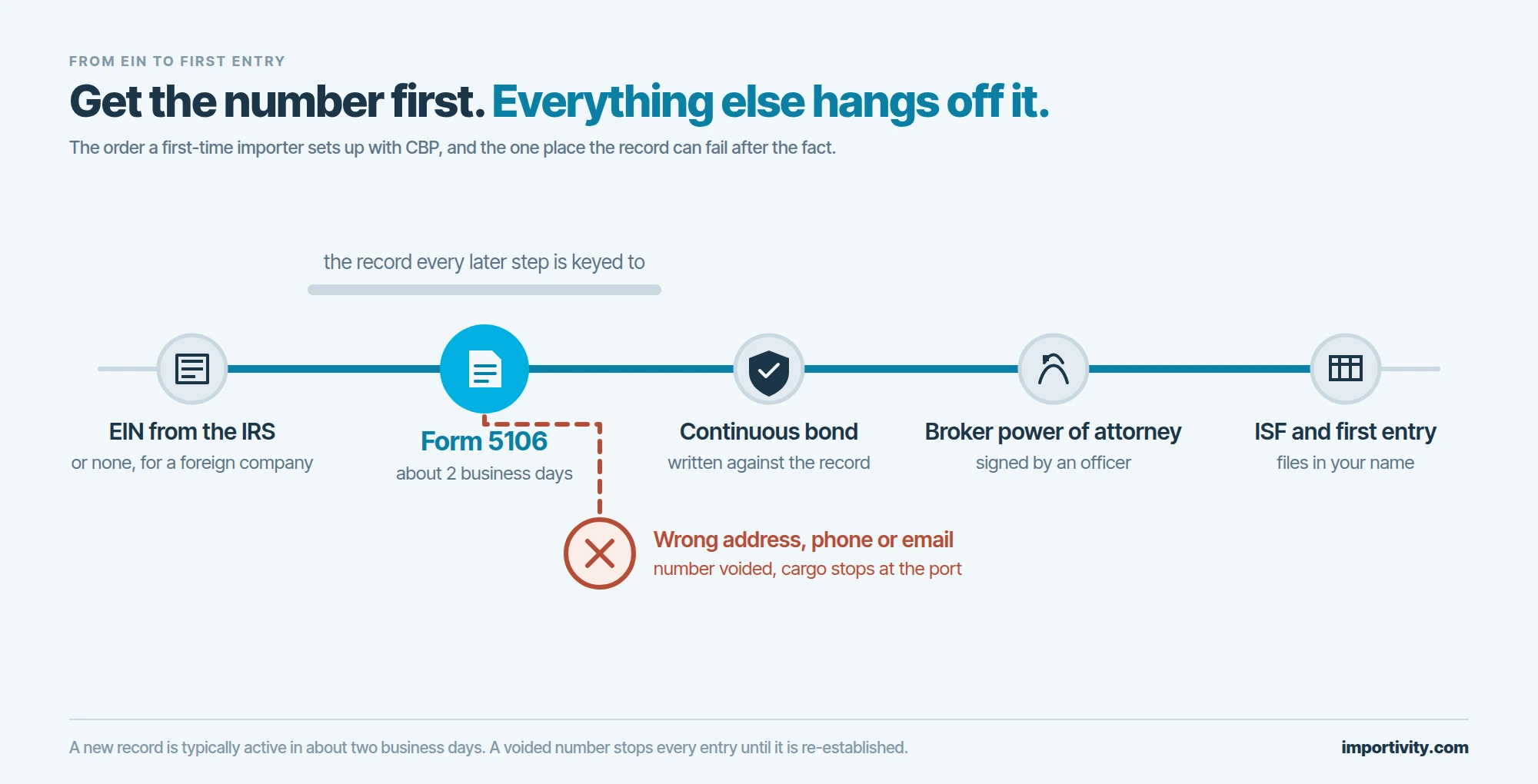
Three fields decide the outcome. The physical address must be the actual location of the business or the individual, so a broker's office, a forwarder's warehouse, a registered agent, a PO box or a business service center will not do. The phone number must belong to the importer. The email address must belong to the importer, not to a broker or a third party. A voided number is invalid for every purpose, including making entry, which means cargo stops at the port with no warning beyond a written notice sent to the email on file. If that email is the broker's old inbox, the notice never reaches you.
To re-establish a voided number you email a corrected, signed form to IORProgram@cbp.dhs.gov with the subject line "Enforcing IOR Accuracy" and wait for confirmation. An inactive record is a different case: it is reactivated with a signed form to your Center under "IOR Reactivation Request," with IRS proof such as a 147C letter or an SS-4 where CBP asks for it. A W-9 is not accepted. Your continuous customs bond is written against the same record, so a void leaves the bond pointing at nothing until the number is restored.
The mistakes that cost weeks
Almost every 5106 rejection or later void traces to one of these, and each is expensive once a container is at the terminal.
- The trade name in 1A. CBP matches the name to the IRS record for the EIN. "Summit Outdoor" on the form and "Summit Outdoor Holdings LLC" at the IRS is a mismatch. Use the legal name and put the trade name in 1C as a DBA.
- The broker's address, email or phone in section 2. This was common practice for foreign importers and it is now the fastest way to lose the number. Block 2E has to be an inbox the importer reads.
- A PO box or a virtual office in 2B. Both are named as unacceptable physical locations. A home address is fine; a mail drop is not.
- A name or address change without the bond rider. If a bond is on file, a change of name or address needs a rider with the form unless the bond is under CBP's eBond program.
- Nobody at the importer keeps a copy. Keep the signed form, the submission date and CBP's confirmation. If a void notice ever arrives, that file is what gets the number back in days instead of weeks.
Keeping the record alive
Treat the importer record as a live asset with an owner inside the company. Update it within days of a move, a rename, a change of officers or a change of legal form (a sole proprietorship becoming an LLC needs a new form, because the number changes too). Ask your broker once a year to pull the record from the ACE portal and read it back to you, and if you want to restrict who can change it, 19 CFR 24.5(f) lets you freeze the record.
Sequence matters on a first import. The record comes first, then the bond, then the broker's power of attorney, then the Importer Security Filing 24 hours before the container is loaded, covered in ISF 10+2 filing requirements. Get them in that order and the first entry is routine. If you are setting all of this up alongside your first factory order, our import and export agency team runs the registration, the bond and the broker relationship as one job, and shipping and logistics takes it from the booking onward.
For a foreign brand this is also the moment to decide who the importer of record should be at all. A non-resident record with a CBP-assigned number works, but every entry then files in your name. When Jordan walks a new client through a first US shipment, the 5106 conversation usually ends with a different structure than the one they arrived with, so it is worth a fit check with Jordan before the form goes in.
Frequently Asked Questions
Do I need to file CBP Form 5106 before my first shipment?
Yes, if you will be the importer of record or the ultimate consignee on a formal entry, or if you need a customs bond. CBP keys the bond, the entry, the bills and any refunds to the record the form creates, so nothing files against your name until it exists. Most first-time importers have their broker submit it through ACE a week or two before the first entry. New records are typically active in about two business days.
What number do I put in block 1B of Form 5106?
A business uses its IRS Employer Identification Number, which automatically becomes its importer number. A sole proprietor with no EIN may use a Social Security Number, or ask for a CBP-assigned number instead and list the SSN in block 3J. A foreign company with neither an EIN nor an SSN checks block 1E and CBP issues a CBP-assigned number, which is for CBP use only and is not a tax ID.
Can a foreign company be the importer of record with a CBP-assigned number?
Yes. A non-resident importer requests a CBP-assigned number on Form 5106, files it before the bond is transmitted, and then buys a continuous bond and signs a power of attorney with a licensed broker. The physical address on the form must be the company's real location abroad, not the broker's or forwarder's US address. That address rule is one of the three fields CBP checks under the September 18, 2026 enforcement notice.
How long does CBP take to process Form 5106?
CBP's published guidance says a new importer record is typically activated in about two business days and an update to an existing record, such as a name or address change, in about five business days. A submission signed by a broker without a power of attorney attached, an expired form version, or more than one form in a single email is rejected and the clock restarts, which is where most of the real delays come from.
What happens if my importer number is voided on September 18, 2026?
The number becomes invalid for every purpose, including making entry, so cargo stops at the port. CBP sends written notice to the email address on file, which is why a broker's email in block 2E is dangerous. To re-establish the number you email a corrected, signed Form 5106 to IORProgram@cbp.dhs.gov with the subject line Enforcing IOR Accuracy, attach the power of attorney if a broker signed it, and wait for confirmation before filing anything.
About the author
Jordan Lewis
Chief Operating Officer, Importivity
Runs Importivity's sourcing operations across China, Vietnam, Mexico and India, from supplier negotiation through landed delivery.
Press and media inquiries: press@importivity.com