What a China Sourcing Agent Costs and How to Pick the Right One

A China sourcing agent works as your representative on the ground, finding and qualifying factories, running samples, negotiating price, watching production and organising inspection before goods ship. Most charge one of three ways: a commission on order value, commonly advertised in the 3 to 10 percent range with 5 percent quoted most often, a flat fee per order, or a monthly retainer that suppliers themselves quote anywhere from a few hundred to a few thousand dollars depending on scope. The number matters less than the model, because a low commission paid alongside an undisclosed factory rebate costs more than a higher fee paid openly.
This guide is for US brands and importers deciding whether to hire an agent, and for those already paying one who want to know if the arrangement is working. It covers the real scope of the job, how each fee model behaves, the conflict of interest built into commission pricing, what the alternatives cost, and what changed in China during 2025 and 2026. If you are still at the stage of finding factories yourself, start with our step by step guide to finding overseas manufacturers.
What a Sourcing Agent Actually Does
The scope is wider than most first time buyers expect, and it is the reason the job exists as a separate role rather than a task your freight forwarder absorbs. A working agent handles supplier identification and screening, turns your requirements into a document a Chinese factory can quote against, coordinates samples, negotiates price and terms, monitors production in line rather than only at the end, arranges factory audits and pre shipment inspection, prepares export documentation, and consolidates shipments before handing off to freight.
Two boundaries are worth drawing clearly. A freight forwarder moves goods and clears customs. It does not choose your supplier, argue about your unit price, or walk your production line. A trading company is a different animal again: it buys from the factory and resells to you, taking title to the goods and earning on the spread between what it paid and what you pay. An agent never takes title. That distinction decides who carries the risk and who sees the real factory price. Our guide to what a freight forwarder does covers the logistics half of that split.
The practical test of scope is simple. Ask a prospective agent which of those nine activities are inside the fee and which are billed separately. Most proposals are vague on inspection and on production monitoring, which are the two that cost the agent real time.
The Three Fee Models and What Each One Really Costs
Commission is the default. You pay a percentage of order value, so the agent earns more as you spend more. Flat per order fees suit a buyer running a handful of repeat SKUs where the work per order is predictable. A retainer suits a buyer with continuous development work, several live projects, and a need for someone whose time is not rationed by order size.
| Fee model | Where it fits | What it gets wrong |
|---|---|---|
| Commission on order value | Occasional buyers, single product launches, low development effort | Rewards higher spend, and pays nothing for the work of driving price down |
| Flat fee per order | Repeat SKUs with stable specifications and known suppliers | Underpays on a hard first order, overpays on a simple reorder |
| Monthly retainer | Continuous development, several live projects, ongoing supplier management | Costs the same in a quiet month, and needs a defined deliverable to stay honest |
| Commission plus undisclosed rebate | Nowhere | The buyer sees one number and pays two |
Be careful with the published percentages. The 3 to 10 percent band is repeated across dozens of sourcing agency websites that cite each other rather than any independent survey, and the retainer figures diverge so widely between those same sources that no standard band really exists. We could find no credible published figure at all for hourly rates. Treat any number you read, including ours, as a starting point for a quote rather than a market rate.
The Kickback Problem Nobody Puts in the Proposal
The structural risk in commission pricing is that your agent can be paid twice for the same order. The factory quotes a price with a referral fee already inside it, pays that fee to the agent after the order lands, and you never see either half. Adrian Leighton at Sofeast, writing on kickbacks and middlemen in China sourcing in December 2025, puts the typical factory rebate at around 3 to 5 percent of order value. That is one experienced practitioner's estimate rather than survey data, but the mechanism does not depend on the number being exact.
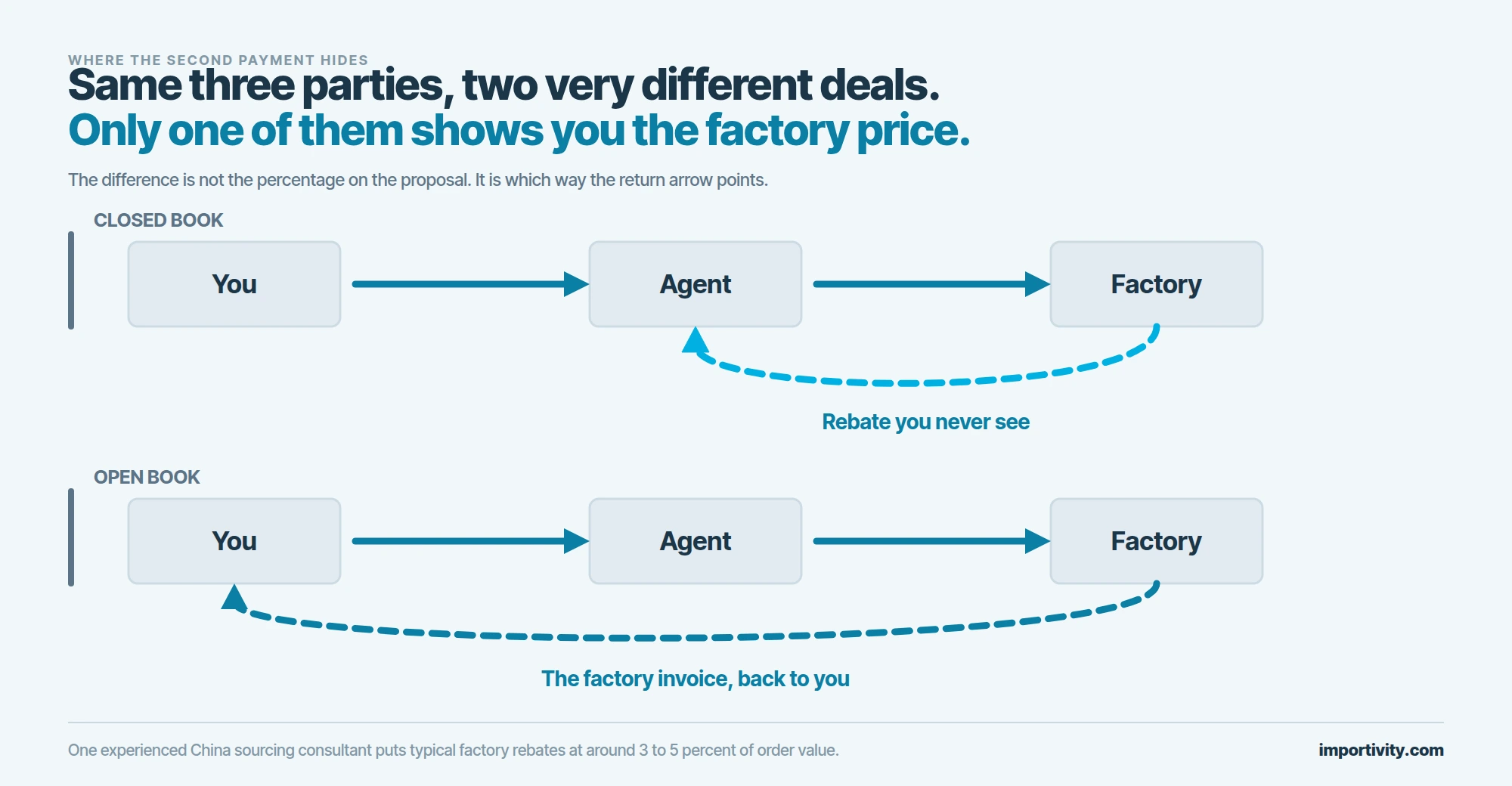
Think about what the incentive does. An agent earning a rebate from the factory has no financial reason to negotiate your price down, because a lower price shrinks their own second cheque. They have no reason to introduce you to a better factory that does not pay rebates. And they have every reason to keep you away from the factory floor, because a direct relationship makes the arrangement visible. That is why the red flags are behavioural rather than numerical: you cannot get a straight answer about which factory is actually building your product, visits and audits get discouraged, and benchmarking quotes against another supplier gets shut down.
The fix is contractual and it is not complicated. Insist on open book pricing, meaning you see the factory's actual invoice and pay a declared service fee on top of it. Ask for direct factory invoicing where you are the buyer of record. Put a written no rebate clause in the agreement requiring any payment received from a factory to be passed back to you. And ask the question directly, in writing, before you sign: do you receive any compensation from factories you place our orders with? An agent who is comfortable with all four is telling you something useful.
What the Alternatives Cost
Before you decide an agent is worth the fee, price the pieces separately, because you can buy several of them a la carte. Third party inspection is the clearest example. QIMA publishes its own rate openly at 419 US dollars per man day for its Zone A, which covers China, Vietnam, India, Bangladesh, Thailand and Cambodia among others. Smaller local Chinese quality control firms are widely quoted lower than that, but we could not verify those figures against any firm's own published pricing, so treat the multinational rate as the reliable anchor and get written quotes for the rest.
A single pre shipment inspection on a first production run is therefore a few hundred dollars, not a few thousand. If your only real worry is quality on a straightforward product from a supplier you already trust, buying inspection directly is cheaper than paying a percentage on the whole order. Our guide to quality control with Chinese factories sets out what a useful inspection actually checks.
Where an agent earns the fee is on the parts you cannot buy by the day: finding a factory that will take your volume, holding a price through a raw material swing, catching a specification drift at week two of production rather than at the port, and having a relationship that makes a factory fix a bad run rather than argue about it. If your product is simple and your supplier is settled, the fee is hard to justify. If you are developing something, moving country, or running more suppliers than you can personally visit, it usually pays for itself on the first avoided mistake.
What Changed in China in 2025 and 2026
Two things moved that affect the hire decision. The first is that the tariff gap which drove the move out of China has narrowed. Reuters reported in August 2026 that US tariffs on Chinese goods, having peaked at 145 percent in April 2025, had come down to a trade weighted average of roughly 33 percent, while Vietnam's rate sat around 12.5 percent. The same reporting described Shein cutting a planned 15 hectare Vietnamese logistics hub down to around 6 hectares, and quoted a Guangzhou factory manager saying suppliers that relocated have been coming back because lower efficiency outside China offsets the smaller tariff.
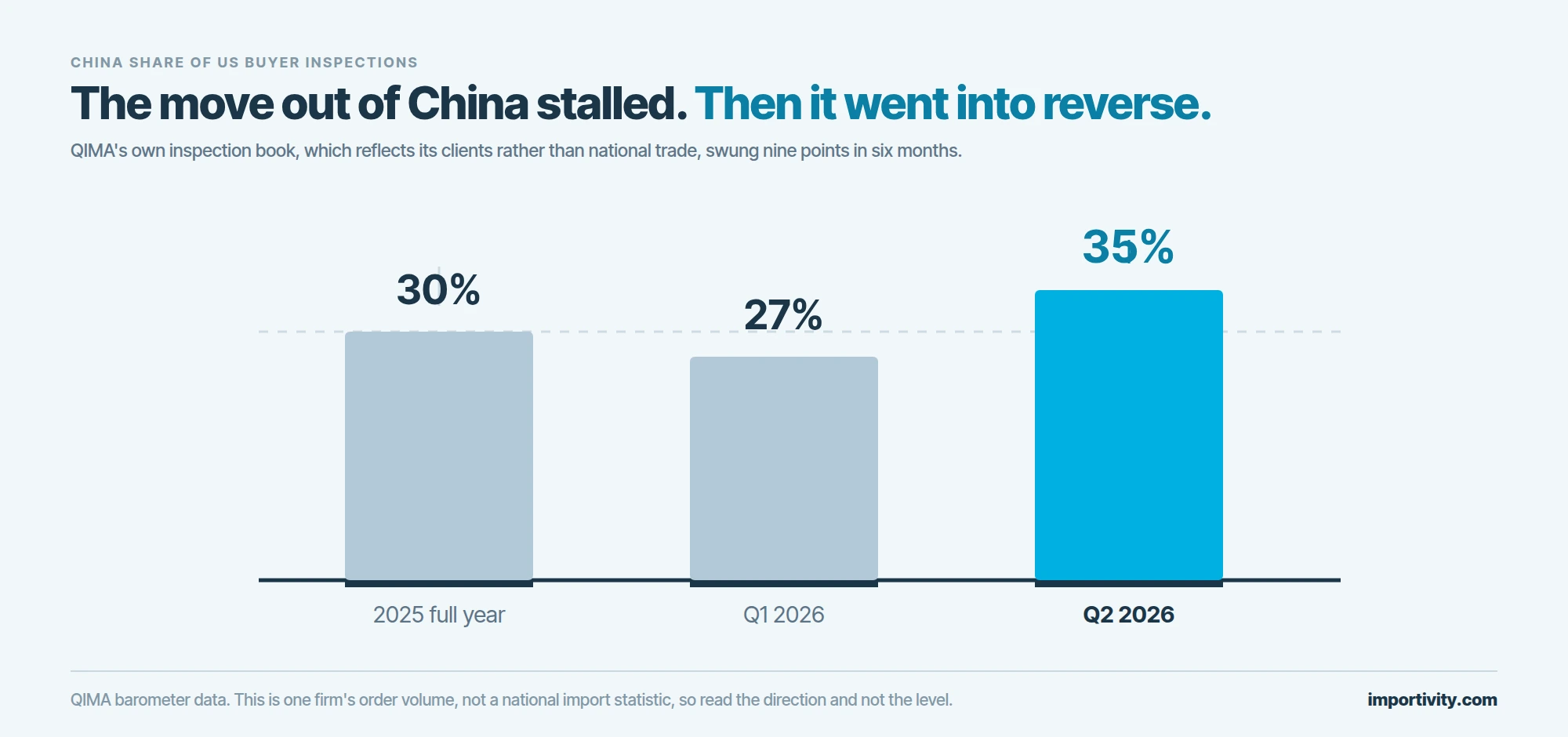
The second is visible in inspection volume. QIMA's own quarterly barometer, which reflects its book of business rather than national trade statistics, showed China's share of US buyer inspection volume falling to 27 percent in the first quarter of 2026 from 30 percent across 2025, then rebounding to 35 percent in the second quarter, the highest since 2024. QIMA attributed the swing to fuel disruption hitting South and Southeast Asian factories harder than Chinese ones. Read it as a caution against treating the exit from China as a one way trend, not as a national statistic.
Cost inside China has kept climbing. Manufacturing wages averaged 113,594 yuan a year in 2025, up from 107,987 in 2024, roughly 5.2 percent, according to National Bureau of Statistics data. That is the slow pressure behind every price conversation your agent will have, and it is why a quote held flat for three years usually means something else got cheaper instead. If you are weighing origins, our comparisons of India against China and sourcing from Vietnam go through the trade offs properly.
The Questions That Separate a Good Agent From an Expensive One
Ask these before the contract, and ask for the answers in writing. The response pattern tells you more than the fee does.
- Do you receive any payment from factories? The only acceptable answer is no, or a full disclosure with the amount returned to you.
- Will you show me the factory's invoice? Open book or closed book is the single most consequential term in the agreement.
- Can I visit or send my own auditor? Any hesitation here is the answer.
- Who is the legal entity building my product? Name, business license, address. If the agent cannot tell you, they are a trading company wearing a different label.
- What is in the fee and what is billed on top? Get inspection, sample rounds, and travel priced explicitly.
- What happens if a shipment fails inspection? The useful answer describes who pays for rework and who holds the balance payment.
Write the answers into the agreement rather than the email thread. If you want a template for the upstream part of this, the RFQ template and our guide to writing a manufacturing RFQ give the agent something precise to quote against, which removes a lot of the room where margin hides.
Agent, Trading Company or Do It Yourself
Doing it yourself works when you have one product, one supplier and time to fly. A trading company works when you want a single price and no visibility, and are content to pay for that convenience. An agent is the right answer when you need the factory relationship to be yours, the pricing to be legible, and someone on the ground between visits.
Whichever you pick, the term that decides your outcome is transparency, not percentage. Our product sourcing service and supplier vetting service both run open book for exactly the reasons above, and our factory audit checklist is worth reading before you let anyone tell you a factory has been vetted. If you would rather see the model working than read about it, Source With Jordan is where we publish the sourcing itself, and our case study on reverse sourcing a national beverage launch shows what an agent actually does across a full project.
Frequently Asked Questions
How much does a China sourcing agent charge?
Commission pricing is most common and is widely advertised in the 3 to 10 percent range, with 5 percent quoted most often. Flat per order fees and monthly retainers also exist, and retainer figures vary so much between providers that no standard band is meaningful. None of those numbers come from an independent survey, so treat them as a guide to what to expect in a quote rather than a market rate.
What is the difference between a sourcing agent and a trading company?
A trading company buys from the factory and resells to you, taking title to the goods and earning the spread between the two prices, which it does not have to show you. A sourcing agent never takes title. It acts as your representative and is paid a declared fee, so the factory price stays visible to you and the supplier relationship remains yours.
Do sourcing agents take kickbacks from factories?
Some do. The factory builds a referral fee into its quote and pays it to the agent after the order, so the buyer pays twice without seeing either payment. One experienced China sourcing consultant estimates typical rebates at around 3 to 5 percent of order value. Ask the question in writing, require open book pricing, and put a clause in the agreement returning any factory payment to you.
Can I just hire an inspection company instead of a sourcing agent?
Often yes. QIMA publishes inspection pricing from 419 US dollars per man day for China and much of Asia, so a pre shipment check on a first run costs a few hundred dollars rather than a percentage of the order. That is the better buy when your product is simple and your supplier is settled. An agent earns its fee on supplier discovery, negotiation and catching problems during production, not after it.
Is it still worth sourcing from China in 2026?
For many categories, yes. Reuters reported in August 2026 that the trade weighted US tariff on Chinese goods had fallen to roughly 33 percent from a 145 percent peak, narrowing the gap with alternatives. QIMA's own inspection volumes showed China's share of US buyer demand rebounding to 35 percent in the second quarter of 2026. Chinese manufacturing wages are still rising, so price the specific product rather than the country.
About the author
Jordan Lewis
Chief Operating Officer, Importivity
Runs Importivity's sourcing operations across China, Vietnam, Mexico and India, from supplier negotiation through landed delivery.
Press and media inquiries: press@importivity.com